
Detroit Opera's ‘Highways & Valleys — Two American Love Stories’ and Detroit Public Theatre's ‘Holiday Cabaret’
Season 53 Episode 49 | 25mVideo has Closed Captions
A look at the opera “Highway 1, USA” and what’s in store for audiences at this year’s DPT cabaret.
We’ll talk with the granddaughter of African American composer William Grant Still, whose opera “Highway 1, USA” is playing at the Detroit Opera House. Plus, we’ll get details on Detroit Public Theatre’s unique take on a holiday cabaret.
Problems playing video? | Closed Captioning Feedback
Problems playing video? | Closed Captioning Feedback
American Black Journal is a local public television program presented by Detroit PBS
Detroit Opera's ‘Highways & Valleys — Two American Love Stories’ and Detroit Public Theatre's ‘Holiday Cabaret’
Season 53 Episode 49 | 25mVideo has Closed Captions
We’ll talk with the granddaughter of African American composer William Grant Still, whose opera “Highway 1, USA” is playing at the Detroit Opera House. Plus, we’ll get details on Detroit Public Theatre’s unique take on a holiday cabaret.
Problems playing video? | Closed Captioning Feedback
How to Watch American Black Journal
American Black Journal is available to stream on pbs.org and the free PBS App, available on iPhone, Apple TV, Android TV, Android smartphones, Amazon Fire TV, Amazon Fire Tablet, Roku, Samsung Smart TV, and Vizio.
Providing Support for PBS.org
Learn Moreabout PBS online sponsorship- Coming up on "American Black Journal," we're gonna talk with the granddaughter of African American composer, William Grant Still, whose opera, "Highway 1 USA" is playing at the Detroit Opera House.
Plus, we'll get the details on Detroit Public Theater's unique take on a holiday cabaret.
So don't go anywhere.
"American Black Journal" starts right now.
- [Narrator] Across our Masco family of companies, our goal is to deliver better living possibilities and make positive changes in the neighborhoods where we live, work, and do business.
Masco, a Michigan company since 1929.
Support also provided by the Cynthia & Edsel Ford Fund for Journalism at Detroit PBS.
- [Narrator 2] The DTE Foundation is a proud sponsor of Detroit PBS.
Through our giving, we are committed to meeting the needs of the communities we serve statewide, to help ensure a bright and thriving future for all.
Learn more at DTEFoundation.com.
- [Narrator] Also brought to you by Nissan Foundation, and viewers like you.
Thank you.
(upbeat music) - Welcome to "American Black Journal."
I'm your host, Stephen Henderson.
Detroit Opera has opened its new season with a double bill, titled "Highways & Valley" two American love stories.
The production includes the works of two composers, Jewish emigre, Kurt Weill, and William Grant Still, who is often referred to as the dean of African American music.
Weill's opera is called "Down in the Valley" and Still's work is named "Highway 1 USA".
Both works combine the heart of American folk music with opera.
Here's a clip from the LA Opera's production of William Grant Still's piece, followed by my conversation with his granddaughter, Celeste Headlee.
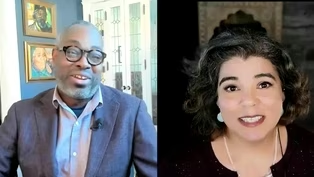
♪ This conceit will destroy ♪ (singer singing indistinctly) ♪ Oh I hate him, hate him, hate him ♪ ♪ I hate him ♪ ♪ For the suffering he's caused ♪ ♪ For the suffering he's caused ♪ - Celeste Headlee, great to see you.
- Good to see you as well.
- Welcome to "American Black Journal."
- Thank you.
It's great to be here.
- Yeah, no, this is a really great occasion to talk about, of course, William Grant still and the opera that's gonna be performed here at the opening of our opera season.
But I have to say, I didn't know of your personal connection to this.
And so that's kind of an extra delight for this interview.
So let's start there.
William Grant Still, who was he and who is he to you?
- Well, I'll answer the second one first, which is he's my grandfather and was my favorite person in the whole world.
I actually didn't realize he was famous until he passed away.
I just thought he was the world's greatest grandfather.
But to the world, he was of course the Dean of African American composers.
- [Stephen] Yes.
- [Celeste] And the reason he's called the dean is because if you check out the number of firsts, the first, you know, black composer due to this, it's long.
It's a long list.
So he opened a lot of doors in classical music, not just for black composers, but any composers of color.
- Yeah.
Yeah.
And let's talk about this particular piece, "Highway 1 USA" and the message that it is trying to get across to us.
And let's talk about that message in 2025.
America, of course, this is written much, much longer ago, in a different era in America, but maybe not in such a different America.
- No, I mean, if you think about it, I think he's began composition on this piece in 1941.
Someone's gonna correct me on that if I'm wrong, but if you think about what was happening at that time in the world, not all that far removed from the Great Depression.
He himself served during World War I. Of course, the world was, again, embroiled in another conflict.
But in terms for him, there was a lot going on in the nation as well.
I mean, racially, it was a very fraught time.
When he came back for World War I, he was one of the many black soldiers who encountered more rage and violence if they were wearing the uniform, right?
So here comes another world war in which black soldiers are being asked to serve and knowing full well that they would not be greeted by a grateful nation.
So there was all this turmoil happening economically, obviously militarily, but also racially as well.
He was also personally in an odd place because he had gone through a very tumultuous and unhappy first marriage.
It was not until he fell in love, he remained married, but it wasn't until he fell in love with my grandmother and decided to get married in 1939 and she said, "You need to get divorced."
- How about we take care of that, first.
- Yeah.
So I mean, she had run off, his first wife had run off to Canada with another man years before, you know, but he had gone through this dramatic, relatively rancorous divorce as well.
So he's coming outta this personal romantic turmoil as well, which you also see reflected in this opera.
- Yeah, yeah.
The imagery just in the title I think is important too.
Highway 1.
This is a nation that is built on the backs of highways and comes up around the idea of travel, of the ability to sort of start your life in one place and maybe conclude it, and in another, talk about the importance of that in the story here, this great American sort of iconography of the highway and travel.
- You know, it's interesting you should say that.
My grandfather loved to drive, and he drove all across, you know, when he was getting his honorary doctorate at Oberlin, he drove all the way from Los Angeles to Oberlin, Ohio.
They weren't allowed to stay at any hotels.
- Right.
- They couldn't stay at any black hotels 'cause he was black, he couldn't stay at black hotels 'cause his wife was Jewish, couldn't stay at white hotels 'cause he of course was black.
So the photos of him at Oberlin, at the festivities, he looks exhausted, but he drove a lot.
He was also a lead foot.
He was a veteran speeder.
Got a speeding ticket, coming back from Tijuana on his wedding night and ended up in jail.
So he loved the highway anyway.
But there is this sense, especially in terms of this opera, there is this sense of what we pass by so carelessly when we're on the highway.
- Hmm, hmm.
- Right?
The lives that are occurring in these towns that we just zip through.
You know, a highway is a lot of things, right?
It can bring business to a community.
It means access and mobility, but also it allows you to zip right by these human dramas that are happening, in this case, literally right on the side of the road.
And again, this is one of those things where, whomever the director, the interpreter of this opera can choose which one of these threads to pull out.
And I think this is a really important one.
And as you say, it's the name of the opera for good reason, right?
Like, the highways are both a tremendous boon to communities, but they also can destroy.
- They destroy.
- And especially for African Americans, they can destroy neighborhoods.
I mean, who knows that better than the people of Detroit, - Yes.
- That in making way for a highway, there's a lot of destruction.
So there's all kinds of things that are sort of wrapped up in just that word, highway.
- Yeah.
Yeah.
The twin performance, I guess here will be of Anthony Wiles down in Kurt Wiles, down in "The Valley."
Talk about that opera and the pairing of these two.
- You know, it's interesting.
I have to assume, you know, grandfather originally wrote this and it was premiered at a university.
And in universities, of course, operas aren't always paired with another opera.
- Right.
- Right?
- Sometimes they're alone, but for the most part, in the professional field, as you and I know, they make a full evening about it by pairing it with something else, some other one act opera.
And I think it's interesting that they've chosen our lives from down in the valley because there's this connection to the folk.
Right, there's this connection to the people, down in the valley.
There's this connection to, it's accessible music.
This is not opera that is intended to oppress you.
It's intended to make you feel resonance, - Yeah.
- To make you feel as though you're seen on stage.
I think that's true of both operas, wouldn't you?
- Yeah.
- And I think both of these operas were written very much with the audience in mind.
You know, these aren't, you know, some high, I'm not trying to put down any opera.
They're all great.
- Sure.
Sure, but it can be obscure.
- Right, these aren't written to as a pure expression of somebody's art or, you know, to impress a music critic.
Both of these operas were very much written for each of those people sitting in the seats and intended to reach you, to touch you, to speak to you, to make you feel seen.
- Yeah, yeah.
- And so I think it's actually a pretty brilliant pairing.
- And well, the storytelling aspect of both of those is also very key to not only opera, but of course the African American tradition of messaging through powerful story.
I think there's something important about that in both of these as well.
- Yeah, I agree with that.
And, you know, the story is even more important in a one act opera than in a full length, right?
- That's right.
You better get it right.
- I can't remember which author said it, but he wrote a letter and said, "This letter would be shorter, but I didn't have enough time."
Right?
I mean, grandfather was never Mahler.
He was never gonna write anything that was hours and hours and hours long.
But it's so much harder in a one act opera because you need to care about those characters immediately when that curtain goes up, and the story needs to grip you immediately.
And if it has a message, like both of these have, that message needs to be clear.
There can't be ambiguous storytelling.
It all needs to feed into the story.
You know, I remember one of my editors used to say that in journalism, the story's like a shark.
It has to keep moving forward or it dies.
- Yeah.
- And I feel the same way, especially about these two operas, like they keep moving forward.
They are impelled for, driven to that final note.
I think in both of these operas, one of the things that makes them so beautifully paired is that in both of these operas, even though the subject matter is serious, - Yes.
- You know, the stakes are high, obviously life or death.
But there's also, I don't feel anxious.
You know what I mean?
I don't feel terrified, I guess.
This isn't making my head hurt, in ways that sometimes other operas can.
- Why do you think that is?
- I mean, so, I mean, think about the differences, just incredible differences between the two composers, between Kurt Weill and William Grant Steel.
They could not be more different.
At the same time, think about the similarities.
These are two composers who had a strong background in popular music, who were never snobby about that label, classical music, right?
- Yeah.
- They felt that classical music was as much belonged to the people in the penny seats as it did to the people in the lounge.
So these are two people who kept the music in such a way that it had a landscape, right?
It gives you respite, and then takes you up and then takes you down.
And it moves you in such a way that, I don't feel in either of these pieces that I'm ever trapped.
You know what I mean?
I'm not stuck, - Yeah.
- You know, without a breath.
I guess that's the thing.
These operas both breathe.
They give you some breath.
- Yeah.
Yeah.
Well, that's a great way to end the interview and the stories about your grandfather.
Celeste Headlee, it was really, really great to have you here with us on "American Black Journal."
Thanks for joining us.
- It was my pleasure.
Thank you so much.
- Detroit Public Theater's Holiday Cabaret is back by popular demand.
The seasonal celebration is becoming a holiday tradition, here in Detroit.
The theater describes it as a production filled with music, laughter, and a whole lot of sass.
Here to tell us more is one of the performers, Lulu Fall.
Welcome to American Black Journal.
- Thank you for having me.
- I love that description, music, laughter, and a lot of sass.
- A lot of sass.
Yes.
- So tell us about this year's cabaret.
- So my first time attending Holiday Cabaret was two years ago, and I believe this is their third year doing it.
So I'm happy to hear that it's backed by popular demand and Holiday Cabaret this year, it's going to feature five performers.
What I love about this particular holiday performance is that this performance, it's geared towards the personal style of each of us as individuals.
- [Stephen] Oh, wow.
- Yeah.
So it's definitely scripted to a certain degree because the last thing that you want is for me to go on stage without a script.
(laughs) - That doesn't work?
- But it's scripted to some degree.
But for the most part, there's a lot of individuality that is weaved into the style and the performance.
So it's a very individualized experience.
- So for you, what does that mean?
- That means that there's gonna be a lot of sarcasm, coming from me.
- Is that right?
Okay.
- Yeah, yeah.
Sarcasm with love.
- Yeah.
- With love, of course.
- Yeah.
- Yeah.
- But the holiday aspect of it, how does that come into play?
- I think that that's a great question.
And I actually was thinking about this a lot this morning.
One thing, in my opinion, that sets Detroit Public Theater's Holiday Cabaret apart from just the average holiday performance or experience, is that for the most part, a lot of these holiday productions are, essentially, unified in one singular emotion, joy, or peace, et cetera, which are all very important things.
But in actuality, not everyone experiences joy and peace when it comes to the holidays.
- Yeah.
- And so what I love about this particular production is that it kind of runs the gamut of emotions, while also providing generally an uplifting and sassy experience.
- [Stephen Yeah.
So that range of emotions, talk about some of the others that kind of get acknowledgement here.
- Yeah, so personally, again, I tend to approach the holidays in a very sarcastic manner.
I am not a Grinch by any means, but I am not necessarily the biggest holiday person.
So I tend to tack on the sarcasm, because that is what makes me feel cozy.
- [Stephen] You feel, right?
- Yeah.
And then there's definitely another cast member who is a walking Christmas tree.
She just loves absolutely all things related to the holidays.
And then, you know, on the opposite end of the spectrum, you have folks who approach the holidays in a saddened, lonely manner.
- [Stephen] It could be an anxious time.
- Absolutely.
Absolutely.
Especially with us, you know, coming out of COVID over these past few years.
- Yeah.
- So I love that.
Detroit Public Theater, they're able to kind of shake up the snow globe, in a sense, by weaving this beautiful experience that runs the gamut of emotions, - Yeah.
- But without particularly dampening the experience.
If anything, it makes it that much more real because everyone, every household, every individual has their own experience.
- Has their own experience.
- Yeah.
Yeah.
And that's what makes it real.
And I believe that that is probably one of the major reasons why Holiday Cabaret is back by popular demand.
- Yeah.
Yeah.
How does this kind of work fit into your work?
I mean, cabarets are not the most popular things around.
I mean, they kind of come and go, but I mean, they certainly had a bigger time in the past, I think than they do now, but how does that feel as a performer to be part of something like this?
- Again, a great question.
Well, I am a singer, songwriter.
I am a Broadway and TV actor, and I'm also the executive director of Cabaret 313 which is a 13-year-old nonprofit here in Detroit.
So it is a huge part of what I do from the executive director standpoint.
I essentially run a nonprofit, - Right.
- That is all about just educating the masses when it comes to the intimate art form and style of cabaret, - Yeah.
- That it doesn't, necessarily have to be, you know, music of the 40s and 50s.
It's all about creating that personalized connection between the artist and the audience through song and through storytelling.
- Yeah.
- Now, on the flip side, as a performer, as a singer, songwriter and actor, that's what I do on stage, is I make sure that I provide some sense of connectivity between my character in the audience, between myself and the audience, and the music that I perform, and the stories that I tell within the music and outside of the music.
So it's a huge part of what I do.
- Yeah.
You know, I'm not sure that if you're in the audience for a cabaret, that you're always aware of the personal, I guess, investment and shaping, really, that is going on with the performers, right?
- Yeah.
- And I'm speaking about myself, I think you sit there thinking, this is a performance, like any other performance on stage.
It was scripted somehow, someone else wrote this.
- Special.
- But I mean, it certainly sounds like, there's a lot more personal, again, investment in how you do this, and what you do in these performances.
- Yeah, for sure.
And that's the beauty of it.
And that's, again, what I believe is one of the major driving forces in Holiday Cabaret being back by popular demand, is the fact that, you know, from the audience perspective, it's fun.
It evokes all of these, you know, emotions and experiences, but it also touches you very deeply because of that real aspect in there.
And as a multidisciplinary artist, I believe that the most profound artists out there, they are the ones who are able to kind of cut through, - Yeah.
- And pierce the hearts and souls of audience members and viewers, particularly because there's always going to be some sense, some ounce of truth from the artist into the piece.
And I think that's what we do as artists.
That's part of our duties.
- Wow.
Wow.
I would imagine there's a lot of energy that you get from the other performers, and what they're doing and what they're putting into their performances, right?
Because it is so personal.
- Absolutely.
Absolutely.
- It's probably a little different from a play or an opera, or some other kind of performance.
- Yeah.
It is a little bit different.
- Yeah.
- But I will say, what ties all of these different types of artistic experiences together is that there has to be a sense of trust on stage.
You know, what's in my opinion and in my experience, what's the most palpable is, the things that are unseen, the things that are not said out loud.
- Yeah.
- It's that energy, that symbiotic energy that you have to have with your castmates.
And that is where that magic tends to form.
- Yeah, yeah.
Well, congratulations on the work and thanks for joining us on "American Black Journal."
- Thank you for having me.
- Yeah.
That is gonna do it for us, this week.
You can find out more about our guests at americanblackjournal.org, and you can connect with us anytime on social media.
Take care, and we'll see you next time.
(upbeat music) - [Narrator] Across our Masco family of companies, our goal is to deliver better living possibilities and make positive changes in the neighborhoods where we live, work, and do business.
Masco, a Michigan company since 1929.
Support also provided by the Cynthia & Edsel Ford Fund for Journalism at Detroit PBS.
- [Narrator 2] The DTE Foundation is a proud sponsor of Detroit PBS.
Through our giving, we are committed to meeting the needs of the communities we serve statewide to help ensure a bright and thriving future for all.
Learn more at dtefoundation.com.
- [Narrator] Also brought to you by Nissan Foundation, and viewers like you.
Thank you.
(bright music)
Video has Closed Captions
Clip: S53 Ep49 | 13m 48s | William Grant Still's granddaughter discusses how "Highway 1, USA" reflects Black life in the 1940s. (13m 48s)
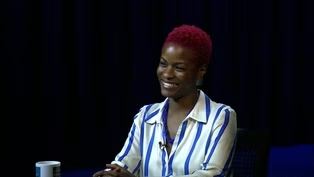
Detroit Public Theatre’s “Holiday Cabaret” is becoming a holiday tradition
Video has Closed Captions
Clip: S53 Ep49 | 8m 27s | DPT The theater describes it as a production filled with music, laughter and a whole lot of sass. (8m 27s)
Providing Support for PBS.org
Learn Moreabout PBS online sponsorship
- News and Public Affairs

Top journalists deliver compelling original analysis of the hour's headlines.

- News and Public Affairs

FRONTLINE is investigative journalism that questions, explains and changes our world.












Support for PBS provided by:
American Black Journal is a local public television program presented by Detroit PBS