
Detroit RiverWalk/Judaism Virtual Tour
Season 4 Episode 21 | 23m 53sVideo has Closed Captions
Detroit RiverWalk/Judaism Virtual Tour | Episode 421
Best in the Country, The Detroit RiverWalk has captured national attention and was voted best in the country by USA Today’s readers. Details on a new coffee table book that highlights the achievements and wisdom of African American elders from across the country. How the International Symphony Orchestra found a creative way to bring music back to the public. a tour of Temple Israel.
Problems playing video? | Closed Captioning Feedback
Problems playing video? | Closed Captioning Feedback
One Detroit is a local public television program presented by Detroit PBS
Detroit RiverWalk/Judaism Virtual Tour
Season 4 Episode 21 | 23m 53sVideo has Closed Captions
Best in the Country, The Detroit RiverWalk has captured national attention and was voted best in the country by USA Today’s readers. Details on a new coffee table book that highlights the achievements and wisdom of African American elders from across the country. How the International Symphony Orchestra found a creative way to bring music back to the public. a tour of Temple Israel.
Problems playing video? | Closed Captioning Feedback
How to Watch One Detroit
One Detroit is available to stream on pbs.org and the free PBS App, available on iPhone, Apple TV, Android TV, Android smartphones, Amazon Fire TV, Amazon Fire Tablet, Roku, Samsung Smart TV, and Vizio.
Providing Support for PBS.org
Learn Moreabout PBS online sponsorship- Hi, I'm Christy McDonald and here's what's coming up this week on One Detroit's Arts and Culture.
Some national love for Detroit's famous riverwalk.
Plus a generation found, life lessons and legacies collected from African-American elders around the country in one book.
Then collaborations across the border with the International Symphony Orchestra and learning more about Judaism through the eyes of a student.
It's all coming up on One Detroit Arts and Culture.
- From delta faucets to bear paint.
Masco corporation is proud to deliver products that enhance the way consumers all over the world experience and enjoy their living spaces.
Masco, serving Michigan communities since 1929.
- Support for this program provided by the Cynthia and Edsel Ford fund for journalism at Detroit Public TV.
The Kresge foundation.
Community foundation for Southeast Michigan.
- The DTE foundation is a proud sponsor of Detroit Public TV among the state's largest foundations, committed to Michigan focused giving.
We support organizations that are doing exceptional work in our state.
Visit DTEfoundation.com to learn more.
- Business Leaders for Michigan dedicated to making Michigan a top 10 state for jobs, personal income and to help the economy.
Also brought to you by, the Fred A. and Barbara M. ERB family foundation and viewers like you.
(upbeat music) - Hi there and welcome to One Detroit Arts and Culture.
I'm Christy McDonald.
Thanks so much for being with me.
We are marking a year since the first cases of COVID in Michigan when everything changed and we started doing shows at home and the arts and culture scene came to a halt.
Things are changing and the hope of in-person concerts and performances are taking shape for the fall.
Musicians have had to adjust to new challenges.
So coming up on the show, we're going to hear from Anthony Wing, the executive director of the International Symphony Orchestra on virtual concerts to satisfy the fan base in Canada and the US.
Then our next stop on our series of Religious Diversity Journeys, we'll explore Judaism plus the legacy and stories of African-American elders in the new book by Ann Arbor, photographer Roohee Marshall called A Generation Found: Precious Pearls of Wisdom.
And then the big news that Detroit Riverfront is number one in the country.
It is all ahead.
(upbeat music) - Well, the beauty of the Detroit Riverfront has captured national attention and has been named the best riverwalk by US today and their readers.
So joining me now is a very proud CEO of Detroit Riverfront Conservancy, Mark Wallace.
- It's really exciting for us and it's always nice to win something.
It's nice to be recognized by people who are out of town because I think a lot of times Detroit's success stories are not told as much as they should be on a national basis.
But it's also a great moment for us to celebrate all of the people who have made this riverfront transformation possible.
And to really remember, you know, sort of reflect on what it means for us to come together as an entire community to achieve a goal like this.
- When you put Detroit's riverfront up against some of the other riverfronts we think of around the world in Chicago and Boston and really the work that has been done here in Detroit over the last 10 years and more it's really significant.
- It is.
And I think that's one of the things that the jurors were excited about was the idea of this transformation.
Yeah, there are a lot of places where they've had a riverfront that's been active for hundreds of years.
We've had that in Detroit as well but our riverfront was not active for the public.
It was active for industry.
And that was a really limited use.
And this transformation that started in 2003 with Matt Colli and Faye Nelson and others has really made this a place that's really special to our whole community.
- And really over the last year in, during COVID we've seen how much open space interacting with nature and really enjoying the resources that we have is good for the soul and is good for our mind body and spirit.
- That's right.
We've seen a 20% increase in visitors to the riverfront in 2020 and a 40% increase on the Dequindre Cut, which is just amazing.
And you put it perfectly.
What we're seeing is that people just need to get out of their houses.
I really feel like it's bringing, you know, fresh oxygen into our brains and sort of healing us in building that community resilience.
It's so important, especially during a pandemic.
- So tell us about the projects that are happening right now because really the riverfront has come in stages and is beautifully melding together now.
- We built about two and a half miles on the east side with a series of parks and we have the carousel.
We have the splash park down by the coast guard at Mount Elliott.
We have a couple of projects that are coming together right now to really complete three and a half miles of uninterrupted riverfront access and really excited about those.
So the big one is the Uniroyal site.
Right across from Belle Isle we did an environmental cleanup last year that was going to allow us to start to build the actual pathway itself.
So that walkway will be under construction very, very soon.
And when that walkway is done you'll be able to go from the old Joe Louis arena site all the way to the Belle Isle bridge without ever having to leave the riverfront.
- So I hope sometime very soon, you and I can actually meet down there.
'Cause that's usually where we meet every year.
And we talk about what's new and what's going on.
So give everybody maybe a couple secret two places that you like along the way that they should check out.
- So the number one spot I would encourage people to check out is our newest park named after Robert C. Valade that's right next to Shane Park which is now known as Aretha Franklin Amphitheater.
There's a great little parking lot, just north of it.
We have two restaurants, smoking cheese, barbecue and geisha grill sushi.
And we actually have a bar it's, we bought a bar and it floats on the river and has a bar.
So, starting midway, you should be able to come down there.
The kids can play on the playground, great sandbox for the children but you can float around and have an adult beverage.
So that's the number one sort of insiders tip on what's new under riverfront.
We're also really excited about the investment that the Ralph C. Wilson Jr foundation has made on the west side.
And I think everybody's kind of intrigued with this, you know, before and after concepts, you know, the transformation of places.
I'd encourage everybody to come down to Ralph Wilson at some point in time.
If you love the fish it's a great time to come down.
If you just want to fly a kite or run around with your kids it's a great spot.
But I think it'd be fun to be down there on the west side before that transformation happens because it's really going to be exciting to stand in a place where you were standing two years ago and then see it fully transformed.
- There's a new book out that pays tribute to the achievements and wisdom of African-American elders.
It's called A Generation Found: Precious Pearls of Wisdom and it highlights the stories and legacies of seniors around the country.
Stephen Henderson from American Black Journal spoke with Ann Arbor, photographer and writer, Roohee Marshall and 84 year old Carol Hall, who was featured in the book.
- Tell me where you got the inspiration for this idea.
- The book really came from a place of need.
Yes, it's something that I was feeling inside.
It was thinking about the elders that I grew up with and missing their presence and their influence and just being in the company of them, you know, and guidance.
And I was driving down the street one day, visiting a friend and I looked to my right and there, I was in Inkster.
I looked to my right and I saw a beautiful elder standing in our yard and I rolled my window down and I said, 'Ma'am, can I talk to you for a minute?"
And she said, "Yeah, sure, come on."
And I went over and I started a conversation with her and she said, "Yeah, honey, I'm standing here cutting my front yard.
And I'm waiting for my niece to come with gasoline so I can cut the backyard."
She was beautiful.
He had brown skin, silver hair, 93 years old cutting her grass.
Immediately I felt connected to her.
And I began to feel like my elders through her and just, you know, embraced by a smile from her heart.
Okay, and her sincerity, you know, and just from that point I began to talk to her and I told her something I really feel I needed inside from her today.
And I totally received it from her.
And on my way home after I talked to her and I asked could I come back and talk to her more?
She said, "Sure, honey, we can talk anytime."
So I scheduled an appointment with her and I went back and talked to her.
But on the way home, I began to think about how I was feeling that day and how I began to like get my colors back again and feel better.
And I thought that there must be other people who were feeling like this today, or just period in the world like me.
And I know that there were other outstanding elders throughout the world that I probably need to like seek and find.
So I could try to share with them what I had received that day.
So that was my inspiration.
- I'm 84 years old.
So this was an unusual situation because she said, "I want to talk to you.
I need to talk with you."
And I thought this was unusual.
About what?
And she came to my home and she sat down with me and she told me that she was doing a book on our elders and that she was putting it together.
And then of course later on I saw this magnificent book that she put together beautifully lined.
Very, the photography is outstanding.
The descriptions of all of us elders is extremely well done.
And I realized, as I talked to my family and particularly even now, Cecily Tyson having left us and realizing the value of finding those beautiful people that have done so much for us.
We buried grandmom and granddaddy and we kind of forget what they've done for us, but Roohee has not forgotten that and she's sharing it.
And I think that we need to do it more often.
We need to have it open for our great grands so that they can see that we don't sit in that rocking chair with a blanket and go away, that we're here.
- What, so of your own story Carol, do you think resonate the most or should resonate the most with younger people?
- I think that the thing that's really critically important to me is that I come from the Hastings era.
I lived on Willis 633, East Willis.
It's since gone because of I'm 75.
And we came from the period where we had to hide underneath the seat and carry a bottle in the car when we had to urinate, going to Mississippi and Alabama.
I'm from that era.
And I'm also from an era that ended up thanks to Mary McLeod Bethune who inspired me in the second and third grade to move forward.
She said the door would open for us and we would have to be ready, but it wouldn't be open long.
And she was right because it's opened up starting with Eisenhower to some extent, but it began to close with Reagan and it began to close with Nixon.
And we've had to kind of struggle from that year up to where we are now.
- Interesting thing happened, my granddaughter, she's nine, 10 years old.
And I showed her the book and I said she went through.
She said, "Oh wow, Nana."
She said, "You went and you got all this knowledge this information from these old people."
She said, "I don't know what to do.
I can go and find out what to do."
- The past year of COVID has made it difficult for musicians to collaborate.
And they are really missing live audiences.
And for the International Symphony Orchestra they're finding new ways to connect with fans here in the US and in Canada.
Peter Whorf talked with ISO executive director, Anthony Wing.
(soft guitar music) - We'd undergone some kind of a renewal.
We had moved into a performance space that we created and we added an art gallery to it called The ISObar on the Canadian side.
We had begun to feature small intimate performances there to go along with the orchestra season.
So when the pandemic happened, we started to, almost right away, to film a distanced musical events and to try to get them up onto our, first onto our YouTube channel.
♪ Yeah the truth hits you over the head like an anvil.
♪ ♪ Tragedy and lies fill your head to swollen.
♪ But in the summertime, there was a bit of an opportunity when the Sarnia City Council decided to shut down the downtown core to encourage supportive small businesses during COVID.
And this happened every weekend for 10 weeks between July and September.
So what we did was we put musicians in the window and we ran a cord out to a speaker on the sidewalk, and we arranged chairs in distance pods on the street.
We had different musical acts every week.
And we would include members of the orchestra run.
Almost everyone donated their time.
So it became a big rent party for us.
And it kept light on us in the community that we had enough sort of bar.
We had enough confidence now as an organization to see if we could put on an entire season, but to deliver it online digitally.
- And then there'll be subsequent releases as we progress into the concert season.
- That's right.
Every month of between December, it'll be late December to late April.
I remember that above all, you know, we're not essential so we've been struggling, but we are preferred.
So we're going to try to remain preferred for our, you know for our bridge to communities and try to get the product to them as easily as, you know, as possible.
You know, we took a look around to see how the, you know, how the large orchestras in the States had been surviving and have been even flourishing during this time.
And it was, you know, and it was the orchestras who had the strongest community support, you know, so that's what's kept this going.
♪ Orange sky don't go ♪ Manhattan looks like someplace else ♪ ♪ It's cloudy with a low fog shelf ♪ ♪ Into the crowded streets.
- Can you share some broad strokes for maybe, kind of the future picture of the International Symphony Orchestra, Anthony?
- Being an orchestra, being a symphony orchestra and having to truncate your lineup, that was doable.
And we're able to do that, of course, because that's part of the experience.
However, being a full orchestra, that means we would be, you know, organizations like ours will be the last to be allowed onto the concert stage.
Audiences will be allowed to fill halls before we are allowed onto a stage when the symphony singers are acquired to perform with us there's, you know, there's about a hundred people on the stage and early on in the pandemic choirs were considered a potential super spreader thing.
So, you know, hence we will be going back in increments and we look forward to it, but we are focused completely on trying to fulfill our mandate for the communities with, you know, on a motion capture level.
So we can continue to feed it as sort of, to consider ourselves as sort of content provider.
Only the content is like the most glorious and, you know, and moving in life-changing content, you could possibly have got real.
(soft piano music) - And finally, we are heading to Temple Israel in West Bloomfield in our latest Religious Diversity Journey.
It's part of our series that explores different faith communities here in Southeast Michigan.
And the program is put on by the InterFaith Leadership Council of Metro Detroit.
And we get to learn through the eyes of students.
This week we're exploring Judaism.
- (speaks in foreign language) - Hi, I'm Ariana Gordon.
I'm the director of education and lifelong learning at Temple Israel.
And we are located in West Bloomfield Michigan.
We are thriving large, very engaged reform congregation.
We have about 3,400 families that participate and our members here.
Judaism is one of the largest religions in the world.
We have about 17 million Jews all over the world.
Today for our Religious Diversities Journey, Kennedy is going to be here to ask some questions about Judaism.
We are so glad that you're here.
I'm Rabbi Gordon, and Rabbi Bennett will join us in just a little bit.
And we have so much to talk about.
Come on in.
(upbeat music) - Judaism seems to have a lot of important objects.
Can you tell me about them?
- Yeah, so why don't we start with these right here?
These are candlesticks and our Kiddush cup and we use these to light candles to welcome in our Sabbath on Friday evening, our Shabbat observance.
And then we fill this with wine or grape juice.
And we have blessings that we say as we light the candles and as we drink from the Kiddush cup and it really helps start our Shabbat observance.
And while we're talking about some Shabbat things I'm actually going to point up here.
This is challah.
Challah is egg bread, and it's one of the other ritual items that's connected with Shabbat.
So when we welcome in on Friday night we start by lighting the candles and then we drink from our Kiddush cup.
We drink wine and then we say a blessing and we eat our challah also.
And these three things together really start off our weekly Sabbath observance.
So Hanukkah is a holiday that we celebrate in December.
So we light on Hanukkah.
We celebrate for eight days and every night we add a candle.
So by the end of the holiday, the entire Hanukia is lit up.
So this festival of light really brings light and we celebrate together with our family and our friends this special holiday.
- Yeah, I think that's really beautiful.
- So this is called a tallit.
So a tallit actually the commandment to where a tallit comes from the same part of the Torah, where we have the commandment to put a mezuzah up on our door.
And it's really an English.
We sometimes call it a prayer shawl.
And it's really less about the part that we put over our shoulders and much more about the fringes at the bottom.
So in the Torah, we are given 613 commandments that we are supposed to follow.
And the way that the fringes are knotted and wrapped really connects us to all of those commandments and reminds us of our responsibility to keep them.
- So Kennedy we're here in the sanctuary which is the central prayer space for the Jewish people here at Temple Israel.
It's where we gather for religious worship services and for special life cycle events.
But it's also where we house our Torah scrolls which are the history of the Jewish people.
- Who can read from the Torah?
- It's different in various areas of Judaism.
In a traditional or Orthodox family or community only men read from the Torah and only men are allowed to lead services from this podium, this Bhima.
But here in liberal Judaism at Temple Israel, in a reform congregation, we're open to the idea of men and women being equal.
We are connected to the LGBTQ community.
We're open to people of all races and colors to be a part of our Jewish community opening up the Jewish world to so many more people.
- Are there beliefs that most Jews share?
- Most Jews have a simple belief in one God, but for the most part what binds us together is our commitment and our connection to the words of this Torah scroll to the words given by God, to Moses at Mount Sinai and handed down for thousands of years of our community and our people.
- What is Judaism?
- Judaism is a religion, obviously, that is 5,000 years old.
And it begins in the biblical narrative.
When we hear the story of Abraham, the first Jew.
Abraham was given the opportunity by God to reject what's known as the Pantheon, the idea that there are many gods in the world and chooses to accept one relationship with one singular God.
- So when someone's Jewish, what does that mean?
- Being Jewish means to connect to that idea of monotheism or the belief in one God, but it also means connecting to those 5,000 years of Jewish tradition that have been handed down from generation to generation.
Much of what we believe is actually contained inside of this ark in Torah scrolls that represent the story, the history of our Jewish people.
So Kennedy, were standing here in front of the Ark of the Covenant which is the replica of the box that held the 10 commandments for our ancestors when they traveled through the wilderness.
Today inside this ark, we hold all of our Torah scrolls, the history of our people that I was talking about.
So each of these Torah scrolls is exactly the same thing.
The five books of Moses, the first five books of the Hebrew Bible or what you might refer to as the Old Testament.
- Thank you so much for having me.
It was really cool to learn about Judaism and I had a great time.
- I'm so glad that you were here.
Thank you for visiting.
You are welcome to come back any time, have a great day.
Bye Kennedy.
- Bye.
- You can see all of our Religious Diversity Journeys at onedetroitpbs.org.
That is going to do it for me.
Make sure you come back on Thursday night at 7:30 PM for One Detroit.
I will see you then, take care.
- You can find more at onedetroitpbs.org or subscribe to our social media channels and sign up for our One Detroit newsletter.
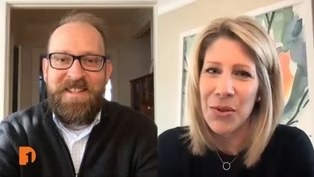
Video has Closed Captions
Clip: S4 Ep21 | 4m 42s | Detroit Riverwalk | Episode 421/Segment 1 (4m 42s)
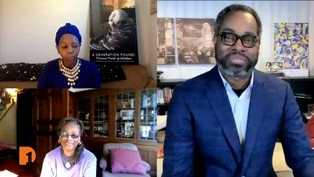
Video has Closed Captions
Clip: S4 Ep21 | 4m 58s | Generation Found | Episode 421/Segment 2 (4m 58s)
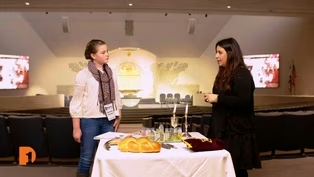
Video has Closed Captions
Clip: S4 Ep21 | 6m 7s | Judaism Virtual Tour | Episode 421/Segment 4 (6m 7s)
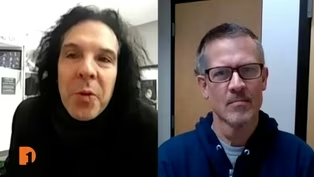
Peter Whorf + Anthony Wing, Executive Director of the ISO
Video has Closed Captions
Clip: S4 Ep21 | 4m 27s | Peter Whorf + Anthony Wing, Executive Director of the ISO | Episode 421/Segment 3 (4m 27s)
Providing Support for PBS.org
Learn Moreabout PBS online sponsorship
- News and Public Affairs

Top journalists deliver compelling original analysis of the hour's headlines.

- News and Public Affairs

FRONTLINE is investigative journalism that questions, explains and changes our world.












Support for PBS provided by:
One Detroit is a local public television program presented by Detroit PBS