
Detroit trans advocate Julisa Abad shares her faith story
Clip: Season 11 Episode 14 | 7m 47sVideo has Closed Captions
The relationship between transgender individuals and the church can be challenging and complicated.
The “Faith in Detroit” project led by Christ Church Cranbrook features Detroit trans advocate Julisa Abad’s religious journey. Detroit PBS is one of several partners in the initiative, which shares stories of faith and resilience. Abad, a trans woman, sat down with “Faith in Detroit” Executive Director Fr. William Danaher to discuss how faith impacts her work in the LGBTQ+ community.
Problems playing video? | Closed Captioning Feedback
Problems playing video? | Closed Captioning Feedback
One Detroit is a local public television program presented by Detroit PBS
Detroit trans advocate Julisa Abad shares her faith story
Clip: Season 11 Episode 14 | 7m 47sVideo has Closed Captions
The “Faith in Detroit” project led by Christ Church Cranbrook features Detroit trans advocate Julisa Abad’s religious journey. Detroit PBS is one of several partners in the initiative, which shares stories of faith and resilience. Abad, a trans woman, sat down with “Faith in Detroit” Executive Director Fr. William Danaher to discuss how faith impacts her work in the LGBTQ+ community.
Problems playing video? | Closed Captioning Feedback
Where to Watch One Detroit
One Detroit is available to stream on pbs.org and the PBS app.
Providing Support for PBS.org
Learn Moreabout PBS online sponsorship- There is something that I'm noticing when I listen to trans stories of faith is that there's a moment in which the individual telling me that story realizes that what they're doing is actually not only fulfilling who God created them to be, but also is a kind of revelation about the world, about themselves, about the journey they're on.
Is there a moment in your life where you realized that you're being faithful to yourself was a kind of God moment in your life?
- Yeah, I think that all trans people believe in a higher power because you have to believe in what the end goal is of what your transition is, right?
So for me, and again, we're talking about years ago, and though things are not completely changed, the statistics of what LGBT youth go through, now you compartmentalize and add being trans youth to that, homelessness, mortality rates, not having access at shelter systems, not having access to employment, healthcare that's affirming.
We are lucky here in Michigan that we are able to get a name change, a gender marker change, and a birth certificate.
Most states don't even allow that.
We're looking at Kansas now reversing that for their trans residents.
So I think for myself, the revelation came when I knew that being my authentic self came with a privilege that I was going to lose now 'cause now the world doesn't see me as an effeminate male, they see me as a trans woman of color, and that I was going to have to experience hardship, homelessness, not access to all of these things, and organizations now that pay me top dollar to do cultural competency and change their policies were the same organizations, shelter systems, and homeless places that were telling me no, no, no, no, no, back then because they had never helped a trans person, didn't know how to do it and didn't want to, especially if they were faith-based, have the issues of what comes from mumblings of other people.
Instead of educating them, they would prefer just to shy away and send you back to the street.
And I think that's when it was for me, when I knew that I was prepared to be homeless and experience all those things to be my authentic self.
- You obviously are doing incredibly important work in Detroit with the prosecutor's office for Wayne County.
Can you say a little bit more about your story?
- Yeah, so I relocated to Michigan about 13 years ago.
I moved to the Palmer Park area, which is really big for the trans community.
Unfortunately, at that time, they did not have protections.
There was an influx of trans women of color being murdered, our prosecutor, Kym Worthy, and our now Attorney General, Dana Nessel, were putting together a task force to combat crimes against the LGBT community, specifically trans women that were murdered.
That turned into the Fair Michigan Justice Project that now has dismantled, but I am the LGBT community engagement liaison for the Wayne County Prosecutor's Office and the Special Victims Unit.
So we still combat crimes against the LGBT community.
We've done 78 capital cases with 100% conviction rate.
We are the first in the nation to have a trans inclusion policy, which has been adapted by Oakland County, Washtenaw County, Ingham County, St.
Paul Minnesota, Nashville Tennessee, and DeKalb County, Georgia.
Through that work, I do a name change program where I've helped over 800 trans individuals out of Wayne, Oakland, McComb, and Washtenaw change their gender markers and birth certificates with no cost to them.
Through that work, trans women of color, because of the disparities, and until we got Elliott-Larsen amended, cannot get their name changed 'cause they had low level nonviolent offenses.
So I had a partnership that originally started with the University of Michigan where we helped eradicate those low level nonviolent offenses so that they can go through the name change process and have a better quality of life.
And then I go to police departments, and jails and train them on cultural competency and the work that I do so that we can change policies for my community.
And then I am the first and only national trans woman of color that can testify as an expert witness on social determinants of health in transgender violence.
Being trans, just the marginalization and the discrimination that trans people face, particularly trans people of color.
So if we talk about statistics and numbers, 60% experience homelessness, 40% are unemployed.
2023, Governor Gretchen Whitmer amended Elliott-Larsen.
What that means is adding gender identity and sexual orientation into our protections.
So if you were to go to an establishment and they were to say, "I'm not gonna serve you 'cause you're white, I'm not gonna serve you 'cause you're a female," those were under our protections and you can civilly sue them and hold them accountable.
As opposed to a trans person, they can say, "I don't wanna serve you," and you would have to leave their business.
If something happened and the paramedics came back then and said, "For religious reasons, I don't wanna touch her," we would unfortunately have to wait for somebody else.
Does that mean that people don't have biases and that the communities has completely changed?
No, but at least that means now that my community has the ability to civilly sue and have protections.
So that is what made me start doing this work for trans people because of the lack of resources and opportunities that they had.
- When you are there working with the police rather than having the police as your adversary, or when you're helping the system that was so constructed to marginalize trans women and trans men, when you are working to change that system, do you feel like you're on a mission?
Do you feel God's presence when you're with a family and you are helping them achieve vindication in the law?
- Every day.
When you're a trans child, when you're a child period, you don't realize how cruel the world is or the things that you'll have to face.
So like any other child, I had dreams of what I wanted to be as an adult, and it was not a trans advocate, if I'm gonna be honest.
Those dreams were a flight attendant, and anything into fashion, and clothes, and styling.
And because of the disparities and the social determinants of health that I went through myself, I started advocating for myself because I wanted a different life.
In doing that, because I just have always naturally been outspoken, I became this national advocate for other people.
And it wasn't until recently that as a trans person, you always question why are you here?
Life is so hard, people don't respect me, don't validate me, don't see it.
And like I stated earlier, I know now that this is my mission and this is why I'm here.
I'm getting emotional.
- It's okay.
- And I don't wanna leave anytime soon because I feel like I still have much more to accomplish, but we don't know when our expiration date is.
And if I were to leave tomorrow, I know that I have genuinely fulfilled something for my people, and that brings me joy because I know the change that I've done for so many people here in Michigan to have a better quality of life.
 New
NewVideo has Closed Captions
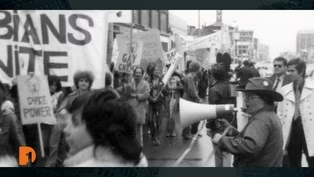
Clip: S11 Ep14 | 15m 43s | LGBTQ+ History Month is a time to recognize the impact of the LGBTQ+ community. (15m 43s)
Providing Support for PBS.org
Learn Moreabout PBS online sponsorship New Episode
- News and Public Affairs

Top journalists deliver compelling original analysis of the hour's headlines.
 New Episode
- News and Public Affairs

Today's top journalists discuss Washington's current political events and public affairs.
 New Season
 New Episode
 New Episode
 New Episode
 New Episode
 New Episode
 New Episode

 New Episode
 New Episode
Support for PBS provided by:
One Detroit is a local public television program presented by Detroit PBS