
Detroit United Front/Gilda Snowden
Season 50 Episode 11 | 23m 55sVideo has Closed Captions
Detroit United Front/Gilda Snowden | Episode 5011
Stephen hears from a new organization, Detroit United Front, that's advocating for better equity and inclusion for Black businesses in Detroit. Then, producer AJ Walker takes viewers to The Scarab Club for a memorial art exhibit dedicated to the late artist, community leader and mentor Gilda Snowden. Plus, Laura Rain & The Caesars perform from the Marygrove Theater stage. Episode 5011
Problems playing video? | Closed Captioning Feedback
Problems playing video? | Closed Captioning Feedback
American Black Journal is a local public television program presented by Detroit PBS
Detroit United Front/Gilda Snowden
Season 50 Episode 11 | 23m 55sVideo has Closed Captions
Stephen hears from a new organization, Detroit United Front, that's advocating for better equity and inclusion for Black businesses in Detroit. Then, producer AJ Walker takes viewers to The Scarab Club for a memorial art exhibit dedicated to the late artist, community leader and mentor Gilda Snowden. Plus, Laura Rain & The Caesars perform from the Marygrove Theater stage. Episode 5011
Problems playing video? | Closed Captioning Feedback
How to Watch American Black Journal
American Black Journal is available to stream on pbs.org and the free PBS App, available on iPhone, Apple TV, Android TV, Android smartphones, Amazon Fire TV, Amazon Fire Tablet, Roku, Samsung Smart TV, and Vizio.
Providing Support for PBS.org
Learn Moreabout PBS online sponsorship>>Coming up on "American Black Journal," three African-American business organizations join forces to advocate for the support of black companies here in Detroit.
We're gonna have the latest on the newly-created Detroit United Front.
Plus, we'll take you to an art exhibition dedicated to the memory of Detroit artist Gilda Snowden.
Stay right there.
"American Black Journal" starts right now.
(jazzy upbeat music) >>From Delta faucets to Behr paint, Masco Corporation is proud to deliver products that enhance the way consumers all over the world experience and enjoy their living spaces.
Masco: serving Michigan communities since 1929.
>>Support also provided by the Cynthia & Edsel Ford Fund for Journalism at Detroit Public TV.
>>The DTE Foundation proudly supports 50 years of "American Black Journal" in covering African-American history, culture, and politics.
The DTE Foundation and "American Black Journal:" partners in presenting African-American perspectives about our communities and in our world.
>>Also brought to you by Nissan Foundation and viewers like you.
Thank you.
(jazzy upbeat music) >>Welcome to "American Black Journal."
I'm your host, Stephen Henderson.
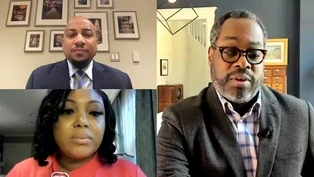
Three leading black business groups have come together to push for economic equality and inclusion for African-American businesses in the city.
The Detroit chapter of the National Business League, the Detroit Black Chamber of Commerce, and the Booker T. Washington Trade Association have formed what's called Detroit United Front, and together, they want to address issues such as education, training, public contracts, and access to capital.
I spoke with Ken Harris who's CEO of the National Business League and Daniel Benson who is president of the Detroit Black Chamber of Commerce about the current state of black business here in Detroit.
So, I wanna start with this just giving you a chance to explain what you're doing and why you're doing it now in the City of Detroit.
Ken, I'll start with you.
>>Yeah, no problem.
I mean, I think it's time, it's necessary.
You think coming out of this COVID environment, everyone's been isolated, marginalized to a certain degree, so what a perfect time to show unity.
For the first time in history, we have merged together in a unified effort three historic and legendary black business organizations.
And so, we have now the National Business League Detroit chapter, the Booker T. Washington Trade Association which has been around since the 1930s, and also the Detroit Black Chamber of Commerce which has been around since the early 2000s, and now, they're the Detroit United Front, and I tell you the excitement on Monday was electric, Stephen.
Standing-room-only crowd.
Line was wrapped around the corner at the DoubleTree Suites partially owned by Emmett Moton, and you couldn't even get into that place.
So, there is an excitement about unity, unification, and coming around this effort to promote black business and also challenge the inequities and scenarios of lack of diversity and inclusion in the City of Detroit.
And so, we're gonna do it as a united front.
We got a tremendous group of young leaders that's ready to go.
>>Yeah.
Danielle, talk about what the agenda looks like for this.
Ken mentioned the inequality that we still see playing out in the business environment in Detroit, despite the fact that this is an overwhelmingly African-American city.
It is home to just so many different African-American-owned businesses.
We still don't have a level playing field.
We still don't get the opportunities that we're supposed to.
>>Absolutely, and that is what we are going to do.
The Detroit United Front is gonna be that pillar, that point of reference, that individuals can go to that they know that we're coming.
If there are situations where there are resources, we want to be the connector for that.
If we know that there are situations where there are challenges within African-Americans and blacks not being able to be in leadership, we wanna be the voice.
So, we are just going to serve as that voice and that connector for black businesses.
That's our ultimate goal is to just connect.
We wanna be able to buy land.
A lot of times, people are just leasing.
We wanna be able to train and teach people about going back to our roots and the foundation of that.
We're supposed to be out here doing great, wonderful things.
A lot of times, people are not able to tap in because they don't know about the resources.
We wanna be that organization that's going to be that bright light, and they know that we're coming and we're coming strong and we're coming and we're not afraid to stand up to whatever challenges may come our way.
>>I wanna talk about capital because I think you can't talk about business or inequality without talking about capital.
Access to capital is a problem for all businesses.
We start there, but especially for black-owned businesses.
This is just a critical part of the difference between success and failure.
I wanna talk just a little about how this kind of organization can help especially smaller black-owned businesses with that problem, Ken?
>>Yeah, no question about it, and look, we're not reinventing the wheel, right?
So, this organization has really been a connector for traditional lenders, CDFIs, MDIs, minority depositor institutions, black-owned banks.
We only have one now in the City of Detroit, but what we see as systematic is historic.
We know, since the Friedman's Bureau was shut down by the overseers that started it, there's been a lack of trust with traditional banking.
We see through COVID 19, when it came to disbursement of capital into marginalized and underserved environments, it was tough to connect with black-owned businesses.
We see that technical assistance is still a major impediment towards capital getting to black-owned firms, and so it's our job, as the Detroit United Front, to bring all of the banking institutions together and to solve these problems together and to find a way where we can create ecosystems that gets capital to the people who need it most.
>>Yeah, Danielle?
>>I'm in total agreement.
One of the things is I am a business owner, and some of the challenges I'm able to speak, not because I don't know, but because I've in the fire, been in the torches, and I'm able to now speak and be that voice for other small businesses because I've experienced it.
There's capital there, but how do we get it?
How do gain access to it?
So, just being knowledgeable about it, and we're gonna be knowledgeable about it, and we're going to also assist other small businesses so that they're able to tap into those resources to not just maintain and sustain, but to just go and grow.
It's all about growth and and development and different things of that nature.
>>I also wanna talk about development which is a big issue here in the city as well.
I mean, we got a lot of development going on, and African-Americans don't have the share of that activity that we should either, although we did recently see a pretty big announcement on the development front, this redevelopment of of the Fisher Body Plant that's being done by two African-American developers, but I feel like the barriers there are similar maybe to capital access, but also kinda different.
I mean, the decision-making at the governmental level has a lot to do with it, and then of course, experience, getting black developers opportunities to start on things and then build a business.
Danielle, what do you make of that challenge?
>>A lot of times, I see that a lot of businesses don't have the tools that are needed, and essentially what that means is that if they're a builder or contractor, are they licensed?
So, it's like a lot of times, they have to get the certain tools that are needed to even get things up and running, and they don't know.
Some business really just simply don't know what it is that's needed and necessary to move their business forward in a legit, legal way.
And so, that's one of the things that we're also we talked about previously that we're going to also provide that resource.
Okay, this is how you run a reputable business so that you are able to even qualify.
A lot of times, businesses may or may not qualify for certain RFPs or for things that are up, so we wanna be able to make sure that black businesses are equipped and ready, and then once they are equipped and ready, that they are absolutely in a category in the options to be selected to be a part of whatever building structures may come their way or whatever opportunities may come their way.
So, we just wanna make sure that black businesses have that opportunity, but they're also equipped and ready to handle whatever may come with those contracts and things of that nature.
>>Ken, you mentioned the end of the pandemic, or what we hope is the end of the pandemic, and its effect on businesses.
Of course, it had a bigger effect on black-owned businesses than other businesses.
Talk about some of the specific challenges we see rebuilding, I guess, after the pandemic or shoring-up businesses that maybe now are on the cusp of failing because of the difficulties from COVID-19.
>>Well Stephen, as you saw, the city not only witnessed a tremendous economic shutdown, and you think about a city that has more than 49,000 black-owned firms based on 2019 census track statistics.
That is 80% of the total 62,000 small and medium-size enterprises that exist in the city, but we also saw that ABC, CBS, "Wall Street Journal," all the major news outlets promoted and estimated that 40% of black businesses either had closed their doors permanently or were one or two paychecks away.
And so, that's where the National Business League stepped up.
We created programs that allowed for folks who were struggling to get grants.
We launched a Amex program of over $10 million that gave $5,000 grants to those who need it.
We started a program with Stellantis for black suppliers to get them access to procurement and contracting opportunities, and like I said, it's our job, too, to challenge the system as an advocacy organization.
We obviously know that structural impediments and racism exists.
It's systematic, it's institutional, it's structural.
And so when you don't have that voice, that advocacy partner at the table, it's harder to move the needle.
So that's our job is to remind businesses that benefit from taxpayer dollars that it's not just a charity to bring on a black company.
It's that it's a necessity.
It's a ROI, a return on investment, a return on inclusion because the citizens invested in you to make sure that that dollar was returned back by supporting black business.
>>Danielle, I wanna give you a chance to talk about your experience during the pandemic as a business owner, but also give us a sense of how you built your business and the challenges that you had starting a business and growing it as an African-American woman in this city.
>>Well, actually I started a couple of businesses actually in the midst of the pandemic, I did.
>>That's not a great idea I don't think, is it?
(laughs) >>Well actually, you know what?
The thing is is that with one of my businesses, I started in the middle of the pandemic.
Everything that I do is does pretty much goes to mental health, but I started a virtual spa for women during this time, and it's called HealHer Virtual Spa, and I did this cause I'm a licensed clinician in the state of Michigan and because women were suffering from various challenges.
They were dealing with grief, loss, and we were all trying to find some sense of normalcy, but the biggest part of that, I ended up servicing 1,100 women with no, I didn't charge.
It was no charge attached, right, because women were going through various challenges with jobs, with employment, and the challenge that I was finding was just where is the capital, where is the funding, where do I tap into, who can connect me to the right organizations of women that really need this service that are grieving that are going through what they need.
So as a business owner, I was struggling with just trying to find who is that connector, who is that person?
What's that one resource that can actually help me to grow the business?
I knew what my purpose was.
You can have a purpose, you can have a plan, but when you don't have that resource to connect you to the right entity, it's very difficult and challenging.
And so for me, it was just trying to find who is that face that's going to support and advocate for me, and that's why I'm so adamant about the work is because I experienced it.
I worked through a pandemic.
I've built businesses, tried to build business, in the midst of a pandemic.
Actually, one of my businesses closed.
I had a closing store.
It closed in the midst of a pandemic.
So, I've been on all sides of it.
And so, that's why it makes you more.
You become an expert through experience.
So I'm more experienced now and more of an expert in this area because I've actually been through it.
It shows some of the challenges and it also showed me why moreso I need to be adamant about the works that we're doing as far as black businesses receiving what's needed for them to be successful.
>>Okay, Ken Harris and Danielle Benson, great to have you here, and congratulations on Detroit United Front.
>>Thank you so much, Stephen, for having us.
>>Thank you for having us.
>>It is Women's History Month, and one of Detroit's most beloved African-American female artists is being remembered at the Scarab Club in Midtown.
Gilda Snowden was an educator and mentor to thousands of young artists.
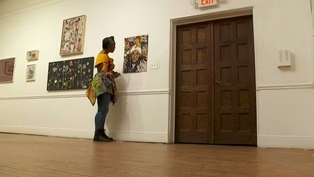
The gallery is presenting the Gilda Snowden Memorial Exhibition through April 15th.
It features the diverse works of local artists.
American Black Journal's A.J.
Walker was there for the opening.
>>Beauty and passion adore the walls of the Scarab Club for an event that is not just an art show.
It's a monument to a woman who gave so much to the art world and the community around her.
>>She had a tremendous love of her family and her community.
She was, in her own right, an amazing artist and just a very prolific artist.
She was a teacher, a mentor, a colleague and friend to so many people, just countless people, and she always had just an enormous generosity of spirit.
>>The legacy she leaves behind at what is now named the Gilda Snowden Memorial Exhibition is giving artists a chance to show their work and take a moment to remember the woman who blazed the trail ahead of them.
Before the opening of the exhibition, we stopped by the Scarab Club to meet some of the artists and speak with one of the people who knew Gilda on a personal level, Trina Planary Erickson, it's gallery director.
She said this was the perfect exhibition to name in Gilda's honor.
>>The Silver Medal Exhibition, which this exhibition used to be called, was her favorite exhibition of the year, and she loved it so much because she felt that it was so inclusive.
It was unthemed, all media, a juried open to all artists.
It could be anything.
It could be absolutely anything.
She loved the idea that students and their teachers might be hanging in the same space.
She loved the idea that it was emerging artists an established artists and that it was an opportunity for artists to have their work seen.
>>Renowned quilt maker April Anue Shipp made this quilt in Gilda's image.
It's on display at the exhibition.
She was inspired by Gilda even though they had never met.
>>When I started doing this piece, I was free.
I let Gilda tell me what she wanted to have on this quilt, so I used fabrics and flowers and hand embroidery on it.
There's silk on there, there's gauze on there.
I just threw everything at it.
I thought she would like that because from what I heard about her was that she loved color, and so I wanted to honor her with just giving her my all, giving her all this beautiful color.
>>One of the things Gilda was remembered for besides her beautiful art was her passion for her community.
That's something April and Gilda have in common.
Helping to serve your community through art, and I know Gilda did that, and it sounds like you do that, too.
>>Trying, trying.
When Philando Castile was murdered by the police, my first instinct was to sew, and so I cut up a bunch of squares and I would sit and sew by hand, and that gave me peace.
I did a quilt entitled "Say Their Names," and it has the names of the African-American men, women, and children who were murdered, who were unarmed, murdered by the police, and I would invite the community to come and pin the names of the victims on this piece.
>>The Gilda Snowden Memorial Exhibition opened during Women's History Month, a time when great women like Gilda are being recognized and appreciated in the art world and beyond.
For April, when this exhibition is over and Women History Month comes to an end, she looks forward to her work continuing to be displayed in galleries like this one.
>>This is a great time to be an artist right now.
Most of my friends who are artists are in shows across the city.
This is a great time, and they're mostly women, painters and sculptors, and they run the gamut.
So I think it's a great time time to be a black woman and to be a black woman artist.
I'm having a ball I'm.
I'm enjoying my life.
I'm having the time of my life, trust and believe.
>>Trina says she's glad that artists of all genders and races are now having their work recognized.
She says art is a part of the conversation that is opening doors for equality, and it should be.
Artist Eno Laget agrees.
>>It's not so much about the object as a piece of art.
It's about the conversations that may happen, the opportunity to have the conversations about things that I think are really important, particularly now when we seem to be reliving a lot of the ugliness that occurred when I was a kid.
>>He created this stencil of Rosa Parks, also on display at the exhibition.
Well, we're standing here.
We're looking at your work that is paying homage to an African-American pioneer, and I just think it all lends to the advancement of women and women of color and just women around the world, even though I know we still have so far to go.
>>That makes me so freaking happy because what's the history of this place?
It's more than 100 years old.
You guys wouldn't have been in here at all, or if you were, as Trina said, you would've been carrying a tray.
So, women weren't allowed in.
People of color were not allowed in, and here we are in 2021, and we have a show that's dedicated to a woman of color who had been very active in the community for many years, beloved by many people, and it's a little piece of a testimony to how things have changed, but at the same time, it's everywhere.
There's still so much work that needs to be done.
>>The exhibition, named an honor of an African-American woman who paved the way for other artists, is a part of that work.
Gilda Snowden, who hoped she was making a difference in the world.
>>One of the things that she said to me is that we think we have forever, but we don't, and so we have to identify what are the most important things in our lives and what we need to give our attention to, and that's what we need to do.
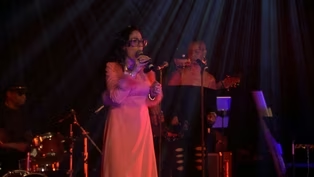
>>Now, we're gonna leave you with music from Laura Rain and the Caesars' appearance on "Detroit Performs Live" from Marygrove.
You can find out more about our guests at americanblackjournal.org, and you can always connect with us on Facebook and on Twitter.
Take care, and we'll see you next time.
(funky jazzy music) ♪ How could you know ♪ If you never know me ♪ ♪ 'Cause my love is pure ♪ Just look and see ♪ How can I show you ♪ I lost a lifetime of love ♪ ♪ If you don't need me ♪ I've already given up ♪ ♪ I'm chasing my past ♪ Where would I go ♪ I'm running too fast ♪ Where would you be ♪ My love is all I have ♪ ♪ I've found the only chance ♪ What would I do without you ♪ I only live and learn with you ♪ ♪ If I can't have you ♪ ♪ If I can't have you ♪ If I can't have you ♪ If I can't have you ♪ If I can't have ♪ How could you feel ♪ ♪ What I can't see ♪ When you let go ♪ You still have me
Video has Closed Captions
Clip: S50 Ep11 | 12m 6s | Detroit United Front advocates for better equity and inclusion for Black businesses. (12m 6s)
Video has Closed Captions
Clip: S50 Ep11 | 6m 13s | The Scarab Club hosts a memorial art exhibit for Detroit artist Gilda Snowden (6m 13s)
Video has Closed Captions
Clip: S50 Ep11 | 2m 40s | Laura Rain & The Caesars performs on ‘Detroit Performs: Live from Marygrove’ (2m 40s)
Providing Support for PBS.org
Learn Moreabout PBS online sponsorship
- News and Public Affairs

Top journalists deliver compelling original analysis of the hour's headlines.

- News and Public Affairs

FRONTLINE is investigative journalism that questions, explains and changes our world.












Support for PBS provided by:
American Black Journal is a local public television program presented by Detroit PBS