
Developer Working to Revitalize Louisville Neighborhood
Clip: Season 4 Episode 111 | 9m 23sVideo has Closed Captions
Developer behind Louisville's thriving 'NULU' neighborhood has sights on new part of town.
The developer behind Louisville's thriving 'NULU' neighborhood has his sights on a new part of town. Gill Holland has been working to revitalize Louisville's Portland neighborhood for more than a decade, securing more than $100 million dollars in investment projects.
Problems playing video? | Closed Captioning Feedback
Problems playing video? | Closed Captioning Feedback
Kentucky Edition is a local public television program presented by KET
Developer Working to Revitalize Louisville Neighborhood
Clip: Season 4 Episode 111 | 9m 23sVideo has Closed Captions
The developer behind Louisville's thriving 'NULU' neighborhood has his sights on a new part of town. Gill Holland has been working to revitalize Louisville's Portland neighborhood for more than a decade, securing more than $100 million dollars in investment projects.
Problems playing video? | Closed Captioning Feedback
How to Watch Kentucky Edition
Kentucky Edition is available to stream on pbs.org and the free PBS App, available on iPhone, Apple TV, Android TV, Android smartphones, Amazon Fire TV, Amazon Fire Tablet, Roku, Samsung Smart TV, and Vizio.
Providing Support for PBS.org
Learn Moreabout PBS online sponsorshipWell.
The developer behind Louisville's thriving new loop neighborhood has his sights set on a new part of town.
Gil Holland has been working to revitalize Louisville's Portland neighborhood for more than a decade now, securing more than $100 million in investment projects.
The most recent is a $35 million project called the luminol, that will transform historic warehouses into 138 apartments and 20,000ft² of commercial space.
I sat down with Gil Holland from the Portland Investment Initiative and Kathy Farrington, partner with Antecedent Development, to learn more in tonight's business, be.
Well, we are happy to be with Gil Holland and Kathy Farrington here in our Louisville studio.
Thank you all for being here.
What an exciting time for the Portland neighborhood.
This groundbreaking, at the liminal, development is huge for this area.
But like we were saying, it's been in the works for a very long time.
And, Gil, you you talked to, more than ten years ago about your investment in this neighborhood.
Why?
Why did you think it was important to invest in the Portland neighborhood?
Yeah, well, so, you know, Portland is one of the most historic.
It was a historic sister city to Louisville.
Lewis and Clark left from Portland.
Abraham Lincoln had his first paying job digging the Portland Canal.
That's where he first saw slaves being traded.
You could argue the seeds of the Emancipation Proclamation are in the Portland neighborhood.
And it was, you know, a sister city.
It's a very resilient neighborhood.
It was under water in the 37 flood and the 45 flood.
But this historic warehouse district, you know, lots of other cities, most other cities have already revitalized their warehouse district.
So I feel like people know what a warehouse district is supposed to be.
It's supposed to be cool off departments.
It's supposed to be some funky art artists hanging out, art galleries.
We have the visual Art Association.
We have the portal.
So it seemed like a no brainer to me, being right next to downtown and also with the the all the investment going into Waterfront Park, the final phase four of Waterfront Park, which is right on our front.
Front step.
Yeah.
And, the liminal project is with antecedent development.
Tell us about this project and what people can expect.
What's it going to look like?
So this project is taking a historic brick beautiful warehouse that used to be a part of a paint manufacturing conglomerate 100 years ago, and converting it into 137 apartments.
These apartments will have beautiful top of the line amenities, including a fitness center, a community center, a clubhouse, and outdoor kitchen.
And as Jill mentioned, it's right next to the expansion of the Waterfront Park.
So they will have the best access of anyone west of ninth Street to this new, exciting waterfront park that's being built.
We are taking these build these apartments, and we're helping to make them affordable to the average worker in Louisville.
So they will be priced at 80% area median income, which means if you earn $54,000, you'll be able to afford these apartments no problem.
And the goal is to create beautiful housing for the backbone of the workforce in Louisville and the folks that work and live near downtown.
And you mentioned that affordability.
And obviously, because it's in this, neighborhood that is underserved right now.
I would imagine that's part of it, but it's part of tax credits to are making it affordable.
That's exactly right.
So we used historic tax credits, both federal and Kentucky, historic tax credits and economic development and brownfields loans from the city of Louisville to make the prices below market rate without having to restrict the apartments to any particular kind of person.
Yeah.
And, like most of the projects that you're working on, it's all about, the bigger picture a lot of times.
Right.
And so the bigger picture with this, I would imagine, is like you mentioned that downtown accessibility and it really is, going to revitalize downtown and Louisville as a whole is the point, right?
Yeah.
All these historic collar neighborhoods, and you could literally walk to downtown if you have a job downtown.
And we need more downtown housing.
We have 30,000 families on the affordable housing waitlist.
So I mean, 137 units, it's a a splash in the bucket.
But, you know, we'll take it a drop in the bucket.
And they're they're going to be beautiful.
And then, you know, Kentucky does a great job with its historic tax credits because we have all these historic buildings that they're all need more money than they're technically worth to re revitalize and rehab.
So you have to have some kind of tax credit because otherwise they will just continue falling apart and falling down.
And we lose our historic heritage and this cultural fabric.
So I feel like that's why Louisville is also kind of ahead of the curve.
When you look at Atlanta.
And I know they've grown more in Austin and Nashville, they've grown more, but they have lost so much of their cultural, historic fabric because they've torn down.
They have not saved some of these great old buildings.
So this these warehouses are so cool.
And it's like Tribeca, literally the first time I went there 15 years ago, because you would always hear, like, they'll go to ninth Street.
Of course, for me, I'm like, I go straight west.
And I see right when I moved to Louisville and I'm like, oh my God, this should be like New Orleans.
This is like the most beautiful.
This is like Tribeca.
So having lived in New York.
Yeah.
I was like, you know, it's going to take a lot of money because these are big buildings.
They're not just the little traditional shotgun, 1850s shotgun that I started rehabbing in Portland.
So, you know, cabbie was nice enough to let me help out on this project.
You know, four years later, we finally had our groundbreaking.
Yeah.
It is.
Hey.
So, and your development firm is, calls itself a mission driven commercial real estate.
And explain what that means.
That means that we only develop projects that we think are going to have a really significant community impact.
We focus on historic renovation, like the liminal project helping to preserve and neighborhood's heritage while building its future.
But we also focus on workforce housing and on making sure that there's enough housing for everyone to live in beautiful places close to where they work, so that every family can have a really lovely home.
And so when we decide which projects we want to focus on, we use that lens, the community impact lens.
Yeah.
Yeah.
And I, you know, I call what we do urban acupuncture because, you know, try to take away like the negative ripple effect of a vacant abandoned property and then replace it with a nice place that's attainable housing or a nonprofit that needs cheap rent or an artist that needs cheap rent.
And then you have this positive ripple effect.
Because when I started in the Portland neighborhood, 1 in 4 buildings was vacant and and or abandoned.
Yeah.
So we got, you know, that's a lot of people that can kind of move back into Portland just to get to the density that it had in 1936.
Yeah.
And a lot of the, I'm curious what it's like for you to, to see something like this that will really be an anchor of this neighborhood.
I know you've been working on this a long time, and like you said, those little projects here, this popping up here.
But for something like this, this is transformative.
Yeah.
I mean, I remember when, you know, like Garage Bar first came to East Market Street and I was like, okay, this is like things are starting to happen, you know, and I always joke like, you know, that was when I was like, if I get hit by a bus, Newley is going to be fine.
And now I'm like, when, when people like KP are coming to the Portland neighborhood, that's a huge get for Portland.
And I'm like, okay, great.
This is going to start happening.
And you know, Painter's Row is is a slightly smaller.
It's 100 units, slightly less expensive, but still 20 plus million dollars.
And so when that finished and opened and I moved my office and, over there and, I was like, that was the next state.
So it's like all these little, little steps, little steps, but you know, long big picture, you know, and I will die before, all 1400 of the vacant abandoned properties that were there 12 years ago are revitalized.
It's worth underscoring just how much momentum the neighborhood has already been experiencing, and we feel like we're just joining the story.
As Gil mentioned, there's the Painter's Row apartment building this across the street.
But even before Painter's Row went into place, there's the peerless distillery that's down the road.
There's really an arts district that's starting to emerge.
There's the 1512 Creative Compound, the portal, which is a community event space.
There's a bookstore.
There's the visual, the Louisville Visual Arts studios.
There's this amazing community that's really starting to emerge.
And we're excited to be developing beautiful housing for them.
Yeah, yeah.
And the Portland Museum's doing great stuff.
And the Ahoy project is going to be the first children's museum, I think, in the whole state of Kentucky.
You know, there's another local, you know, a lot of the local Portland folks that have been there for years, decades, generations.
There's new businesses starting to pop up, as well, because I think lots of people are now saying like, okay, it's worth investing in this neighborhood.
Yeah, it's it's going to be exciting to see what happens.
Thank you all so much for being here.
We appreciate it.
And the LemonHall project is expected to be completed in 2027.
Resource Center Giving Support with Assistive Technology
Video has Closed Captions
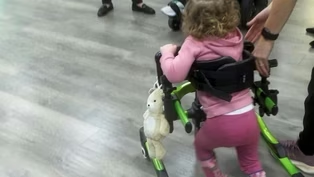
Clip: S4 Ep111 | 3m 28s | Northern Kentucky resource center has the equipment to help developing children, teens, and adults. (3m 28s)
Video has Closed Captions
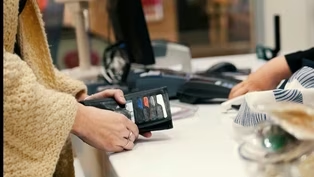
Clip: S4 Ep111 | 3m 13s | How tariffs could impact the 2025 holiday shopping season. (3m 13s)

Vice President J.D. Vance Visits Kentucky
Video has Closed Captions
Clip: S4 Ep111 | 2m 23s | Vice President visits troops at Fort Campbell. (2m 23s)
Providing Support for PBS.org
Learn Moreabout PBS online sponsorship
- News and Public Affairs

Top journalists deliver compelling original analysis of the hour's headlines.

- News and Public Affairs

FRONTLINE is investigative journalism that questions, explains and changes our world.












Support for PBS provided by:
Kentucky Edition is a local public television program presented by KET