We Are Here
Racing To the Top with DG32!
10/24/2024 | 26m 46sVideo has Closed Captions
DG32 Racing quest to go professional and rise to the ranks of American motorsport royalty.
The father-son duo of DG32 Racing aims to turn professional and elevate Deacon Greenfield to the ranks of American motorsport royalty.
Problems playing video? | Closed Captioning Feedback
Problems playing video? | Closed Captioning Feedback
We Are Here is a local public television program presented by WHUT
We Are Here
Racing To the Top with DG32!
10/24/2024 | 26m 46sVideo has Closed Captions
The father-son duo of DG32 Racing aims to turn professional and elevate Deacon Greenfield to the ranks of American motorsport royalty.
Problems playing video? | Closed Captioning Feedback
How to Watch We Are Here
We Are Here is available to stream on pbs.org and the free PBS App, available on iPhone, Apple TV, Android TV, Android smartphones, Amazon Fire TV, Amazon Fire Tablet, Roku, Samsung Smart TV, and Vizio.
Providing Support for PBS.org
Learn Moreabout PBS online sponsorship>> Let's give it a try.
>> During the early days of American motorsports, black racers were not allowed to compete with white racers.
Black racers were forced to create their own association called the Colored Speedway Association.
It was not until 1947, when the first black racer, Joie Ray, was granted a license by the American Automobile Association and was allowed to race with white racers.
Since then, there has been a scarce number of black racers to make it to the track.
Deacon Greenfield looks to join their ranks.
>> Once the helmet goes on and I'm in the car, just the few minutes I have before we go out on track, I do a visualization lap, so I just close my eyes.
I picture the track in my mind.
I picture my inputs, my, uh, how I break, I picture how I shift, I picture when I want to turn into the corner, and I picture where I want the car to be right before the green flag.
It's all just -- you just focus in and you kind of just black out a little bit, and the reflexes take over.
Being out on track is an amazing feeling.
It's a very awesome feeling to get out there and to just let it all fade away and you just focus on that next corner, that next corner.
Uh, and hopefully you focus on that next position that you're trying to come up on and get a better result.
My name is Deacon Greenfield.
I'm 19, and I am an amateur racecar driver.
Racing cars has been something that I've always wanted to do my entire life, and it's something I always knew that I wanted to do ever since I was about four years old.
Um, and it's really something that when you start living it, it's all you can think about.
And that's exactly what I wanted to do.
As any other kid, I was really interested in trains at first, until my dad brought home some movies and they were all they were racing movies, and I kind of just got hooked and I started to, like, memorize the movies, and I started to just fall more and more in love with cars and competition like that.
And then I started hunting for more cars in the media type of thing.
When I found out that it was something that I could do and I could possibly do professionally, it was just something that clicked.
And I knew immediately that was what I wanted to pursue.
And it's just an end all type of career or just lifestyle, really.
>> Kids.
A lot of kids.
Yeah.
Just passion for Hot Wheels racing cars, um, myself included.
I still have a collection, believe it or not, at home.
He picked that up, and we started to notice, yeah, this is more than just a normal passion, though, because he was using them on the floor, actually making little stop motion videos with them and scenarios and things and animating them.
Really interested in racing.
You know, where does this performance level like most people do, myself included, where the envelope gets bigger and bigger, what can it go?
So we took that, and later on, after the the young stages got into a remote control racing, one tenth scale, one eight scale cars, joined a local club in Manassas, Virginia.
Um, spent time on the track and that was the moment that we saw that, uh, hey, there's more here than just interest, because suddenly this ten year old was beating adults who have been racing these things as a hobby routinely.
And also his dad, who has introduced him to it, right, said, hey, this is how you go left, right, forward and back.
Now we're going fast.
Then he was beating me relentlessly at this hobby.
And we took him there.
This little guy has more than a normal interest and talent for this kind of thing.
>> I didn't know anything except for what I could absorb and what I could learn from my peers around me and from what me and my dad would learn together.
Going from RC to karting was, I learned a lot of the fundamentals for the driving in RC, and a lot of how a car works, and transience in terms of, racing pace instead of just driving around regularly.
But the big shift was actually feeling a car.
With RC racing, I can't feel the car.
I'm just standing on a ladder looking at it.
But once I got into karting, I had to learn how to adapt what I learned from afar into what I also felt as well.
And from there I took further steps to learn more about how I can adapt what I'd learned through feeling as well as what I can see.
So that and then going from karting to cars was a lot easier than from RC to karts, because karting is actually physically harder than racing just a full scale car like this, because you have a lot more forces going through you.
So you still get those fundamentals like how to drive a line and how to pass somebody or looking into a corner.
So going from karting to cars wasn't as hard, but cars is still an adjustment.
Every stage has its own adjustment and it's been amazing every step of the way.
>> From RC to cars, Deacon faced growing pains through each major adjustment in his career, but he did not navigate the track alone.
His dad was there every step of the way.
Now they look to attack Deacon's final major adjustment stage from amateur to professional racer.
>> It was me and him with RC.
Um, it was, you know, it was me and him in karting and it was me and him with this now.
So we're getting to the point where I'm starting to branch into professional.
Um, but ever since the start, it's always been me and my dad.
Uh, at first we both had two RC cars, and we were running the same class at the same time, and we would learn together.
We would read about how to race, how to set up a car, um, and everything that we could and learning from others at the track.
At every step of the way, we both had to learn new and new things about car racing and competition, and how it has its own unique aspects to racing.
>> Proudest moments was indeed being on a racing day with remote control systems.
Having talked up what to do, we had a good reputation of being decent drivers and then seeing him take control of a race day literally take control was one of my proudest moments because it was literally from that point forward, there was no going back.
Uh, there was nothing more that I could do.
Like Mr. Miyagi has nothing else to teach you.
You are now the master of this.
And it continues.
I've never been able to beat him since.
So extremely proud.
You're flying on your own, buddy.
>> This is a very dangerous sport, where you go over 100 miles an hour constantly.
Um, and a lot of it, everyone who goes out on the track knows the risk.
You don't do this without knowing the risk.
Um, and it's up to as much as we all want to fight competitively and hard and aggressive, uh, there has to be a respect between drivers to ensure that we have fun and that we race properly, but we also do it safely, um, and sometimes those things, just whether it's a variable that's out of control, like a dangerous weather condition or an unforeseen, like a tire puncture that can cause in just the wrong area.
So we deal with that with training ourselves the best that we can and, uh, getting the best gear that we can.
And a lot of the organizations that we race in like SCCA and FIA, all have safety standards, met up to new technology to make sure that everyone is as safe as possible to do this.
>> Yeah, the inherent risks, which, uh, luckily, both me and my wife understand, me being military and she being a military spouse, she has had to live with risks as part of our daily life.
Um, seeing our son come up and show this interest in something that is high speed, potentially dangerous.
Uh, nobody wants their child to be subjected to any kind of harm, but we went out about it methodically.
We're starting to measure out what is danger and recognizing that this is a dangerous sport, potentially, seeing where that, uh, danger has been mitigated, though, you know, high speed and all the safety things are in place.
We were comfortable with that because we certainly wouldn't have put him out there if you weren't comfortable.
>> Car racing is very unique in the way that you have to have a synergy with you and your car, even though you know you can't run in a car race, but your car can't go without a driver, so both the car and the driver have to be in tune with each other, and they both have to be working together.
And you have to know each other's limits, really.
So it feels very much like you're running a three legged race where you're both dependent on each other.
That's a really big challenge.
>> Remember 9.3 shotgun on the field here.
Uh.
Looks like... >> It's about a second and a half separating them at the line.
But we can see now as they come out of turn ten... >> We're qualified pretty good.
P2 in class, second place.
Um, went out knowing exactly where we were standing, so I had a plan to just be consistent.
I knew we had the pace to stay second place for sure.
Um, so I went out there with the mind of just bring the car home and get some solid, consistent times.
Um, going out there, I knew what my competition was looking like, and I knew the state of we had for a car.
So I went out there and just really tried to focus myself into a mindset of not exactly push so hard that I would be doing a lot of risk, but push hard enough to get fast, repeated times.
So, uh, ultimately we finished first place, which is the first time for us in this car.
Uh, really happy about that.
>> Biggest thing from stopping me from going pro is funding.
I would say it's the biggest barrier in terms of pro racing.
A lot of people will stop at just club racing because it's -- with club racing, you can still support it out of a garage, but with pro racing you need a team, you need a crew, you need the car.
Um, and that's where a lot of people stop because they think that it's not possible.
But if you really devote yourself to it, you can find people to support you and and ways into it.
Um, but I would say that's the biggest barrier that people stop at.
>> They're all fast.
They took it on into heart way earlier.
He wanted to be one of those guys, if not the guy, because none of them talk about being second place.
And we followed Formula 1 as a passion.
One of the best racing series there is.
Seeing people like Lewis Hamilton out there doing his thing.
Top of the game became a hey, I can be that, and there's no Americans doing that.
I could be that.
I literally heard him say that.
Be the next American F-1 driver.
There should be one.
Should have been another one for a long time.
Uh, well, how do we get there, dad?
It's one of those questions.
And yep, following up.
Lewis Hamilton was an RC driver.
You did that.
Lewis Hamilton did karting.
We did that.
Um, then getting into some lower level, full scale, we did that, too.
So there was the latter.
And luckily here in Northern Virginia, in Maryland, there are those opportunities that we could take advantage of.
And, uh, we stepped into that world.
And ultimately, yes, he has that goal.
Would like to progress, go overseas or some professional level, get paid for doing this as well the interest.
And move on from there.
>> Yeah, I would like to see a lot more people, and I think it's just the stigma of this isn't something that they think something like someone who looks like us would would be interested in, but I've never had anyone turn me away from this or say that I shouldn't be here before.
And the community's been amazing, and we continue to work hard and prove to everyone that we belong to be here.
>> We've talked to plenty of parents along the way, um, whose kids both were interested in the same kind of field, as well as, uh, the basic question of how do you get involved?
And certainly you have to see where that passion is.
Because there's a lot of dedication to this sport like there is with any.
If that passion is there, and we saw it in our son, who would stay up at night and read all kinds of books and watch it on TV.
And it was more than just a passing passion.
You got to fuel that, especially the parent, you know, there's no way you can say no.
Um, certainly there's risks.
There's resources that are needed.
But I would advise any parent, when you see that, that's like, fertilize the plant and it'll grow.
Otherwise it'll be something that you'll see wither and die, uh, without the right cultivation and fertilizer.
So me and my wife decided to to do just that.
>> So there's a couple places that you could start.
A lot of people start with karting, because it's a really simple way to get a lot of experience and a lot of knowledge, uh, with racing, whether that's setup and driving itself.
And a lot of people can start in full size cars, too.
SCCA makes it where you can apply for their competition license, and you don't have to have any prior experience to that.
So, you know, like a club like SCCA or NASA, um, or other avenues like karting, I would say are the best.
Another one that's been great thanks to the technology of current times, has been sim racing, which would be online digital racing where a lot of experience can be gained and it takes out the cost of running a car, takes out the danger of putting yourself at those breakneck speeds, and you can gain as much experience as you can and you want to.
And all it takes is a good computer.
So that's where a lot of kids, especially over COVID, where they were able to gain a lot of experience despite not being able to actually race, is just getting on the computer and continuing to get experience and knowledge.
>> One, we mentioned passion earlier.
Having that passion is key because when you're up at 1:00 in the morning researching how to put a gearing system into a car, that's the first thing you check within yourself, because there's a lot of good times and even more bad times.
Uh, like I said, we witnessed that this weekend.
You have to research a fuse or an electrical problem.
You have to have that drive to finish something that you start.
And only then would you, this is for me.
True of many things, many passions.
But there's a lot of it, because there's a lot of mechanical knowhow, a lot of science behind the racing that you truly got to grasp in order to make this work.
And, uh, yeah, as a young guy, once you identify yourself that, yeah, I've got the passion, I want to do this too, then go out and seek it.
Uh, Northern Virginia, and Maryland has these communities, uh, there's simulation systems now that are in-house that are are military grade, literally that you can buy and put in your basement in your house.
Beyond the Xbox and other gaming systems, they really get you in tune with what it means to do this full scale.
And from there, you seek out, like we did here at Summit Point, there are driver education programs about a large scale car, get a competition license.
Many of Deacon's buddies, same age, turned 16, jumped right into a competition school and go for it.
And having that kind of energy, no matter what somebody tells you, just go for it and continue to progress.
>> A lot of the people that I encounter when I tell them about racing that are just like you and me, they don't ever -- They're so amazed by it because they just see it as it's not a sport for someone like us.
Uh, and I've never saw it that way.
I was just -- I've been always so in love with it, and, um, it should be for everyone.
And yet it takes a lot to do, But, um, that's a big thing is people just like, wow, I didn't know that was something that someone like us could do.
And luckily, as time progresses, we've been able to get more staples into the community and into the sport of people who are breaking through and breaking down those walls of belief.
So unfortunately, there's still not that many really.
You can go to any event and you won't see many of us, but when you do, it's amazing.
And that's one thing that I've always wanted to do, was just be that person there that someone believes is breaking down the walls and just showing that it's for everybody.
It's not just -- not excluding.
It's a sport that anyone can do.
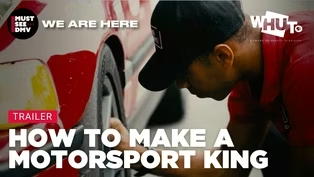
Preview: 10/24/2024 | 30s | DG32 Racing quest to go professional and rise to the ranks of American motorsport royalty. (30s)
Providing Support for PBS.org
Learn Moreabout PBS online sponsorship













Support for PBS provided by:
We Are Here is a local public television program presented by WHUT