State of Affairs with Steve Adubato
Diane Travers; William L. Crockett; MaryEllen Picciuto
Season 8 Episode 22 | 27m 29sVideo has Closed Captions
Diane Travers; William L. Crockett; MaryEllen Picciuto
Diane Travers, Senior Director of Programs for Family Connections & NJ4S-Essex Hub Director, addresses the youth mental health crisis. William Crockett, Director of Youth Programs at Joint Base McGuire-Dix-Lakehurst, discusses providing quality programs for military youth. MaryEllen Picciuto, Retired President & Advisor of Johnny Mac Soldiers Fund, discusses challenges facing military children.
Problems playing video? | Closed Captioning Feedback
Problems playing video? | Closed Captioning Feedback
State of Affairs with Steve Adubato is a local public television program presented by NJ PBS
State of Affairs with Steve Adubato
Diane Travers; William L. Crockett; MaryEllen Picciuto
Season 8 Episode 22 | 27m 29sVideo has Closed Captions
Diane Travers, Senior Director of Programs for Family Connections & NJ4S-Essex Hub Director, addresses the youth mental health crisis. William Crockett, Director of Youth Programs at Joint Base McGuire-Dix-Lakehurst, discusses providing quality programs for military youth. MaryEllen Picciuto, Retired President & Advisor of Johnny Mac Soldiers Fund, discusses challenges facing military children.
Problems playing video? | Closed Captioning Feedback
How to Watch State of Affairs with Steve Adubato
State of Affairs with Steve Adubato is available to stream on pbs.org and the free PBS App, available on iPhone, Apple TV, Android TV, Android smartphones, Amazon Fire TV, Amazon Fire Tablet, Roku, Samsung Smart TV, and Vizio.
Providing Support for PBS.org
Learn Moreabout PBS online sponsorship- [Narrator] Funding for this edition of State of Affairs with Steve Adubato has been provided by The Healthcare Foundation of New Jersey.
Horizon Blue Cross Blue Shield of New Jersey.
Here when you need us most.
The Turrell Fund, a foundation serving children.
The Russell Berrie Foundation.
Making a difference.
Valley Bank.
The New Jersey Economic Development Authority.
PSEG Foundation.
The New Jersey Education Association.
And by New Jersey Institute of Technology.
NJIT makes industry ready professionals in all STEM fields.
Promotional support provided by Insider NJ.
And by BestofNJ.com.
All New Jersey in one place.
[INSPRATIONAL MUSIC] - Hi everyone, Steve Adubato.
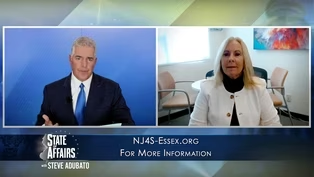
We kick off the program with an important conversation with Diane Travers, who's the Senior Director of Programs at an organization called Family Connections.
We'll put up the website there and also NJ4S-Essex Hub Director.
Diane, good to see you.
- Good morning, Steve.
Thank you for having me on the show.
- You got it.
You'll see this at night, but we're taping in the morning.
Diane, you got a lot going on with the titles here.
First, website's up for Family Connections.
What's that?
- Well, Family Connections is the managing organization for NJ4S-Essex, and Family Connections is a leading nonprofit here in northern New Jersey.
We've been around, we're about to celebrate our 145th anniversary, so that's exciting.
And we've got a variety of programs, over 35 programs that combat trauma, mental illness, substance use, child abuse, and domestic violence, just to name a few.
- What is NJ4S?
That's a separate website, right, Diane?
- Yes, we are connected through the Family Connections website as well as we have our own.
And NJ4S-Essex is one of the newer programs here at Family Connections, but it's part of a statewide initiative.
So, what NJ4S stands for is New Jersey Statewide Student Support Services.
- NJ4S.
- You got it.
- Four S's, go ahead.
- Four S. The Department of Children and Families really had been working on this concept with the legislators in New Jersey, really is an effort to expand student support services throughout the state of New Jersey.
So, there are 15 hubs across the state.
We are the Essex County hub, and we serve all of the schools in Essex County as well as 130 of the schools are eligible for our more intensive services.
- So Diane, we were introduced to you through our friends and colleagues at the New Jersey Healthcare, the Healthcare Foundation of New Jersey, lemme clarify that.
The Healthcare Foundation of New Jersey.
And one of their big pushes is, and one of their big priorities is around youth mental health issues.
Describe the youth mental health crisis in Essex County, which is representative of the crisis across the state and the nation.
- Yeah, so, I think what's important to highlight is back in 2021, the Centers for Disease Control did conduct a study of students across America, which is very representative of what we're seeing here in Essex County and statewide.
42% of the youth surveyed reported feeling persistently sad or hopeless.
29% of those students reported feeling like they had poor mental health.
And 22% admitted that they had thought about attempting suicide.
So, we're seeing this same crisis play out in our schools here in Essex County with a few variables.
We've got a lot of high needs students, over 100,000 students have identified as being high needs in our county.
Those students are dealing with a significant amount of trauma.
They're dealing with racial trauma in the communities, violence, crises within their families.
So, we've got this added layer as well here that really, really creates, again, as you said, you know, quite urgency for services to support the youth.
- Diane, let's be more specific.
What do many of these young people need?
What do they need?
- I think what a lot of young people need is they need somebody that can mentor them, that cares about them, that can be a support to them.
More specifically, they need individuals who are trained in the areas of difficulty that they're experiencing.
So, our clinicians have been trained in cognitive behavioral interventions for trauma in schools with training on racial trauma to really support our students who are experiencing trauma, as well as grief, anxiety, other mental health challenges like depression, suicide prevention, violence prevention, and bullying prevention.
- But does that not also include mental health issues, issues of isolation, issues of anxiety, fear, depression, et cetera, tied to the increase in antisemitism, the increase in Islamophobia, it's always been there, but given the events in Gaza, it's worse.
Talk about that.
- We are hearing from our schools that the incidents have increased and we have gotten referrals specifically for students who are unfortunately parroting some of that hate in their rhetoric.
I think that there are so many challenges today in terms of the world feeling to be a very uncertain place for many of our youth.
We've got the wars, we've got the political climate, and we have a lot of racial trauma right here in Essex County.
Tell folks if it's a parent, if it's a younger person they're watching, how do they access the support services?
- It's a great question.
So, one of the things that we've done is really tried to increase the awareness around parents.
So, if you go to our website, we've got a specific page for parents, for students, we've got a spot that parents can click on and get a template for a letter that they can give to their principals to say, "Where is NJ4S in my son or daughter's school?"
We've got access for students where we've been really promoting our social media, Instagram posts, getting youth to sign up through QR codes so they can receive important information.
As well as we're rolling out a really important text messaging system where parents will be able to sign up to get updates from NJ4S-Essex, but also to receive kind of resiliency messages each week on how to support their youth, challenges they may be experiencing within their families.
How to connect, how to connect to their teenagers.
- Diane Travers is Senior Director of Programs at Family Connections, also tied to the state program called NJ4S in the Essex County area.
But it doesn't matter where you are watching, 21 counties in the state.
Access the website that we've had up of NJ4S.
Find out more, find out how you can get help for those closest to you, particularly younger people struggling with severe mental health challenges.
Intercede, get engaged, find out what the services are.
Diane, thank you so much for joining us, we appreciate it.
- Thank you, Steve.
- Stay with us, we'll be right back.
(grand music) - [Announcer] To see more State of Affairs with Steve Adubato programs, find us online and follow us on social media.
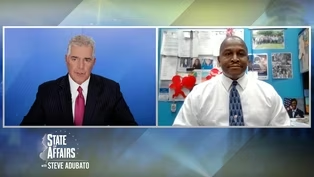
- We are honored to be joined by William Crockett, who's Director of Youth Programs at Joint Base.
That's JB McGuire-Dix-Lakehurst.
William, good to have you with us.
- Pleasure's all mine, Steve.
- Explain 'cause there's a lot going on in that title.
Joint Base McGuire-Dix-Lakehurst.
Explain all that.
Not Linhurst, Lakehurst.
- So pretty much that consists of, it starts out us being part of the 87th Force Support Squadron here at Joint Base McGuire-Dix-Lakehurst.
And then what we have, it breaks down into a flight, which we call Child and Youth programs flight.
And then within that flight, we have youth programs for McGuire, Dix, and Lakehurst.
- That's Lakehurst, New Jersey.
- Yes.
Joint Base McGuire-Dix-Lakehurst, New Jersey.
- So we're gonna put up the website right now.
The mission of your organization is?
- Our mission is to provide quality, affordable youth programs for the youth and the families of the Joint Base McGuire-Dix-Lakehurst community and ensuring that our military, DOD, and civilian contractors can have their youth in our care and have no worries of them being a part of a safe, fun environment while they try and complete their mission.
- William, talk about your military experience with the Air Force and also how it currently connects to your passion for the work you're doing right now, please.
- Yes.
I started out as serving in the United States Army and I did four years in the Army as an NCO.
And then after my military.
- NCO is non-commissioned officer.
- Non-commissioned officer.
Yes.
So after my time served as active duty member, I joined the Department of Defense as a government civilian employee, started working in child and youth programs.
- Speaking about youth.
In 1995, the Boys and Girls Club became a partner of your organization, a partner to do what?
- So pretty much it became a partnership where that we both had the same common goals and what the military was looking at was trying to bring some consistency and continuity and utilizing the various programs that the Boys and Girls Club had to offer.
So we pretty much married up to the programming aspects of things and it became very beneficial for us because we wanted, there was a couple things that came into play there.
We wanted our youth to be able to have a consistency when they traveled from one installation to the other installation when it came, programs that was available and being offered.
And that was the way for us to branch that model toward that.
If you was at Ramstein, Germany and you PCS to McGuire Youth.
- There's a lot of military jargon and acronyms.
If you what?
- Oh, so that's called a permanent change of a station.
So if you relocated from one military installation to another installation, we wanted to have a consistency of the type of programs that was available.
- You understand the mental health issues that young people face who are in military families.
Help us understand this.
So there are young people across the state and in the nation are facing a whole range of mental health challenges, but what do you think is particularly unique, different, or more challenging for a young person in a military family?
- A lot of things come into play there, Steve.
You know, after coming off of being part of this post pandemic, that affected a lot of our military youth in a certain way because everything was shut down and that was something that they had not gone through before.
On top of that, and coupled with that is also that a lot of our military youth go through the transition of having one parent or both parents go on deployments in the certain missions overseas to various nations and everything.
So sometimes it might be just one parent available, other times it might be a grandma or grandpa who's coming in and filling in while the parents are away.
So again, it's about trying to keep their lives as stable as possible and being able to keep their minds off of what's going on and being able them for them to interact and engage in the various programs we have to offer to soothe that situation that they're going through.
- Talk about a couple of those programs, William.
Be specific about what service or services are offered to those young people as well as their family members.
Military family members, please.
- Well, we have a slew of different programs that we offer from everything, from on the youth, from the youth aspect of it.
And pretty much for some of the families when it comes to what we have what we call our school age program, which is a program that offers care to assist our youth from them being able to be dropped off in the morning, having a good lunch, or I'm sorry, breakfast prior to going to school.
Sometime the parents don't have time to do because they're trying to get to work themselves or they're not here to provide that for them.
And we have a program that gets them on the bus to get 'em to school and then when they come back to us after school, we're there with snacks and assistance with schoolwork and things of that nature to help them get through their days.
And also just offering them quality programming where there's not so much structure to just the education aspects of being, coming in, you know, second part of school.
But for them to be able to participate in programs, the arts, life skills, leadership, the service, helping them develop life skills as well.
- Hey, William, how much of this is personal for you?
- It is very personal because I'm very passionate about it.
I've been involved with this for almost over 30 years.
So it's something that, you know, we have situations where we have youth who started out in our program as pre-teens, what we call, which is 9 to 12 year olds.
And now they're on staff and getting, paying back and doing the same thing for youth.
That was done for them when they was going through the programs that we offer.
- Where's the funding come from?
- Funding come from various aspects.
We have, you know, we fall under the Department of Defense, so we have certain funding that comes straight from the Pentagon to our program to all the installations.
And then when it comes to the east installation, in our case, like we have 87th Force Support Squadron, we have programs that generate revenue, that help offset and pay our staff, and for us to provide programming as well.
And we also get grants from our partnership affiliation with Boys and Girls Club of America.
And sometime in getting assistance in funding.
- William Crockett, director of Youth Programs at Joint Base.
That's JB McGuire-Dix-Lakehurst.
William, I was remiss, not in just thanking you for joining us, but thanking you for your service.
And let me add onto that.
The work that you've been doing for three decades plus helping military families, military youth deal with real challenging mental health challenges and issues that those of us who have never been connected to the military will never understand.
William, thank you so much.
We appreciate it.
- You're very welcome.
Thank you for having me.
- You got it, stay with us.
We'll be right back.
(grand music) - [Announcer] To see more State of Affairs with Steve Adubato programs, find us online and follow us on social media.
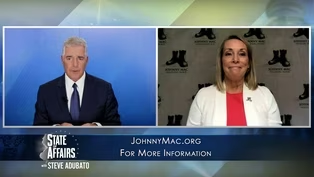
- We're now joined by MaryEllen Picciuto, who's a retired president and advisor to Johnny Mac Soldiers Fund, we'll put up the website for Johnny Mac Soldiers Fund as we do the program.
MaryEllen, thank you for joining us.
- Thanks so much for having me, Steve.
- Let me disclose that my very close friend, Jim McHugh, who lost his brother John in 2010 in Afghanistan.
We talk about these issues all the time.
He introduced me to you.
I said, let's do this program.
Let's talk about who John McHugh was, and why his legacy still matters, and what the heck it has to do with this soldier's fund, which is so important.
- Absolutely.
So, John McHugh, otherwise known as Johnny Mac, was one of my West Point classmates.
And he was tragically killed in Afghanistan in 2010 by a suicide bomber attack.
And our West Point class is very tight-knit.
And, you know, we hadn't lost anyone in post-9/11 combat because we were senior in age.
John was a full bird colonel when he was killed in action, had five children and his spouse, of course.
And so we.
- And a grandchild.
And a grandchild.
- And a grandchild.
And we launched into action, first to just raise money for the five McHugh children to make sure that they were taken care of should they want to go to college.
And then later, about four years later, in 2014, we decided that there was enough impetus behind this, enough effort and energy behind this that we could form the Johnny Mac Soldiers Fund, a 501(c)(3) nonprofit and help many, many more military children the same way that we helped John's family.
So in 2014, Johnny Mac Soldiers Fund began.
And we're commemorating already, I can't believe it, but our 10th year this year throughout 2024.
- MaryEllen, when we were talking together with Jim McHugh and we started talking offline, one of the things that struck me is, not just your relationship and connection to Johnny Mac and your commitment to military families, but also your passion for making sure that not just the fund itself does what it does, but that we, all of us, as a country, understand, recognize, and instead of just simply saying, and it's important to say, we thank you for your service, and P.S., thank you for your service, it's not nearly enough, is it?
- It's not enough, you know?
And now that everyone is out of Iraq and Afghanistan for a couple of years now, slowly fading from folks' memory, it's not in the news every day anymore, but the vast majority of the children who lost a parent in those combat operations in Iraq and Afghanistan are now college age.
So that's where we're stepping in and we're trying to absolutely never forget the folks that fought for our freedoms.
- What are some of these children of military men and women who have been killed in war, what are some of them facing, many of them facing?
- Well, I think having raised two military kids of my own who absolutely did not have to face any kind of profound loss like some of these children have.
You know, military kids already have it a little bit tough with frequent moves, new schools, making new friends.
The fear of their parent going off on deployment, or to war, combat operations.
But now factor in a military child who loses a parent and, you know, obviously, this is something that stays with them for the rest of their lives.
And many of the kids that we're serving now were so young when they lost their parent that their memories are from the stories that other people are telling them and from photographs and so forth.
- Speaking of stories, I've heard a little bit from Jim McHugh about his brother over the years.
Tell us what Johnny Mac was like.
- So I'm gonna date myself a little bit, but do you remember the commercials from probably the late '70s or '80s, "Baseball, Hotdogs, Apple Pie and Chevrolet"?
- Yeah.
- Not to give Chevrolet a beat there, but that's what Johnny Mac was.
He was the guy next door, the boy next door.
Had a smile on his face.
I'm a fellow New Jerseyan and I grew up in Freehold.
- From Freehold, right?
- Yes.
- So, it's you and Springsteen from Freehold, so go ahead.
- Indeed, indeed.
And, you know, I got to West Point and everybody asks you, "What exit are you from?"
Well, I had never heard that in my 18 years growing up in Freehold.
But when you get to West Point, everybody from everywhere else asks you what exit you're from.
So I met Johnny Mac at some point, fellow New Jerseyan, we connected.
- The McHugh's are from Caldwell.
- Exactly.
And just super nice guy.
Unassuming, humble, great guy.
Did not surprise me later on to learn that he went on to serve 24 years in the Army, career Army officer, aviation officer, flew Black Hawks.
And raised five amazing children that I've had the pleasure of meeting.
And, you know, clearly, the apple doesn't fall far from the tree.
They're all just wonderful human beings like their dad was.
- Let me ask you this.
How much of this, MaryEllen, from your perspective, beyond what people can do individually, and P.S., go on the website for Johnny Mac Soldiers Fund, please go on it.
I'm not gonna turn this into a fundraiser, but the dollars go to helping the children of military men and women who have been lost in service.
But I'm gonna ask you this, that's a private thing, that's a not-for-profit thing.
Are there any specific government policies that you believe, I'm not gonna make this political, but policy to me is different, are there any specific policies on the state and or national level that need to be changed different to show how much we really care about military families instead of the rhetoric?
- No, you know what, Steve?
The benefits for military children of the fallen are actually quite robust.
And Johnny Mac Soldiers Fund steps in where there may be gaps.
And so sometimes a student has a gap with a private school or some other special circumstances.
And so we're trying to plug those gaps with the scholarships that we give out at Johnny Mac Soldiers Fund.
There's also very few benefits for military children of the fallen when it comes to private K to 12 schooling.
And so we've stepped into that gap as well.
So some of those children maybe require a little bit of extra attention that's not available in their public school system wherever they might reside.
And so we're finding that that K to 12 need is also great.
And we've expanded to help children of our wounded warriors as well with their education.
And so far fewer benefits are out there through the VA or the government for children of wounded warriors.
So we're helping with their K to 12 and college scholarships as well.
- Before I let you go, you chose to serve in the military for a lot of reasons.
What was the most significant?
- That's a great question.
You know, growing up in Freehold, my dad worked in New York City, commuted in every single day.
It was, West Point was something very different.
None of my high school classmates were doing something like that.
And I think I was influenced by the join the military, see the world.
I wanted to do something more.
I hadn't really been out of the New York, New Jersey metro area in my youth.
And so I, you know, those commercials, join the Army, see the world, I was like, oh, this sounds really exciting.
I can't say that I had this call to serve in the military, but I certainly developed it.
And once I visited West Point, I knew that was the place where I belonged.
And I ended up going there and then serving for five years in the Army, including duty in Operation Desert Shield and Storm.
So I left after five years, but continued to serve as a military spouse.
My husband served 24 years.
And Johnny Mac Soldiers Fund is just another phase of my life of service, I guess you could say.
- MaryEllen, thank you for joining us, but way more importantly, thank you for your service, thank you for your husband's service.
And we'll continue to talk about Johnny Mac and the Johnny Mac Soldiers Fund.
And we'll do our part.
We'll continue to.
Thank you, MaryEllen.
- Thank you very much, Steve.
Great opportunity.
- You got it.
And thank you so much for watching.
I'm Steve Adubato.
We'll see you next time.
- [Narrator] State of Affairs with Steve Adubato is a production of the Caucus Educational Corporation.
Celebrating 30 years in public broadcasting.
Funding has been provided by The Healthcare Foundation of New Jersey.
Horizon Blue Cross Blue Shield of New Jersey.
The Turrell Fund, a foundation serving children.
The Russell Berrie Foundation.
Valley Bank.
The New Jersey Economic Development Authority.
PSEG Foundation.
The New Jersey Education Association.
And by New Jersey Institute of Technology.
Promotional support provided by Insider NJ.
And by BestofNJ.com.
- I'm Tim Sullivan, CEO of the New Jersey Economic Development Authority.
Since joining the NJEDA, I've been struck by the incredible assets and resources that New Jersey has to offer.
The NJEDA is working every day to grow New Jersey's economy in a way that maximizes the values of those assets to benefit every single New Jersey resident.
This includes more support for small businesses and a focus on reclaiming New Jersey's position as a leader in the innovation economy.
Visit njeda.com to learn more about how NJEDA is building a stronger and fairer New Jersey economy.
Examining the NJ Statewide Student Support Services program
Video has Closed Captions
Clip: S8 Ep22 | 8m 32s | Examining the NJ Statewide Student Support Services program (8m 32s)
Providing quality recourses and programs for military youth
Video has Closed Captions
Clip: S8 Ep22 | 9m 3s | Providing quality recourses and programs for military youth (9m 3s)
The unique challenges military youth are facing today
Video has Closed Captions
Clip: S8 Ep22 | 10m 49s | The unique challenges military youth are facing today (10m 49s)
Providing Support for PBS.org
Learn Moreabout PBS online sponsorship
- News and Public Affairs

Top journalists deliver compelling original analysis of the hour's headlines.

- News and Public Affairs

FRONTLINE is investigative journalism that questions, explains and changes our world.












Support for PBS provided by:
State of Affairs with Steve Adubato is a local public television program presented by NJ PBS