
Diary of a Misfit - Casey Parks
Season 8 Episode 8 | 15m 12sVideo has Closed Captions
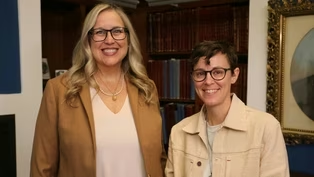
Author Casey Parks talks with host J.T. ELLISON about her book DIARY OF A MISFIT.
“It can be really hard to be yourself in the world, but it can feel worse to be someone that you’re not.” Casey Parks talks with J.T. Ellison about DIARY OF A MISFIT. Heartbreaking and poignant, Parks' journey to find her grandmother’s friend, Roy, a woman who lived as a man, examines a host of issues from opioid addiction and poverty to religion, gender identity, and sexuality.
Problems playing video? | Closed Captioning Feedback
Problems playing video? | Closed Captioning Feedback
A Word on Words is a local public television program presented by WNPT
Diary of a Misfit - Casey Parks
Season 8 Episode 8 | 15m 12sVideo has Closed Captions
“It can be really hard to be yourself in the world, but it can feel worse to be someone that you’re not.” Casey Parks talks with J.T. Ellison about DIARY OF A MISFIT. Heartbreaking and poignant, Parks' journey to find her grandmother’s friend, Roy, a woman who lived as a man, examines a host of issues from opioid addiction and poverty to religion, gender identity, and sexuality.
Problems playing video? | Closed Captioning Feedback
How to Watch A Word on Words
A Word on Words is available to stream on pbs.org and the free PBS App, available on iPhone, Apple TV, Android TV, Android smartphones, Amazon Fire TV, Amazon Fire Tablet, Roku, Samsung Smart TV, and Vizio.
Buy Now
Providing Support for PBS.org
Learn Moreabout PBS online sponsorship(bell ringing) (upbeat music) - I'm Casey Parks and this is "Diary of a Misfit."
Sometimes I just say it's a fruit salad of Southern issues because there's opioid addiction, there's religious stuff, there's gender identity, there's sexuality, there's poverty.
(soft music) - This is just an absolutely amazing book.
It is heartbreaking, it is poignant.
It is historically fascinating.
It's your life's journey and the way you've overcome a very difficult upbringing to not only live but thrive and be happy.
It's the journey to uncover who Roy is?
And it's also an examination of the religious south and the damage it inflicts.
Where do you want to start?
- Well, I want to start by taking you on the road to tell people what the book is about, when people ask me.
'Cause normally I just stutter a bunch because it is a lot of different things.
- Here you can have that.
(group laughing) There you go.
- Nice.
(upbeat music) - [J.T.]
You had a rough upbringing?
- I just now realized that.
- Sometimes you don't know when you're in it, that things are not the way that they're supposed to be, I mean, if you don't know, it can be different.
- Yeah, and I even thought when I started this book and I pulled out all my journals from fifth grade and sixth grade and seventh grade, I thought, oh, it's not as bad as you remember it.
And then I opened up the journals and it was much worse than I remembered it.
And I think I just kind of absorbed this idea that you can live through anything if you can turn it into a story.
And so I think I saw my journal that way as a kid.
Like nothing can hurt me because it's just narrative tension.
And that I think maybe has held me back a little bit as an adult and I had to like relearn how to be in the world as it is.
But I do think it helped me survive a lot of hard stuff when I was younger.
I really had to grieve for my little self when I was writing it in some ways.
'Cause it's just like, there was one I remember that was like I need to go to school but my mother is passed out and I don't know if she's gonna die while I'm at school today and I don't know what to do.
And just reading it, I felt really horrified for my little self in a way that I don't usually allow myself to do as an adult.
And we do those things to survive.
(upbeat music) - [J.T.]
Has writing the book helped you reconcile the past with the present?
- It has helped me start to start to, when I started writing I realized there are so many things in here that I have never told my spouse.
I've never told my best friend.
And in a way, as I just said, I hadn't told myself.
And that first part process is really hard where you're just dragging everything out in the closet into the open.
And I was writing this book during the pandemic so there's no way to really exorcise it out.
And only now am I kind of able to put some of it to rest.
I mean, I did find that I had a lot more empathy both for my mother and for myself as I wrote it.
For instance, I said we grew up poor and I kind of always thought that we grew up poor 'cause my parents made bad decisions.
And then as I started to piece it together and interview my family members of okay, what was happening when I was born?
And in the mid-1980s, Louisiana's total economy was built on oil and the price of oil crashed.
And nobody had any money in Louisiana.
The state economist of Louisiana told me that so many people left the state, they ran out of U-Hauls in the mid-1980s.
- Wow.
- And just that kind of thing, like using my journalistic chops to go back and look at my family and be like, "Okay, what are you, what systems were at play in your life?"
I think it just allowed me to forgive some things.
I do think I have a particularly open mind and can come meet people wherever they are and just see, okay, what shapes you?
Why are you the way you are?
Because most of us are just products of where we grew up and who we grew up with and what happened to us?
And I just really don't think most people are evil and on either side of whatever, and I think I was able to bring that to my book to my own life in a way that I never had before.
Because it's a lot easier to have empathy for strangers than it is your own family.
- Oh my gosh, that is so true.
Oh, that is so true.
(upbeat music) You tell the story of coming out to your mom and how your grandmother stepped in.
Can you tell us that story?
- So when I was 18-years-old, I had kind of started to already suspect that I was gay.
I would see girls with short hair and get this kind of fluttery feeling.
And then I tried to figure out how to be gay.
I was living in Jackson, Mississippi.
It's really hard to know what to do when you don't know anyone gay.
Like I would take the bus to the bookstore and go back to the sociology department where they had like a couple of gay books.
But it all kind of felt theoretical.
I think there's something wrong with me but I don't fully know.
I just have this like buzz inside.
But then I met a girl at a coffee shop and she kissed me.
And after that I was like, "I never want to kiss a boy ever again."
Once it happened, I knew I can't hold this back.
I have to tell my mom in part because my mom and I always talked about first kisses.
Every time I kissed a boy, she'd make a big deal out of it.
We'd go to Waffle House or we'd go get a Sunday at Outback Steakhouse and it'd be this whole thing where I'd give her every single detail.
And I wanted to do that with her because this was the best kiss I had ever had.
And so I went home for Easter Sunday and I wound up confessing in the middle of the church service on Easter Sunday.
And initially it went okay but then later she wrote me a letter that said "Every time I think of you, I want to throw up."
And then the next week our pastor went in front of the whole church and prayed that I would die before I committed any more sins.
That summer I decided like, okay, I'm gonna go home and I'm gonna prove to my family I'm not evil.
And so I went home and everything kind of came to a head on 4th of July, like we were having a big barbecue and this uncle stared at me over the meat and he said "Have you ever heard of Sodom and Gamora?"
And at the time I was like, okay, I'm alive in North Louisiana, yes, I have heard of Sodom and Gamora.
And he looked at me and he said "God destroyed a whole nation to get rid of homosexuality.
What makes you think he wouldn't destroy you?"
And my mom immediately jumped up and ran to the bathroom and started crying.
And I went in there after her and we were kind of having this painful conversation when all of a sudden my grandma just barges in and she stuck her finger in my mom's face and said, "Rhonda-Jean life is a buffet.
Some people eat hotdogs and some people eat fish."
And the rest of her speech was a little like not safe for TV but basically she was just telling me in this, kind of crass metaphor that this is just the way life is and I accept you.
And she kind of stormed back out of the bathroom and later on that day she pulled me aside at at the kitchen table and just out of nowhere said "I grew up across the street from a woman who lived as a man."
And this, I mean, this was 2002, there was no Caitlyn Jenner, there was no Laverne Cox, there was no transgender tipping point, no Alliance Defending Freedom, traveling the country trying to keep trans-kids out of bathrooms.
I did not know any gay people other than like Ellen DeGeneres and Elton John, like my close personal friends.
And it just rocked my world, when she told me that, I was like, what?
The fact that there was someone like me in that tiny town just made me feel it's so hard to describe, like it felt like I had a past and a future at the same time.
There is a historical context for me and there is a way I can live.
And she told me that he had been the most important person in her life at one point, he played country music on his front porch every night.
He played the first music she ever heard but she'd lost touch with him.
And so she wanted me to go track him down.
And I was 18 and I wanted to be a journalist but I was not technically one.
I had written one story but she's like you're a journalist, I want you to go to my hometown, which is this it's called Delhi.
She's like, "I want you to go to Delhi and I want you to find out about Roy?"
And I kind of like, readied myself and my family loved to smoke in the carport, like an enclosed garage.
And I remember I kind of like stepped into the carport and their smoke was all around me and I just kind of bravely stood up and I was like "I will go to Delhi and I will do this."
- I kind of love your grandmother.
- Oh yeah.
- She gave you not only acceptance but a quest.
- It was the perfect thing for me.
She's like, I know you're nosy.
I know you like stories and I know you need something, so here you go.
And it's funny because we were not close at that time.
I don't think she had ever told me she loved me.
Pretty sure she had never hugged me.
My parents had separated a lot when I was a kid and I often would live with my dad instead of my mom.
So my grandma had a lot of animosity toward me because of that.
But something in her just like that day was like, "no, I'm gonna be there for you."
And that story wound up bringing us very close together because for years, we had something to talk about and after I came out, I assumed everybody in my family hated me.
And so I just stopped talking to all of them.
It was just easier to like totally cut all of them out of my life.
But then once I really started reporting this book in earnest, and I would go home and I would see all of them, they all actually wanted to help me report this book.
They would call people for me or they would come run the sound.
At first, we were just talking about Roy, but then eventually those conversations gave way into other things and we all were able to come to know each other outside of the story.
- And they love you.
- And it turns out they all love me, even just since the book came out, I've had a couple of them message me and say "I never hated you or I wanted to know about you."
And I realized it was me projecting that onto them.
One of my aunts is a really big Trump supporter, she has Twitter and her Twitter bio is MAGA.
But she writes me every week and is like "What's up in your dating life?
Any cute girls out there?"
People are more complicated than media narratives paint them out to be.
(upbeat music) - [J.T.]
Tell us about Roy and tell us how you started investigating who he was?
- Well, initially when people would talk to me about him, they all said the same really basic things.
They said he mowed lawns for a living.
He played music and he rode a three wheel bicycle.
And I quickly discovered that most people didn't know a whole lot more than that.
But they did know that something about his gender presentation and his anatomy didn't line up the way they thought it should.
And actually, I mean this was mostly during, from the 1940s to the early-2000s that Roy was around.
And so there wasn't, I don't think people were aware of transgender as an identity in the same way that they are now.
And so because they weren't aware, there was not really a thing to be opposed to, people weren't as they didn't have political feelings about it the way that they might now.
And so most people were like, "okay, this is the way Roy is."
And then they kind of made their own stories of why Roy was the way he was.
One woman told me, "oh well, you know, a piece of farm equipment fell on Roy and hit Roy in the head, and that's why Roy dresses like a boy."
My favorite theory was Roy's family was too poor to buy starch for dresses, so they had to raise him as a boy.
And I don't know how much starch costs but I don't think it's super expensive.
So the very first trip I went on went on someone told me Roy kept a journal every day and his neighbors have all of them.
So I spent, most of the 10 years I was reporting trying to persuade this neighbor to let me see the journals.
And every year the neighbor told me "No."
Eventually he changed his mind, which you can kind of there's a whole dramatic scene that you can read in the book about it.
But when we got the journals it's not completely clear actually how Roy viewed himself.
He really wrote about himself with a lot of hatred.
He mostly would describe himself as ugly and old and fat.
He would say, I'm a female in men's clothes.
I mean, he did not have the word transgender so that word doesn't appear in his journals because it wasn't really an identity in the same way.
I mean, there certainly were transgender people and there are people who called themselves transsexuals or transvestites, but he was living in rural Louisiana.
There wasn't like a scene down there or anything.
It was just himself.
But he did write very often that it was just an innate sense that he had that he should dress this way and that he couldn't change it unless God worked a miracle in his life.
And so to me that feels very reminiscent of the way trans people talk about themselves.
I wonder if he were living now if he might identify that way but I just really have no way of knowing.
I mostly, I think the way he identified was lonely.
But, you know, I... it can be really hard to be yourself in this world but it can feel worse to be someone that you're not.
And sometimes you have to make that decision of I'm going to, both of these roads are gonna be hard but one of them is gonna be true to me and I'm just gonna do it even though it's gonna be hard.
(upbeat music) - Casey, thank you so much for writing this book and for being here today and being so open and honest with us, I really appreciate it.
- Thank you for having me.
- And thank you for watching "A Word on Words," I'm J.T.
Ellison, keep reading.
(bell ringing) - [Casey] It doesn't matter how good of a writer you are, you really can't fully capture the way a southerner talks.
They're just all such natural performers and there's just no writing that.
Diary of a Misfit - Casey Parks | Short
Video has Closed Captions
Clip: S8 Ep8 | 2m 30s | Author Casey Parks talks with host J.T. ELLISON about her book DIARY OF A MISFIT. (2m 30s)
Providing Support for PBS.org
Learn Moreabout PBS online sponsorship













Support for PBS provided by:
A Word on Words is a local public television program presented by WNPT