Utah Insight
Digital Nomads and the Housing Dilemma
Season 4 Episode 7 | 26m 46sVideo has Closed Captions
A rise of digital nomads compounded Utah’s housing crisis. How do we improve the situation
The pandemic created an increase in remote work opportunities leading to a rise in digital nomads and a compounding of Utah’s housing crisis. What changes can we expect to see now that workers are being called back to the office? What steps need to be taken to ensure enough housing for all? Find out what we can expect moving forward as we discuss the future of digital nomads in Utah communities.
Problems playing video? | Closed Captioning Feedback
Problems playing video? | Closed Captioning Feedback
Utah Insight is a local public television program presented by PBS Utah
Utah Insight
Digital Nomads and the Housing Dilemma
Season 4 Episode 7 | 26m 46sVideo has Closed Captions
The pandemic created an increase in remote work opportunities leading to a rise in digital nomads and a compounding of Utah’s housing crisis. What changes can we expect to see now that workers are being called back to the office? What steps need to be taken to ensure enough housing for all? Find out what we can expect moving forward as we discuss the future of digital nomads in Utah communities.
Problems playing video? | Closed Captioning Feedback
How to Watch Utah Insight
Utah Insight is available to stream on pbs.org and the free PBS App, available on iPhone, Apple TV, Android TV, Android smartphones, Amazon Fire TV, Amazon Fire Tablet, Roku, Samsung Smart TV, and Vizio.
All Episodes Now Streaming
Hosted by Jason Perry, each week’s guests feature Utah’s top journalists, lawmakers and policy experts.Providing Support for PBS.org
Learn Moreabout PBS online sponsorship(bright music) - [Announcer] Funding for "Utah Insight" is made possible by viewers like you.
Thank you.
- [Liz] Coming up on "Utah Insight," digital nomads and the housing dilemma in Utah.
With an in influx of remote workers, local employees are having a tough time securing housing.
- Many of our most affordable housing options have been converted into short-term rentals.
- Learn more about how this way of living impacts your life in the Beehive State.
(bright music) You've probably heard a lot about the rise in remote work due to the COVID-19 pandemic, but what isn't discussed as often is the fact that quite a few of those remote workers are on the move.
Thanks for joining us, I'm Liz Adeola.
A chunk of remote workers have ventured to destinations with strong Wi-Fi signals to get their fill of adventure and work while making their paychecks stretch.
Those people, the so-called digital nomads, skyrocketed in number in the past few years.
MBO Partners, one of the few organizations that studies digital nomads, reported in 2022, digital nomads had increased 131% compared to numbers collected before the pandemic, with 16.9 million people describing themselves as digital nomads in 2022.
Now, here in Utah, early census data points to a decrease of remote workers in Salt Lake City but an increase in areas like Ogden and Provo.
We're gonna discuss this information in just a bit, but first let me introduce our great panel that we have today.
We have Barbara Bruno, who is the mayor of Springdale, and she's joining us online today from Southern Utah.
Maria Garciaz is the CEO of NeighborWorks Salt Lake.
And Danya Rumore is a professor at the University of Utah and founder of the Gateway Natural Amenity Region Initiative.
And Danya, I'd love for you to start things off by sharing a little bit more about what your organization does and how that relates to today's topic.
- Thank you, Liz.
So the Gateway & Natural Amenity Region Initiative was actually started in 2020 and launched kind of immediately watching what happened with the pandemic.
For years, we had been studying what we call gateway communities.
These are small towns and cities, so communities less than about 25,000 people throughout the West that are approximate to natural amenities.
So things like national parks, national monuments, scenic rivers, lakes, ski areas.
And for years, these places had been desirable places to live and visit as a result of having these natural amenities and things that people wanted to come visit being nearby, great quality of life associated with that.
So we'd been studying them for years and recognizing that they were becoming increasingly popular places to live and visit.
And then when the pandemic hit, my team saw the writing on the wall of, oh boy, people are gonna start moving, and they're not gonna wanna be in cities.
So we launched the GNAR Initiative, as we call it, again, the Gateway & Natural Amenity Region Initiative, to continue to study these communities and what's happening in them but to also provide help for them and to really try to help them deal with the planning and development challenges that come with an influx of a lot of people, whether that be visitors or actually the movement of people like in-migrants when you are a small town with very limited resources.
'Cause what we had seen in our research prior to 2020 is these places were already overwhelmed with the kind of planning and development pressures they were facing.
Things like just so many requests for building permits that the few planners in town couldn't even keep up with it.
And we'd heard from them kind of scary quotes back in 2018 saying, "We don't have the staff to deal with the crisis."
So again, 2020 hit, and we're like, oh boy, these places are gonna need help.
And I'm sorry to say we were a bit prescient, 'cause as we're seeing with this digital nomad movement and a variety of other forces, many of these communities, Springdale included, have felt really a crush of both visitors and people moving in temporarily or to stay, but then also some related pressures with that, such as people recognizing a lot of people are moving through these communities and therefore buying up homes and turning them into things like short-term rentals.
So we're seeing a massive impact on the housing in these communities for a variety of reasons.
- Yeah, and I wanna bring Barbara in, because you live in one of these so-called Zoom towns, a play on the word boom town from the past.
And Barbara, I'd love for you to share what you've seen so far and how this has impacted how you live and how people in your area are living this increase of digital nomads.
- Well, we're very impacted by the number of visitors that come to Springdale.
We have a population of fewer than 600 full-time residents, and anecdotally we have more than that that are part-time residents that own houses here and come periodically.
But we also have over 1,000 employees that come into Springdale every day to work.
And then we last year had 4.7 million visitors that visited Zion National Park.
So on any given day, we have about 30,000 people in our town, and we have very little housing, we're landlocked.
And what we've seen, especially as the visitors increased, is more people who can afford to rent our places, the few long-term rentals that we have, and decide to come and live here and work remotely.
So it's putting further pressure on the housing that we have, and prices are going up and businesses are having trouble staffing because there's really nowhere for their staff to live.
- And a report in 2022 published by the Kem C. Gardner Policy Institute showed that housing prices in Utah doubled in the past five years, faster than income growth and inflation.
And Maria, I know that supply and demand has a lot to do with that, but what are some of the other factors that are causing this?
And if salaries aren't keeping up with housing costs, who or what entities are able to even afford these homes?
- Well, that is the million-dollar question.
What we're seeing right now is, with a lot of the families that we're serving that are coming in from out of state, they're coming in with, as you mentioned, higher incomes, they're able to purchase homes at half of what they bought in California or even in the East Coast, so it's limited the inventory for a lot of Utah locals.
There are funding entities like Utah State Housing Corporation that's creating down payment programs to help, but even at that, because of the lack of inventory, there are not homes available for the more middle income families.
- Mm, and there were so many new terms for me to learn while researching this.
One of the terms that I'm gonna throw out there, geoarbitrage, which MBO Partners defines, writing, quote, "To help stretch their income, many if not most digital nomads work from places with relatively low cost of living.
And at the same time, they often virtually serve customers in higher-wage labor markets."
I think we've already heard California mentioned in this show.
"Combining low cost of living with earning incomes at the wage rates of higher-cost locations," and there's gotta be an impact when people are bringing these larger salaries to smaller communities.
Can you talk about the disparities that that showcases, Danya, when people move to these towns with these larger incomes and they have the cashflow and they're spending in these places?
- Yeah, and it's a really complicated answer 'cause there's a lot of things feeding into each other.
So just to talk a little bit about we're seeing in these communities, we're seeing some people moving in who wanna stay long term, and they're still continuing to have their salary in say, Silicon Valley.
And so that person, as has been mentioned, is gonna bring a lot more buying power and continue to have a high salary.
Those people, though, don't seem to be the problem from the communities we're working with.
Actually, a lot of these communities welcome those people, especially if they're young and they bring families and they're gonna invest in the community.
What we're seeing a lot more of in these gateway communities is actually people recognizing that these are places where you can make good investments.
And so buying up a lot of homes and, again, turning them into short-term rentals such as Airbnb and Vrbo.
And there's so many visitors moving through these communities 'cause there's so much mobility now that there's a constant demand for those short-term rentals.
And so it really has created a very vicious cycle in a lot of these communities where people can buy a short-term rental and they can fill that one, and then they can buy another home and buy a short-term rental.
And basically in some communities, the whole long-term housing stock has been turned into short-term rental, more or less.
And that's not the case in all these communities, but we've seen some pretty striking examples.
And one of the things that often happens in these communities, as I mentioned, is they're small, they don't have a lot of paid public officials.
Even if they do have a number of paid public officials, they're often overwhelmed by other pressures, so they don't even realize how bad it's gotten.
They haven't necessarily managed short-term rentals until they've got a major crisis on their hands.
So it is in some ways that more of what we think of as a digital nomad, somebody maybe relocating to one of these communities living there, but it really is probably more pressing for the communities I study that we have so many people with so much wealth who can then buy these homes and continue to accrue wealth from them.
And it's really eroding the fabric of these communities and kind of, I don't know if ironically is the right word, but it really is starting to degrade the very things that make these places so special.
And that's everything from, I've heard stories from places like Springdale where local businesses are being bought up and turned into short-term rentals.
So it used to be an art gallery, now it's a housing place, and that really affects the community fabric.
Local workers can't afford to live anywhere near or in the community, not to mention, like, within the region often, 'cause these regions surround natural amenities, and the whole region's desirable.
And also the public officials working in, say, the community or in the nearby national park can't get housing anywhere nearby.
So management of the national park or the resources that draw people to these places is also at risk.
- I think the only thing I would add to that is not only are high-wealth individuals purchasing these homes, real estate is a great investment.
So you have investment companies that are coming into Utah and buying a lot of these homes that come up for sale.
Traditionally, our organization would buy that home, fix it up, sell it to a family.
So we are competing with large real estate companies that are coming in, paying $40,000, $50,000 in cash and then renting them out.
- That's a really important point, I just wanna say this is recent to me, hearing that hotel companies are now getting into the short-term rental game.
Yeah.
- Wow.
I was trying to figure out who are these people moving in and where are they coming from?
And while I was looking at census data for the top cities that remote workers are moving from, I noticed that California was one of the top cities listed in the top five at least three times, different cities in California like San Francisco.
Maria, while Utah wasn't the top spot that they were all moving to, there is still an impact.
Can you talk about that?
- Yeah, I mean, the challenge for us when you have individuals that are in-migrating is taking out that local inventory.
So I have a pipeline of 50 families, local families that have been renters that we've worked with for two to three years, save money to get into a home.
But the homes have gone from 350,000 to half a million dollars, so they can no longer own a home, which is the greatest form of wealth for any family, is to own, the greatest asset is to own your home.
So these families end up in rentals and multifamily rentals in two- and three-bedroom homes.
And so they're paying someone else's mortgage instead of their own mortgage.
- Mm-hmm.
Well, as more people flock to Zion National Park, finding housing for the local workforce has become an uphill battle.
Utah Insight's RaeAnn Christensen takes us to Springdale, where the community strives to preserve its unique charm while navigating the challenges of progress.
- [Stan] It's been in my family for 51 years.
- [RaeAnn] This is Stan Smith, the proud owner of Bumbleberry Inn, one of the few remaining independent motels in the small town of Springdale, Utah.
- The only reason I'm here is because of my dad.
I couldn't afford it.
My kids are here because of me, they couldn't afford to buy the houses and buy the business.
- [RaeAnn] Springdale, the gateway to Zion National Park, is a town of about 600, but Stan says the reality is the city swells to about 15,000 when you count all the tourists.
Unfortunately, the combination of increased park visitation, the rise of short-term rentals, and the effects of inflation have made affordable housing an elusive dream.
- Once the Vrbos started, the renters got kicked out.
- [RaeAnn] Essential workers of Springdale are being priced out.
- You have the National Park Service that has employees, you have a lot of restaurants and hotels and other businesses in Springdale that require employees, and there's not enough employees to go around.
- [RaeAnn] Many individuals are enduring lengthy commutes, although these situations are not sustainable in the long run.
- [Stan] The further out you go, the more difficult it is to bring them in.
- Over a thousand people a day are commuting from outside Springdale to come work inside Springdale or Zion National Park.
How do you wanna handle public input?
- [RaeAnn] Thomas Dansie, director of Community Development in Springdale, says it's always been difficult for employees to find adequate housing.
But the nature of the housing market and the pandemic exacerbated the problem.
- Certainly there were digital nomads, people that came and just enjoyed Springdale would stay for a period.
And then we've also seen an increase in remote workers, permanent remote workers.
- [RaeAnn] He says on top of all of this, Zion National Park has experienced exponential growth in visitation.
- The combination of those factors has made it really, really difficult in a resort town like Springdale that relies on service sector employees to be able to find adequate housing.
It's just not available anymore.
It's a real concern for public safety, medical providers.
There's not a single solution that's going to be the answer.
I think what we will have to end up doing is looking at a number of small solutions all adding up to provide a larger benefit.
- [RaeAnn] Thomas says any change to housing styles or development patterns can be threatening to those who already live there.
- What we have tried to do is to explore options that would preserve that community character while at the same time allowing different development styles and helping people understand that maybe we can accomplish both of those goals.
- [Stan] This is Tandy, this is last year's.
- [RaeAnn] Preserving the town's unique character also holds importance to Stan.
Independent establishments are increasingly giving way to big chain hotels, something he questions is truly beneficial for the community's wellbeing.
- I've always tried to stand up for the mom-and-pop shops, but the mom-and-pop shops are going away because they can't afford to be mom-and-pop shops.
- [RaeAnn] A situation Stan hopes never becomes a reality for Bumbleberry Inn.
- Well, hopefully it's thriving and my grandkids are enjoying it and my great-grandkids are also enjoying it.
It's a wonderful place to live.
- And a recent New York Times article pointed out that "During the pandemic, more than a quarter-million American workers moved to metros with a high share of homes intended for seasonal use, a good proxy for places that are effectively vacation destinations.
That's two and a half times as many moved there in the previous two years."
Barbara, would you mind going into detail about some of the new policies or plans to deal with the increase of traffic out in your area?
- Yes, we've done a couple of things.
You know, some of the developers that developed these nightly rentals, for example, the one that turned our best gallery, if you will, into nightly rentals, said, "Well, I'm just following the ordinances.
If you don't like the ordinances, you should change the ordinances."
So we're working on that.
We have put a stop to the proliferation of nightly rentals, by this calendar year, not accepting any applications to turn properties into nightly rentals.
And we are bringing new ordinance to the planning commission probably next month that makes it a lot trickier to turn a property into a nightly rental.
So we're hoping to require things like long-term rentals in addition to nightly rentals that are derestrictive in perpetuity.
The other thing that we just passed with much controversy from some of our residents is a transient lodging overlay zone.
And that is intended to offer higher density to residential properties if the housing that's built there is derestricted for employees of Zion National Park, the town of Springdale, or people who work in Springdale.
And it's different than employee housing because you could change employers within Springdale.
You know, an employee house is tied to your job, whereas this is something that you would just have to be working in Springdale.
So we're trying to counter some of what's been happening with ordinances that stop the insanity.
- Danya, most people have heard of the term of gentrification.
How does this differ?
Does this differ?
Is this a new form of gentrification?
- Yeah, it's a great question.
When we think of gentrification historically, I think we've tended to think of the idea of people with higher incomes moving into neighborhoods and then effectively pricing out the people who've been there a long time and people with lower incomes.
Like, that's typically how we've thought about it.
And what we're seeing now is that phenomena happening, one, at a community and regional scale, like people just getting entirely pushed out of not just communities but the regions because of the cost of living.
But also as we've been talking about, it's not just necessarily people coming into the community to buy a home and live their full-time who have higher incomes, it's people buying property in the community, homes in the community through all these different means, right?
It might be a short-term rental, might be a long-term remote worker, and frankly just a lot of people have wanted to own property in these communities and were able to get a really low cost loan during the pandemic and bought a home in whether it was Springdale or Moab or some gateway community you've never heard of.
And they just have it as a second, third, or fourth home, and they don't even live there.
And that comes with its own problems, right?
We tend to demonize short-term rentals, but vacant homes are also a burden for communities.
So this gentrification is the same idea of pushing people out, particularly those of lower incomes, but it's a very different phenomenon in some ways of what's actually happening in the place and the scale at which it's happening.
And I think it's just also important to recognize, like, the degradation of the community fabric that is happening through this, 'cause usually what happens with gentrification as we historically thought of it is people move to a neighborhood 'cause it's got nice amenities, it's got a new park, and then they move there and that brings more wealth to the community and then it gets a nice grocery store, right?
And there's that sort of this addition of amenities, and it comes at the cost of pushing people out, but there is this addition of amenities.
And as we're hearing here, like, in this new version of it, we're actually sort of degrading those amenities, whether it's the community character, the small-town feel, or the natural amenities, just 'cause there's so much pressure in these complex dynamics that are interacting.
- Yeah, and I think the only thing I would add to that is the demand for housing has increased multifamily development.
And so in the past, it would be more thoughtful in terms of how they were doing the development, and I feel like now developers are just reacting and displacing families without any thought about the impact in the community and not bringing those additional amenities, like a coffee shop, like an ice cream shop, those have disappeared.
- Right, and as Barbara said, they're pushing out the galleries, not bringing in the galleries.
- Yeah, and it seems as though in some communities, especially internationally, this is happening as well.
People are starting to fight back.
CNET recently published an article on the ethics of the digital nomad lifestyle.
The author Katie Collins wrote, quote, "Nomads also have a tendency to bunch up in hotspots, and in doing so they don't always endear themselves to local communities.
From Lisbon to Mexico City, locals are holding nomads responsible for forcing up rents, taking valuable resources for taking things, period, without any effort to give back or to integrate."
And I think this, you know, it begs to the question of, just because you can work from anywhere, should you?
And I think that's something that people should consider, what they're taking from these communities.
Barbara, what are your thoughts on this?
- Well, it's interesting you say that 'cause that's always been one of my favorite sayings.
Just because you can doesn't mean you should.
I think that most of the people who are coming in and building or buying second homes don't see them as taking anything away from the community.
And we've had some pretty lively debates about that, that these houses are sitting empty most of the time when we're so desperate for housing for people who live here, doesn't seem to, they don't seem to think that's their problem.
So I don't know how you get past that at all.
And you know, we've got a lot of construction going on even in my neighborhood, but these are $2 million, $3 million homes, and again, they're for people who are part-time, so.
And they're pretty unapologetic about it.
- And Maria, what are your thoughts on that?
- Yeah, I would agree.
I mean, one of our services is community engagement, really working with marginalized communities to give them voice to fight for their community.
So you'll get a core group of residents that live in the neighborhood that are trying to protect those elements of the neighborhood, and they try to engage some of the digital nomads, and they'll say, "Well, I'm only here short term.
I don't care about this particular issue that's happening."
And so it's difficult, it creates tension in community.
- Mm, is there anything that can be done to resolve some of that tension?
Danya, what are your thoughts?
- Yeah, and just to build on what people are saying, like, I think one thing we need to recognize is whether or not people mean to be doing this, we've gotten into a little bit of consuming these communities.
There's been a longstanding conversation about stewarding public lands and natural resources versus just consuming them, and I think we need to have a similar conversation about these communities that are proximate to natural amenities or just very desirable places to live and visit.
And so that leads into what can we do about it?
And I think it's a multifaceted answer 'cause there's a lot of things a lot of people need to do to respond.
I think for the public officials in these communities and the community members, recognizing this is a really very huge challenge, it's very complex and that communities need to be able to use the tools they have, which are quite limited, to try to respond to these issues.
And Barbara was talking about this earlier, of there's planning tools, there's ordinances, codes, things like that that communities can use.
And often when they try to use those tools, they're getting a lot of opposition from their community members or big developers or people with a lot of wealth, and that's very difficult for these communities, especially, again, they have very limited public officials, you know, staff to really work on it.
So I think for the public officials to recognize, like, this is real and we need to try to get ahead of it as much as possible.
Springdale's been a great example of that.
And then for the community members and those in the community investing in the community to be part of that problem-solving enterprise is so important because the tools communities have are already so limited, and that leads to, I think, what's the second part of that for me, which is a colleague of mine who studied Aspen, Jenny Stuber, says these communities are effectively bringing a knife to a bazooka fight.
And I think we need to be real about that, of, like, local planning tools, governance tools are pretty limited in what they can do against the crush of this new mobility and wealth inequality.
So I think we need to be having a broader conversation about what's happening to our world in a lot of ways, but we can use these communities as a canary in the coal mine for some of the implications of these broader phenomena.
And I know that sounds huge, but having studied these communities for years, like, I really think they're quite limited in what they can do without us having conversations about whether it's okay to own 10 homes and to have the wealth to pay 30,000 million, or sorry, $30 million for a house in Aspen.
I mean, these numbers are staggering, right?
So I think that we should not be delusional that like, oh, just use your local planning tools, and people should work together on that.
I think there are bigger things affecting these communities that we really need to be talking about.
- Yeah, and Barbara was talking about people commuting into town, a thousand people, you said, Barbara?
Commuting into town?
- Over a thousand.
- Over a thousand people?
- Yeah, and some of them commute as far as an hour, and some of them frankly are living off the grid in RVs without running water.
And I think that they deserve better than that.
I wish there were a quick solution for that.
And our businesses are paying a premium to get them up here because they're having to do that commute, I know that our local restaurants are paying dishwashers $20 an hour and still having trouble staffing up.
- And I wanna add to that, it's not just service workers.
We're hearing reports from places, again, like Aspen, that their, like, doctors can't live here.
- Wow.
- Right, I mean, your whole community fabric, the people who support your community are getting pushed out.
Definitely teachers, emergency service workers.
So I think it's also, again, important to understand it's not just, oh, the restaurant workers, it's truly, like, the people underpinning these communities in all the different ways who are being affected by this.
And it can be helpful for communities to think about multimodal transportation systems and helping people commute more easily.
And again, these whole regions are very desirable places to live and visit, so as this pushes out and spills over, that solution only works so long and so well, and it adds a lot of commute time for people who often aren't earning very much money.
- And it is a broader discussion, and what's critical is leadership.
- Yeah, absolutely.
Well, I wanna thank you all for sharing your thoughts today and just enlightening us all on this topic, I know it's something that a lot of people have never heard of before, so thank you so much for sharing today.
Next week on "Utah Insight," the future of the Great Salt Lake.
We're gonna be talking about what can Utahns do to help reverse the decline of the Great Salt Lake.
We wanna hear your thoughts, you can send us an email or respond on social media or you can even give us a call.
The number is on your screen right there.
And you just might see or even hear your comment or question on the show next week.
Thank you so much for watching, and we'll see you next week.
(bright music) (bright music continues)
Digital Nomads and the Housing Dilemma
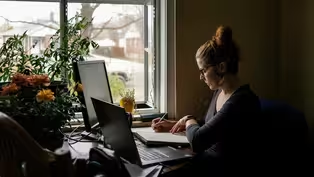
Preview: S4 Ep7 | 30s | A rise of digital nomads compounded Utah’s housing crisis. How to improve the situation? (30s)
Housing Shortage in Springdale
Video has Closed Captions
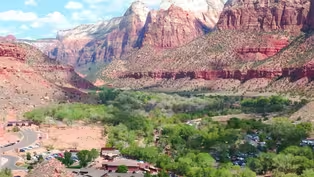
Clip: S4 Ep7 | 3m 28s | Learn how one Utah town is battling a housing shortage while preserving its unique charm. (3m 28s)
Providing Support for PBS.org
Learn Moreabout PBS online sponsorship
- News and Public Affairs

Top journalists deliver compelling original analysis of the hour's headlines.

- News and Public Affairs

FRONTLINE is investigative journalism that questions, explains and changes our world.












Support for PBS provided by:
Utah Insight is a local public television program presented by PBS Utah