
Diplomacy Expert Gives His Insight on the war in Iran
Clip: Season 4 Episode 336 | 6m 5sVideo has Closed Captions
A look at the diplomatic and economic stakes of the war with Iran.
We spoke with Dr. Robert Farley, a diplomacy, intelligence and national security expert at the Patterson School of Diplomacy at the University of Kentucky, about the about the economic and diplomatic stakes of the war in Iran and what he thinks it will take to end the conflict.
Problems playing video? | Closed Captioning Feedback
Problems playing video? | Closed Captioning Feedback
Kentucky Edition is a local public television program presented by KET
Diplomacy Expert Gives His Insight on the war in Iran
Clip: Season 4 Episode 336 | 6m 5sVideo has Closed Captions
We spoke with Dr. Robert Farley, a diplomacy, intelligence and national security expert at the Patterson School of Diplomacy at the University of Kentucky, about the about the economic and diplomatic stakes of the war in Iran and what he thinks it will take to end the conflict.
Problems playing video? | Closed Captioning Feedback
How to Watch Kentucky Edition
Kentucky Edition is available to stream on pbs.org and the free PBS App, available on iPhone, Apple TV, Android TV, Android smartphones, Amazon Fire TV, Amazon Fire Tablet, Roku, Samsung Smart TV, and Vizio.
Providing Support for PBS.org
Learn Moreabout PBS online sponsorshipLast night, the U.S.
Senate rejected a so-called War Powers resolution demanding a halt to the U.S.
military campaign against Iran unless it gets backing from Congress.
Kentucky's two U.S.
senators were split on the measure.
U.S.
Senator Mitch McConnell voted against the resolution backing President Donald Trump's right to launch the attack without congressional approval.
His Kentucky colleague, though Senator Rand Paul, voted for it.
He was the only Republican to vote yes.
The U.S.
House rejected a similar resolution today, 219 to 212.
Congressman Thomas Massie, a Republican from the fourth Congressional District, spoke out for the resolution.
He says the president's decision to go to war under these circumstances violates the U.S.
Constitution.
But he says there's more.
Beyond the constitutional question.
Here lies an even more important one why are we going to war with Iran?
We owe our military service members a clear mission.
And American families in my district want to know how this is going to help them pay for groceries.
How does this make them any safer in their schools or in their neighborhoods?
How does this help them pay for housing?
Americans are already feeling the economic pinch of the war, as prices at the gas pump have climbed more than $0.30 and expect prices to go up on other goods and services, says Doctor Robert Farley, a diplomacy, intelligence and national security expert at the U.K.
Patterson School of Diplomacy.
He recently sat down.
We recently sat down with us to find out more about the economic and diplomatic stakes of the war in Iran, and what he thinks it will take to end the conflict.
This is the most profound disruption in Iranian U.S.
relations, really, in the history of Iranian U.S.
relations.
So the United States has been preparing to use force against Iran for the past month and a half, two months.
We have been building up forces in the Gulf region and the surrounding countries.
These have been air forces.
These have been naval forces.
What triggered the specific moment for us to launch the conflict?
We received intelligence that the supreme leader of Iran, Ayatollah Khamenei, was going to be having a meeting with senior military and civilian leadership at his compound, his residential compound in Tehran.
We gave that information intelligence to the Israelis, and the Israelis launched a strike based on that.
That effectively started the war.
As we are learning more about how the war started.
It is feeling more and more as if we were not prepared to launch a war at this particular time.
And there are lots of indications of this.
The State Department was not prepared to evacuate American citizens, from the Middle East.
And now it is deeply chaotic as Americans are trying to get out.
And that includes government employees, State Department employees.
We were not militarily well prepared.
The deaths of the six U.S.
service members, the six soldiers in Kuwait were probably because of under preparation to receive an Iranian attack.
There was a friendly fire incident that shot down three American, F-15s off of Kuwait.
I think that the best analysis so far also suggests that that was the result of poor, poor planning and poor staff work.
That was probably came out of not being well prepared and not anticipating that the war was going to start on the day that it started for a diplomatic outcome.
It would be really, really helpful if the United States could clearly enunciate what it wants from this war.
We have talked about a number of different goals that we have in the conflict, from the extreme regime change to simply the elimination of Iran's nuclear and ballistic missile programs.
If we were able to settle on an outcome in the United States, which was less than regime change, that would mean that there would be some sort of diplomatic off ramp available.
How that would be undertaken.
And who would be the mediators is sort of up in the air at this point.
But the United States really has to determine that we're fighting for something less than regime change, because if it's regime change, the Iranians have absolutely no interest and no incentive to negotiate.
What I suspect may happen is that, as the weeks and months go by, as the United States runs out of munitions to strike Iran and as we run out of targets to strike Iran, we may sort of come to the understanding that we have to have some sort of diplomacy in order to end the war.
We don't want this dragging on forever.
We can't really afford to drag it on forever.
The economic damage to the United States and the rest of the world will be significant.
The United States does not by much Middle Eastern oil, but oil is a fungible commodity, which is to say that oil that goes one place is much like oil that goes any other place.
And so as oil prices go up and oil prices will go up because Iranian production is being taken offline, and because Iran has, purposefully attempted to disrupt the transit of oil through the Persian Gulf, through the Straits of Hormuz, oil prices are going to go up when oil prices go up, everything becomes more expensive.
That's not just gas, although that's the first thing that people notice.
And people probably already noticed that, their, local gas station has gone up 30, 40 or $0.50 over the past two days.
But it affects air travel.
The airlines are extremely dependent and extremely price sensitive, based on increases in oil.
Oil also goes into lots of other products.
Petroleum is a hugely important part of plastics, of, just about everything you manufacture.
It is, immensely important to the transport economy, which is to say that every truck that brings us something is a truck that depends on oil.
And so this war will drive prices up.
There's no there's no question.
And there's no way around it.
We appreciate Doctor Farley's insight.
In an interview today with Axios, President Donald Trump said he should be involved in choosing Iran's next Supreme leader.

Bill Gives Children in State Custody Full Federal Benefits
Video has Closed Captions
Clip: S4 Ep336 | 3m 41s | Bill creates program that sets aside federal benefits money for children in state custody. (3m 41s)

Bill Looks to Change Certificate of Need Law
Video has Closed Captions
Clip: S4 Ep336 | 3m 53s | State lawmaker wants to alter law she says keeps competition out of healthcare. (3m 53s)
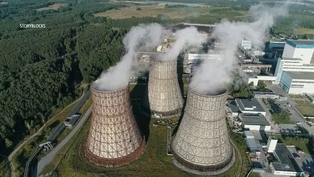
Kentucky Gets One Step Closer to More Nuclear Energy
Video has Closed Captions
Clip: S4 Ep336 | 4m 19s | Grants offered to get ball rolling on nuclear energy production in Kentucky. (4m 19s)

Kentucky Reaction to Firing of Secretary of Homeland Security
Video has Closed Captions
Clip: S4 Ep336 | 1m 34s | Kentucky's federal delegation reacts to firing of Kristi Noem. (1m 34s)
Providing Support for PBS.org
Learn Moreabout PBS online sponsorship
- News and Public Affairs

Top journalists deliver compelling original analysis of the hour's headlines.

- News and Public Affairs

FRONTLINE is investigative journalism that questions, explains and changes our world.












Support for PBS provided by:
Kentucky Edition is a local public television program presented by KET