
Director of Reentry Shares City's Efforts to Help the Formerly Incarcerated
Clip: 1/14/2026 | 7m 37sVideo has Closed Captions
Chicago's Office of Reentry is designed to assist people returning from prison.
Chicago's Office of Reentry is designed to create a holistic reentry process for people returning from prison. Joseph Mapp heads the office.
Problems playing video? | Closed Captioning Feedback
Problems playing video? | Closed Captioning Feedback
Chicago Tonight is a local public television program presented by WTTW
WTTW video streaming support provided by members and sponsors.
Director of Reentry Shares City's Efforts to Help the Formerly Incarcerated
Clip: 1/14/2026 | 7m 37sVideo has Closed Captions
Chicago's Office of Reentry is designed to create a holistic reentry process for people returning from prison. Joseph Mapp heads the office.
Problems playing video? | Closed Captioning Feedback
How to Watch Chicago Tonight
Chicago Tonight is available to stream on pbs.org and the free PBS App, available on iPhone, Apple TV, Android TV, Android smartphones, Amazon Fire TV, Amazon Fire Tablet, Roku, Samsung Smart TV, LG TV, and Vizio.

WTTW News Explains
In this Emmy Award-winning series, WTTW News tackles your questions — big and small — about life in the Chicago area. Our video animations guide you through local government, city history, public utilities and everything in between.Providing Support for PBS.org
Learn Moreabout PBS online sponsorshipPeople impacted by the justice system are the sole focus of Chicago's office of Reentry.
The office is tasked with providing access to services and investing in formerly incarcerated people, including housing, mental health services and job training and its leader Joseph Maps is out with the office's first year and report.
Joining us now is Joseph Map skews me one map, director of Chicago's Office of Reentry.
Howard, I'm loving this thing called life you.
I'm great.
Thank you for So when you visit this time last year, you are fresh on the job.
The office had been dormant for 3 years.
>> What were some of the challenges over this past year.
>> So one of the challenges worse, making sure we heard from the people who are at greatest impacted.
So we had to deliver Billy unintentionally me 30 community-based organizations meet with the Illinois Department of Corrections to talk to not only to staff, but those who are preparation for returning home with juvenile detention centers and also Cook County jail.
So just making sure we heard from everyone to inform this work was deliberate and sometimes paints stake the slow.
>> Among the highlights of this first to report that you just released yesterday are finishing an RFP for Chicago's first women focus Community Reentry, support center, raising the standard of care and accountability across city funded reentry, support centers and most recently, a $600,000 Micro Grant Program to help organizations expand their services.
Let's talk about some of those.
What are some of the unique challenges that women face when their re-entry necessary?
what we found is 75% of women who are incarcerated mothers to children 18.
>> So and we recognize and that's when they return home, then not only trying to stabilize to sales, but they're trying to stay family.
So that in itself is very important to being the son of a single one of the I recognized the struggles that women face without being incarcerated.
incarceration compounds that we want to make sure we're here to support that transition.
How long before we can see a center and in effect for those with best great the center will be open tomorrow.
rights.
It's about looking at everybody.
We're breaking news over here.
Okay.
So we're gonna come back to Have you been able to improve care and support at the city funded reentry centers?
Yes.
And our partnership with Department of Family and Supportive Services.
We have been working.
There million to reentry support centers that acted as hope.
What we did with these organizations was developed, protocols taken in has serviced and every we didn't did not want them just rest bag, transactional support, a transformational.
We want them to walk with individual student process recommended some that each individual situation is different and unique.
So what that means, that means, you know, adding additional staff with specific training or that were.
So expended just funding to CRA season.
What that looks like us.
We're created of collaborative ecosystem where not only will it be reliant on the CRA seasonal community-based organizations are partners and not solely that.
Just like you hear Mayor Johnson say all that.
I missed whole of government approach.
So we're bringing more city departments to the table to create pathways for individuals return.
And then there's the returning with Hope Micro Grant Program.
What kind of support is that providing?
So most importantly mental health support is normally stigma task and people who've been engaged in institutions, 10 try to separate from those structures.
We want to create a space where people can heal income team where we can introduce different modalities for that type of support and organizations have been doing this work.
This is not a new created.
initiative will what it is a way to support these organizations so that work can continue.
Tell us about that work.
I know we talked about this last time.
You're here.
You're formally formally incarcerated system impacted, served 20 plus years in prison.
What are some of the needs that that folks half when they return to community that these organizations are providing a meeting.
And so of the most important things you can offer tangible supports house and thoroughly needed.
You can offer workforce development and transitional jobs and even permanent placement.
But we think about emotional intelligence when we think about family reunification, we think about how the into personal skills to engage with people in ways that can help us be successful.
Even when people I've not treating us the most kind.
these are important because that supports job retention that supports family reunification and that supports community to build that.
That was a significant effort on our part.
There are 111 community-based organizations that offer reentry programming with 40 of those having engagement with your office.
>> What you think returning home in with 111 organizations working on this.
Right.
Like you think the problem would be, you know, fairly soft.
Why do you think returning home for from incarceration continues to be such a challenge for people.
>> So just keep this ideal seized Illinois Department of Corrections.
Population, at least 44% of that population returns to Chicago.
That's a large number one ideal see have really 16,000 individuals in one year.
organizations to 111 organizations to strive.
Entire asked to do this work need support.
And when you have a collaborative effort when you have ecosystem, now's supportive systems and do not go on to you last.
That's why my office worked with CTA public awareness campaign so we can make sure those returned to Chicago are aware of what services are available for.
>> How's your office?
Has you say you're incorporating input from the people who are system impacted into the work that you're doing?
Thank you for that question.
One of the first things my office has done was a conveyed this to be a committee.
That's a mixture of system impacted individuals and those that have been doing this work.
We recognize that the funds of knowledge rest throughout the city of Chicago is not one particular place that holds our wisdom.
So we lane into the support so we can make sure that informs the work and the direction that this office move today.
>> The General Assembly recently passed the Clean Slate Act during the veto session in this helps people to receive automatic records ceiling for certain offenses.
Of How's the city?
How's your office?
Working with state lawmakers to further support re-entry?
>> So thank you for that question.
We have individual, office, Hadley Levin, she's in charge of policy and she's building now.
She's working with the Mask Office policy team as well as community-based.
They coldest advocates we're meeting with alderman now so we can begin to address some of these challenges.
Dead may be a systemic and creating barris intentional or unintentional.
We want to remove those so we can and also sad that our partners in Art Circuit court have been working with partners and state's attorneys office.
Public defender's office.
We ensured that we work hard to make sure that everyone at the table.
Every voice is left up so we can approach this with it's.
>> It'And we're back to wrap things up right after this.
>> Reflecting the people and
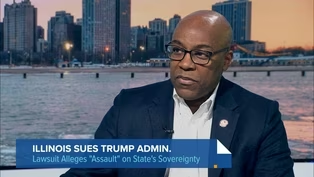
Illinois AG Kwame Raoul on Immigration Enforcement, Federal Funding
Video has Closed Captions
Illinois is locked in a series of legal battles with the Trump administration. (12m 42s)
Providing Support for PBS.org
Learn Moreabout PBS online sponsorship
- News and Public Affairs

Top journalists deliver compelling original analysis of the hour's headlines.

- News and Public Affairs

Today's top journalists discuss Washington's current political events and public affairs.












Support for PBS provided by:
Chicago Tonight is a local public television program presented by WTTW
WTTW video streaming support provided by members and sponsors.