
Cottonwood Connection
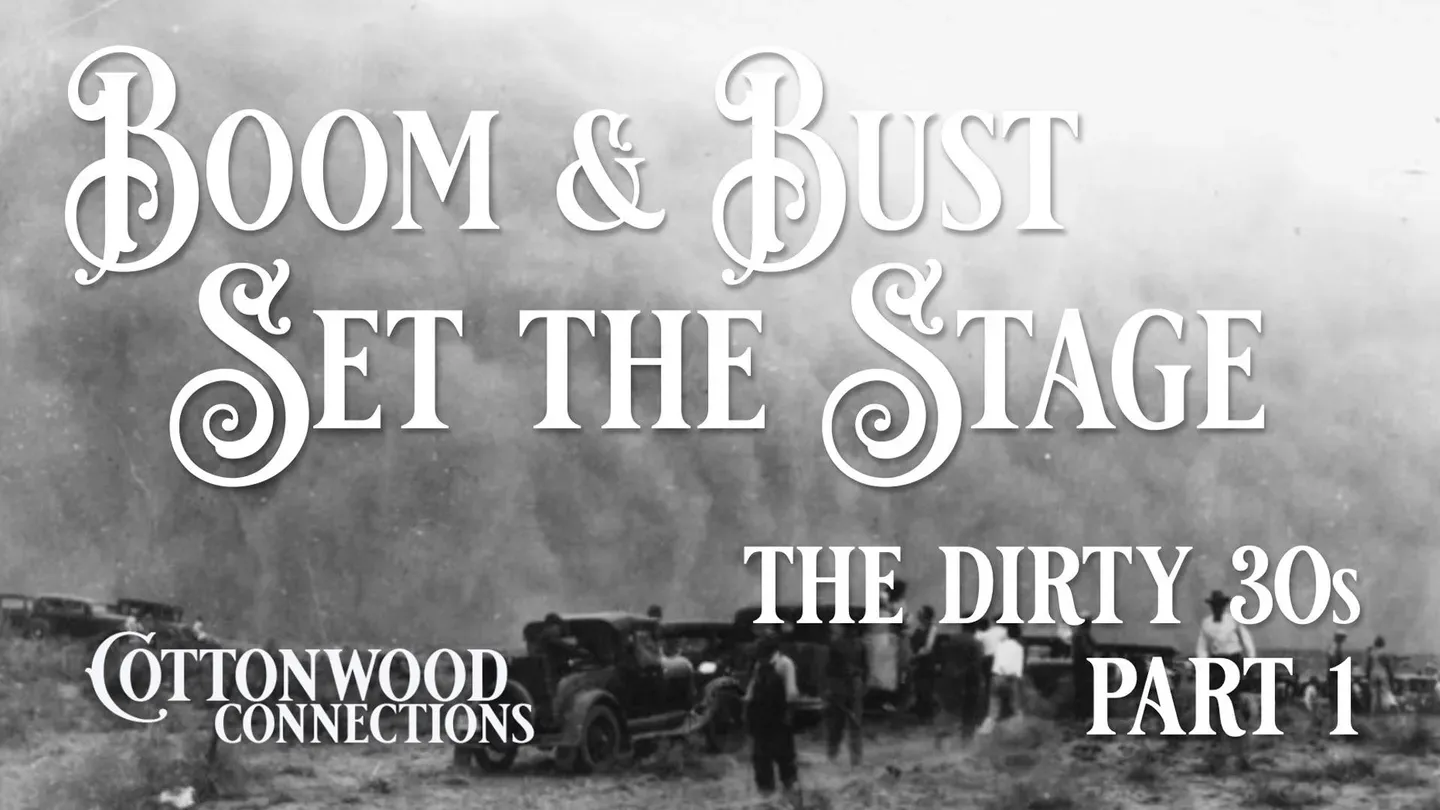
Dirty 30s: Boom and Bust Set Stage
Season 8 Episode 6 | 24m 50sVideo has Closed Captions
How the Roaring 20s came to a screeching stop. Part 1
In part one of a three-part series, we look at how the Roaring 20s came to a screeching stop and the country was plunged into economic distress and an agricultural crisis.
Problems playing video? | Closed Captioning Feedback
Problems playing video? | Closed Captioning Feedback
Cottonwood Connection is a local public television program presented by Smoky Hills PBS
Cottonwood Connection
Dirty 30s: Boom and Bust Set Stage
Season 8 Episode 6 | 24m 50sVideo has Closed Captions
In part one of a three-part series, we look at how the Roaring 20s came to a screeching stop and the country was plunged into economic distress and an agricultural crisis.
Problems playing video? | Closed Captioning Feedback
Where to Watch Cottonwood Connection
Cottonwood Connection is available to stream on pbs.org and the PBS app.
When weeks go by without a drop of rain on the plains, when fields are too dry to harvest, when the dust begins to blow, stories revive of a decade of depression and drought, a decade known as the Dirty 30s.
The Dirty 30s are a complex time that we will cover in three episodes.
Our host, Don Rolison, is joined by Kansas State Professors of History, Dr.
Andrew Orr and Dr.
Suzanne Orr, Professor Emeritus of Purdue University, Dr.
Douglas Hurt, author of Dust Bowl, An Agricultural and Social History, and actor and educator Nolan Sump in his characterization of a Kansas farmer of the 1930s.
How are you all doing today?
Well, I'd like to say I'd be doing better, but I'd be accused of lying.
I ain't doing well at all.
See, I woke up this morning and a duster blew in last night.
I sleep with the covers over my head so as to keep the dust out of my lungs.
So I left the mike and body out of bed.
I looked around and I saw about a quarter inch of a dust covering every item in the house.
So I made my way from the bedroom to the kitchen.
I looked back and saw footprints.
Well, I saw little footprints too, as for my daughter.
It was kind of cute, but I shouldn't have to see footprints in my own house after a duster like that or even have a duster.
But here it is, May 12, 1937.
What do I have to show for all of this?
Other than a couple of children, lovely wife, not much.
There's three episodes on the Dirty 30s and yes, a lot of it was wind and weather, but there's other factors that were involved.
The stock market crashed and prices dropped to two bits of bushel at the elevator because about that time we also had bumper crops of wheat.
Law of supply and demand, that's right.
That's what those economists call it.
When you get too much supply, there's not enough demand.
Prices drop.
So that's what happened to us.
Kansas' experience with the Great Depression is in some ways defined by how Kansas was settled and how Kansas' economy evolved in the 19th century.
Kansas has always been inextricably tied to back east.
The settlement of Kansas, bleeding Kansas, were extensions of conflicts happening in other parts of the country and broader phenomenon.
Kansas' economy is no different.
With the building of things like the transcontinental railways, Kansas became part of a national economy as it was being settled.
And that shaped agriculture.
People weren't growing food in Kansas to feed Topeka or Lawrence.
They were growing food to feed Chicago.
They were buying things made in Chicago and Boston and New York and Philadelphia.
And so when the larger American economy age changed, things would always have to change in Kansas too.
It was never its own separate thing.
It was always part of something bigger.
Often that was helpful.
When other parts of the country boomed, money flowed into Kansas.
Industrialization in the 19th century, it really picks up around the 1840s.
And it's influenced by the building of the railroads.
And it progresses through the late 19th century.
And more and more people are going to start moving from rural areas into big cities.
The population overall in the country is growing.
Kansas is, agriculture is going to help feed those cities like Chicago, New York.
Its economy is going to be tied to the northeast and to the Midwest.
Agriculture is becoming more industrial itself.
It isn't a separate thing from industrialized cities with big factories, but farms remain untouched somehow.
And there are going to be new inventions and equipment and mechanization that make much larger scale farming possible.
And gradually you see the shift from smaller subsistence family farms to larger agricultural production.
There is need for a lot of labor, but some of that labor becomes transient labor, as opposed to people staying rooted in one place on the land.
You get more people moving from place to place following harvest.
This is a time of a very rapid agricultural expansion in the southern Great Plains.
And it's largely technologically driven and it's driven by the price of wheat.
Between 190 9 and 1929, that period before the great collapse, you have the First World War, which escalates the price of wheat from what it had been of around a dollar in the early 20th century.
It's about the time of the Great War.
Gosh, wheat prices were $1.80 a bushel at the elevator.
Love to see that now.
I'd have to say, just like where I'm standing here on this front porch, I looked out and I could see a vast ocean that lay before me.
Not like the Pacific, of course, but more an ocean of wheat and how the wind blew.
And this grain just green and lush, just flowing with the wind.
It was a thing of beauty.
World War I has a profound effect on the American economy long before the U.S.
enters the war.
The war begins in the summer of 1914 in Europe.
The U.S.
doesn't get in until April of 1917, but immediately it starts shaping the U.S.
economy.
You can see it on an industrial level.
Britain and France make large-scale orders for things like ammunition, fabric, for uniforms, and a bunch of other things.
But they also need food because modern total war is insatiable with its literal hunger for calories.
You need a lot of food.
It takes a lot of calories to sustain a soldier fighting outside in an open air 24 hours a day.
And a lot of the food that was being grown in Europe was being grown by the men who have just been drafted to fight in the war.
And women take up a lot of labor, but women had been doing a lot of farm labor before, too.
And so you couldn't just call on women to replace men.
They'd already been doing a lot of the work.
And they only had so many hours in the day.
European food production struggles from 1914 on because of all the labor that is lost, but also because of secondary effects of military production.
Munitions ammunition and fertilizer are made from the same things, natural nitrates in 1914.
And so when Britain and France start mass production of artillery shells and bullets, they're pulling in fertilizer out of the farm economy.
They have less agricultural labor.
They have less fertilizer.
They make up that calorie gap by buying from the Western Hemisphere, especially from the United States, which means Kansas.
It was a good time to be a Kansas farmer during World War I that encouraged Kansas farmers to invest heavily in mechanization, to maximize per acre yields, and to bring inferior quality land into production.
The prices were high.
The wheat was at an exceptionally good price.
And also steam tractors were around.
And there's a lot of grasslands out in the high plains of Kansas and throughout Kansas.
It's very affordable to acquire land in this area that hasn't been settled and simply planted in wheat because the price is high.
That will change in 1919 though, when the war ends and European food production starts to grow.
The wheat price went down, but the farmers continued to grow wheat and they broke out more land.
And then it comes back up to about a dollar a bushel, which is marginally profitable throughout the 1920s.
So farmers complained about the price of wheat, but they could still make a living at a dollar a bushel.
So what do farmers do when the price drops?
They plant more wheat to make up in volume for what they lost in price.
They thought, well, the wheat price has gone down, so we'll plant more to make up for the loss because they were used to a net income that was pretty high.
And the only way they could think about it and that equipment they had is to tear up more land and do it.
So they tore up a lot of their grassland, the short grass prairie out here, which has changed the environment a whole lot.
And it's also a time in which the average precipitation rates are above normal.
So everything seemed to be perfect.
And we all know from living in that area or traveling through that area at different times of the year, you plant winter wheat in the autumn and it grows and it turns green.
And it's like Ireland.
It's just a beautiful green across the countryside.
And that wheat is like, it was like the grass, the native grasses.
You know, wheat has a very fibrous root system.
It goes down and it holds the soil.
So above normal precipitation, an agricultural crop that is bountiful and holds the soil and rich lands that can be planted, expanded, broken for more wheat, everything seemed to be a good deal for farmers that could make that investment.
The newspapers, they call it the roaring twenties.
Well, it definitely was because we had an abundance of rain.
We had wind that blew and helped ripen that wheat by the end of the decade with wheat prices at about a dollar a bushel.
It's going to be a right successful farmer.
Yeah.
It's a period that where this expansion is money driven so much so that if you had the credit or the capital to buy land, you could hire somebody to go plow your quarter section, your section, or your two sections, or your thousands of acres and put it in wheat.
And there's some people out there that, you know, they plowed and planted at night.
I mean, this is really a big business industrial scale kind of agriculture.
And then you can let it go and come back and harvest.
But suitcase farmers, this is, as an interesting group of entrepreneurs.
The definition is there's someone that owns this farmland that in order to work it till it planted, harvested, had to come in from somewhere else.
So they brought their suitcase and they stayed in the local hotel or something.
Sort of a flip side of the coin of that is sidewalk farmers.
People that lived in town owned property and they could go back and forth and they're relatively close.
Even as the 1920s economy, it has that image of roaring and easy consumer goods.
Access to them is one of the dominant images of the 1920s.
People get access to cars, for instance, widespread car use changes the country.
Now I have a good buddy of mine.
His name is Jake.
He's married to Jake and Martha.
Their names.
Well, he was doing quite well for himself.
He bought himself a Ford Coupe.
Had a rumble seat in the back.
So we decided we go on this double date.
So Esther and I, we sat in the back and Jake and Martha sat in front.
We went to this picture show there in Elkhart.
But at the same time, rural areas don't experience the boom equally as a lot of urban areas do.
Not everyone is making as much money.
So for instance, for a family to have a car in an urban area, the average family would spend anywhere between 25 to 45 percent of their yearly income to buy a car.
For the average rural family, it was 100 percent of their income.
And so you can see the difference in how much money people actually had.
Those consumer goods were things that people absolutely wanted.
Buying a car is especially desirable for people in rural areas, but it has a different meaning when it's 100 percent of your yearly income to be able to purchase something.
So even though the 1920s were roaring, they weren't roaring the same way for everyone.
But the 1920s are really a period of considerable expansion of the tractor industry, for example, John Deere and Farmall, particularly trying to build implements that are affordable and meet the needs of these farmers.
During the 1920s, you have a economic cycle in Europe that's complicated.
At the beginning of the 20s, you have a severe dislocation that looks a lot like the U.S.
except worse, because the end of World War I has destroyed the Russian Empire, brought the Bolsheviks to power, the communists there.
It destroyed the Austro-Hungarian Empire.
You have a whole series of brand new countries.
Often, their economies are in shambles because they used to be part of one big state.
And now, the factory is in a different country from where the raw materials come from, and both are in a different country from the consumer market they used to sell to.
It takes years to rebuild these supply chains, rebuild these markets.
By the mid-1920s, though, Europe has become a driver of global economic growth again.
By, say, 1926, Germany is growing extremely fast, is one of the wealthiest per-capital places in the world, and it is soaking up global consumer goods.
It's booming.
It's buying American goods.
It's buying American food.
Europe is a major market for American agriculture and American production in the mid-1920s, and it helps sort of sustain the boom of the mid-1920s for the parts of America that fully participated.
But that driver from Europe is part of why the Depression is going to bite so hard when it finally emerges.
Yeah, the overall economy of the country was doing very well.
The danger is that people thought it would never end, and the economic cycles swing back and forth.
Part of the problem, too, is there's an increasing surplus of wheat.
And so the price is variable.
In 1929, with the general economic crash, it collapses in the central Great Plains, southern Great Plains, and well for wheat farmers everywhere, but particularly bad for this dustbowl region.
By 1932, the price of wheat had dropped around 30 cents a bushel, 32 cents a bushel on some local markets.
And that's a catastrophic loss of income for paying your mortgage.
Perhaps you had incurred to buy more land during the 1920s.
It causes problems for people that bought equipment and tractors that maybe now can't easily meet those payments.
So it's a time in which the capitalist investment of the 20s became one of, not boom, but really a bust economy.
And farmers are not able to make quick adjustments to this, particularly if you're a one-crop farmer and this is your chief source of cash income.
Even though they were doing some other things, wheat was really the bottom line for the farmers that lived in that part of the country.
We still can't decide what in the world caused the Great Depression.
We have an awful lot of explanations, and there is no single answer, because historians in the U.S.
have a set of answers, but they're not the same answers that historians in Britain, France, Germany, or Eastern Europe have.
The Depression is almost so big that it's impossible to fully explain, because it looks different in different places, and every country's national answer reflects how the Depression came to them.
In the United States, the economy was growing rapidly in the 1920s, and it was growing at a rate that wasn't really sustainable.
And before the crash of the stock market in 1929, there were signs that the economy was slowing down.
That demand for consumer goods was starting to drop off.
It was a sign that this growth wasn't sustainable, but people didn't really believe it at the time.
They ignored those markers.
There were also changes in how people were investing, because with the stock market growing so much, it really creates this incentive for people to want to participate.
And they will start buying stocks on margin, basically buying stocks with borrowed money, which is a risky investment practice.
And there are going to be a lot of new people engaging in the market for the first time.
And this combination of risky investment practices and an economy that's showing some signs of faltering, those are things that are going to probably contribute to that 1929 crash.
But even when the crash happens, there's still fundamentally a belief that it's going to be temporary and that the economy is actually stable.
There was this desire to believe that things were still sound.
And if maybe the government could help by managing the economy better, it would lift the nation out of this temporary slump.
The collapse is really relatively quick in terms of dust blowing.
But I guess one could say that the economic collapse was sort of a slow bleed through the 1920s.
Farmers were hanging on.
They're unhappy about conditions.
They want the federal government to do something.
No one was quite sure what, but they knew that farmers couldn't save themselves.
The problem is bigger than an individual can handle.
But this is a period in which the precipitation rates in the southern Great Plains are about normal.
You're going to start seeing some dry conditions, about 30 and 31 particularly.
But it's still a bountiful era and area, and that's the problem.
Farmers are raising too much wheat.
The conditions are right to do so.
And they don't have very much money in their pocket books.
Then while they're balancing this matter of income decline and surplus production, the climatic conditions start to waffle and merge into drought conditions.
I figured I'd get through this because the next year and seven years ago in 30, it was we had decent crop.
And then 31, well, it just seemed like the Lord Almighty just decided to turn off the faucet.
In the summer of 31, you can really start to see this in the southern Great Plains.
The summer rains just aren't quite what they were.
Farmers are back in the field in September, October, and they plowed their stubble and they're planting their wheat crop.
And things really start to get dry through that autumn.
And after that nice harvest, I just couldn't get anything in the ground to get it to really grow.
So those plants don't grow and mature.
They're kind of scraggly.
And you just don't have the plants that cover the soil that are going to hold that wind down.
Well, you've got, say, a million acres of natural grass plowed under.
And if you plant it with wheat, but if it doesn't grow, you've got a lot of bare soil or near bare soil there.
And then those prevailing winds that we know about can easily lift that soil.
When it got dry and the wind kept blowing, you don't have the wheat to hold that soil in the ground.
The soil just started lifting up.
And as it kept going, you get these dusters rolling through.
By January of 32, you start to see some dust storms in the Texas Panhandle, Oklahoma panel, this Liberal area of southwestern Kansas.
People were starting to become very much aware of this in the early spring of 1932 as a result of that drought period from 1931.
And then it just gets worse after that.













Support for PBS provided by:
Cottonwood Connection is a local public television program presented by Smoky Hills PBS