
Discovering the Artistry of Science, Public Art & Hilltop
Season 9 Episode 12 | 28m 45sVideo has Closed Captions
Dive into the world of generative design, public art transformations & jam band, Hilltop.
We venture into the fascinating world of generative design at Nervous System, where science, art, and technology intersect to create unique patterns and products. Discover the captivating story of Troy Art Block, a dynamic public art initiative by The Arts Center of the Capital Region that revitalized downtown Troy with murals and community engagement. Plus, groove to the tunes of Hilltop.
Problems playing video? | Closed Captioning Feedback
Problems playing video? | Closed Captioning Feedback
AHA! A House for Arts is a local public television program presented by WMHT
Support provided by the New York State Council on the Arts (NYSCA), M&T Bank, the Leo Cox Beach Philanthropic Foundation, and is also provided by contributors to the WMHT Venture...
Discovering the Artistry of Science, Public Art & Hilltop
Season 9 Episode 12 | 28m 45sVideo has Closed Captions
We venture into the fascinating world of generative design at Nervous System, where science, art, and technology intersect to create unique patterns and products. Discover the captivating story of Troy Art Block, a dynamic public art initiative by The Arts Center of the Capital Region that revitalized downtown Troy with murals and community engagement. Plus, groove to the tunes of Hilltop.
Problems playing video? | Closed Captioning Feedback
How to Watch AHA! A House for Arts
AHA! A House for Arts is available to stream on pbs.org and the free PBS App, available on iPhone, Apple TV, Android TV, Android smartphones, Amazon Fire TV, Amazon Fire Tablet, Roku, Samsung Smart TV, and Vizio.
Providing Support for PBS.org
Learn Moreabout PBS online sponsorship(bright music) (bright music) - [Matt] Visit a design studio that works at the intersection of science, art, and technology.
Learn about The Arts Center for the Capital Region's public art project, Troy Art Block, and catch a performance by Hilltop.
It's all ahead on this episode of "AHA!
A House for Arts."
(bright music) - [Announcer] Funding for "AHA!"
has been provided by your contribution and by contributions to the WMHT Venture Fund.
Contributors include, the Leo Cox Beach Philanthropic Foundation, Chet and Karen Opalka, Robert and Doris Fischer Malesardi, and The Robison Family Foundation.
- At M&T Bank, we understand that the vitality of our communities is crucial to our continued success.
That's why we take an active role in our community.
M&T Bank is pleased to support WMHT programming that highlights the arts and we invite you to do the same.
(bright music) - Hi, I'm Matt Rogowicz, and this is "AHA!
A House for Arts," a place for all things creative.
I recently took a trip down to Palenville, New York, to step inside a generative design studio called Nervous System, where computer simulations of natural phenomena are used to generate everything from earrings and puzzles to vascular networks for 3D-printed organs.
(bright music) - Nervous System is a design studio that works at the intersection of art, science and technology.
Our work is very inspired by how nature creates patterns.
So we look at a lot of the science and mathematics behind how patterns are formed in nature, like how does coral grow, how do veins form in leaves?
And then we use those mathematical algorithms to grow products and artworks.
- I'd say our medium is really more code and software than any material.
We create systems that can create a myriad of unending forms.
- So everything that we make, whether it's 120 foot tall sculpture, or a microscopic 3D printed organ, is based on code that we write.
(gentle music) If you look at a tree outside, every leaf on that tree is different.
They're generated by the same growth process, but there's a variety to the forms where every one comes out unique.
We wanna have that same type of variety in our work.
Let's say we're making a jigsaw puzzle.
Every single jigsaw puzzle that we make is different, to have the different image, a different set of pieces to it.
For our work on leaf venation specifically, we read a lot of scientific papers about how do veins form in leaves, and there's normally not a clear cut answer.
So there's a lot of scientists who have theories, and they've written up those theories, and then we sort through the research, and find one that may be a good tool for us to use in design.
So we found a specific paper written by a guy named Adam Runions, that was built on a theory called auxin flux canalization, and he had a rudimentary algorithm already written out.
So we adapted that, and created our own software based on that, and that allowed us to use it for design.
We used it to grow a collection of 3D printed lamps.
Each one is unique like leaves on a tree.
And then also we have a jewelry collection that's based on the same thing.
(bright music) There are certain projects that our studio is very known for, one of which is a 3D printed dress.
Our kinematics dress project is a project that's all about thinking about new ways to make custom fit clothing.
So it's a completely 3D printed garment, that comes outta the machine ready to wear, which is made from a 3D scan of your body, and co-designed by you.
So it's a project where we're working with new fabrication methods.
We're working with software that allows you to design clothing in 3D.
- And then you're designing something which is much bigger than your typical 3D printer.
So one of the cornerstones of the project is we design this garment in 3D, and then we digitally fold it into a smaller configuration that fits inside the printer, and then it comes out in one single piece, just unfolds and is ready to wear with no assembly.
(bright music) We collaborated with scientists at Rice University working on creating 3D printed organs, structures that are smaller than a dime.
We collaborate with them designing vascular systems so... - Blood vessel networks basically, but also air networks.
One of the organs that we worked on the longest is the lung.
So in the lung, you have networks for air, and network works for blood that are interpenetrating and work together, to oxygenate blood.
So the project was pretty fun to work on, just because it's really interesting.
Our work is very inspired, as we said, by how patterns emerge in nature, and specifically in biological systems.
So it's really neat to be able to take our algorithms and put them back into biology, and see structures that we generated, and grew actually have blood pumping through them, and being used in a scientific study.
A photo of the structure we designed appeared on the cover of "Science" magazine, which is a huge milestone for us, to have our work as designers recognized also in the scientific world.
- This research is also very long term.
There's so many steps, and it's many, many years of research ahead, before putting 3D printed organs in a person is a real thing.
(bright music) A recent project that we did, was creating a sculpture that is currently at the Albany airport.
- It's called "Corollaria Gyroid," and it's based on a mathematical surface called the gyroid, which was discovered by a guy named Alan Schoen at NASA in the 1970s.
When Alan discovered it, he first thought it was purely just a mathematical, abstract idea that he had come up with, but later they discovered that it actually occurs in nature, inside of butterfly wig scales.
- We had the opportunity to meet Alan Schoen last year, which was really great, and we made a version of this sculpture in wood for his university.
That evolved into this latest piece, which is the evolution of that sculpture.
And rather than making it in wood, we're making it in a much more permanent, durable material of aluminum.
(gentle music) - People frequently ask us, where do we see Nervous System going?
"What are you gonna be doing in 10 years?"
And the answer is, we have absolutely no idea.
That isn't the way we operate the studio.
We just go where our interest takes us, and we get certain opportunities and we follow those.
- We just do what we do, which I guess is art.
It's really just about exploring ideas that excite us.
(gentle music) - The Arts Center for the Capital Region, recently produced a new open air gallery event, The Troy Art Block, where artists temporarily transformed two blocks of downtown Troy.
Jade Warrick spoke with The Arts Center's, Judy Gilmore and muralist, LO Pador Luce, to learn more.
- Judy, I wanna ask you the first question.
First, I wanna give the audience, what's a little bit of your creative background.
- Sure.
Thanks for having us.
My background, I'm currently the Director of public art, and placemaking at The Arts Center of the Capital Region.
I've been there about a year, but I've been in the public art field for over 20 years.
- Wow.
- Which is crazy.
And I started that work at NYU, I moved to Philadelphia where I worked for the mural program there, and I still do a lot of work for them.
So I'm very connected to that program, which is amazing.
And then I moved here, and one of the first projects I worked on in this region, was Breathing Lights, which was a very large, regional public art program, funded through the Bloomberg philanthropies, and incredible opportunity for me to get to know local artists.
But after that I was hired by the City of Troy and The Arts Center to create the master plan for public art for the city of Troy.
And that's where I really started thinking about public art, in the context of Troy specifically.
And so that was a project where over a year, a consultant friend and I talked to over a thousand people in Troy, to really see what folks in Troy wanted to see in terms of art and how art could really help in Troy specifically.
And one of the resounding answers we kept getting from people was murals, more murals.
Why aren't murals happening in Troy?
They're happening in Glens Falls or Albany.
Fast forward five years, and a year ago, The Arts Center received two really large grants, one from the state of New York, through the Downtown Revitalization Initiative, and another grant through the City of Troy, through the American Recovery Plan Act, ARPA, for just public art.
And so we could really start to implement some of these things that came out of the plan.
So when I started about a year ago, there was some really cool things already happening, but we really wanted to think about, how we could start a mural program, that was a little different than what was happening in other cities in the region.
So we started doing research, and we came across a program in Oklahoma of all places, which isn't really known for public art, but once we started looking, there was an incredible program down there called Plaza Walls and Liz Reese, the Director of The Arts Center, and I traveled to Oklahoma to see this program in action.
And we went to Tulsa, to Oklahoma City, and to Miami, Oklahoma, which is right on the the edge of the Cherokee reservation, and saw what they had done, which has rolled out this statewide mural program, starting in Oklahoma City, with a program that basically created an arts district with temporary murals.
And we just were like, this is exactly what Troy needs.
- This is what we gotta do.
- Exactly.
- Which is Troy Art Block.
- Exactly.
So we came back and we said, "We wanna do this, we wanna call it Troy Art Block."
We started looking for a location, and we settled on Church Street.
And fast forward a few months later, on October 14th, after a week of working with 29 artists, including Lowe and tons of business owners and partners, we've created an open air gallery, in two blocks in downtown Troy with 29 murals.
And it's just been an incredible journey, and now we're really excited to program that.
- Oh, heck yeah.
And I love it.
It's beautiful.
And LO, you're one of the muralist artists.
Give us a brief background of your creative endeavors, or who are you as an artist, and then how did you find this project?
- So my art career actually is very recent, and I would say that my art has been woven into my life, and story in pieces.
But it wasn't until recently that I started to work on it.
I actually found the Detroit art block, in a very unexpected way.
Actually, my grandfather passed about two months ago, and it was actually the funeral, the evening of my grandfather's funeral, that I found I just, I couldn't sleep.
I found it on my phone, I was scrolling, and I came upon the application, and it shows also the application.
It's so welcoming.
So I was like...
I wasn't even thinking, I just started applying.
And I've never applied for anything art related before.
So I just started, and a couple weeks later, a month later, I got an email from Judy I think.
And I was just like, "Wait, this is actually happening?"
And going back to my art career, which has only been a couple years honestly, I have been diving into different types of media.
I would call myself an interdisciplinary artist, meaning that I use various disciplines, and connect them together relationally.
And I feel like they affect each other.
So I've done things from installations recently, and to paintings and I've done sculpture, and furniture design and things like that, in my creative process and research.
But by the grace of God, I found my path, and purpose through it all.
- That's amazing.
And as an emerging artist, how has art been fulfilling to this current journey of yours?
- Specifically through this season, for me, it's definitely been healing for me.
And I say that in a way, that it's allowed me to discover more about myself, and beyond myself.
And it's been wonderful to see art is truly a gift.
- It really is.
- And knowing that, and living it out is a whole other feeling, and a whole other...
I can't even explain how it's changed my life.
- Hey, I get that.
I feel the same way.
I really do.
And Judy, this project was huge, 29 muralists.
So what were some of your challenges with this?
- I mean, it was huge.
I think the biggest challenge was how quickly we had to move once we got our locations.
So it was all the normal logistics, but it was just moving so quickly, and really wanting to keep the integrity of the project, which was not just to get the murals up, but to make sure that we were creating a community for the artists.
The Arts Center has a mission about teaching, and so it wasn't just to get the murals produced, but to create a community, and to really create mentorships among the artists.
So we were very thoughtful from the application process onward about how to make the experience for the artists, as well as for a future audience.
And so we did things like make the application process easy.
We wanted to curate where the artists were gonna be, so that they could be mentored by some of the artists, who had been doing this a lot longer.
And quite honestly for me, one of the biggest challenges was to just let artists do what they wanted and not have to pre-approve... - Freedom.
- Their images, yeah.
To give them that freedom and we had to do that, because when it's moving so quickly, we wouldn't have time to approve 29 artists' concepts, nor would we want to get in the middle of building owners approving those.
And so what again we had, we'd learned from the Oklahoma program, was to give artists that freedom to go off of their portfolio and to really trust them to show up as their best selves and see what they create.
And that was for me, very challenging as a curator, but sometimes, a good curator just gets outta the way.
- Yeah.
- And I think facilitates the magic that the artist can bring to the project, which is I think what happened.
- That's amazing.
And besides an accessible application, what were some other ways you supported artists throughout this project?
- Sure.
I mean, we tried very hard to make sure that we were in communication with artists, that we made sure that they felt thanked, and it wasn't transactional, that they felt like what they were doing was really more about giving to the city their incredible gifts.
So I think just setting the stage, for making sure it didn't feel transactional, like sometimes work for hire can.
We had a big thank you dinner for the artists.
And again, I think we just tried to create, somewhat of a community so that artists could get to know each other.
And I think one of my goals is to really start building that connective tissue among artists so that public art isn't just about making spaces beautiful, it's about creating a real desire in this region for more art in more places, and to let artists be change makers, and leaders in some of the biggest, exciting things happening.
So just trying to create that connective tissue.
- That's really, really important.
I would think you would agree as well, right?
Yeah.
So LO I have a question for you.
What was your highlight of this project?
Hearing all the positive things you have to say, I wanna know your golden moments.
- There's a lot.
There's a lot.
This is my first mural, first.
- [Jade] Wow.
- That's a big highlight for me and my career, my life.
- And it's beautiful.
- It is.
- Thank you so much.
- It's one of my favorites.
- Thank you so much.
One of the major highlights I would say is the mentorship, and the friendships that I've gained.
I joke about it, I mentioned that it felt like I was at camp, mural camp, and all these artists came together, and we became friends for the week, and then it got sad and we had to leave, and say goodbye to each other.
But it was so wonderful.
I learned so much from so many, artists, so many people, that are in the community in general.
And also the people coming by, and walking by that are part of the community itself.
I think it's such a beautiful thing because I had just moved here.
I used to live here, I moved back, and it was wonderful to see the connection, 'cause I was craving that connection with the community again.
And also the art community.
So it was, match made in heaven, perfect.
So getting to talk with people in the community, and how it's affecting them, it was a wonderful thing to hear.
And lastly, the creative freedom.
The creative freedom that we got to express.
Since, like I said, it was a healing process for me, and getting to like lay it out there.
This is my first piece I got to create since I moved back.
So it's been six months.
So first personal piece, and what an honor that it was at Troy Art Block.
- Yeah.
You're leaving your mark in your place that you hopefully love.
Troy's great.
I love it.
It's very artistic, and I do appreciate all the work all these organizations, are doing locally to foster a community of creatives.
That's so important for me specifically as an artist.
And I know it's very important for you both.
So before we wrap up, what's some stuff you both have going on, Judy?
What's going on at The Arts Center that you want audiences to know about?
- Well, we're doing two really big planning processes, with both communities in south Troy as well as Lansingburgh, which are outside of downtown, both of them to do public art in neighborhoods as well.
And so we're really excited to roll those out next year.
- That's amazing.
What about you LO?
You got anything going on that you want the audience to know about?
- I have a couple personal projects that'll come up soon, hopefully.
And right now I'm actually focusing a lot of writing, and also illustrating for children's books.
- Oh, yay.
Children's books.
Yes.
We have to sit and talk about that.
I want to try to do the same thing.
Well, thank you both for sitting down and speaking to us, and really giving us some background on that amazing project.
Thank you.
- Thank you.
- Thank you so much.
- Please welcome, Hilltop.
(bright music) ♪ Keep so close to nothing when we're going way too fast ♪ ♪ Find our way to something if we just dig up the past ♪ ♪ Made for sunshine and we got rain ♪ ♪ We'll be there by nighttime but it just might be the same ♪ ♪ For worse or for better it's still the same ♪ ♪ If we were together we'd ease the pain ♪ ♪ No matter the weather ♪ ♪ If it rains we'll make our own sunshine today ♪ (bright music) ♪ Finally here now and it feels fine ♪ ♪ All of our days fall into rhyme ♪ ♪ You may not like it and that's okay ♪ ♪ Because with love we'll find our way ♪ ♪ For worse or for better it's still the same ♪ ♪ If we were together we'd ease the pain ♪ ♪ No matter the weather ♪ ♪ If it rains we'll make our own sunshine today ♪ ♪ Push the clouds away ♪ ♪ Gonna shine we're under the sun ♪ ♪ Push the clouds away ♪ ♪ Gonna shine we're under the sun ♪ (bright music) ♪ For worse or for better ♪ ♪ It's still the same ♪ ♪ If we were together we'd ease the pain ♪ ♪ No matter the weather if it rains ♪ ♪ We'll make our own sunshine today ♪ ♪ We'll make our own sunshine today ♪ ♪ We'll make our own sunshine today ♪ ♪ We'll make our own sunshine today ♪ (bright music) ♪ Lost in reverie ♪ ♪ Normal life is now a memory ♪ ♪ Whispers echoing ♪ ♪ To find your start and know it's there for free ♪ (bright music) ♪ Life has what you seek ♪ ♪ Climb that hill until you get a peek ♪ ♪ Patience is the key ♪ ♪ Nothing worth your time comes easily ♪ ♪ Something is telling me nothing is truly free ♪ ♪ Truth and reality ♪ ♪ Are not what they used to be ♪ ♪ I'm going to the sea ♪ ♪ Nobody's stopping me ♪ ♪ I'll be what I want to be ♪ ♪ If I want to see if I believe ♪ (bright music) ♪ Waking from the dream ♪ ♪ Realize what I have in front of me ♪ ♪ One night is all I need ♪ ♪ One more night and dream's a legacy ♪ ♪ Something is telling me ♪ ♪ Nothing is truly free ♪ ♪ Truth and reality ♪ ♪ Not what they used to be ♪ ♪ I'm going to the sea ♪ ♪ Nobody's stopping me ♪ ♪ I'll be what I want to be ♪ ♪ If I want to see you've got me ♪ (bright music) ♪ I'm going to the sea ♪ ♪ Nobody's stopping me ♪ ♪ I'll be what I want to be ♪ ♪ If I want to see if I believe ♪ ♪ I'm going to the sea ♪ ♪ Nobody's stopping me ♪ ♪ I'll be what I want to be ♪ ♪ If I want to see if I believe ♪ (bright music) (bright music) - Thanks for joining us.
For more Arts, visit wmht.org/aha, and be sure to connect with us on social.
I'm Matt Rogowicz.
Thanks for watching.
(bright music) - [Announcer] Funding for "AHA!"
has been provided by your contribution and by contributions to the WMHT Venture Fund.
Contributors include, the Leo Cox Beach Philanthropic Foundation, Chet and Karen Opalka, Robert and Doris Fischer Malesardi, and The Robison Family Foundation.
- At M&T Bank, we understand that the vitality of our communities is crucial to our continued success.
That's why we take an active role in our community.
M&T Bank is pleased to support WMHT programming that highlights the arts and we invite you to do the same.
Hilltop's 'Sunshine' Live Performance
Video has Closed Captions
Clip: S9 Ep12 | 3m 56s | Hilltop performs their song "Sunshine" live. (3m 56s)
Hilltop's 'To the Sea' Live Performance
Video has Closed Captions
Clip: S9 Ep12 | 4m 17s | Hilltop performs their hit "To the Sea" live. (4m 17s)
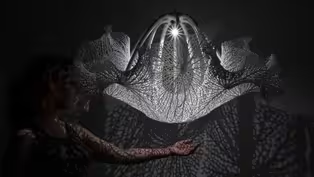
Nervous System Studio Bridges Art, Science, and Tech
Video has Closed Captions
Clip: S9 Ep12 | 6m 16s | Discover Nervous System, where art, science, and technology converge to create 3D designs. (6m 16s)
Troy Art Block Transforms City Into An Open-Air Gallery
Video has Closed Captions
Clip: S9 Ep12 | 11m 1s | Discover Troy Art Block's captivating public art transformation. (11m 1s)
Providing Support for PBS.org
Learn Moreabout PBS online sponsorship













Support for PBS provided by:
AHA! A House for Arts is a local public television program presented by WMHT
Support provided by the New York State Council on the Arts (NYSCA), M&T Bank, the Leo Cox Beach Philanthropic Foundation, and is also provided by contributors to the WMHT Venture...