
Discrimination Financial Assistance Program
Clip: Season 2 Episode 116 | 5m 29sVideo has Closed Captions
In the past, the Department of Agriculture discriminated against up to 50,000 farmers...
In the past, the Department of Agriculture discriminated against up to 50,000 farmers. Now the USDA is making up for that with the Discrimination Financial Assistance program.
Problems playing video? | Closed Captioning Feedback
Problems playing video? | Closed Captioning Feedback
Kentucky Edition is a local public television program presented by KET
Discrimination Financial Assistance Program
Clip: Season 2 Episode 116 | 5m 29sVideo has Closed Captions
In the past, the Department of Agriculture discriminated against up to 50,000 farmers. Now the USDA is making up for that with the Discrimination Financial Assistance program.
Problems playing video? | Closed Captioning Feedback
How to Watch Kentucky Edition
Kentucky Edition is available to stream on pbs.org and the free PBS App, available on iPhone, Apple TV, Android TV, Android smartphones, Amazon Fire TV, Amazon Fire Tablet, Roku, Samsung Smart TV, and Vizio.
Providing Support for PBS.org
Learn Moreabout PBS online sponsorshipIn the past, the Department of Agriculture discriminated against up to 50,000 farmers.
Now, the USDA is making up for that with the Discrimination Financial Assistance Program.
One group is making sure farmers here in Kentucky are getting the support they need as they go through the application process.
The Discrimination Financial Assistance Program is a $2.2 billion program for farmers who face discrimination in farm loan programs prior to 2021.
This discrimination can be proven by documentation for those who do not have the documentation.
Either they've lost it over time or in some instances there was no documentation established.
Those farmers have the opportunity to tell their story.
I'm a third generation farmer.
This will be 70 years that my family has stewarded and maintained this land.
We were sharecroppers for the majority of it.
It was just perfect to be able to come back and buy something that my family's already put their blood, sweat and tears into.
That loan process was a little bit different than what I remember as a child, or what I've heard from other people.
So completed every task that they needed me to.
As far as the loan goes, just like you would do approval at a bank.
But then I was denied a request because my property wasn't zoned correctly.
So that was a whole consortium of different problems where I had to talk to the field office in Washington, D.C. to get approval, stating that there should be no issue.
But my field office said that was an issue per the loan requirements, which later found out there was none.
I also asked my city.
They said they had no arguments against it, that it could be approved.
So that's how long my fight with that to where my loan got pressed back and I missed opportunities to grow that season.
Very frustrating.
Was very time consuming money wise too, because you still got to work, but you got to meet these quotas and you got to meet this time and you're trying to balance all that and you're looking to have contractors come in and start clearing out some of the land, cutting down trees.
But you can't own the land yet.
So you're stuck in between this limbo where you put money into it.
And so you start your investment into this lifestyle that I grew up with.
But at the same time, I'm not seeing the return because I can't finish the rest of the process to do so.
The discrimination is not only based on race, it also includes gender.
It includes different protected classes.
We've had a lot of veterans.
Veterans who who either went off to Vietnam and came back and needed to get loans to keep their farms going.
Where there were times in their narrative that some of the other landowners around them were in collusion with USDA officials to to not help those veterans get the loans that they needed because the larger landowners wanted to swoop in and take their land.
In Kentucky, we were partnered with black soil and they have membership.
These local groups have memberships where we're able to reach into the farmer community.
Here right now and the Kentucky office.
It also serves as the black soil fulfillment center.
Many times when farmers are coming into the fulfillment center, they're either delivering their seasonal produce or their local meat.
So that also gives us an opportunity to open up the conversation around the fab program.
A lot of times we're able to help you piece together your story.
Sometimes the incidences have happened so long ago that the documentation isn't there, that the person that they had the experiences with perhaps are no longer with the agencies or no longer living.
And so it is our goal as the technical assistance support to really ensure that Farmer has the confidence that they need to complete their application.
A lot of farmers know a lot of their stuff was never capped and receipts when they go to the office and ask for apply their applications lost so they never got to reapply an application.
They help me find some of my paperwork that I needed to and request that.
So what they're doing is key because it's people that's from this community that know these farmers and know how to get to that information or make sure they get that information for them.
It is very hard to truly calculate the total cost of these losses.
There are some that are social, there are some that are, you know, physical in regards to the toll that it takes on people's mental health.
But more than anything, a collective depressive feeling of how do you recruit people into becoming a farmer, wanting to get excited about growing food or owning land when this is the uphill battle that they see so many around them experiencing?
So why would I want to pursue that?
So I really think it causes the loss of a deeper pipeline of individuals wanting to participate in agriculture.
I'm thinking of so we can eat them.
Don't give up because almost did.
Although it's in my blood, it was just a headache to go through that.
But I wouldn't trade it up for nothing because once you achieve and you get your process going and you got your land, it's it's glorified.
Farmers who qualify could receive up to $500,000, depending on the number of applicants.
The deadline to apply is January 13th, 2024.
Video has Closed Captions
Clip: S2 Ep116 | 3m 42s | Paris honored veterans Wednesday with Bourbon County High School students and the band... (3m 42s)
Inside Kentucky Politics (11/9/23)
Video has Closed Captions
Clip: S2 Ep116 | 7m 18s | A look at the latest news in Kentucky politics. (7m 18s)
Video has Closed Captions
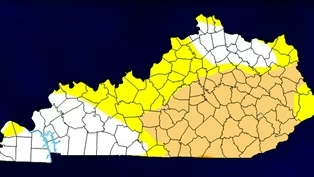
Clip: S2 Ep116 | 14s | The wildfire situation isn't being helped by our current drought. (14s)
Video has Closed Captions
Clip: S2 Ep116 | 16s | Congressman Morgan McGarvey of Louisville knows something about his future plans. (16s)
New Recommendations for Lung Cancer Screenings
Video has Closed Captions
Clip: S2 Ep116 | 2m 38s | The American Cancer Society has new recommendations for lung cancer screenings. (2m 38s)
State of Emergency for KY Wildfires
Video has Closed Captions
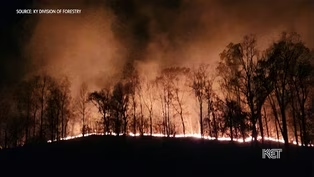
Clip: S2 Ep116 | 34s | Governor Andy Beshear has declared a state of emergency as firefighters battle more than.. (34s)
Video has Closed Captions
Clip: S2 Ep116 | 2m 20s | In Kentucky, governors are limited to two terms in office, serving a maximum of ... (2m 20s)
Providing Support for PBS.org
Learn Moreabout PBS online sponsorship
- News and Public Affairs

Top journalists deliver compelling original analysis of the hour's headlines.

- News and Public Affairs

FRONTLINE is investigative journalism that questions, explains and changes our world.












Support for PBS provided by:
Kentucky Edition is a local public television program presented by KET