State of Affairs with Steve Adubato
Discussing homelessness and affordable housing in New Jersey
Clip: Season 9 Episode 27 | 10m 35sVideo has Closed Captions
Discussing homelessness and affordable housing in New Jersey
Taiisa Kelly, CEO of Monarch Housing Associates, joins Steve Adubato to explore homelessness in NJ, the importance of affordable housing, and concerns about laws penalizing unhoused individuals.
Problems playing video? | Closed Captioning Feedback
Problems playing video? | Closed Captioning Feedback
State of Affairs with Steve Adubato is a local public television program presented by NJ PBS
State of Affairs with Steve Adubato
Discussing homelessness and affordable housing in New Jersey
Clip: Season 9 Episode 27 | 10m 35sVideo has Closed Captions
Taiisa Kelly, CEO of Monarch Housing Associates, joins Steve Adubato to explore homelessness in NJ, the importance of affordable housing, and concerns about laws penalizing unhoused individuals.
Problems playing video? | Closed Captioning Feedback
How to Watch State of Affairs with Steve Adubato
State of Affairs with Steve Adubato is available to stream on pbs.org and the free PBS App, available on iPhone, Apple TV, Android TV, Android smartphones, Amazon Fire TV, Amazon Fire Tablet, Roku, Samsung Smart TV, and Vizio.
Providing Support for PBS.org
Learn Moreabout PBS online sponsorship[INSPRATIONAL MUSIC STING] - Hi, everyone.
Steve Adubato.
We kick-off the program talking about housing and homelessness with someone who knows it well.
She's Taiisa Kelly.
She's the chief executive officer of a terrific organization called Monarch Housing Associates.
We'll put the website up right away.
Taiisa, thank you so much for joining us.
- Thank you for having me.
- Describe the organization.
- Sure, Monarch, we're a nonprofit consulting agency that was formed in 1990.
Our belief is that everyone deserves the safest, stable place to call home 'cause we believe that housing is a human right.
And so, we do that by ensuring that we can help nonprofit organizations build affordable and supportive housing, working with developers, both non-profit and for-profit developers, to build housing.
And we work with communities across the state to really figure out how to better address homelessness within their region and develop and implement plans that really help people to get back into housing and get stable on their feet.
We also engage in public policy work to make sure that we have the resources to do that and the policies that make sense in this effort to create housing opportunity and to end homelessness.
- Taiisha, to what degree do our policies make sense on the federal and/or the state level to confront the crisis of homelessness?
- So, things are changing.
You know, we were going in the right direction for quite a while.
We know that there are best practices that work to really end homelessness.
Those are things like programs, such as Housing First, which say, "Let's help a person get into housing before we start to figure out the services.
Because at the end of the day, a person needs to be stable before they can work on other things."
There were investments in programs, like Rapid Re-Housing, that help to provide temporary rental assistance.
And so, we have a lot of those things happening at the state level.
And we did have some of that happening at the federal level, but there has been a change in approach and tone at the federal level that is moving in a direction that we know is not what works to end homelessness.
So, we've got a little bit of a unique situation in New Jersey, where we've got some state efforts to really end homelessness.
Engaging in practices that work and policies at the federal level that potentially can undermine that.
- So, let's be more specific.
Name a policy coming out of the federal government through the Trump administration that you would argue is not helpful as it relates to the homelessness crisis in our state and the nation.
- Sure.
So recently at the end of the July, there was an executive order that was released or signed called but ending crime in our streets.
And it really called for essentially the criminalization of homelessness.
It really called for communities to enforce camping bans, anti-loitering bans, bans on anybody who's experiencing unsheltered homelessness to prevent them from being on the street.
It calls for involuntary institutionalization of individuals if they do not choose to participate in services.
And it also pulls away from programs, such as harm reduction and Housing First that we know really work to help engage people in services.
Those types of activities really move us backwards in this work, because those were the ways that we approached homelessness, you know, 20, 30 years ago.
That did not work, and we moved towards a more productive approach of housing first, of trauma-informed, of course.
- Taiisa, so why do you think leaders in the federal government, we'll talk about the United States Supreme Court in a recent decision as it relates to some people argue making homelessness illegal in a second.
What would you, what do you believe the motivation is on the part of those in the federal government, in the Trump administration to push such policies?
How does that help communities.
A and B, they would argue they're just trying to get homeless people off the street.
- So, I think there's two things that are happening that are really dangerous, that are happening at the same time.
One, they are conflating homelessness with criminal activity and criminalization and you know, implementing a punitive criminal justice approach to addressing homelessness, when it is essentially a state of a person not having a place to- - One second.
I don't, I'm so sorry for interrupting.
At times when there are incidents, criminal incidents, high-profile criminal incidents that are sometimes caught on videotape, and then spread throughout social media, there is a perception on the part of many, not just in government, but in society overall, that there is a correlation between homelessness/mental health /criminal activities, violent crime in which innocent people are victims.
- So, I would say that the unfortunate reality is that those incidents are the ones that are highlighted, but the reality is the total population of people experiencing homelessness, the total population of people who are unsheltered experiencing homelessness do not represent, are not represented by those individual incidents that happen.
The reality is the majority of people who are experiencing homelessness are experiencing homelessness, because they're not earning enough money to afford a place to live.
They got behind in their rent, they got evicted, and for those who are on the street, they were not able to get into a shelter.
There's not enough shelter beds.
There's not enough housing opportunities for people.
Yes, there are going to be incidents of people who have mental health, who are struggling with mental health issues or substance abuse issues that are also within that homeless population as well, but that is not the majority and that is not the only part of the homeless population.
So, we are creating rules for a small segment that is being applied to the whole population.
It's like throwing out the baby with a bath water.
You're hurting everybody in the process and you're not supporting and helping those who do have mental health issues or support substance abuse challenges as well.
- What did the United States Supreme Court, Taiisha, rule as it relates to communities around the country being able to create ordinances that make homelessness a crime?
Is that it?
- Yes, so in 2024 with the Grants, the Supreme Court made a ruling in the Grants Pass Oregon v Johnson case, which said that it was perfectly fine for communities to pass local ordinances that made it illegal to camp or sleep in public places.
The challenge is that that type of ordinance ignores the reality of accessibility of shelter beds.
It assumes that there is a place for people to be, when there is actually no place for many people to go.
So we do not wanna see people on the street, but if there is no place for them to go, we should not be then pushing them to jail or to institution when there is no other available option for them.
- There'll be a new governor in New Jersey in January, 2026.
What's the number one issue in your mind they should take on and deal directly with whomever is elected governor in January of 2026 as it relates to the issue of homelessness?
And frankly, affordable housing, which are not disconnected?
- Yeah, they're intimately intertwined.
It's hard to say number one, but I would definitely say- - What's most pressing or couple most pressing, go ahead.
- Couple most pressing I would say definitely is we need to be investing in building more affordable housing and deeply affordable housing.
Housing that is affordable to people who are earning very, very low incomes, working minimum wage jobs.
That is gonna make it easier for folks to maintain their housing and avoid the homeless service system.
- Hold on one second.
Does that go beyond Section 8 housing that is more affordable?
Hey, you're building this development, a percentage of those apartments, there are those dwellings, whatever they are, they have to go to people who are under a certain income guideline.
Is that what we're talking about?
- Yes, that's exactly what we're talking about.
We need more Section 8 housing.
We need more housing that have vouchers attached to it.
We also need more landlords in the open market that are accepting vouchers and that are renting to people who have vouchers.
Because that's the other half of the challenge is that folks do sometimes have a voucher and have a really hard time finding - What's a voucher?
What do you mean?
- A voucher, meaning it can be a state rental assistance voucher, a Section 8 housing choice voucher, something to help them pay their rental assistance, long-term or short term.
And we do have landlords that are not always willing to accept those vouchers, even though they're supposed to in New Jersey.
Even though it's illegal to deny a person for a voucher, that still happens in the state.
And so, we need to both build housing that is dedicated, but we also need to open up the market of existing apartments within the state.
We need to, as a state, we need to be investing in and confirming that we are a housing-first state and investing in the services to help people get into housing and help a person navigate the process of getting into housing.
If you can imagine being unsheltered and being homeless for a long period of time on the street, you've lost your IDs, you've lost your birth certificate, you've lost your social security card, and those are some of the primary things that landlords are looking for when you're applying for an apartment.
So, there's a whole process of getting the documents that you need of signing up for programs of even just kind of getting started in the process before you can move into an apartment.
And so, investing in services to help support people through that process is really important.
- Taiisa Kelly, will not be the last time she joins us.
She's the CEO of Monarch Housing Associates.
Taiisa, thank you so much for joining us.
We appreciate it.
- Thank you very much.
- You got it.
Stay with us, we'll be right back.
- [Narrator] State of Affairs with Steve Adubato is a production of the Caucus Educational Corporation.
Funding has been provided by The Russell Berrie Foundation.
Robert Wood Johnson Foundation.
RWJBarnabas Health.
Let’s be healthy together.
The Adler Aphasia Center.
New Jersey’s Board of Public Utilities.
The New Jersey Economic Development Authority.
Johnson & Johnson.
The Fidelco Group.
And by Kean University.
Promotional support provided by NJBIZ.
And by Meadowlands Media.
Hi, I'm Naomi Gwartz from the Adler Aphasia Center.
Aphasia is a language disorder that usually results from a brain injury such as stroke or a brain tumor.
While aphasia can affect one's ability to speak, understand, read, and write, it does not affect intellect.
Programs offered at our center help improve communication skills as well as confidence and quality of life while surrounded by others who understand aphasia.
If you or a loved one is diagnosed with aphasia, there is hope and community.
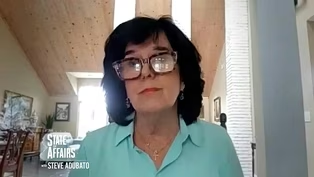
Breaking the cycle of homelessness and addiction in NJ
Video has Closed Captions
Clip: S9 Ep27 | 8m 41s | Breaking the cycle of homelessness and addiction in NJ (8m 41s)
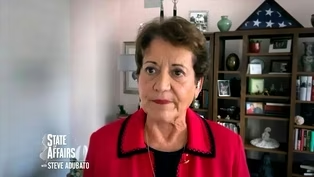
Examining the evolution of public health
Video has Closed Captions
Clip: S9 Ep27 | 8m 19s | Examining the evolution of public health (8m 19s)
Providing Support for PBS.org
Learn Moreabout PBS online sponsorship
- News and Public Affairs

Top journalists deliver compelling original analysis of the hour's headlines.

- News and Public Affairs

FRONTLINE is investigative journalism that questions, explains and changes our world.












Support for PBS provided by:
State of Affairs with Steve Adubato is a local public television program presented by NJ PBS