
Discussing the outlook for small businesses with Mark S. Lee, president and CEO of The LEE Group
Clip: Season 10 Episode 37 | 5m 38sVideo has Closed Captions
Mark S. Lee also speaks to the unique economic challenges faced by African American entrepreneurs.
One Detroit contributor and American Black Journal host Stephen Henderson sits down with integrated marketing consultant Mark S. Lee, president and CEO of The LEE Group and a Detroit PBS board member, to talk about how small business owners can plan for the rest of the year amid ongoing challenges such as inflation, tariffs and labor shortages. Lee stresses it isn't a time to sit still, and he off
Problems playing video? | Closed Captioning Feedback
Problems playing video? | Closed Captioning Feedback
One Detroit is a local public television program presented by Detroit PBS
Discussing the outlook for small businesses with Mark S. Lee, president and CEO of The LEE Group
Clip: Season 10 Episode 37 | 5m 38sVideo has Closed Captions
One Detroit contributor and American Black Journal host Stephen Henderson sits down with integrated marketing consultant Mark S. Lee, president and CEO of The LEE Group and a Detroit PBS board member, to talk about how small business owners can plan for the rest of the year amid ongoing challenges such as inflation, tariffs and labor shortages. Lee stresses it isn't a time to sit still, and he off
Problems playing video? | Closed Captioning Feedback
How to Watch One Detroit
One Detroit is available to stream on pbs.org and the free PBS App, available on iPhone, Apple TV, Android TV, Android smartphones, Amazon Fire TV, Amazon Fire Tablet, Roku, Samsung Smart TV, LG TV, and Vizio.
Providing Support for PBS.org
Learn Moreabout PBS online sponsorship(gentle upbeat music) - I talk to a lot of businesses and what they're experiencing is just this uncertainty.
This uncertainty is very persistent right now.
People are still feeling the effects about tariffs, high costs, revenue's not increasing.
Revenue, quite frankly is flat.
Collectively, when we go get the trend lines, if you will, business confidence is relatively middle of the roads.
Not highs, not lows.
In that mid range strain.
So, I'm experiencing a lot of, I'm sensing a lot of uncertainty from these businesses, and they're trying to figure out again, navigate these chartered waters.
I think with the president came in office, there was believe or not some optimism in that space.
But now that several months into his second year of his second term, optimism is really kind of gone down.
- Yeah.
We talk about this each year about how people ought to kind of approach these short term conditions with an eye toward the long term, right?
You don't wanna make rash decisions that don't put you in the right position for when things get better.
So, let's talk about what some of those things are.
Like, how do you react to the negative numbers that we're all seeing now without overdoing it in a way that doesn't put you in a position to benefit.
- And that's the hard balance right there.
- Yeah.
- And so, I think short term, what businesses need to do is to go back and retrench.
Look at your current plans.
Look at your current financials.
Make sure that you're on solid ground, right?
Look at your revenue projections.
Look at your diversification opportunities.
Can you diversify your income streams?
Don't just sit still.
Now is not the time just to sit still.
Work with partners, identify larger businesses and other smaller businesses that can become a partner of yours.
'Cause right now, the challenge is if you sit still in this today's economy, we don't, we can't predict the future.
We don't know what's going to happen.
I can also tell you that there's a 30 to 40% chance, according to various economists across the country, that there could be a recession issue.
- An actual recession.
Yeah.
- An actual recession.
The good news is that's only 30 to 40%, right?
The bad news is that there's an opportunity that could still happen.
So you have to continue to navigate those challenges and make sure you go back and retrench and get your foundational principles, as well as get your plan and your financials.
- Yeah.
You know, the one part of the economy that is doing very well is the stock market.
- Yeah.
- I mean, investments are doing extremely well.
Now, most Americans are not participants in the market.
But a lot of businesses are.
And certainly wealthier individuals are.
But how do you make or take advantage, I guess, of that part of the economy while also trying to sort of pull up the rear in the sort of core part of your business.
- So let me, also, when I just say this.
That 50% of the American public is not in the stock market.
- Not in the stock market at all.
- Not at all.
So, they're not seeing that benefit of the stock market boom that you're seeing right now.
- Right.
Every day I am getting a text message or an email from a bank or some other kinda lender trying to give my business money.
Trying to say, and I think they're looking at the same things we're looking at.
If revenue's down, costs are up, you might need cash.
But of course, that's a different kind of cash than than revenue, right?
You gotta pay it back.
- Yeah, pay it back.
- And it's adding to the bottom line.
What kind of counsel do you give small businesses about a restructure at this point that includes borrowing to get through what, you know, if it's a shorter term, kind of slow down.
Maybe that is that bridge that you need, you know, talk about that versus cost, discipline, spending discipline and the other things that you could do.
- That's a great question.
I counsel business owners by saying, "Look at your financials.
What is your business plan?
What's your long term objective?"
So yes, those banks are coming after you right now to try to give you some type of funding, but you wanna be careful.
Just understand there are two types of funding opportunities.
Here are quite a few, but two most famous ones, for lack of a better phrase.
One is taking a loan.
So, a bank will give you a short term loan, a longer term loan.
The challenge with that is what?
You have to pay it back.
- Yeah.
- You gotta pay back the interest.
So, therefore your cost will go up.
It affects your bottom line.
- Right.
- It affects your revenue and your overall profitability.
There's another opportunity though.
A grant.
- All right.
- We talked about that before.
- We've talked about that before.
- A grant, you do not have to pay back.
A grant is from an organization that simply provided you with revenue so that you can scale your business.
That you can address the outstanding challenges.
The only catch is, I just say that respectfully, is that you still have to demonstrate how you're gonna spend that money, - Right.
- What the return is going to be.
Not necessarily the business return, but what is the grantor getting for the resources they're giving to you.
So, to answer your question in a nutshell is look at your financial position.
Look at what your short term and your long term needs are.
Get your costs and make sure you make the decision based on the financial opportunities that you have for yourself and for your business.
- Yeah.
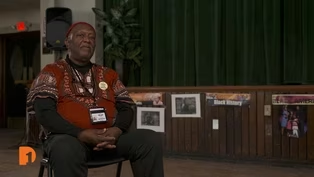
Caregiving Conversations: Leroy Callaway
Video has Closed Captions
Clip: S10 Ep37 | 1m 31s | We hear from Detroiter Leroy Callaway who took care of his mother after she became ill. (1m 31s)
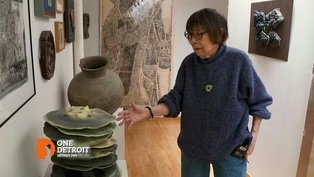
The legacy of ceramics artist Marie Woo, 2020 Kresge Eminent Artist
Video has Closed Captions
Clip: S10 Ep37 | 5m 46s | Woo spoke with One Detroit in 2020 about her art philosophy and more. (5m 46s)
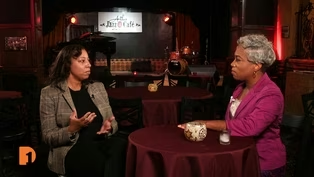
Oral history project preserves the legacy of Detroit women in jazz
Video has Closed Captions
Clip: S10 Ep37 | 9m 23s | Oral historian Veronica Johnson discusses the Detroit Women in Jazz Oral History Project. (9m 23s)
Providing Support for PBS.org
Learn Moreabout PBS online sponsorship
- News and Public Affairs

Top journalists deliver compelling original analysis of the hour's headlines.

- News and Public Affairs

Today's top journalists discuss Washington's current political events and public affairs.












Support for PBS provided by:
One Detroit is a local public television program presented by Detroit PBS