Unspun
Disorder In The Courts | Unspun
Season 1 Episode 136 | 27m 53sVideo has Closed Captions
What happens when you’re elected by the people, but rejected by the courts?
What happens when you’re elected by the people, but rejected by the courts? President Trump says he won’t take no for an answer, from what he calls ‘rogue judges’ – promising to appeal their rulings against his White House executive orders. Plus: Will the NC Supreme Court overturn the results of its own election? Tonight's special guest is Constitutional Attorney John Wester.
Problems playing video? | Closed Captioning Feedback
Problems playing video? | Closed Captioning Feedback
Unspun is a local public television program presented by PBS Charlotte
Unspun
Disorder In The Courts | Unspun
Season 1 Episode 136 | 27m 53sVideo has Closed Captions
What happens when you’re elected by the people, but rejected by the courts? President Trump says he won’t take no for an answer, from what he calls ‘rogue judges’ – promising to appeal their rulings against his White House executive orders. Plus: Will the NC Supreme Court overturn the results of its own election? Tonight's special guest is Constitutional Attorney John Wester.
Problems playing video? | Closed Captioning Feedback
How to Watch Unspun
Unspun is available to stream on pbs.org and the free PBS App, available on iPhone, Apple TV, Android TV, Android smartphones, Amazon Fire TV, Amazon Fire Tablet, Roku, Samsung Smart TV, and Vizio.
Providing Support for PBS.org
Learn Moreabout PBS online sponsorship- [Narrator] This is a production of PBS Charlotte.
This week on "Un-Spun", disorder in the court.
What happens when the elected president becomes the rejected president?
As the federal courts say no to Trump's executive orders, and here in North Carolina, the State Supreme Court could overturn the outcome of its own election by ordering thousands of votes tossed out.
Plus, we'll count down the top five political cliches used in constitutional battles.
In today's America, welcome to the spin game.
Believe me, I know.
I'm Pat McCrory.
When I was governor and mayor, I played the spin game.
I was played by the spin game.
But aren't we all done being spun?
Let's take the spin out of the world we're in, here on "Un-Spun".
(patriotic music) Good evening, I'm Pat McCrory and welcome to "Un-Spun", the show that tells you what politicians are thinking, but not saying.
When the founding fathers designed our system of checks and balances, I wonder if they ever imagined the power struggles we're seeing today, starting with the latest game of chicken between the lower courts and the Trump White House.
- President Trump escalated his fight with the federal courts today as the president called for the impeachment of the federal judge who ordered a halt to the deportations of hundreds of Venezuelan migrants.
- They're throwing monkey wrenches at you with these judicial rulings.
- Well, we have to go through an appellate process, that takes a long time.
The good news is we will be appealing it.
We have rogue judges that are destroying our country.
- We, the courts have the final word on what the meaning of the law is, and everyone else in the government has to listen to us.
- You know, I don't know that we're at the outright defiance stage yet, but I do think this is more resistance from the executive branch than we've seen, certainly in our lifetime, and perhaps ever.
- Legal experts say it's a question of compliance versus defiance that could reach all the way to the US Supreme Court with the White House and the lower courts accusing each other of overreaching their constitutional authority.
But that's a legal fight that could drag on for months, maybe even years.
So what happens in the meantime?
Well, the president is still deporting migrants and immigrants and still cutting budgets and still shutting down federal agencies, just like he promised to the voters who elected them.
And Trump is ignoring the courts that rejected them.
So for now, at least, welcome to the White House that won't take no for an answer, even when that answer comes from a federal judge.
Joining us now is the Charlotte lawyer who's fought these constitutional battles at the state level right here in North Carolina.
John Wester served as lead attorney for myself and three other North Carolina governors, both Republicans and Democrats in two different landmark cases, debating the balance of power between the governor's office and the General Assembly in Raleigh.
He's a Duke Law School graduate and a litigator with Robinson, Bradshaw, Henson Law Firm right here in Charlotte.
John, it's great to have you here on "Un-Spun".
- Thank you.
Honored to be invited.
- Well, first of all, let's start out with the, all the legal cases and power struggles in North Carolina.
And the first one has to do with an election that occurred over a year ago, the Supreme Court election for the State Supreme Court.
Tell the audience and me what is going on there.
- Certainly.
The election was November five when we elected the President of the United States and other things, and North Carolina had one Supreme Court race on the ballot.
Allison Riggs, the incumbent Justice and Court of Appeals Judge Jefferson Griffin.
And that case- Griffin is the Republican.
- He is.
- The incumbent was the Democrat.
- Yes.
I resist the party things because I wish very much we didn't have partisan labels and I'll like to speak to that, but nonetheless, and for 12 years we did not, but we do now.
And this has gone on and I, without suggesting what the outcome should be, I observed that Jefferson Griffin has asked for an invalidation of over 60,000 people who voted in that election.
And that stands right now in the North County Court of Appeals, where three judges in the last week have taken the case under advisement and they will rule when they choose to rule whether there is validity to his argument.
- And then after the three court, the three judge court judges, does it go to the State Supreme Court?
- It might- - The same state Supreme Court that this election was all about.
- That's correct.
That, this one seat is all about.
There is pending because the United States Court of Appeals kept an attachment, if you will, if you could think of a sort of like a yo-yo in a, if you I yo-yo as a child, they can pull the case.
There's an a parallel case that Judge Justice Riggs has brought that would say that the remedy that Jefferson Griffin is seeking violates this voting rights Act.
So they could take the case- - So the federal people, the federal courts could intervene and overrule our State Supreme Court.
- That's what it would amount to.
- Right.
- But it would be at her motion to do so.
And then at their motion to decide, they had the case already- - Right.
- And they said this is a state court matter and it is, quintessentially.
However, in the event that there is a ruling that violates a federal law, then they get the case back.
- This sets incredible precedent for North Carolina.
Within North Carolina, for example, you know, I had a very close governor's election, which I lost.
I had a recount.
Lost the recount, but we stopped it there.
- Yes.
- This is where they're basically going, we want to revisit the rules that were set for this election and even have military votes oversee military votes challenged for this election, including one young military person who was tragically killed in the helicopter crash over Reagan airport.
What do you think the results are gonna be?
- Well, that is very similar to saying the weather next week will be X, and I would do the viewing public and you and me no good to make such a forecast and I- - Real quick, but there's a lot of money, political money being thrown in on and paying for the lawyers on these cases by both the Republican and Democratic operatives.
- If I were writing a story of this and putting it in the Bible somewhere, it would be in the Book of Lamentations.
- Gotcha.
Okay.
Real quick, another North Carolina case.
Balance of powers between the executive branch, the governor primarily, and the state legislature.
You and I have been in a case called McCrory v Berger.
You represented myself, Governor Martin, Governor Hunt, and others.
What's the latest in that, in about a minute if you could make it.
Well, we we're just having arguments there about moving away authority of the governor to the General Assembly.
The, now the, the state auditor would take control of the board of elections.
- Right.
And then the DOT would get more appointments for the- - That's right.
- From the state legislature than the governor who runs the DOT.
- That's correct, sir.
Here it is.
In one paragraph, overlooked a whole lot of the time is the command of the North Carolina constitution.
- Right.
- That the governor of the state has the duty faithfully to execute the laws.
Faithfully to execute the laws.
- Right.
- That is an authority that has been there since our constitution was adopted.
- Right.
And that's what this is all about.
- And this has much to do with that.
If these measures hold, they would overrule the case that you and Governor Hunt and Governor Martin brought.
- [Pat] Right.
- They would overrule some other cases and I think they would turn the duty in the constitution faithfully to execute the laws into elongated episode of "May I".
- Right.
We even have the highway patrol, possibly.
- That's right.
- Having controlled by the state legislature, head of govern governor, which that's right.
Would've impacted my ability to call the state highway patrol as governor for riots.
Let's go to the federal level real quick.
Trump versus the courts versus the legislature.
Let's start off with executive power versus the court's legal power, right now on immigration.
- Yeah, well, the bedrock and the place, the point of that we really ought to have in mind, the hold times and I think is just getting lost in the fray, is the judicial branch is where the buck stops.
In 1803, Chief Justice Marshall said it is emphatically the province of the judicial branch to declare what is the law.
Now, that is lost in this.
There will be arguments and lots of them between the executive branch and the legislative branch.
- Right.
- But the buck stops and the final decision stop with the judicial branch.
- All right, the immediate case is Trump, President Trump put immigrants on a plane to El Salvador, I believe- - That's right.
Venezuelan immigrants.
A federal court, loan federal court justice said, "No, you can't do that."
He went on with the plane.
He's going, "How can one judge stop me?"
- Because the is emphatically the province of the judicial branch to declare what is the law.
The president is under our constitutional system, bound to follow that judge's ruling.
Can he appeal?
Yes.
Can he appeal the appeal?
Yes.
But until the judiciary says the outcome there is not, that he must obey.
I'll put it that way.
- And this is the time when the president is challenging one lone federal judge by going, I'm not gonna, I'm gonna wait until the Supreme Court rules, until we stop.
- And that is against the law.
That's against our system of government.
It is not the fact that it's one judge.
One judge is the judiciary.
And in this context, and the judiciary is where the buck stops.
That's where the decisions take hold and must be obeyed.
Or we would have no judicial, we would have nothing recognizing the system we have today.
- All right, the next big controversy in Washington is the federal government, the executive branch laying off people throughout because the people said, cut, waste, cut, whatever.
We've got trillions of dollars of deficit.
Congress is not moving on this.
It's very similar to Biden with student loans, you know, forgiving student loans.
Trump is doing it.
Courts are challenging him going, you don't have the authority to do this.
- That's correct.
And you fight those in the courts.
And when the courts rule, and because we have judges across the country, they may even rule different ways at different times.
That's not been happening here.
They've been consistently saying that the president cannot do this the way he's doing it.
It has a whole lot to do with the manner in which he's doing it and the grounds for doing it.
And that has to be decided in the courts.
The public is understandably frustrated by this because it takes a long time in contrast to an executive order- - Right.
- Judicial proceedings are long and many would say boring, but they are also fundamental to our system of government.
- Alright, in the remaining seconds, are we in a constitutional crisis, both in North Carolina and in the federal government or with this thin piece of paper we call the Constitution hold up?
- The thin piece of paper is the most, and the, there are two of them.
The, our state and federal are the most formidable papers that have whatever their thickness, your Honor, they're the most formidable papers that we must adhere to those papers or we do not have a democracy.
And I long for return to that and including a, the regard for the judiciary that our system depends on.
Not just that I wish for it, but it depends on, and I can say that I cling to that hope and wish all the time.
- John, it's been an honor to have you on the show.
Thank you very much for your very legal input and insight in this very complex situation our country and state is in.
Thank you very much.
- I appreciate the opportunity.
- Next up, PBS Charlotte's Jeff Sonier takes "Un-Spun" on the street for your thoughts on the power struggle between the courts and the White House.
- Yeah, the people we're talking with here in uptown Charlotte, say it's not just the power struggle they're concerned about, but also the constitutional question about whose authority is the ultimate authority.
- Yeah, I think over the course of the last few years we've seen executive privilege kind of pushed to its boundaries.
The system was designed to have checks and balances and the judiciary was supposed to be the check for the executive.
So when he starts ignoring that, the president is overstepping.
- [Jeff] Do you think when the time comes, if the time comes where the judge issues an order and the president either defies it or ignores it, what happens then?
- I don't think he's defied any right now.
I think he goes along what the judge says, but he calls him names, you know, and as I said before, I don't think a district judge should tell the federal government what to do.
- Well, I think it's vice versa.
Like if he order, if he gives you the order, you should follow it, even if you're a judge.
I mean, everybody has to follow it, you know, because he's the president.
The, in the past it was set up where you have checks and balances.
You know, you don't give any one man or any few group of people power within power 'cause absolute power corrupts absolutely.
- It is egregious to me that Trump wants to exercise or any president for that matter, wants to exercise like impeaching someone or firing someone- - Just ad hoc firing people.
- Right, just because he disagrees?
Fine, disagree, but go through the process.
Yeah.
- There's an inherent bias that every person carries within them, right?
And our hope is that the judiciary, once they're sitting on the bench, they're able to separate their personal from the, but I don't think it happens as much as it should.
And I think that, that we know that it exists.
It's just a matter of how do we curb it?
How do we remove it from the bench?
And is it even possible?
- Yeah, and when it's the White House versus the courthouse, a presidential order versus a judge's order, well folks on both sides of that argument say maybe it's time for both sides to step back to protect our system of checks and balances instead of undermining it for political reasons.
Pat.
- Thanks Jeff.
So what do you think about the issue?
Let us know by tagging PBS Charlotte when you post on social media about this week's show.
(intense music) Alright, tonight on our "Un-Spun" countdown, the top five political cliches used in these incredible constitutional battles right now in Washington DC.
Let's start out with number five.
Number five, a federal judge.
One federal judge should not have more power than the President of the United States that's elected by all the people.
This is what the Trump White House is saying right now.
How can one federal judge have all this power to stop the actions of the American people?
Well, you just heard a top lawyer say that's what the Constitution allows.
Number four, the courts are partisan and rigged.
You know, even John just stated, well, why are the courts even considered Republican or Democrat?
The fact is they aren't supposed to be, but they sure are acting like that right now.
And number three, Congress is not doing their job.
This is probably the most accurate of the ones because Congress doesn't seem to be in the debate between the battle, between the courts and the White House.
Where's the responsibility of Congress in making some of these decisions?
It's not being talked about.
Number two, Hey, the President ran on this issue.
Why shouldn't he be able to implement this issue as president of the United States?
And number one, number one, the biggest political argument that's often used by the Democrats right now is the President is not the king.
(intense music) PBS Charlotte's Jeff Sonier joins me now for "Un-Spun" One-on-One.
- Your favorite part of the program.
- Absolutely.
- I ask the questions, you answer the questions.
- I love the media.
- I can see the sincerity in your eyes.
Hey, first question is about the state supreme court battle we've got going right now- - Yeah.
- In the courts.
You've got a five to two advantage Republicans over Democrats right now.
They're fighting to make it six to one.
Is six to one really that big of a difference than five to two when it comes to the key issues that Republicans might wanna see defended in court by the Supreme Court?
- Well, the Republicans want as big as advantage on the Supreme Court as possible because they never know what might happen in the next Supreme Court election.
So it's like a football coach in the fourth quarter.
Go ahead and pile on the score because you never know if there's gonna be a comeback down the road.
- You take the seats that are available whether you really need 'em or not.
- Absolutely.
And big money.
Big money.
And first that Supreme Court race, as we saw in Wisconsin and now big money in the lawyers supporting both sides of this constitutional battle on how we do elections in North Carolina.
- Win or lose, don't you lose a lot of goodwill and maybe taint the, you know, the legitimacy of the court by doing all this?
- I think this one is gonna really stain the confidence in the elections regardless of who wins.
People are gonna go, this brings me more doubt about how elections are held in North Carolina, whether it's deserved or not.
- Yeah, I wanna talk about your lawsuit that you talked about with John Wester.
That lawsuit was decided you won, this was McCrory versus Berger.
- Yeah, and it was you and Governor Martin and Governor Hunt together- - And Governor Easley.
- Yeah.
- And all the living governors.
- Yeah.
- Bringing a case against the legislature for trying to power grab from the governor's office.
- Right.
The Republican legislature when I was governor, was trying to basically have appointments to run one of my cabinet.
It was the environmental area of one of my cabinets at this point in time, at that point in time.
And what happened was, I said, you can't do that.
You're supposed to make the policy, I enforce and operate the policy just like we see in Washington DC.
And they went, no, tough.
We're gonna take it to the state Supreme Court.
I won with one, only one dissenting vote.
At that time, the Democrats actually had the majority, but the Republicans voted with, the majority of Republicans voted with me on the Supreme Court too.
This time the dynamics may change because Paul Newbie was the lone dissenting vote against me or the governor at that time.
- And now he's the state Supreme Court Justice.
- He's the Chief justice.
- The Chief justice, yeah.
- With a majority.
- It's ironic.
Chief Justice Newby and I went to high school together and are very close friends, that made no difference regarding this court case.
- So you kind of anticipated my second question.
If you won that case, why do we keep, why does the legislature keep going back to the well?
Keep trying these power grabs, keep winding up in court like- - The Democrats did it in the '60's, '70's and '80's, even to their own governor, Jim Hunt.
Then they did it to Jim Martin, the Republican, then they did it to Lieutenant Governor Gardner, took away his power and now they're doing it with the new governor.
- So this is- - Democrat.
- This is like an annual right of spring here.
- Yeah, regardless of party structure, the legislature in North Carolina has a history of wanting all the power and there isn't an equal balance of powers between the three judicial branches.
The interesting thing is politically, the judicial branch is more aligned with the legislature than they are with the governor.
So will the State Supreme Court become more politicized?
Frankly, it always has been, but it hasn't been as apparent as it is today.
- Kinda goes back to why you want that majority as big as possible, whether it's Republican or Democrat.
- Exactly.
Yeah.
That's probably Phil Berger, who's the president pro-temp, some say the now the most powerful person in the state of North Carolina.
- Hmm.
Let's talk about the federal lawsuits.
We don't know how these things are gonna turn out.
We have a pretty good idea of what John Wester thinks as far as what the law says.
But while we're playing this out in the courts, while the appeals process goes on, doesn't the President kind of win because he continues to do what he started doing and that is passing these orders, having, you know, departments closed down, people laid off, immigrants and migrants transported overseas.
Doesn't he win by virtue of the fact that while the courts battle this out, he still kind of has free reign to do what he started doing?
- As long as public opinion stays with him.
If public opinion leaves him, then those running in the house in two years or for the Senate in less than two years will start maybe running away and challenging the President's authority.
On immigration, the polls are showing the public's with him.
On the layoffs on federal agencies, including Health and Human services, we don't know yet.
So we don't know the real impact.
But public opinion often also has an impact on the courts, whether they admit it or not.
Sometimes public opinion has an impact on lower level courts and the Supreme Court.
- You talked about having a friendly court here in North Carolina influencing the power grabs here.
Is that why the president is testing the limits of the Oval Office power?
Because he's got a quote unquote friendly court, the Supreme Court with, you know, several of his appointees and a mostly Republican makeup now?
- Absolutely.
And again, this has gone throughout our history.
Franklin Roosevelt tried to pack the courts.
The Democrats talked about packing the courts.
Biden challenged the courts through several hearings on, President Biden challenged the courts on student loans.
The courts ruled against him.
He slightly changed the words and did it again.
The courts again ruled against him.
So what you're seeing is the executive branch, especially now under President Trump, challenging even more.
Especially this one case where a federal judge, one federal judge, tried to stop a flight from occurring, that is unique in American history.
- Well, let's talk about that one federal judge.
I would assume that when you're filing a lawsuit against the President, you're looking for a judge that might be friendly to you.
Is is that's what, is that what's happening?
Are they shopping around for the right judge to challenge the president, the Democrats and the opposition here?
- Absolutely.
There's judge shopping all the time in constitutional crisis.
So they can slow something down or speed it up based upon the lower level judge they select.
The real question is the Supreme Court, what will, especially the swing Republican justices, and again, John mentioned he hates to mention either Republican or Democrat.
But the fact is that's the reality of politics now, even in the judicial system.
- 30 seconds.
You mentioned it during the top five, you mentioned it during the interview.
Where is Congress?
It's supposed to be a three-way street, this whole checks and balances there.
- Congress during the last three administrations is at a standstill and therefore nothing is being done.
And the public wants something, someone to do something about it.
And that's why the president is moving on immigration because Congress doesn't have the votes to move on immigration.
Remember, the 60 vote threshold in the US Senate.
They can't get there on either side.
Therefore, nothing is done on immigration.
On this cutting the size of the federal budget, Congress doesn't wanna make those tough decisions.
It's too difficult in the reelection.
The president's willing to do that.
But with that Congress might pay the consequences in the next Congressional and Senate elections.
- And speaking of paying the consequences, when one branch of the government sues the other branch of the government, aren't taxpayers picking up the bill for both branches of the government?
- Absolutely.
And there's probably nowadays some super PAC money behind it.
And the question is, who else is helping pay for these very expensive lawyers?
- Yeah, we don't have legal degrees, but we play lawyers on TV, I guess, right?
- No doubt about it.
- Interesting discussion.
A lot of folks talking about it.
I'm glad we could talk about it this week.
Thanks governor.
Thank you, Jeff.
(intense music) - You know, elections are a popularity contest, but once you win, the game changes.
You find out quickly that making promises is a lot easier than keeping promises.
Especially when your political opponents are keeping score and focusing on your failures.
That's why political power is so addicting.
Power can turn your promises into priorities, your ideas into realities.
Believe me, I know as mayor and governor, I used the power of my office to solve problems and get things done, and the public praised me for it.
But here's another lesson I learned, very quickly.
In our system of checks and balances, you're not the only one with political power.
And what works for you can also work against you.
You know, my city council and my state legislature used their power to stop my initiatives, forcing me to get their approval or sidestepping me to take action on their priorities instead.
And that's where the courts come in.
There's supposed to be the referees in this political power game, but just like a bad call on the basketball court, judges can be wrong too.
So who judges the judges?
Well, in today's world, whether it's election results or immigration or cutting the budget, you name it, we're testing the boundaries of political power on difficult issues where it's a challenge to get things done in a state or a nation that's politically divided.
And when the courts step in, well, you challenge them too.
In any game, the rules can change, but usually the boundaries don't change.
So how willing are we to cross a line that's been there since the beginning in 1787?
Or should the boundaries stay where they've always been, in a system of sharing power that has served us well for over 200 years?
Well, that's the reality as I see it.
I hope you'll come back next week as we tell you what politicians are thinking, but not saying right here on "Un-Spun".
Goodnight folks.
(intense music) - [Narrator] A production of PBS Charlotte.
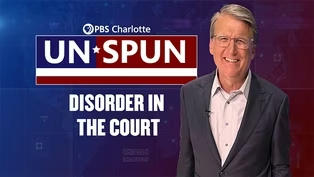
Disorder In The Court Preview| Unspun
Preview: S1 Ep136 | 30s | What happens when you’re elected by the people, but rejected by the courts? (30s)
Providing Support for PBS.org
Learn Moreabout PBS online sponsorship
- News and Public Affairs

Top journalists deliver compelling original analysis of the hour's headlines.

- News and Public Affairs

FRONTLINE is investigative journalism that questions, explains and changes our world.












Support for PBS provided by:
Unspun is a local public television program presented by PBS Charlotte