Roots, Race & Culture
Distrust in Healthcare
Season 3 Episode 2 | 26m 59sVideo has Closed Captions
Explore healthcare distrust in marginalized communities and solutions for building equity.
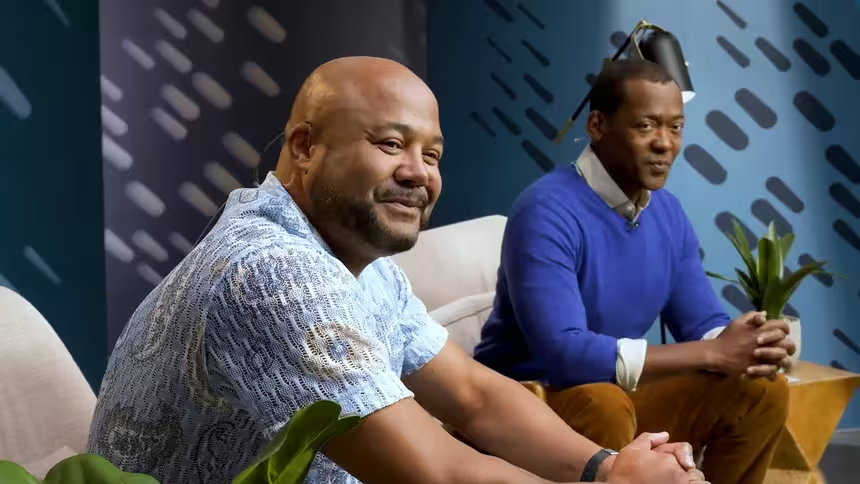
Learn about healthcare distrust in marginalized communities. Lonzo and Danor discuss historical factors with healthcare professionals and advocates, highlighting events like experimentation on enslaved Africans and the Tuskegee Syphilis Study. They explore solutions for rebuilding confidence, including education for healthcare professionals, and creating an equitable healthcare system for all.
Problems playing video? | Closed Captioning Feedback
Problems playing video? | Closed Captioning Feedback
Roots, Race & Culture is a local public television program presented by PBS Utah
Roots, Race & Culture
Distrust in Healthcare
Season 3 Episode 2 | 26m 59sVideo has Closed Captions
Learn about healthcare distrust in marginalized communities. Lonzo and Danor discuss historical factors with healthcare professionals and advocates, highlighting events like experimentation on enslaved Africans and the Tuskegee Syphilis Study. They explore solutions for rebuilding confidence, including education for healthcare professionals, and creating an equitable healthcare system for all.
Problems playing video? | Closed Captioning Feedback
How to Watch Roots, Race & Culture
Roots, Race & Culture is available to stream on pbs.org and the free PBS App, available on iPhone, Apple TV, Android TV, Android smartphones, Amazon Fire TV, Amazon Fire Tablet, Roku, Samsung Smart TV, and Vizio.
Welcome to Season 7
Bold and honest conversations tackled with humor, insight, and empathy.Providing Support for PBS.org
Learn Moreabout PBS online sponsorship(gentle music) - [Announcer] "Roots Race & Culture," is made possible in part by the contributions to PBS Utah from viewers like you.
Thank you.
(upbeat music) ♪ Yeah, yeah, yeah, yeah ♪ (upbeat music) - Hey everyone, and welcome to "Roots Race & Culture," where we bring you into candid conversations about shared cultural experiences.
I'm Lonzo Liggins.
- And I'm Danor Gerald.
Today we're going to take a deep dive into the perceptions and lack of trust that Blacks and people of color have toward the healthcare industry.
Understanding how this attitude took hold in these communities and how the situation can be improved, is our goal.
- Now to help us understand healthcare's difficult history, we have two experts in the studio today.
First, let's hear from you, Dr. Cephas - Yes, my name is Ryan Cephas.
I'm a child and adolescent psychiatrist at the University of Utah.
I work at Huntsman Mental Health Institute.
I did my residency training at Howard University in DC.
I'm originally from Maryland, so I'm a transplant to Utah, but I've been enjoying my time.
I've been living here for about three years now.
- Excellent.
- Yeah.
- Yeah, so, Dr. Wright, you are a Utah native, - I am, yeah.
So I'm Tashelle Wright.
I am from Utah, born and raised.
I am a health equity researcher, and I'm also a program officer.
I do, most of my work is in tobacco and oral health, which I absolutely love.
I do research on Black, African, and Afro Latinx communities.
Well, with and within those communities here in Utah and in California.
- Let's just dive right into this, 'cause we've got a lot of questions about this subject today, that I would love to just to hear your views on this subject as well.
- Let's talk about the history first.
Like how this... 'Cause this is not just a modern issue, this goes back in time.
So, let's go back to the beginning of America, with people being enslaved.
How were they treated?
I mean, were they given the same medical care that everyone else?
What can you guys talk about on that?
- That's a good question.
I feel like it's rhetorical, right?
I'm looking at Ryan like... Yeah, I feel like there has been a lack of access, lack of fair treatment since we can remember, for centuries and centuries.
Here in the US, to this day, and even historically, health for folks that look like us has always seemed to be a privilege versus a right.
Where others, they had the right to it and didn't have to ask, didn't have to advocate, it was just given.
How do you feel about it, Ryan, in your practice?
- Yeah, I mean, I think, if you go back and look at things, Black people weren't actually viewed as people, they're viewed as property.
And so I think the idea that healthcare was definitely a privilege versus a right, was something that was a common thought back then.
And I think as we've moved forward, of course, those thoughts have changed and improved, but I think that there are some things that still kind of are in the recesses of people's minds when it comes to healthcare and how Black people have been treated, or people of color have been treated by the healthcare system as a whole.
- Well, we have an image of a woman named Lucinda who was enslaved.
And I'm just gonna read you the story about this.
Here's the picture right here.
"The physician and owner was named William Aiken "of Winnsboro, North Carolina "And in 1852, he experimented on Lucinda, "who suffered from a bony growth around her right eye.
"Aiken and other doctors disfigured her "by boring holes in her head without chloroform, "which was a gas that was used for anesthesia."
So they're experimenting on people without anesthesia, that kind of thing.
There's some other historical events that are pretty popular... You did a play about one of 'em in fact, - I did "Miss Evers' Boys."
It was about the story of the Tuskegee experiment.
Yeah, we did that at the Grand Theater here, and it was a group of African American men, who were purposely injected with syphilis so that they could figure out, what the symptoms were and how the disease progressed.
Even though the penicillin was available at the time, they purposely withheld it from them, so they could document their symptoms.
It was a pretty awful thing.
- Yeah, that was the point.
We have a picture actually from this where you can see a doctor drawing blood from someone who was being part of this experiment.
- Do you guys think that experimentation leads to distrust today?
These types of things?
- Specifically to the Tuskegee Syphilis trial, it led to distrust from a lot of angles.
One, they were kind of coerced into being part of this.
They was a little bit of incentive for them to participate, but they were withheld treatment when it was available.
And it wasn't just impacting them.
Some of them were married or partnered, and it impacted their partner who then got syphilis as well, and again, without treatment and impacted all of them.
And so I feel like that's a study that echoes in medical education and public health education to today.
And people will quote that, even those who don't know a lot about it, they have heard of those trials.
We have interesting history here in the US and beyond.
- And, you know these stories start going around the neighborhood and among families, and you were gonna mention something about that.
- Yeah, I was gonna add onto what Dr. Wright was saying.
On top of not receiving the penicillin, they were also given other types of treatments that were known to be poisonous that did have arsenic or other poisonous elements in them.
And aside from that, the study was only supposed to last for a few months, but it extended 40 years.
- 40 years.
- They weren't told about the implications of what it would mean to have end stages of syphilis.
So that wasn't shared.
- Some of 'em died.
- And a lot of them died, or there were kids who were born with syphilis as a result.
Like you mentioned, spouses also contracted this disease.
- So, let's bring it a little bit to more modern times.
It's modern history.
You guys mentioned something to me in an earlier meeting we had about a woman named Henrietta Lacks.
Let's talk about her story.
- So her cells are known as the HeLa cells, which Henrietta Lacks kind of a abbreviated.
And so she was a patient that her cells were used to do cancer research, and actually some very advanced cancer research and to save lives, really, but her consent wasn't given.
She actually had asked they wouldn't use her cells, and they did, and they didn't tell her family for years.
There's a book about it that's really, really interesting.
I would definitely recommend, "The Immortal Life of Henrietta Lacks," because she's lived on, her cells still live today to help solve cancer research.
But again, all the money that has gone into that, nothing went to her family, she wasn't acknowledged until much later on.
- And they did a full genetic sequence of her cells, which means that the implications for the family were that other people could have access to their genetic material, which means that they would know about her descendants and possible genetic predispositions in terms of diseases and things like that.
- Do you all think there is distrust is... - I mean, there's definitely distrust within the white community, towards the medical industry as well.
- Do you think it's significantly higher with people of color when it comes to the medical industry?
Or do you think those numbers are somewhat correlated?
- Yeah, I would say for sure.
I think when you look at the history, a lot of people of color refer to history in terms of how their families have been treated, how other people that they know have been treated.
And a lot of times those stories can be pretty negative.
Even, I mean, the syphilis study was something that just ended in 1972.
So it's not like, oh, this is slavery time, this was a long time ago, this was pretty recent history.
- Seen a lot of people's lifetimes.
- I wanna transition a little bit to maternal health.
There was a recent study done in Utah that talked about how the mortality rates among Black women during pregnancy and childbirth are much higher.
They die... And in fact, we have some statistics.
It's three times higher than white women right here.
What can you tell us that same... That's maybe a national average, but also holds true in our local state, but what can you tell us about that study Dr. Wright?
- Yeah, through the Office of Health Equity, they've done some really great work when trying to understand some of these disparities.
They have a program called Embrace, where they are trying to build an understanding of why Black women may have more poor outcomes when it comes to child mortality and maternal mortality.
A lot of it has to do with how we're taken, whether we're taken seriously or not, when it comes to pain.
We were talking about this, right?
Like there are women, and there's research that shows people perceive Black women don't experience the same amount of pain.
So sometimes the sort of interventions that are made for others aren't given to those of us who are Black women, that we're also thinking about environment and sort of the things we're exposed to put us at greater risk.
Gestational diabetes is higher in Black and African American women.
And so these are all things that can complicate a pregnancy.
So there's a lot that goes into it, but the significance is important to think about.
And it has nothing to do with class, as we've seen with some of the people we'll talk about.
- Right, well, we can talk about one right now.
Tori Bowie, she's an Olympic gold medalist, a sprinter for the United States who had some fears and trepidation and ended up dying during childbirth complications, is what they said.
And obviously she had access to good healthcare.
So, do you ever... Have you seen anything like this in your experience?
- Oh yeah, absolutely.
I'm reminded of my wife actually in a situation like this.
We just had our son 18 months ago.
- Oh congratulations.
- Thank you, yeah.
And, while we were getting checked leading up to the delivery, she kept saying to me, "Hey, you're not gonna let me die."
Like, "You have to speak up for me.
"Make sure that what they're doing is on the up," and things of that nature.
And while, I had never experienced anything negative personally, and I haven't known her to experience any negative... Have any negative medical experiences previously, that was still something that was a big fear of hers, based off of other stories that she had heard and things like that.
She kept on bringing up the fear about, "They don't think that Black women experience "the same type of pain that we feel, "so just make sure that I'm being treated the same."
And during delivery she was telling them that her water had broken, that was something that the doctors were kind of not believing as the test had come up negative.
She had asked previously to have the test redone.
And I kind of had to say, "Hey, I'm a doctor, "I work here at the university.
"Can we do this test just one more time?"
And they did it and it turned out that her water had broken, and during that same time that she was in labor, pain meds weren't offered to her, I had to ask for pain meds.
As they were...
It's standard that they're given as needed, and something that you ask for, but she didn't know that she could ask for pain meds.
- We have some sort of standard things that in our own communities, we know our issues we have.
For example, sickle cell anemia.
My aunt had sickle cell, and that's by and large only people of African descent, not completely exclusively, but mostly them.
And it's like one in 500 in the Black population where you'd be hard pressed to find a European person who gets sickle cell.
So like what are some of the things that doctors need to also be aware of?
- I think one of the big complications with sickle cell is that it does cause a lot of pain.
And so you do get people who are in the hospital in the ERs seeking help and pain meds, and then you get this kind of, I guess, downward spiral where people assume that you're asking for meds because you're drug seeking, but you're in pain.
And so I think it's important, again, to just be aware that people who have different illnesses or things like that, sickle cell in this particular case, just because we think that there may be higher pain tolerance in certain communities, doesn't mean that we should ignore those complaints of pain.
And we should take all the complaints seriously.
- So I was born here in Utah, long time ago, we won't say when.
And when I was born, they actually had to go to books to try to figure out how to test for sickle cell.
'Cause I was one of the first Black babies born in Bountiful, Utah Hospital.
- Oh my goodness.
- So it was interesting that they actually took the time to look.
I'm not sure if it's just my parents were educated and asked, or they were just curious.
Like, "This is a first, what should we do?"
But I think when it comes to...
In a medical setting, it's worth doing those extra tests.
They may cost more.
And unfortunately when we're seen in hospitals, sometimes it's assumed we don't have insurance, or we have lack of, or limited insurance.
And so they don't go above and beyond to do those tests.
And so you do have people coming in complaining of pain, and they may be doing the opposite.
They're looking for relief, they may not be looking for medicine at all.
My dad is West African and he won't go to the doctor unless it's on his death bed.
And one time he was in so much pain and we went to the doctor, and they assumed he was there.
And they said, "We don't sell narcotics here.
"We don't prescribe narcotics here."
That's not what he was there for.
And so that left a really bad impression that there's even an assumption that might not be what we're looking for.
We're looking for something, some advice.
A lot of times we look for holistic things, like ginger's heals everything in our house.
(panelists laughing) So I think if doctors, if they're able to take the time, even if it's at an extra expense, go above and beyond and we can find some of those...
Determine why folks are coming in.
- And this pain tolerance thing is kind of interesting to me.
Is that a perception or reality, to think that, "Oh, so and so has a higher pain tolerance?"
- Well, I think individually, some people do have higher tolerances for pain, but I don't think that Black people as a whole or colored people as a whole have a higher pain tolerance than white people.
And so I think if we start making those big generalizations, that's where we kind of fall into trouble, because then it informs - how we treat our patients, - Whoever walks in the door.
- And then instead of trying to make the care individualized, it becomes just, "Well, you're Black, "you're probably not in that much pain, "maybe Tylenol instead of something stronger."
- You mentioned something in a previous conversation about education and about what's in the books.
Like for example, when you're dealing with a skin ailment.
Talk about that for me, because I think that's really fascinating.
- Sure, and what I was talking about is representation matters.
So we were talking about skin dermatology.
In the realm of medicine, some people forget about skin, they forget about teeth, they forget about different things.
But in the books that we're taught... Like textbooks that are used, a lot of times the skin that shown or the sort of diseases that are depicted are of individuals with a lot more fair skin, be it Caucasian, be it just fair skin in general.
Even Spaniards, a lot fairer skin.
And so when folks like us may go to a dermatologist or even to the hospital, something that is diagnosable on someone who may be of fair skin, they will say they've never seen it, they don't know what it is.
And then just give you maybe the Neosporin version, when you actually might need a steroid or an antibiotic, because they don't actually know what it looks- - On dark skin, because they've never seen a picture of it or anything.
- And so there's been this movement that I'm really excited about, where in narrative medicine and in other spaces, people are really advocating for the textbooks to also represent us.
And it comes into that question of ethics.
How do we go about that when there's already so much distrust.
Who's gonna volunteer and be like, "Can we take pictures of your skin, "of your eyes, of your nose, "of different areas?
When there's already been so much harm done, but it's needed.
And so I think we need representation, but it needs to become...
The process needs to be really ethical and we need to make sure we're doing it the right way.
- What do you guys think the weight, the gravity, the challenges are for people of color BIPOC and physicians who are Black?
Because I almost feel like there's a weight, there's a burden, there's a sorrow that even the two of you have to carry in your line of work, particularly when it comes to some racial inequalities and things and disparities that you might be dealing with.
Like how can we make more people of color want to be physicians?
It seems like a hard job.
- Yeah, well, you know, I think first of all, having more representation in the medical field of Black people or people of color in any field, not just psychiatry.
It's easier to want to be something, if you can imagine yourself being there.
And to imagine yourself being there in whatever position you have to see somebody like you in that position, that makes it easier.
- Yeah, absolutely.
- So one, I think representation is really important, but I also think exposure is really important as well.
Like teaching kids or getting kids exposed to what it's like to work in mental health.
Teaching kids about what it's like to deal with patients who are suicidal or those types of things.
Showing somebody what an everyday life looks like for a psychiatrist or for a cardiologist.
And that's where shadowing opportunities or other things may come into play.
But I think that's a big part of how we can encourage that next generation of physicians.
- Well, and if you're not taking your kids to the doctor, I mean, honestly, I didn't go to the doctor or the dentist very many times growing up.
And I'm sure I should've, or could've, would've been more than I was.
But that was part of the reason why for me, it wasn't really ever on my radar of things to do.
I mean, I love helping people, but the idea of doing it as a physician just never crossed my mind, 'cause I never sat...
I don't remember being young and sitting in a room across from a doctor who looked like me.
- I've had that experience a couple times where I have...
When people go to lunch, they're in lines, the patients, and I'll walk down a hallway and there's a Black kid who's never seen a Black psychiatrist.
and he stops the line, 'cause he's like, "What?
"Wait, I didn't know that there were Black psychiatrists.
"Can you be my doctor?"
That's happened a couple times, where it's like, just the surprise of seeing another Black face, not one who's on the patient side.
I think that that does wonders for somebody, especially with what you talked about before, in terms of encouraging people to go into mental health, 'cause now they can see themselves like, "Oh, I've seen somebody who looks like me "who was a psychiatrist."
- Yeah, we're just about out of time guys, but we would love to get some final thoughts.
Is there anything you'd like our audience to know before we part?
Why don't we start with you, Dr. Wright?
- Yeah, I would say that I'm a huge advocate.
So when you can and if able, advocate for yourself in medical spaces, wherever it is, whether it's a hospital, whether it's a clinic, whether it's a dental office, advocate for yourself.
And if you don't feel comfortable doing that, find someone to advocate for you.
- I got a question for you though.
Do you consider yourself an advocate or an activist?
- Ooh, that's a good question.
- I don't know, you seem like you might be a little bit of both.
- Yeah, I'll go with a little bit of both.
I grew up here, very low middle class.
And I call myself a resource queen.
From when I was born to now, I really love finding resources for people and in multiple languages.
And so I think for me, I'm outspoken, very extroverted, and I will be that for others.
But I really try to step back sometimes, not try to do it for people and help people really feel like they have the self-efficacy to advocate for themselves, 'cause I can't always be there.
I do interviews for a living it seems as well, when it comes to health equity.
And a lot of the people I interview never even thought they could ask for pain medicine.
They never even thought they could ask for a second opinion.
And some will have one experience, they'll never go to the doctor or dentist again, ever, and they would rather die.
And so it's changing that narrative and letting them know there's doctors that look like all of us, or there are doctors who don't look like us, who really care.
And so just advocate for yourself, ask questions.
You can go to a doctor and hate them and find a new one.
People don't think that.
They think they have to go to the same person.
And if someone mistreats you find someone new.
- And I wanna say this before, and then I want you to jump right in after this.
And this is for everybody who's listening or watching everybody.
(Tashelle chuckling) When she says if somebody has a bad experience and they don't go back, they would rather die, she's not kidding, she's not joking, it's not hyperbole.
Sometimes it's that bad that somebody would rather die than feel that disrespected or that...
I mean, for lack of a better term right now, 'cause I'm feeling kind of emotional about it, abused.
I mean, this is not a joke for some people that doctor could end up causing that person to die unnecessary... Tori Bowie didn't go to the hospital.
This woman won a gold medal for our country and she didn't even go to the hospital.
So, sorry, you hit me hard with that.
You said it lightly but it was a real thing.
- And it ties to what you said about your wife.
Like, she literally said, "Don't let me die."
And that hits home for sure.
- Yeah, I think advocacy is a big thing that's very important.
A lot of people don't know that they can do that.
The thing that you said about switching doctors, I think is very important for mental health specifically, because people think that they go to one therapist and they say, "Ah, I didn't connect with my therapist, "I didn't really like them, "I'm not really gonna go back."
Not knowing that that is really a part of the process for finding a therapist, is that you are gonna have to- - Shop around.
- See a couple, before you can find somebody who you- - This looks like going from AT&T to Cricket.
(all laughing) - [Tashelle] It's a great analogy.
- So I think also speaking to other physicians who may be watching, who aren't people of color and wondering like, "Well, how am I gonna connect?
"I don't know anything about Black culture" or "I don't know that much about this or that."
- "I don't speak Spanish."
- Yeah, I would say that really being authentic and really trying to just understand where the person's coming from.
This is a team...
It's a team effort.
The patient knows what's going on on in their body, and you may be the expert in whatever field that they're coming for you in, and trying to make it a collaborative thing, where you make the other person, the patient, feel heard, I think is something that could go a long way in terms of building that relationship and building trust in the community.
- I'd love to know, where can people go to get more information?
- I think the Black Physicians of Utah, their website is fantastic.
They don't just have Black doctors, they have Black mental health providers.
And it's a wonderful resource for anybody.
And then I also think that there's organizations like Project Success Inc, who have done this work forever.
There are individuals who were born and raised here, individuals who are transplants, who have really put in a lot of work specifically for Black health.
How do we improve our health with the resources we have?
Whether you are a professor at the University of Utah, or you are a sanitation worker, there's something for you, there's resources available.
So those are some places I would go.
- That's it for this episode, and we really appreciate you guys watching, and thank you so much, doctors Cephas and Wright for your time today.
It has been wonderful speaking to you.
- And thanks for joining us folks for another episode of "Roots Race & Culture."
Join us next time as we discuss the impact of jazz in Utah.
And no, we aren't talking about the basketball team.
So come check us out.
- And remember, you can find other episodes of the show and bonus content on our website, pbsutah.org/roots.
Until next time, it's "Roots Race & Culture," and we are out for now.
- [Announcer] "Roots Race & Culture," is made possible in part by the contributions to PBS Utah, from viewers like you.
(upbeat music) ♪ Ah, ah ♪ (upbeat music)
Preview: S3 Ep2 | 30s | Explore healthcare distrust in marginalized communities and solutions for building equity. (30s)
Providing Support for PBS.org
Learn Moreabout PBS online sponsorship












Support for PBS provided by:
Roots, Race & Culture is a local public television program presented by PBS Utah