
Diversity: Different points of views benefit the bottom Line
Season 4 Episode 4 | 26m 46sVideo has Closed Captions
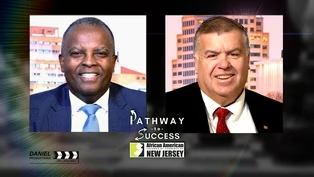
Mike Reagan (VP CGI), talks diversity & using technology to help clients & young people.
John E. Harmon, Sr., Founder, Pres. & CEO of the African American Chamber of Commerce speaks with Mike Reagan (Sr. VP CGI) about family, diversity and how CGI uses technology to help his clients as well as young people in the community. Produced by the AACCNJ, Pathway to Success highlights the African American business community.
Problems playing video? | Closed Captioning Feedback
Problems playing video? | Closed Captioning Feedback
Pathway to Success is a local public television program presented by NJ PBS
Diversity: Different points of views benefit the bottom Line
Season 4 Episode 4 | 26m 46sVideo has Closed Captions
John E. Harmon, Sr., Founder, Pres. & CEO of the African American Chamber of Commerce speaks with Mike Reagan (Sr. VP CGI) about family, diversity and how CGI uses technology to help his clients as well as young people in the community. Produced by the AACCNJ, Pathway to Success highlights the African American business community.
Problems playing video? | Closed Captioning Feedback
How to Watch Pathway to Success
Pathway to Success is available to stream on pbs.org and the free PBS App, available on iPhone, Apple TV, Android TV, Android smartphones, Amazon Fire TV, Amazon Fire Tablet, Roku, Samsung Smart TV, and Vizio.
Providing Support for PBS.org
Learn Moreabout PBS online sponsorshipannouncer: Support for this program was provided by: Horizon Blue Cross Blue Shield of New Jersey.
Berkeley College.
Education drives opportunity.
Be inspired.
[upbeat jazz music] ♪ ♪ - Hello this is John Harmon, founder, president, and CEO of the African American Chamber of Commerce of New Jersey.
And we're just delighted to have you tune in today to "Pathway to Success."
Today with me is Mr. Michael Reagan, member of the African American Chamber of Commerce of New Jersey.
He's senior vice president of CGI Technologies.
So, Mike, let's just get right into it.
You know, who is CGI Technologies?
- Well, thanks, John.
I appreciate you having me on today.
CGI is a global IT and management consulting company with just over 90,000 members worldwide in 400 locations.
We call them members versus employees because at CGI, we encourage our members to have an ownership stake in our company.
And there's pride in ownership.
And I'll get into that later.
But it's just, the culture we have at CGI is an ownership mentality.
- So a little bit about you.
- I was raised in Sayreville... - Okay.
- Middlesex County, two brothers.
My dad was a truck driver for Exxon for 35 years.
And he instilled in us hard work, nothing's free in life, and really stressed education.
So I'm educated.
My two brothers have degrees.
What's more interesting is... - Mm-hmm.
- My parents have ten grandkids.
- [laughs] - And we are-- right now, nine out of ten grandkids have degrees, with the last one a sophomore at Miami University.
So something we take great pride in is, you know, a truck driver from Middlesex County and the success his family has had through hard work and a good education.
- That is a phenomenal story, a great testament to your parents for setting the tone.
My father was a truck driver as well.
The schools you attended, let's talk a little bit about that and why.
- Sure.
I graduated from Sayreville High School.
From there in the early '80s, I went to Geneva College, a small Christian engineering school in Beaver Falls, Pennsylvania.
- Mm-hmm.
- I have degrees in both electrical engineering and mathematics.
But I knew I would not do well in a large university.
I needed that personal touch that a small Christian university would bring.
And that really has been the foundation of everything I've done in my career.
I started in New York Telephone as a network engineer.
- Mm-hmm.
- And I've done different stints at MCI and Sprint.
I'm the former CIO of BellSouth Long Distance.
I lived in Atlanta for over 25 years, so my children are raised in Atlanta.
- Mm-hmm.
- But five years ago, we decided it was time to come home.
My wife is originally from Colonia.
And we came home.
And what's interesting, all of our children followed us.
So very fortunate that the family's together.
We're very close to our two grandchildren, who is, you know, mine and my wife's pride and joy, Carli at 2 1/2, and James is 4 months.
So very fortunate to have them all here locally.
- That's an inspiring message that I'm hoping that those that are tuned in can look around at their loved ones today and embrace them and let them know how much you appreciate them and what family really means.
So CGI was founded when?
- 1976 in Canada.
Our founder is still in Canada.
Our corporate headquarters is in Montreal, and our U.S. headquarters is in Fairfax, Virginia.
And then our headquarters in New Jersey is in New Brunswick.
- Mm-hmm.
- But family's very important to CGI.
It is a family culture.
Our founder is still very involved in our company.
His daughter has a senior leadership position in our company.
And we want to have that family culture, which is one of the main reasons I've been at CGI for 17 years.
- Mm.
Talk about its mission and its core values.
- Yeah, our missions are to make our clients succeed.
And we help them solve business problems by enabling them with technology.
I mentioned earlier about the ownership mentality.
Most companies have mission statements, and most companies have values.
But what makes CGI unique is, we have a dream.
And our dream is to create an environment in which we enjoy working together and, as owners, contribute to building a company we can be proud of.
And I'll highlight a few things there-- one, working together.
None of the problems are solved by myself or any individual.
It takes a team to work with our clients and solve their business problems.
The other word I'll emphasize is "owners."
It's a different mentality when you have an ownership stake in something.
- Mm-hmm.
- Right?
There's pride in ownership.
You bring that pride to our clients.
We have a saying at CGI.
No one ever washed their rent-a-car.
But when it's your own car, you make sure you maintain it 'cause you have a pride in ownership.
And that's really what sets CGI aside from other companies is that pride in ownership and that ownership mentality.
- So services that you all provide.
- Provide services to multiple industries.
- Mm-hmm.
- Here in New Jersey, I really focus on life sciences, utilities, manufacturing.
We provide management consulting to help them solve their business challenges.
And then we follow it through with technology, which is an enabler to solve those business challenges.
- So projects that you can speak to and elaboration on some of the sectors that you work in.
- Sure.
State and local government, we do a lot of work with Department of Environmental Protection in the state of New Jersey.
We do a lot of work with DCA.
DCA, for example, we put together a piece of software right after Superstorm Sandy that allows the state of New Jersey to track all the federal money.
We've pivoted from there and we're doing the same thing with COVID relief money.
- Mm-hmm.
So what is a typical day like for you?
- There is no typical day, right?
I spend time with clients, helping them solve their problems, time with our members, interacting with them.
I spend time out in the community.
I am the face of CGI in New Jersey.
- Manufacturing-- and you and I both have a relationship with John Kennedy-- or Dr. John Kennedy, who's the president of New Jersey MEP.
So what are some of the things that you're doing with New Jersey MEP and how we're working collectively to get more focus on the manufacturing sector?
- Sure.
Yeah.
CGI and New Jersey MEP through John has built a relationship recently-- and manufacturing is newer for us in the state of New Jersey... - Mm-hmm.
- On how CGI can help his membership.
So we put together a program where we will work with John's members to help them automate and improve their processes.
What we're finding is, a lot of John's members are small to midsize manufacturers.
And a lot of the work that they do from a process is all manual.
- Mm-hmm.
- And consulting companies typically don't tend to focus on those midrange companies.
They tend to focus on the larger logos.
But there's definitely a need that if a company like CGI can come in there with programs to help them automate their processes, right, drive costs out of their business, they then can reinvest that money back into their operations, whether it's hiring additional people, setting up additional production lines, but just gives them the opportunity to take cash away from manual processes and invest it back into their business.
And what we're seeing through this program is, John, as he's helping us go to his membership, really is becoming a salesperson for CGI because he sees the value that CGI can bring to his membership.
And it's a value add that he sells to his members when they ask him, like, why should I be part of New Jersey MEP and the value that you bring to me?
This is just one example of John working with his membership, bringing value through CGI.
- John Kennedy is a friend, he's a supporter of the African American Chamber of Commerce, the president of New Jersey MEP, and works tirelessly across the state trying to get folks connected to the manufacturing sector.
When many thought it was dead, you know, he went to Congress, state legislators, you know, beating on the table, if you will, at times, letting individuals know the significance of manufacturing.
We need collectively to talk more about manufacturing in New Jersey because to build stuff is important.
It creates a lot of jobs.
It fuels the economy.
And there's a lot of wins in that continuum.
- Absolutely.
- So I'm gonna take a break here now here on "Pathway to Success."
We'll be back in a moment.
announcer: The African American Chamber of Commerce of New Jersey is your pathway to success.
We encourage you to visit our website at www.aaccnj.com, or call us at 609-571-1620.
We are your strategic partner for success.
- Welcome back to "Pathway to Success."
I'm your host, John Harmon, founder, president, and CEO of the African American Chamber of Commerce of New Jersey.
Joining me today is Mr. Mike Reagan, my man, of CGI Technologies.
So now let's talk a little bit about programs, how you connect the vision and the mission of your organization back to the people within the community.
P-TECH, what is that all about?
- Yeah.
Thanks, John.
And P-TECH-- there's a saying I have.
It's, sometimes it's better to be lucky than good.
Here's CGI's story with P-TECH.
And it was an absolute fluke.
It goes back to my family.
I talked about my children.
My oldest daughter, Katie, is a teacher in New Brunswick.
And I was sitting on a couch watching a football game with my son.
And his phone rang, and I heard them talking.
At the time, my son was in grad school.
And when he was in grad school, he helped the university write grants for funding.
And when he hung up, I asked him what that was about.
And he said, I don't know.
Katie's writing a grant for her school district.
OK. Fast-forward two or three months, I was talking to her, and she seemed a little down.
And I asked her why, and she said, my grant that I applied for a STEM camp got denied because they ran out of funds.
- Mm-hmm.
- So at a STEM camp, what are you trying to do?
Said she wanted to bring a STEM camp.
And STEM is bringing technology to younger students.
CGI does STEM camps all over the country all the time.
I said, you don't need a grant for that.
I will get CGI to do a STEM camp at your school.
- Wow.
- When we go to schools when we do STEM camps, it's an after-school program.
We're there from roughly 3:00 to about 8:00 at night.
We take half of the student bodies and we put them in a programming session.
The other half of the student body, we bring in old computers and we take them apart.
And we teach them here's what a motherboard does.
Here's how it interacts with the keyboard.
We take a break, we throw a pizza party, and then we switch them.
As we were doing a STEM camp at Woodrow Wilson Elementary School in New Brunswick, I was walking the halls with the principal.
And Mr. Smith said to me, are you familiar with what New Brunswick's doing with P-TECH?
And I said no.
And he says, you really want to get with Dr. Johnson, the superintendent.
And I think your company would be ideal business partner for our P-TECH program.
Fast-forward.
I met with Dr. Johnson.
P-TECH is a program that was set up through grants from Governor Murphy in 2019 that allows school districts to set up a separate high school for STEM.
- Pathways in Technology Early College High School.
- I like the class because we have to solve a problem, find a solution.
- We learned how to, like, vocalize ourselves, how to present ourselves.
That has helped me a lot, since I used to be, like, really shy.
- We are proud to be here in New Brunswick, working closely with P-TECH.
You're gonna be spending time in this office.
As part of your next phase of your education, you're gonna be in the CGI offices, working with my project teams and helping my clients.
- When they teach, like, they actually legit love it.
They actually want everyone to participate, be engaged socially.
And, you know, the work that they give out is-- you know, it's interesting and it's fun.
These great staff and teachers we have here that P-TECH provides us, they've inspired me to pursue what I actually want to do.
- Think of this as a technology vo-tech school where the focus is on engineering, computer science, where the students start this curriculum in ninth grade.
It's a six-year program.
In theory, the students will graduate with their high school diploma and an associate's degree in some STEM field in six years.
So we are aligned with New Brunswick and Middlesex County College to help these students through this path.
What CGI provides them is a few things--mentoring.
- Mm-hmm.
- We start working with these students in the ninth grade.
And I've always said this.
CGI does a lot of hiring, particularly in New Jersey, out of the universities, whether it's Montclair, Rutgers, Rowan.
And we get great talent.
But when they join CGI, it typically takes us about six months to put them through training and get them ready to put in front of my clients.
That training that those students with four-year degrees go through, I am going through that same training with the P-TECH students in bite-sized chunks starting in the ninth grade.
So when they graduate from the P-TECH program and come to CGI, they hit the ground running.
I don't have to train them for six months before I can put them in front of the clients.
They've been getting this throughout the entire six years of the P-TECH program.
- So, Mike, this is exciting stuff.
The one thing that has got my attention is hands-on.
Tell the viewers, the people who are now at the edge of their seats, how can they get more information.
- Yeah, well, P-TECH, it was initially three grants that went to Passaic, New Brunswick, and Burlington Township.
And Trenton has gotten the fourth grant.
If it is something that the local school district is interested in, I suggest working with the Department of Education and the governor's office to see if we can get more grants to start these programs in other townships besides the four that currently have them.
P-TECH is a program that was started actually about 15 years ago with IBM in New York City.
- Hmm.
- This program is global.
And we're in the process of setting up an ecosystem where not only do we train them, but then we provide jobs for them so we don't train this talent and they take jobs in other states.
We want them working right here, contributing to the innovation economy in the state of New Jersey.
- Well, we have to applaud Governor Murphy for having the vision and the foresight to bring this to fruition.
I think our collective strategy today should be, how do we expand this resource?
Because by having more people engaged in the STEM field, that will lead to more innovation but also start to create a pipeline, as you've referenced, for future employees, future careers, higher salaries.
And that would also help a lot of families get from one socioeconomic status to another.
And so let's go a little deeper here.
You are a member of the African American Chamber of Commerce, or CGI is, very large corporation that's global as you look at its entire footprint.
You know, we've been having conversations about, how can we work with you with some of our members?
Speak to potential opportunities that could be derived from that collaboration.
- Sure.
Well, we plan on working with your membership the same way I work with my current clients.
You know, how can we help them solve their business challenges through technology?
In addition, since CGI does work particularly in our state and local governments, there's usually requirements in those contracts to work with minority-owned, women-owned businesses.
And I have to partner with companies that are minority-owned, women-owned in order to win those contracts.
What we're seeing is, that requirement is slowly bleeding over into the commercial space.
So I'm gonna have to partner with your membership, John, in win-win situations around the state of New Jersey for all of us to be successful.
- So elaborate on it a little more.
Why are these strategies important, just to hear your perspective on the value proposition of these collaborations?
- Absolutely.
When we bring a project team to a client that is diverse and inclusive, it brings very different point of views.
- Mm-hmm.
- And we all have a point of view, and sometimes we think, my point of view is the right point of view.
- Mm-hmm.
- The real answer is, the right point of view is in the middle.
And it's our collaboration.
I want yours, John.
I want mine.
I want the other team members'.
This way, we're bringing the best of CGI forward.
- Mm-hmm.
- And I can't do that unless I have partners that help me shape my point of view for my clients.
- That's an excellent point.
I often say it provides a competitive advantage.
- Absolutely.
- Let's talk a little more about our state, New Jersey.
- John, absolutely.
The cost of doing business in the state of New Jersey is higher than most states.
But I do think there's a couple things going on.
One, I'm very happy to hear that our governor is going to not extend the surcharge, so we'll get a 2 1/2% reduction at the end of this calendar year.
But I think you have to take a step back.
Yes, it is expensive to do work in New Jersey.
However, I do believe New Jersey has the most talented workforce.
- Mm-hmm.
- In order for me to be successful, I have to have great talent on my projects.
New Jersey, through these great educational systems that we have, whether-- I guess I mentioned Montclair, Rutgers, Rowan, TCNJ, Middlesex College where the P-TECH students go provide a great talent pool for me.
The other thing is, I hire locally.
I work on project locally.
And I believe New Jersey has a fantastic location, whether it be the Jersey Shore, the mountains in North Jersey.
I can be in New York City on Broadway shows in an hour.
I can be in Philadelphia.
If I expand that out a little bit, you know, within 2 1/2, 3 hours, I'm in Washington, D.C., or I'm in Boston, so great location, great workforce.
And over time, I believe that our governor and legislators will start lowering some of the barriers to being successful in New Jersey, particularly the corporate business tax.
- I think you made some excellent points about the assets, about the diverse talent here.
But I think the most significant, your willingness or the willingness of CGI to leverage the diversity for an optimal outcome.
And so hearing that from you, echoing what we say all the time, we're in this to make New Jersey more competitive.
To have a relationship with CGI and you, I think we're gonna have a great year.
The pandemic-- talk about that, its effect on your business model during those tumultuous times.
- Yeah.
- It's not over yet.
- No, it's not over.
And here's what we found.
Just like most companies when the pandemic hit, we had to vacate our offices, vacate our clients, and work remotely.
Being a technology company, we had the technology in place to do that.
But I'll be honest.
When we started the pandemic, I think I was married 32 years.
I'm not sure I would have made 33 if I had to keep working from home.
And I hear that from members all the time.
And what we've done at CGI is, is we've asked our members to come back into the office or to be with our clients about three days a week.
We find great value in collaborating.
And you can't collaborate-- you can't have that personal touch in front of a computer screen.
- Mm.
- We believe in, let's get together.
Let's solve problems together as a team.
Let's celebrate successes.
Let's go out to lunch.
So I'm happy that we are back in our offices and back in front of our clients.
And I think we'll be able to leverage the technology to stay in that hybrid model going forward.
- Over the next five years, where do you anticipate-- you know, where are you guys going?
- Yeah.
Well, at CGI, we have a five-year plan.
And what we do in our five-year plan is, we want to double the size of our company within five to seven years.
- Mm.
- So we're gonna grow our company globally as well as in New Jersey organically by growing my existing footprint and inorganically in finding the partners that have the same values and culture as CGI and possibly merge them into our company to grow.
- Your relationship with the African American Chamber of Commerce of New Jersey is significant.
- Absolutely.
Like I mentioned earlier, you know, the diversity that your organization brings, the talent it brings, we are very excited about our new relationship.
And I think the sky is the limit on what we can do together to bring win-win propositions to your membership.
- You said all this great stuff.
People may want to reach out to your organization.
How can they find you?
- You're welcome to stop by anytime and take a tour of our operation and see all the exciting things we're doing in New Brunswick within the state of New Jersey.
- Well, Mr. Mike Reagan, we're just delighted that you would join us today.
And be well, my friend.
And to our viewers, on the next time on your "Pathway to Success," this is John Harmon, founder, president, and CEO of the African American Chamber of Commerce of New Jersey.
Thank you for tuning in today.
Today's message is collaboration.
And if you noticed, some of our more recent guests were not Black businesses.
And that's intentional because our strategy coming into 2023 is to really show our collaboration with some of these corporations and larger businesses that embrace diversity.
There's still some reluctance in the marketplace here in New Jersey.
And our ability to showcase those companies who are willing to be on camera to talk about our relationships, talk about their commitment to diversity in a meaningful way, I think that leads to the transformation.
The data is not lying to us.
The data is well documented by some of the most credentialed professionals in the marketplace that working with diverse businesses, specifically Black businesses, you get better outcomes, notwithstanding the sector.
So we're trying to bring some real, live examples or testimonies to lend more credibility as we continue to advocate in the weeks and the coming years.
And so repetition is good.
We're gonna sound the alarm until more and more businesses realize that this is in their interest.
The last thing I'll say, you know, coming out of the whole George Floyd situation, I believe that it was the children that challenged their parents at the table to say, hey, Mom, hey, Dad, this is a bad situation, but some of these people that are being marginalized are my friends.
And, Mom and Dad, are you really like that?
It is time for you, Mom and Dad, to show society who you are and what you represent through the work that you do.
Again, thank you for joining us today.
Let's keep it going.
We're committed to making New Jersey a better place to live, work, and play.
♪ ♪ announcer: Support for this program was provided by: Horizon Blue Cross Blue Shield of New Jersey.
Berkeley College.
Education drives opportunity.
Be inspired.
Diversity: Different points of views benefit the bottom Line
Video has Closed Captions
Preview: S4 Ep4 | 32s | Mike Reagan (VP CGI), talks diversity & using technology to help clients & young people. (32s)
Providing Support for PBS.org
Learn Moreabout PBS online sponsorship
- News and Public Affairs

Top journalists deliver compelling original analysis of the hour's headlines.

- News and Public Affairs

FRONTLINE is investigative journalism that questions, explains and changes our world.












Support for PBS provided by:
Pathway to Success is a local public television program presented by NJ PBS