
Diversity in the Nation’s Newsrooms/Journalists
Season 48 Episode 38 | 26m 46sVideo has Closed Captions
Diversity in the Nation’s Newsrooms/Journalists | Episode 4838
Continuing our special series, “Do Black Lives Matter in America?”, produced in partnership with Bridge Detroit. Today, we’ll take a deeper look at media coverage of the black lives matter movement and the role of African American journalists. Episode 4838
Problems playing video? | Closed Captioning Feedback
Problems playing video? | Closed Captioning Feedback
American Black Journal is a local public television program presented by Detroit PBS
Diversity in the Nation’s Newsrooms/Journalists
Season 48 Episode 38 | 26m 46sVideo has Closed Captions
Continuing our special series, “Do Black Lives Matter in America?”, produced in partnership with Bridge Detroit. Today, we’ll take a deeper look at media coverage of the black lives matter movement and the role of African American journalists. Episode 4838
Problems playing video? | Closed Captioning Feedback
Where to Watch American Black Journal
American Black Journal is available to stream on pbs.org and the PBS app.
Providing Support for PBS.org
Learn Moreabout PBS online sponsorshipComing up on American Black Journal we are continuing our special series.
Do black lives matter in America?
Produced in partnership with Bridge Detroit.
Today, we're gonna take a deeper look at media coverage of the Black Lives Matter movement and the role of African American journalists.
Don't go away.
American Black Journal starts right now.
Announcer 1: From Delta Faucets to Behr Paint, Masco Corporation is proud to deliver products that enhance the way consumers all over the world experience and enjoy their living spaces.
Masco, serving Michigan communities since 1929.
Announcer 2: Support also provided by the Cynthia & Edsel Ford Fund for Journalism at Detroit Public TV.
Announcer 1: The DTE foundation proudly supports 50 years of American Black Journal in covering African American history, culture and politics.
The DTE foundation and American Black Journal partners in presenting African American perspectives about our communities and in our world.
Announcer 2: Also brought to you by Nissan foundation, Ally and viewers like you.
Thank you.
♪♪ Welcome to American Black Journal.
I'm Stephen Henderson.
And I'm Orlando Bailey from Bridge Detroit.
Our special series of reports on Black Lives Matter continues with a look at how the news media are covering stories about racial injustice.
Plus, we'll hear from journalists of color on what it's like to report on stories that impact them personally.
Let's get started with a report from One Detroit's Will Glover on the importance of diversity in the nation's newsrooms.
WILL: Historically black Americans are underrepresented in decision making positions in one of the country's most important institutions, the news media, but why does it remain this way?
Is it denial in unawareness of the status quo?
Here's Vincent McCraw, president of the Detroit branch of the National Association of Black Journalists.
Unfortunately, over the years, I think it's a little of both.
I think newsrooms have been in denial for a long time.
And now when we see the culmination of these events just this year with the pandemic, the protest and some violence related to racial injustice issues around the country, and even this election now.
It's even more important that the voices of journalists, black journalists in particular, and people of color, be in these newsrooms, not only just in reporting positions, but in the news decision making positions.
WILL: Objective observation is a cornerstone of journalism.
If newsroom directors don't understand or acknowledge that if all observers are the same, and thus, what they consider to be objective is the same, then this can lead to incomplete stories or coverage that may miss the point entirely.
Many are starting to understand.
Many do understand and have understood for a long time, but then they lose their way.
What they all should be looking for and understanding is that we as black journalists and journalists of color, the life experiences, the lived experiences that they bring to a newsroom, the way they see a community, the way they cover a community.
And it doesn't mean that there's, and that's not to suggest that they'll cover it any different than any journalists would cover a community.
But when you bring your lived experiences to the job then there's a different eye.
You see something that a white journalist is not gonna see.
WILL: That difference in life experience can be seen in moments like when CNN reporter Omar Jimenez is arrested live on air.
The anchor doesn't address the fact that the police arrest people with little to no explanation regularly, an observed truth in the black community.
REPORTER: We don't know why they are being arrested.
They're not being given any explanation as far as we can hear for why they are being arrested.
We don't know why they're being handcuffed.
WILL: Or when senior writer for the Root, Michael Harriet was arrested.
REPORTER: They're asking if he's media.
He says he is.
I wasn't the only one who didn't have visible credentials.
I wasn't the only one who was filming.
The only thing that distinguished me from the other people in that area was that I was black.
And the reason that Michael and the other, they weren't surprised is because it's a part of their lived experience.
Either in their own private lives.
It may not have been them who's been arrested or harassed by police, but someone close to them, some relative.
And frankly, many of us, particularly, many of us black men have been pulled over by the police for something.
A new survey from the Knight Foundation and Gallup show 79% of Americans feel news organizations should increase diversity among their staffs to better reflect the make-up of the U.S.
population.
I spoke with Michael McCarter, a managing editor at the USA Today Network about the role of diversity standards and ethics in the media.
So this is a pretty challenging time to be a black journalist in America, not that there's an unchallenging time to be a black journalist in America, but this is a particularly challenging time.
But it's also a challenging time for newsrooms and the people who inhabit newsrooms, whether they be black or white to make decisions about how to cover African Americans, African American issues, things like police brutality and systemic racism.
I want to start with just your reaction to the way that American media is handling this moment.
Well, I don't want to paint anything with a broad brush, but I will say because everybody's handling things in their own way, just depending on what corner of the country you're in.
I will say that I am actually rather impressed that it has received the intense attention that it has, because there have been times previously where any issue like this would get tamped down simply because it got zero coverage or very minimal coverage.
Now could I say that everything has been handled fairly?
No, absolutely not.
There are some markets where it's sometimes you can see bias seep into some the coverage.
But overall I am impressed, especially because it's been, you know, 90 days, more than 90 days, and the coverage is still there.
It hasn't gone away.
It hasn't been one of those flavors of the week, and, you know, they've moved onto the next thing.
Yeah.
You and I have worked in newsrooms a long time, so we know how things work and how decisions get made, but give our viewers a sense of the way in which these issues get discussed and sort of debated in newsrooms as you're thinking about coverage, and how prominent black voices are in those discussions and in those decisions.
Well, again, it depends on what newsroom you're in and what company you work for and what part of the country you're in, because if you are fortunate enough to have a newsroom that has diversity and it's not just diversity in the room, but you have diversity in leadership ranks and decision making ranks, you can have more thoughtful conversations about how to approach the storytelling of these issues of today.
And you can also have very thoughtful and considerate conversations about, once the reporters come back, about how these stories are going to be presented.
It's very important that these things be thought through and conversations be had.
And you have to have a diverse newsroom, otherwise you run into situations where if you have people in the room that don't have the empathy, don't understand, have never been in some of the situations, don't understand what the big deal is, then the way they frame the stories takes a whole different tone.
Yeah, yeah.
I also think that there's a particular challenge here that doesn't get talked about a lot.
And that's the challenge to white reporters who don't share the experiences obviously that African American reporters might have, but the need for them to be able to learn and try to gain some of the understanding and knowledge about the African American experience that will help them cover these issues a little better.
I'm not sure that I feel like in most newsrooms that imperative reaches the highest levels of decision making.
I feel like it's a kind of lack of awareness of the need to have not just more black reporters in the room, but also to change the way that white reporters and editors deal with these things.
I don't disagree with you.
And I think there's some that would argue that's one of the challenges that we're facing right now in policing is that it's hard to look in the rear view mirror and fix anything, but if you know that your reporters have not traditionally gone to certain neighborhoods, have not traditionally asked to interview people of color, have not traditionally tried to do uplifting stories in certain communities, then when it all hits the fan you don't have an in, it is much harder for people to trust you.
It becomes something that you can't really fix overnight in the heat of the moment.
What I work hard to do is to make sure that not only do we have reporters of color in the room who can offer some insight and do have an experience that they can share with the room, but that we get our reporters that aren't traditionally in those neighborhoods out more often.
And get them, I won't say trained, but get them familiar with the neighborhoods that they don't normally visit.
You know, I won't go so far as to say that you have to have black people covering black issues, because that just wouldn't be fair.
I'm not saying that a white journalist cannot cover black issues well if they worked at it, but I would not sit here and say that I could cover women's issues fairly and accurately because I don't have that life experience.
And it's important that that's in the room and that those opportunities would be made.
I would hate for any news organization to just hire people of color so when things go bad or things go sideways or they want reporting out of a different community they can just send the black reporter.
To me that's not really helping the issue.
That's a very poorly attached band-aid.
I think it's also imperative that this is work that has to go on all the time.
The explosion of interest nationally in the BLM movement is a moment and that's important, but to be prepared for that moment you have to have been doing the work before.
And I think that's how newsrooms and reporters get caught flat footed is that we don't spend the time when there isn't a crisis or when there isn't a huge news headline getting people to understand that these issues matter.
And that you can't just jump into 'em and really understand what's going on.
We gotta be working all the time to improve.
Absolutely.
I mean, there's a proverb I use a lot that says, "The time to fix the roof is when the sun is shining."
We have to be in the neighborhoods when everything is okay and everything is fine.
We have to have conversations with people just over normal topics, normal issues.
So then when things do escalate or there are issues that are more challenging, the effort to get into the neighborhoods and have people trust and talk to you is not nearly as hard.
So what is it like to be a journalist of color covering the Black Lives Matter protest and other stories about racial injustice?
Are you expected to separate personal experience from professional reporting?
I post these questions and more to journalists Katrease Stafford of the Associated Press and Olivia Lewis from Bridge Detroit.
The murder of George Floyd has reverberated in cities all over the nation, including Detroit.
How do you feel about the coverage of perhaps the the largest modern civil rights movement is being covered by media organizations in the city and around the United States?
Kat, we'll start with you.
I kinda compare it to every time a crisis hits America, if you look at our coverage of Hurricane Katrina.
If you look at the coverage around Trayvon Martin and so many other deaths that have come before.
Whenever you talk about the media writ large and coverage there are always obvious gaps and holes in coverage.
And I believe that's a reflection because of the newsrooms not having the right people in there to add the proper nuance, to add the proper coverage that is needed to really explain to readers what's happening.
And so when you asked me how do I feel about the coverage of George Floyd, I feel the same way that I felt in previous years, where I feel that there's a lot of great coverage, there is a lot of nuanced coverage that I am seeing, but I feel that we can always do more and do better.
Yeah, Olivia you're covering protests and watching, following this story closely here in the city of Detroit.
How do you feel about the media's coverage of this civil rights movement, this Black Lives Matter movement and the protests that have ensued in cities across the nation, including our city?
Right.
So, you know, when I think of all of the protests that are happening, not just here in Detroit, but everywhere, the Black Lives Matter movement started in 2013.
So going back to that time there were reports going out in 2013 that were asking if Black Lives Matter was a terrorist organization, which is crazy.
And so now, and there are still reports that are going out with that question.
And it's like when we think about the words that we're writing or the words that we're saying on podcasts or TV or whatever, radio, like those words have meaning.
And so it affects the way that the community sees the protest, how it's happening, the people who are involved.
And so when we're asking questions like, oh, well, has there been any looting or how many people have been arrested, those questions matter.
And so we have to think about our reporting in terms of how is this affecting the community?
What is the community doing to either be involved or what are their feelings about the protest?
And so I think that there's been a lot of reporting in terms of there's been a lot of change in the way that protests have been covered, but it's still being covered from the forefront in terms of like a crime story, which I think is very troubling.
I'm glad to see that there have been some changes.
Like there's, I think it was on NPR.
There was like a stance about how headlines should say a black man was shot and killed and murdered instead of an unarmed black man, and just the difference that that makes in terms of the reader and understanding the issue.
But locally, those little things can make such a huge difference.
And so I think Bridge Detroit has done a really great job in terms of looking at what the community is doing, how the community is acting and reporting those stories.
And, you know, I guess cementing how important it is to have newsrooms that are reflective of the makeup of the cities that they are covering to add that layer of nuance that non-reporters of color or journalists of color will miss, because they just have a different experience.
Right Kat?
Absolutely.
And just thinking about the city of Detroit, using that as an example, if you are from the city, if you know the neighborhoods, you know the power players, you know who the grandma is on that street, you know the right people to interview.
You know the right questions to ask.
You have that perspective that's really ingrained in you to know what's going on in the neighborhood.
You're not just what I call parachuting in to get a story and then leaving.
You're invested in the community.
And in my opinion, that is something that every newsroom should hope for, not even just local news.
Now I'm on a national level and it's like how do you bring that perspective into national coverage?
And it's by still amplifying those voices, still finding the right context and the right people to talk to.
So even thinking about who am I interviewing in these stories?
And if you are not using the right voices in your stories, that's a problem.
That's why we're going to continue to have this coverage that feels like it's just scratching at the surface and not getting at the underlying issues.
That makes so much sense.
Let's talk about facts versus the narrative that we hear from the president and other spaces of power, right?
Does that narrative line up with what you know is happening on the ground?
I think a lot about how President Trump lately has really kind of stuck to this law and order narrative that he wants to restore law and order in communities across the country.
And what we know what that's doing is that's signaling, he's trying to signal to a certain base.
He's trying to signal to this narrative of the white suburban mom who he, you know, he believes that they don't want to see crime come into their neighborhoods.
And that's how, as Olivia said, that's how he is painting the picture of the movement for black lives.
But what we know is on the other side, they're saying, we're not out here trying to destroy neighborhoods.
We are literally fighting for our lives.
So I think as reporters, it's on us to provide that, once again, nuance is my favorite word lately.
To share facts and the facts are that there people protesting in the streets because they are tired of seeing black men die at the hands of police.
They are tired of seeing police brutality.
They are tired of seeing people of color die disproportionately from COVID-19, right?
It's not even just about police protest.
And so how do you cover that?
Yeah, Olivia, we've been paying close attention to the narrative that has been cascading here in the city of Detroit, from the mayor and the chief of police, as well as the president.
Does it line up with what you know is happening on the ground and in the streets of the city of Detroit?
Not at all, just not at all.
It's actually really frustrating, especially because, and I can go back to Bryce Huffman's piece on Operation Legend because the entire, when news broke that the FBI was gonna send federal agents here to Detroit it was really confusing to people on the ground.
And said, "Wait, I thought these protests "were predominantly peaceful.
"I thought that people were, you know, "really coming together."
And now it's like, wait, now we're sending in federal agents.
What does this have to do with the protest?
And so I think it caused a lot of confusion around what was actually happening here and really tried, I feel like it was the federal government's way of trying to take over the narrative and say, well, this is what we're going to do and how we're gonna react.
And even though it ended up not being about the protest, it was very confusing and an unsettling time when it didn't have to be.
I wanna ask you both about what, the layers that exist in being black women and journalists covering Black Lives Matter.
What's going on with you, Olivia, internally as a black person, as a black woman, as a journalist who is expected to put words to an experience that people are feeling and going through, but that you're also going through at the same time?
Mm-hm, yeah.
You know, honestly, I feel very fortunate because I work for Bridge Detroit.
So like back to your earlier statement about being in a newsroom that also represents the community that we're covering, I think that is so tremendously helpful just for my own sanity and my own peace that I know that I can rely on my team and that if I have questions, you guys are gonna be there for me, or if I am doubting myself or the things that I'm doing, I can always go back to my team.
And I didn't always feel like that in other newsrooms.
And so I feel like that's a huge part of it, but also, I feel very invested in the stories that we're telling that.
I really want to tell stories that reflect the community or are answering the community's questions.
Like it's not just about saying, okay, there was a protest today.
This many people got arrested, or this many people didn't get arrested.
You know, it's more than that.
It's like Kat said.
When you think about the neighborhoods, you know, who were the people involved?
What's going on in the neighborhood and how is the protest impacting them, or how are they getting involved in the protest?
All of that matters and so I feel very invested in the stories that we're telling.
These past several months have forced me to rethink journalism and how I approach my own reporting, because I've just been in my head trying to explain what does being objective mean?
You know, when you're in journalism school all they talk about is the notion of objectivity.
But what I've really thought about over the past several months is the fact that I am a black woman first, and I am also a journalist.
And I believe that my experiences in America, my experiences in Detroit, inform my reporting.
It's not a hindrance.
And the goal for me as a journalist is to work in a newsroom that allows me to bring my full self into my work, to again help inform that reporting.
So as I've been watching everything unfold, I feel that as a journalist I have to get it right.
And I think about that every day, because the things that we write, the things that we report, it impacts people.
It shapes the thought process of people in Detroit and beyond.
So I think it's an honor to tell our stories and not take it so seriously, because I know that journalism really does have an impact on people's lives.
That is gonna do it for us this week.
You can see extended interviews with today's guests at AmericanBlackJournal.org.
Plus you can find additional resources and reports at BridgeDetroit.com.
Join us next week when we look at the relationship between police and the community in the midst of the Black Lives Matter movement.
Meanwhile, let us know what's on your mind.
Connect with us on Facebook and on Twitter.
Stay well and we'll see you next time.
♪♪ Announcer 1: From Delta Faucets to Behr Paint, Masco Corporation is proud to deliver products that enhance the way consumers all over the world experience and enjoy their living spaces.
Masco, serving Michigan communities since 1929.
Announcer 2: Support also provided by the Cynthia & Edsel Ford Fund for Journalism at Detroit Public TV.
Announcer 1: The DTE foundation proudly supports 50 years of American Black Journal in covering African American history, culture and politics.
The DTE Foundation and American Black Journal partners in presenting African American perspectives about our communities and in our world.
Announcer 2: Also brought to you by Nissan Foundation, Ally and viewers like you.
Thank you.
♪♪
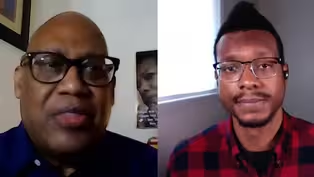
Diversity in the Nation’s Newsrooms
Video has Closed Captions
Clip: S48 Ep38 | 12m 2s | Diversity in the Nation’s Newsrooms | Episode 4838/Segment 1 (12m 2s)
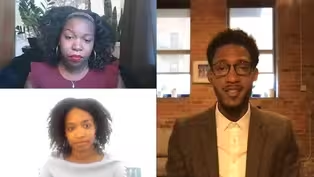
Video has Closed Captions
Clip: S48 Ep38 | 11m 6s | Journalists | Episode 4838/Segment 2 (11m 6s)
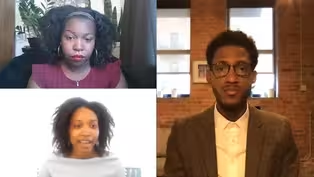
Katrease Stafford & Olivia Lewis Extended Interview
Clip: S48 Ep38 | 18m 18s | Katrease Stafford & Olivia Lewis Extended Interview (18m 18s)
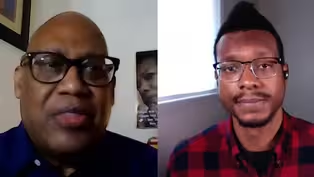
Michael McCarter Extended Interview
Clip: S48 Ep38 | 11m 22s | Michael McCarter Extended Interview (11m 22s)
Providing Support for PBS.org
Learn Moreabout PBS online sponsorship New Episode
- News and Public Affairs

Top journalists deliver compelling original analysis of the hour's headlines.

- News and Public Affairs

FRONTLINE is investigative journalism that questions, explains and changes our world.




 New Episode
 New Episode



 New Episode
Support for PBS provided by:
American Black Journal is a local public television program presented by Detroit PBS