
Diversity & Inclusion and Corporate Social Responsibility
Season 3 Episode 311 | 26m 48sVideo has Closed Captions
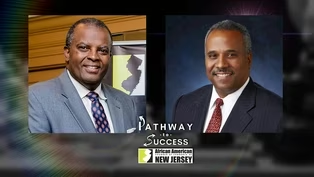
Neil H.Wilcox, of FiServ, talks about DEI and Corporate Social Responsibility.
John E. Harmon, Sr., Founder, Pres. & CEO of the African American Chamber of Commerce speaks with Neil H. Wilcox, Head of Corporate Social Responsibility at FiServ, about how they are addressing Diversity & Inclusion, by helping small businesses in communities around the country. Produced by the AACCNJ, Pathway to Success highlights the African American business community.
Problems playing video? | Closed Captioning Feedback
Problems playing video? | Closed Captioning Feedback
Pathway to Success is a local public television program presented by NJ PBS
Diversity & Inclusion and Corporate Social Responsibility
Season 3 Episode 311 | 26m 48sVideo has Closed Captions
John E. Harmon, Sr., Founder, Pres. & CEO of the African American Chamber of Commerce speaks with Neil H. Wilcox, Head of Corporate Social Responsibility at FiServ, about how they are addressing Diversity & Inclusion, by helping small businesses in communities around the country. Produced by the AACCNJ, Pathway to Success highlights the African American business community.
Problems playing video? | Closed Captioning Feedback
How to Watch Pathway to Success
Pathway to Success is available to stream on pbs.org and the free PBS App, available on iPhone, Apple TV, Android TV, Android smartphones, Amazon Fire TV, Amazon Fire Tablet, Roku, Samsung Smart TV, and Vizio.
Providing Support for PBS.org
Learn Moreabout PBS online sponsorship- Support for this program was provided by Horizon Blue Cross Blue Shield of New Jersey... [light jazz music] PSE&G, proud sponsors of Pathway to Success... ♪ ♪ JCP&L and the African American Chamber of Commerce of New Jersey, working together to build a stronger community for all, Investors Bank, banking in your best interest, Berkeley College, education drives opportunity, be inspired.
NJM Insurance Group, the New Jersey Economic Development Authority.
♪ ♪ - Hello, I'm John Harmon, founder, president, and CEO of the African American Chamber of Commerce of New Jersey, and welcome to Pathway to Success.
Today's guest is an amazing individual.
We just had an opportunity recently to be on tour in the great state of Illinois, so I'm interested to see and what he has to share today.
I speak no other than Mr. Neil H. Wilcox.
He's head of Corporate Social Responsibility for Fiserv, Inc. Fiserv is a multinational payment and technology provider.
And, Neil, welcome to Pathway to Success.
- John, thanks so much for having me here today.
It's a real privilege and honor for me to be with you.
- Having a relationship with Fiserv and the African American Chamber of Commerce of New Jersey is significant, but before we get into all the things that you and your organization do on a daily basis, can you share with our viewers a little bit about you?
Your background, your family, your upbringing.
You know, where are you from?
We wanna get to know you first.
- Glad to tell that story.
I'm actually a native New Jersey boy, so this is home for me.
Grew up in Montclair, home of the Mounties.
Go Mounties.
And so my-- I have a twin brother, Gary, who's actually a judge in Bergen County, and really have phenomenal family.
My mom was really a motivator, a real idol in a lot of ways for me and a hero in terms of, you know, for a good part of my life, single parent, went back to school.
My mom was a teacher.
My father was a fireman.
And went back to school, got her master's, and then her doctorate, and really set the foundation for my brother and I that education was a key in terms of being able to move forward and advance.
And so after graduating from Montclair High School, my brother and I both went to Duke University down in North Carolina, and spent four years there.
And really, for me, it was formative in the sense of learning how to think about, you know, what career possibilities could be.
And so I was fortunate after that experience to come back to New Jersey.
I worked at Prudential, spent four years at Pru, and at that time, decided to go back to law school.
By this time, I was married to my lovely wife Donna Ramsey-Wilcox.
And we both quit our jobs, went back to law school, and so we went to Georgetown, down in Washington.
Three years later, came back to the New York area, worked at a law firm, and then from there went to Chase Manhattan Bank, now JPMorgan Chase.
And so worked there as a corporate lawyer for eight years and then moved around a bit, went to Marsh McLennan, First Data, which is now part of Fiserv, and USAA, and I'm really thrilled.
I've came back to Fiserv in 2020 as chief of staff to our CEO and then took my current responsibilities in January of 2021.
- Your mother.
Can we just--you know, women are just amazing beings in the fact that she went back to school and she's a teacher, so that means she was a teacher investing in the foundation of people's future success.
Can you just talk about her a little bit?
- Yeah, happy to.
You know, my mom was really a leader in so many ways.
So she actually taught mathematics-- high school mathematics-- once she graduated from college and if you think about it, this was during the '60s, so I think she was maybe, when she got her master's, I think she was one of two women in her program at Montclair State University, by the way.
And, you know, just a trailblazer and fearless.
And so I remember when we were growing up, I know, you know, New Jersey in the '70s had its challenges as well and, you know, she was a leader in terms of civil rights, making sure people had access to vote, had opportunity, obviously active in Board of Education matters.
And so she was really a motivating force for my brother and I to aspire to greater things, and, you know, every day just trying to continue to make her proud.
- A little bit about the mission of Fiserv and then we'll transition into, you know, what is a typical day in the Corporate Social Responsibility world for you.
But, you know, what's the mission and some of its core values of the organization?
- Sure, you know, our mission or our aspiration, if you will, is to move money and information in a way that moves the world forward.
And our purpose is to deliver superior value to our clients through leading technology, targeted innovation, and really achieve excellence in everything that we do.
You know, and while that's a broad, lofty statement, we really try and bring that to a personal level.
We wanna be a human company.
Even though we're in technology, we wanna bring those capabilities to our customers each and every day.
A typical day for me in this space is really kind of, you know, a continuation of our aspiration and purpose.
So I'm trying to look for ways for us to deliver that kind of client excellence to our various stakeholders.
One of my responsibilities is to develop our ESG platform, so that's environmental, social, and governance.
So it's really, for me, a challenge and an opportunity every day.
- Approximately how many employees?
Where are some of your offices?
- Great, John.
And so, you know, you talked about it a little bit earlier.
We are a technology provider for financial services.
Think all things that help the movement of money, right?
And so we are about 45,000 employees globally and really we touch commerce each and every way that commerce happens.
We touch nearly 100% of all US households, for example, in some way, shape, or form.
And our primary businesses involve supporting banks and financial institutions such as credit unions as well as merchants from large to small and everything in between, and then we provide output services.
So think of print services, creation of cards, debit/credit cards, and other complementary services to enable commerce.
- So anyone who's making a transaction with Visa, American Express, MasterCard, they tend to run on your platform, that correct?
- That's right.
So when you either swipe or insert that credit card or debit card, we can have a hand in that transaction, be it at an ATM or at your favorite grocery store.
When you get your bill from, you know, your cell phone bill, for example, we could have a hand in producing that.
So you know, it really runs the gamut of financial services and making sure, again, that we help to enable commerce.
- Well, Neil is out around the country.
He's 100% intentional about the mission, about the focus, about the Fiserv organization in general.
Your engagement with the African American Chamber has been that and more.
So I just want to get that out because oftentimes we talk to corporations and it's very scripted and you don't know who the person is beyond what they've articulated.
Neil Wilcox is the real deal.
That said, being a New Jerseyan, how does your organization function in New Jersey with all its issues from labor costs, taxes, regulations?
How do you find a way to be competitive?
- Well, John, first of all, thank you very much.
I really appreciate the compliment, and it really is a credit to my colleagues, starting with our CEO, our management committee, really, and the 45,000 strong that represents Fiserv.
They allow me to have the opportunity to be in communities and be that intentional leader, so I appreciate that.
We're actually very bullish on New Jersey.
We've got a presence here already.
If I can maybe talk a little bit about our clients.
We've got roughly 80,000 merchants who we help enable to do their business, and we work with roughly 100 financial institutions in the state already.
So we love New Jersey certainly from the standpoint of supporting our clients.
Today we have roughly 1,000 of our associates who are based in New Jersey.
And with the new innovation center that are we building in Berkeley Heights, we look to triple that number, get it to closer to 3,000.
The innovation center is really about designing ways to move money going forward, so looking at ways the next generation, if you will, of how we move money, how we process payments.
If you look at New Jersey, it's got really everything that you could want in terms of excellent schools, both, you know, primary, secondary, and then colleges.
We are a gateway to other areas of the country and the world in terms of travel, so very easy to get there and it's really a convenient place for our clients, so we're excited about the prospects of not only being in New Jersey, but growing our presence here.
- What do you anticipate your involvement or your organization's involvement in getting young people more engaged with what you all do?
- Well, one of the things, and we're incredibly excited about it, is we recently announced a relationship with Rutgers University Newark Campus, where we're looking to build out really a partnership with Rutgers to focus on innovation in the financial services space.
And so we are excited about the relationship.
It's an opportunity for us really to deepen our roots in New Jersey and also achieve the benefits of really diversifying the mix in terms of people we work with.
We anticipate having an incubation lab, being able to work with local developers here, local business people, getting the benefit of young minds and having them help us develop things and really forming collaborative spaces, so that we can all achieve great things.
- I think about the wealth gap here in New Jersey.
I'm just thinking these potential career opportunities could be a transformer for many of the students from Newark and surrounding communities.
Why don't you speak to that?
- You know, we didn't get to this point in a couple of minutes, if you will, from a historical perspective.
But I think it's important that we start to lay the foundations to provide those opportunities going forward, and I'm excited about not only what we're doing with Rutgers Newark, but being a corporate citizen here, having the opportunity to engage folks like you, John, and other community groups really to help, to lend our talents, our time, and our treasure to help the community grow and achieve things.
If we can lift up communities through our support for small businesses, for example, that's really a scenario where all boats can rise, where, if that small business in the community is thriving, it gives the kid who maybe needs an after-school job a chance to work after school, and it can create wealth.
And, John, to your point, get to hopefully closing that wealth gap.
- No, this is great.
So we're gonna take a break.
We'll be back in a moment.
- The African American Chamber of Commerce of New Jersey is your Pathway to Success.
We encourage you to visit our website at www.aaccnj.com or call us at 609-571-1620.
We are your strategic partner for success.
- Welcome back to Pathway to Success.
This is John Harmon, founder, president, and CEO of the African American Chamber of Commerce.
We're here today with Neil H. Wilcox, head of Corporate Social Responsibility for Fiserv, Inc. And so, Neil, you know, coming into the break, I talked earlier about the intentionality of you and your organization, but also partnerships matter.
You know, you take the intentionality, you put a building in a particular location, but it's people that make it all possible for other people.
- We're excited to work with different community partners as well as our clients and corporate partners to really look at what is next in financial services, what's next in technology, and how can we deliver the very best to our clients and our other stakeholders.
- So when you talk about delivering the best, everyone had to pivot when this pandemic hit.
How did that affect Fiserv and its operation?
- You know, John, I think first of all, you know, my heart goes to families who were impacted, but I look at our business, you know, we are somewhat probably more resilient than other businesses in the sense that there's still a need for money movement.
A lot of that evolves.
So think about, you know, going to your favorite restaurant.
Maybe you didn't go to the restaurant during the pandemic, but you ordered out.
And so you still needed a way to make payments and, in fact, the pandemic actually helped us, and others I'm sure, develop ways to make the takeout experience easier.
But our business model generally was resilient, but we, like others, had to adapt.
And so I think if you look at it longer term, the ability to adapt will only help us going forward.
But if you look at the technology side, there's constant innovation.
- Mm-hmm.
- And so, you know, as that innovation occurs, I think the expectations of clients and other stakeholders only increases.
It's very exciting in terms of what the next generation is gonna look like, what the next set of capabilities will be from real-time payments, to really ways to make money move more efficiently, more inexpensively, and more securely.
And so for all of that, we are in for the long haul, and we're excited about what the future holds.
And, John, I'll also add I've got a millennial son, 24-year-old, Jonathan, too, so he helps keep me honest too as well in terms of what capabilities are.
And it's great to have him remind me every day of what I don't know 'cause that only helps keep us-- certainly helps keep me sharper.
- Well, I get the same thing.
They make jokes about me sticking CDs into the car and they have playlists.
But on a serious note, we had the murder of George Floyd.
I know that your organization has corporate social responsibility strategies before that, but what changes, as a result of that or in general, did you make your strategy around corporate social responsibility?
- Certainly George Floyd was a pivotal moment but, you know, if it wasn't George Floyd, it was Breonna Taylor.
There were just so many others.
And so the murder of George Floyd really helped us in terms of crystalizing not only our thinking, but our approach to how we wanted to engage internally and externally.
And so from that, we created what we call our Forward Together plan.
And really it's supported on four pillars.
The first is really looking to increase diversity across all levels of the company.
The second is to increase awareness through education and other means of our associate population, particularly focused on diversity, equity, and inclusion.
We wanted to be very intentional about investing in and supporting Black- and minority-owned businesses, and then we wanted to support community groups that focused on social justice, human rights, and racial equity.
And so for us, putting those pillars in place allowed us to then develop programming around that approach.
And one of the things, John, I'm really incredibly proud of with our company is a program we developed called Back2Business.
- Mm-hmm.
- And so that was launched in 2020 as a way to make a direct impact on small Black- and minority-owned businesses.
- It was important for me to put the business where I live and be an integral part of the neighborhood, and make sure that we give back.
We actually employ a lot of people from the community as well.
Clover has made Brown Sugar more efficient by allowing us to directly integrate with our website.
The Back2Business Grant is so important to Brown Sugar.
We're gonna implement shipping of our product nationwide, which is gonna create two more jobs.
- 'Cause it's touching a series of people, not just the workers, not just the landlord, but the vendors who stayed behind us and supported us, and that spreads exponentially.
- When we have corporations like yours and others that are committed to these goals and objectives that we are, that derives that mutual benefit that we're always talking about.
The African American Chamber of Commerce's core mission is to get Black businesses in a more equitable place in New Jersey's economy.
If we came to you and said, "Hey, "Neil, we have some Black businesses "that have a desire to have a conversation "with your organization about a value proposition that they would like to articulate to you," how would that be received?
- John, I think that would be received very well.
You know, at Fiserv, we have a robust supplier diversity program and, you know, we work with a number of different groups, not only minority organizations of course, but, you know, veteran organizations, women organizations as well.
So I guess the first step I would advise folks to go to fiserv.com and register with us.
John, if I could also just compliment not only you, but other chambers, you know, the African American Chamber here in New Jersey.
We've worked with other chambers across the country as well.
So, John, you mentioned earlier we had an opportunity to meet in Illinois.
That was a gathering with multiple chambers.
To me, the chambers really provide a unique opportunity for us to have that one-on-one type of engagement.
- You know, you referenced earlier over 80,000 merchant service relationships, over 100 financial services-- financial institutions that you have relationships with.
I would like for you to share to the smaller businesses that might be members of the African American Chamber of Commerce of New Jersey-- just underscore the significance of our partnership and why it's important that they continue to stay engaged with the African American Chamber of Commerce of New Jersey.
- Sure, John, and if I can maybe even give an example as well.
You heard me talk a little bit before about our Back2Business program.
For those who are in the Newark and surrounding areas, stay tuned, because we are looking to additional portals to open our program.
And so a new opening of our Back2Business portal may be coming to your neighborhood very soon.
But when you look at that program and what we offer, subject matter expertise.
We offer our point of sale devices, Clover, for merchants.
And so it's bringing to bear, the experience that we have, the capabilities that we have, for small businesses.
So, you know, looking to really help you have the tools so that you can grow your business.
What enables us to do this is our relationships with the chambers, and so the fact that we are a member of the chamber gets us closer to you, so that we can have that contact, so that we can have those conversations.
You know, as much as we wanna help, we're also very interested in hearing from you in terms of, you know, are we providing the right products and services for your business?
Are there things that maybe we can or should do better?
And so having a form where we can get that feedback and hopefully create the things that are gonna help you succeed and grow, the chambers really enable those dynamics and those conversations to occur.
And so we're incredibly grateful for the relationship and we look forward really to growing it in the years to come.
- Neil, that was a great response and it took me back to when the PPP resources were being distributed.
Because many small businesses did not have a connection to the African American Chamber or other organizations, they were left out on the street, but what you shared is so critically important.
So to everyone that has tuned in today, you know, I just wanna thank our special guest, Neil Wilcox, head of Corporate Responsibility of Fiserv, Inc. Until the next time, on your Pathway to Success, this is John Harmon, founder, president, and CEO of the African American Chamber of Commerce of New Jersey.
[light jazz music] ♪ ♪ You know, partnerships matter.
We just had a conversation with Neil Wilcox, and he talked about the programming as it relates to corporate social responsibility.
He also talked about putting resources and opportunities and information where people can get them, people who traditionally would not have access to.
But through their partnership with the African American Chamber of Commerce, we serve as the bridge, as the connector, to introduce our members, our constituency, to the vast resources and opportunities and information that exists through Fiserv.
He mentioned they have over 80,000 merchant service relationships and over 100 financial institutions in the state.
You know, every transaction, you know, at your local takeout, you're swiping a card.
And this company not only produces the cards, but they have the platform to disseminate that transaction.
They are a member of the African American Chamber of Commerce of New Jersey.
We search far and wide for corporations like Fiserv because we realize that they have something to offer to our members.
We talked about career opportunities.
We talked about supply and diversity.
we talked about corporate citizenship investment.
I will say to you that we seek out these credible partners because you have risk capital on the line and we wanna help make you successful in your business.
Again, the African American Chamber of Commerce of New Jersey is your partner for success.
Thank you.
♪ ♪ - Support for this program was provided by Horizon Blue Cross Blue Shield of New Jersey, PSE&G, JCP&L, Investors Bank, Berkeley College, NJM Insurance Group, the New Jersey Economic Development Authority.
♪ ♪
Diversity & Inclusion and Corporate Social Responsibility
Video has Closed Captions
Preview: S3 Ep311 | 32s | Neil H.Wilcox, of FiServ, talks about DEI and Corporate Social Responsibility. (32s)
Providing Support for PBS.org
Learn Moreabout PBS online sponsorship
- News and Public Affairs

Top journalists deliver compelling original analysis of the hour's headlines.

- News and Public Affairs

FRONTLINE is investigative journalism that questions, explains and changes our world.












Support for PBS provided by:
Pathway to Success is a local public television program presented by NJ PBS