
Diversity Is a Business Necessity
Episode 4 | 26m 20sVideo has Closed Captions
Indiana's former First Lady explores how business impacts our lives and connects us.
Indiana's former First Lady explores how business connects us in different ways. Elle O'Bannon discusses studying business at Indiana University. Mario Rodriguez explains how Indianapolis International Airport fits into the complex network of air travel. Bob Wilsey connects his talents as an actor, financial advisor, and community organizer. Kathy Sipple explains the concept of "time banking".
Problems playing video? | Closed Captioning Feedback
Problems playing video? | Closed Captioning Feedback
The Common Thread with Judy O'Bannon is a local public television program presented by WFYI
Diversity Is a Business Necessity
Episode 4 | 26m 20sVideo has Closed Captions
Indiana's former First Lady explores how business connects us in different ways. Elle O'Bannon discusses studying business at Indiana University. Mario Rodriguez explains how Indianapolis International Airport fits into the complex network of air travel. Bob Wilsey connects his talents as an actor, financial advisor, and community organizer. Kathy Sipple explains the concept of "time banking".
Problems playing video? | Closed Captioning Feedback
How to Watch The Common Thread with Judy O'Bannon
The Common Thread with Judy O'Bannon is available to stream on pbs.org and the free PBS App, available on iPhone, Apple TV, Android TV, Android smartphones, Amazon Fire TV, Amazon Fire Tablet, Roku, Samsung Smart TV, and Vizio.
Providing Support for PBS.org
Learn Moreabout PBS online sponsorship- [Announcer] Generous support for the following program provided by the Bible Family Fund of the Denver Foundation and the O'Bannon Foundation, a fund of the Indianapolis Foundation.
(playful music) - [Judy] As an 88-year resident of planet Earth, I'm constantly amazed by the infinite variety of activity I see going on around me.
The complexity of it all, the way it all works together.
Every animal, every vegetable, every mineral, every solid, liquid, and gas, each its own unique contribution, just like us, to the bigger picture, the vast, infinite, interdependent, interconnected web of all creation.
I admit it's a lot for me to process, more than I can handle on my own, which is why I reached out to these people.
- I exist because you exist.
- [Judy] Some of my most thoughtful and most thought provoking fellow Hoosiers to help me sort it all out.
- I see this connectedness in my community where pieces fit together.
- You know, if we kind of allow science to inform our social understanding and whatnot, it's that we really are connected.
- If there really is a true back and forth connection between everything and everyone, what does it mean?
How does it affect, or maybe how should it affect the way we live our lives?
How we think and feel and believe and behave?
Good questions in search of good answers, which I hope we can get a little closer to as we explore the connections that exist between you and me, everyone and everything, everywhere.
(tribal music) (gentle music) We begin today by talking with someone I've known all her life.
Let me introduce you to her.
She's a senior at Indiana University in Bloomington studying business.
Her first name is Ellie.
Her last name's O'Bannon.
And yes, she's my granddaughter.
And while she's almost 70 years my junior, it was she, the kid, who really opened the old lady's eyes to that sense of connection you can only get through the study and practice of what she studied and practicing, business.
Ellie, you could have gone to school anywhere, you could have studied anything.
You chose Indiana University and you chose business.
Why?
- Well, if you think about it, everything is a business.
Your favorite podcast, where you go to get your kidney stones taken out, your favorite restaurant.
So I figured no matter where my interest developed, what I fell in love with as I age, that I could use that to kind of transform into any sort of industry.
- You are in supply side economics, what is that?
- So I'm studying supply chain management.
I also have the major of business law, ethics and decision making.
And supply chain management is essentially the study of how everything works.
So, the entire lifecycle of a product or service from the conceptualization, the planning, to the sourcing for that product.
So where you get the trees for a table or paper or anything like that, all the way to how it gets to where it needs to go to be sold.
So I really liked it because it's everything.
- So would you say that looking at it as in the concept of supply side shows how it connects us?
- Absolutely.
So you'll see things like issues with suppliers.
So if one supplier that supplies to a car company has an issue because they can't get the raw materials from some country that's having issues with their government, let's say, then you see that all the way into the issues we're having in our day-to-day lives.
So for instance, I know there's a lot of cars that can't get the microchips they need to function because we're having issues in China getting those microchips overseas.
So a lot of people are having issues with being able to get cars and also those that are making the cars are having issues because we don't need to make as many cars because we can't fully develop them.
So we see how an issue in a country that we've never even been to is affecting our day-to-day lives.
- So you're saying what happens in Ukraine and what happens with gasoline and oil from Russia really does affect what happens in Bloomington?
- Absolutely.
We're seeing gas prices go up.
We're seeing people even change how they kind of commute to different places.
We're seeing more people take up bikes.
So now the bike industry is seeing a surge because the gas prices are going up.
So it's really amazing how something that you're not even actively thinking of is subtly moving (indistinct) your life whether you realize it or not.
- [Judy] Another connection that plays a big part of my granddaughter's or anyone her age's life is, of course, social media.
- So I am the age where a lot of people have never known life without social media.
So, I got social media when I was 12.
A lot of people my age got it even younger.
So we're constantly connected, whether it's for the better or worse because, I mean, during the pandemic it was good because we were able to stay connected with those that we love, those that we miss.
So connections is really important.
And not to mention, I am in business, so every social connection I have is considered, you know, a network.
So I'm reaching out, trying to find jobs, and I'm reaching out to those I know through my social connections, through my business fraternity.
I'm reaching out asking how they're doing and their job and, you know, can you tell me a bit about it, about the company, and do you think I'd be a good fit there?
- What did COVID and the pandemic show us about our business and professional interconnectedness?
- Well, COVID showed us that there is a new way to do business.
A lot of stuff is moving online.
And because of all those business meetings moving online, I'm taking a class right now on simply how to do business via Zoom.
So we learned that productivity does take a dip when you go online initially, but you have to set up meetings in a certain way where people feel like they know who they're talking to because they don't know who they're talking to.
Coming into my generation, going into the workforce, these are people that have been here for a couple dozen years and we have no idea who they are, but we're working with them every day.
But, so the way we're learning how to do business online now is find a way to make those connections, suggest a podcast, suggest a book, talk about what's going on in your life, show them your puppy, something to show them that you're not just a robot on their screen.
That you are a person, that they are interacting with people, so they don't feel quite as isolated.
So they feel kind of an obligation, like a duty to you to get their work done so that you can get your work done and have a good product at the end of it.
- [Judy] Speaking of good products, if you think of an airport as a product, which I do, then the products don't get much better than this one, our own Indianapolis International.
(lively music) I got a chance to sit down recently with Mario Rodriguez, executive director of the Indianapolis Airport Authority.
What kinds of connections does he deal with as he leads a force of more than 400 employees serving almost 10 million passengers a year?
We will get to that question in a minute, but first I want you to hear the story of the historic, improbable cross-cultural connection responsible for bringing Mario into this world in the first place.
- My mother and father were Cubans, and they came over to the United States as political refugees when Castro took over.
As a matter of fact, it is a rather interesting story because talking about interconnectivity, my mother studied law with Fidel Castor, and she made part of the first government that was set up after Batista.
So she was a social democrat.
My father was a very, very conservative person and made a part of the Batista government.
So at the end, they eventually met up in New York.
So the political conversations around the dining room table were fantastic.
- [Judy] Mario leads a diverse workforce, which makes perfect sense when you consider the airport's diverse clientele.
- Diversity, if you really think about it, it's a business necessity because we all have different life experiences, and we're all summation of our experiences, as I said before.
So if you combine all these people, you get a better result.
If you have the same type of experiences in the same group of people, you're gonna get one answer.
If you combine different people with different experiences and life experiences, you're gonna get a richness of answers.
And it just works better.
It's been proven time and time again that that combination elevates whatever you're doing, whether it's an organization, whether it's corporation, whether it's our airport right here.
- [Judy] The airport has won six J.D.
Power Awards.
The gold standard for recognition of customer service.
- And customer service is such an incredible thing because it's all about connectivity, about connections.
Our people, because of their diversity, they're able to connect with our customers.
We have people that speak Spanish, we have people that speak multiple languages that are from different cultures, and they're able to connect with the customer base in a deeper way than they would've otherwise done if we didn't have that diversity internally.
- Although Mario now manages an enormous workforce, he began his career not in the managing business, but as an engineer.
How does being an engineer prepare you to run an organization that handles all kinds of human social issues, all kinds of technical, everything, from the weather to people's health, to security, to what did you eat?
Did you get sick on the airplane to that woman sat and she was too heavy in the seat.
- Yeah.
- How does it prepare you for all of that that gets you to where you get such awards?
- It's a great question.
Engineering gives you the ability to, at least it gave me the ability to figure out that things are completely interconnected.
Everything is completely interconnected.
The aviation system is not, there's multiple types of aviation networks.
There's hubs that use banks and coming in and out, but there's also other airlines that connect, call it milk runs, right?
In order to be as efficient as possible, they wanna maximize the utilization of the airplanes and the cruises.
So, that's why a storm in Denver could affect you here, because a plane may be going through Denver to Atlanta, from Atlanta, here.
And if there's a storm in Denver, it domino effects all the way through.
Weather, natural disasters, political problems, like in the Ukraine.
Right now that horrible war in the Ukraine is causing not just a massive amount of pain for the Ukrainians, which is heartbreaking, but it's also closed off air airspace, part of the airspace of the world.
So you have to fly around that airspace.
So it adds hours, it adds basically an economic penalty to anybody that's flying in those general areas.
So it really, it really affects everything from here, all the way around the world, and air traffic control knows exactly where it is.
You get handed off from country to country to country, but there's standards that are set worldwide by the United Nations organization called International Civil Aviation Organization, and we abide by those laws and we connect into them.
That's how everybody could talk to each other.
It's an amazing feat, not just of technology, but of human connection, where you're able to get a German airliner, a Lufthansa airliner, and move it from Frankfurt all the way over here with the same standard, with different air traffic control systems controlling the same aircraft.
You know, not one side is not a hundred percent right all the time, and there's no a hundred percent right, in my opinion, on anything.
There's no black and white.
Everything is gray all the time.
And if you could do something positive, movement is positive, stagnation is not.
Change is positive because it's just normal.
- [Judy] Now we celebrate that sense of connection, we can't help but recognize when we see two drastically different types of people residing happily in a single human body.
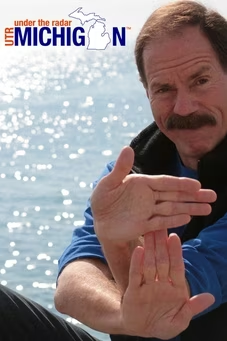
- You're talking to Bob Wilsey, W-I-L-S-E-Y, - [Judy] Bob Wilsey, the extremely successful and always in demand actor, singer, and all around entertainer.
- Every Christmas I become Ebenezer Scrooge for a group of fifth graders through seventh graders.
You know, Ebenezer Scrooge.
Bah, Hamburg!
Everyone who goes around with Merry Christmas on their lips should be boiled in their own pudding and buried with a steak of Holly in their heart.
- [Judy] And Bob Wilsey, the extremely successful and always in demand financial advisor.
- Hello, Joe?
Yes, Bob here.
How are you?
Listen, I think it's time for us to move everything from stocks to bonds for a while until we get through this mess.
- Two Bobs who somehow connect, not as adversaries, but as partners, ♪ Stocks to bonds ♪ ♪ Top ends a bag ♪ You know, it's like this, Joe.
♪ If you don't make a little interest ♪ ♪ You are gonna lose some money in the market ♪ - [Judy] You've said the word money so many times, it makes me know you're really all about adding up numbers and putting 'em in columns and doing investments.
How's that fit with the fact that you love to perform?
- I still love to be involved in singing with our group, the Castlewood Singers.
I still also enjoy being in theater productions, which I've done in the last several years.
And all of that connects because for one thing, in theater, you play a character and you develop empathy.
And having the numbers is one thing, but being able to translate that to your client's needs and wants and desires and be able to communicate to them and put yourself in their shoes, it gives me training to have done that.
Secondly, with music, you know, it requires you to count to understand that a piece of music is in a certain key signature, a time signature, and you have to know how long to hold a quarter note, a half note, a dotted half note, full note.
So, you know, that trains your brain to think in the terms of numbers.
- Well, I know you as a civic supporter.
I love that part of you about.
And you're a big help and you've stayed with them for a long time, Garfield Park.
- Right.
- Tell me about how being a financial advisor, but also being a performing artist, how that sort of feeds into your interests and your dedication on Garfield Park.
- I've used my investment skills and financial skills to help them to raise money, to help them to figure out where to put money.
And all during that time period, we were also doing performing of Shakespeare in place.
We also did a lot of music.
So I just hosted a Coral Festival out there with our Castlewood Singers.
We've done two of those.
So I've used almost every aspect of my experience from performing arts, music, financial, fundraising, in that Friends of Garfield Park quest and we're in the process of raising almost $3 million to refurbish those iconic fountains that are in- - [Judy] Oh, good.
- And we're doing pretty good so far.
We've almost got there.
- Well, what does the park do for a community?
- Well, park is a place where everybody can get together and work together and apply a lot of those same skills that we are talking about and is a team effort.
And it brings people from all walks of life and all age groups together to accomplish a common goal, like putting on a performance or putting a concert together.
We've been able to keep that park up where the city really couldn't afford to do it, to stretch so thin.
So we've partnered with them, they've been very supportive of us.
- We talked about how they speak of someone's left brain or their right brain, then...
Fit a little of that in, what it means to be interrelated in the things you do.
- Yeah.
I think, again, when you talk about that, really, I think in terms of your rational thought, your scientific side, your math skills versus your artistic, creative side.
And I think that developing one side or the other without pairing them is not healthy long-term for any person.
Because we need all those critical thinking skills along with our creativity to match up, to live in society as we've got it.
- Okay, what can you sing that gives us several lines of about being connected?
We're all one, something like that.
- Well, if I was to sing something, - [Judy] Yes.
- Let's see.
The song that I just sang.
♪ One day I'll hear the laugh of children ♪ ♪ In a world where war has been banned ♪ ♪ One day I'll see man of all color ♪ ♪ Sharing words of love and devotion ♪ - Finally today, we meet Kathy Sipple.
Kathy is a businesswoman with lots of irons and lots of fires, but everything she touches seems to circle back eventually to her one central overriding concern.
It's her purpose in life, really.
The creation and nurturing of, you guessed it, connections.
Okay, well, you know we're talking about everything being interconnected.
- Yes.
- And when I talk to other people, say, who knows about this stuff, they said, "Well, talk to Kathy.
She's a connector."
What do they mean when they say you are a connector?
- You know, I think it's...
It might be different for other connectors, but for me, I really value connection in community.
I moved around a lot as a child, and you have to find your way when you're new, and so you look for the connectors.
You asked me before, why do I value connection?
Me doing one thing on my own, I can only do so much.
But when I find those like-minded people and we band together as a tribe of sorts, that's the biggest thing I can think of to rally around and get it together with as many people as you can.
- What in the world is time banking?
- Time banking has been one of my most favorite experiments ever.
It's a way where people in the community can share what they do for maybe people that they know, maybe people that they don't know.
And instead of being a volunteer, instead of bartering, they earn an hour of time credit.
They can use that hour of time credit to then get an hour of service from anybody else in the time bank.
So it's just a really great way for people to meet one another, to maybe develop new skills, share skills that they don't do professionally, but that they do as an amateur.
And I love the root word amateur, which means "for the love of" in Latin.
That breaks down "for the love of."
So not professional, but something that you do for the love of it.
It's not meant to replace our, you know, traditional money, but it can unleash a lot of community wealth that would otherwise not be recognized.
And it's great too for people who are time rich, let's say, teachers during the summer.
There's that Jim Croce song, "If I could save time in a bottle," well, you could save your time over the summer in the time bank, and then in the fall when you go back to school and you're busy, you could actually have community members cooking meals for you, or, you know, maybe buying snacks for your school or, so many different things.
So I'd love to talk about how this garden got created.
I mentioned as the time bank coordinator, I don't get paid and I end up with a surplus of time bank credits.
During COVID, when it just started in 2020, I thought, "What would it take for me to spend down my balance?"
And that was part of the impetus for starting this garden.
So I spent down a hundred hours in time banking credits to help me get this garden done.
I gave people time units for dropping off cardboard to help me with sheet mulching in my yard.
I gave time units to a neighbor who let me borrow her truck to go get, you know, a load of compost.
I gave time units to young people who helped me schlep all the mulch all over the garden.
I gave time credits to people who gave me their plants.
And then people gave me time credits back for the plants that I shared with them and for teaching them.
I always meant for this to be a teaching garden.
So sometimes people came to help me, I was prepared to pay them with time units, and instead they said, "Well, you just taught me" or "You just gave me these plants, so we're ending up equal," which is also fine.
But it's been amazing.
When I was putting it in here, it also gave me exercise.
I would otherwise have just been sitting on Zoom meetings.
And just to be out attached to your land.
There's multiple, multiple reasons why I love gardening like this and the wildlife.
I mean, I never had hummingbirds in my front yard before.
I never had toads in my front yard before.
I have dragonflies now, I have bees, I have butterflies, I have so many birds.
You know, I think every creature has its purpose.
And, you know, I think in western science, we don't always know what is the full purpose, but I think nature left to its own devices had it worked out pretty well.
So I think just restoring nature to a way that most closely approximates what it would be doing without our interference of chemicals and, you know, a lot of poking and prodding.
It just allows nature to be, and I trust nature to seek its own balance.
- Kathy Sipple discovers how creating a garden creates connections between people, their skills, and the natural environment.
Bob Wilsey connects to the arts and finances to develop a full rich life with fruitful civic engagement.
Mario Rodriguez uses business, engineering, and people skills to make the connection between global airways, global regulations, the efforts of support personnel, and the traveler about to take his or her seat, wanting nothing more than a safe, worry-free flight.
Ellie O'Bannon, the college student, looks to business technology to find her connections with friends, of course, and with what she'll need to succeed in the bright future that lies ahead.
Where do we look to find our connections within the web of life?
Perk up your sensors.
What do you see, hear, feel, and experience that tells you you are not alone?
You belong.
I'm Judy O' Bannon.
Thanks for watching.
(gentle music) - [Announcer] Generous support provided by: The Bible Family Fund of the Denver Foundation and the O'Bannon Foundation, a fund of the Indianapolis Foundation.













Support for PBS provided by:
The Common Thread with Judy O'Bannon is a local public television program presented by WFYI