Roots, Race & Culture
Diversity on Stage and Screen
Season 4 Episode 4 | 26m 5sVideo has Closed Captions
Discover experiences and challenges BIPOC actors face in Utah’s entertainment industry.
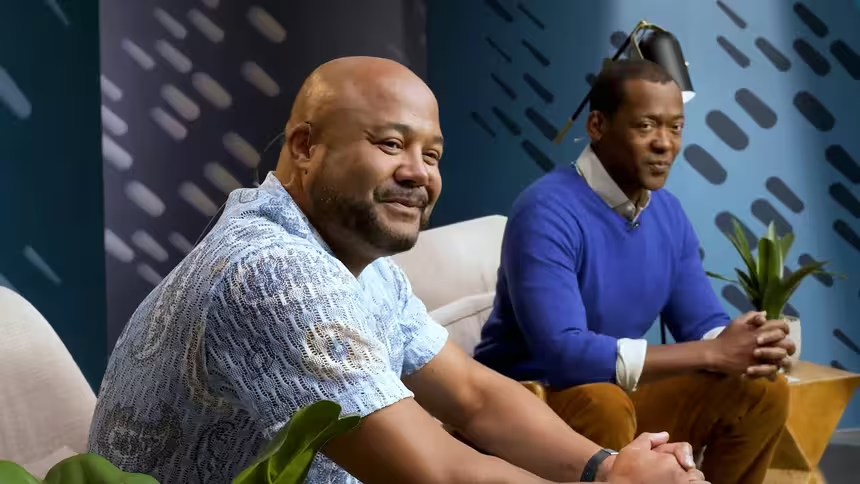
Explore the careers of BIPOC actors in Utah's theatrical market and learn about the challenges faced by these artists, from implicit bias to casting paradoxes, and the limited local projects available. Yolanda Wood and Jerry Rapier join in a comprehensive discussion on the realities BIPOC actors face and the importance of equitable opportunities in Utah’s entertainment industry.
Problems playing video? | Closed Captioning Feedback
Problems playing video? | Closed Captioning Feedback
Roots, Race & Culture is a local public television program presented by PBS Utah
Roots, Race & Culture
Diversity on Stage and Screen
Season 4 Episode 4 | 26m 5sVideo has Closed Captions
Explore the careers of BIPOC actors in Utah's theatrical market and learn about the challenges faced by these artists, from implicit bias to casting paradoxes, and the limited local projects available. Yolanda Wood and Jerry Rapier join in a comprehensive discussion on the realities BIPOC actors face and the importance of equitable opportunities in Utah’s entertainment industry.
Problems playing video? | Closed Captioning Feedback
How to Watch Roots, Race & Culture
Roots, Race & Culture is available to stream on pbs.org and the free PBS App, available on iPhone, Apple TV, Android TV, Android smartphones, Amazon Fire TV, Amazon Fire Tablet, Roku, Samsung Smart TV, and Vizio.
Welcome to Season 7
Bold and honest conversations tackled with humor, insight, and empathy.Providing Support for PBS.org
Learn Moreabout PBS online sponsorship(gentle music) - [Announcer] Funding for "Roots, Race, and Culture" is provided in part by the Norman C. and Barbara L. Tanner Charitable Support Trust, and by donations to PBS Utah from viewers like you.
Thank you.
♪ Yeah yeah yeah yeah ♪ - Hello, everyone, and welcome to "Roots, Race, and Culture," where we bring you into candid conversations about shared cultural experiences.
I'm Lonzo Liggins.
- And I'm Danor Gerald.
Today we're going to dive into the world of acting on stage and screen.
What challenges and triumphs are people of color facing who choose such an extraordinary profession?
Why does diversity on stage and screen impact society so profoundly?
And how are actors of color feeling in Utah and other regional markets versus LA and New York?
- Now, of course, we have two fabulous guests with us on the show today.
Legends, if you will.
Absolute legends.
- Yes.
- Introduce yourselves.
Let's start with you, Yolanda.
- Hi, I am Yolanda Stange.
I am an actor, producer, casting director here in Utah.
I've been doing it, too, for way too long, so I'm not even gonna tell you how long I've been doing it.
(group laughing) And I'm just happy to be here.
Thanks for having me, you guys.
- Awesome.
And we also have Jerry Rapier.
- Correct, yes.
- Oh, I said it properly.
- So, let's just say this, I've been saying his name wrong for the last 15 years.
- Everybody does.
Everybody does.
It's all right, it's all right.
I'm Jerry Rapier.
I'm the artistic director of Plan-B Theatre, which I have been in that position for 23 years.
I'm the first person of color to lead a professional arts organization in the state's history, which I feel kind of good about and also kind of awkward about because it seems like I shouldn't be able to say that.
Here we are.
- Like, the whole process of acting starts with auditioning, right?
And if you're an actor of color, if you're Black, Hispanic, Asian descent, whatever, it's kind of hard to know what the right thing is for you.
So, can you speak to the importance of how you, how the casting process works to help make sure that actors of color get a chance to work?
- I think the key is just to be sure that folks of color know they're invited to the table.
They're invited into the room.
There's a place for them that isn't specific to their cultural background, their ethnicity, the color of their skin.
- I don't know about the theater world, but in the film and TV world, a lot of times I'll see a thing that says "any ethnicity," which is not specific at all, right?
So, what do you think about that process?
- You know, it's so funny because I feel like they're getting a little bit better in film.
You know, any ethnicity.
That's been my bread and butter.
Like, anything that was saying "any ethnicity," I would always go out for.
It's the chances that we take, you know, why is this role labeled white?
You know, why really is it?
Is it because the husband is going to be white, and that makes everybody feel comfortable?
Is it because you're, you know, you know, dare I say, I thought I had an audition and I really wanted to do it, thought it was a great character.
But come to find out, I had to read the entire play to find out that there's a whole racist rant in this, that the character says.
So there's this like disconnect.
Like, that character really should have been labeled Caucasian.
And so everyone can't just put any ethnicity.
Like, I'm okay with that.
- Yeah.
- I would say the really hard part right now for me is, during COVID, I moved into voiceover, and that's where it's really, really sticky right now.
Because they're asking for, they want a Black person, but they never see you.
So I know a lot... Yeah, so I know a lot of white artists who have learned how to emulate.
- White artists who've learned to emulate?
- Absolutely.
- And they're working?
- Absolutely.
And they work.
And then in voiceover, they don't really know what you are.
- They only hear.
- But they want it.
Yeah.
- Which is just sad because that's like you're stereotyping a Black voice if you're mimicking a Black voice, right?
And in theater, I think that's interesting, because in theater, there's also, like you said, the character may have some very specific subtext that they say.
Like, there's no such thing as colorblind casting if this character's gonna do a racist rant.
There is a talent agent in Utah who's a Black, and we actually have a video where she discusses a little bit about some of these things.
So, let's take a look.
This is Ashley Justice at Talent Management Group, and let's see what she had to say.
- Hi, I am Ashley Justice.
I work at Talent Management Group or TMG in Salt Lake City, Utah as a booking agent.
And I just wanted to share a couple experiences or thoughts with you about working as a person of color in this industry.
And honestly, it's been such an incredible experience.
I really enjoy my job.
I enjoy the people that I work with.
Definitely know that Utah isn't really known for being as diverse as other places.
I mean, we're obviously growing and improving in that area for sure, which is awesome.
But I do have a lot of conversations just in everyday life just, you know, outside of my job with people that think that there's not a lot of opportunity here in Utah for people of color.
But the other thing I wanted to touch on too is interracial families and couples or multi-ethnic.
Just being a person that grew up in a multi-ethnic family, my dad being African American and my mom being Caucasian, it was just something that I, you know, it was normal for me.
I saw it pretty much all the time.
I grew up in Southern California and I saw a lot of our friends, our family, friends, just people in our community that were part of interracial or multi-ethnic couples and families.
So it was just like part of normal everyday life for me but I rarely saw it being portrayed on camera or on screen.
So it's really cool to see now that, I guess you could say like the entertainment industry is kind of catching up with society and just seeing more multi-ethnic and interracial couples and families being shown and represented on screen.
- Yeah, yeah, definitely a little bit more with the interracial, which is weird that she's actually, you know, that we have to acknowledge the fact that interracial couples and families actually exist.
'Cause I grew up in an interracial family, and that was a normal situation for me.
I didn't think of it any differently.
- You know, the thing about it though is like, like you said, we have had so many years of not being up to speed in our industry that everybody involved needs to know what it takes.
So can you speak a little bit to how you help foster the local talent so that they can be capable and able to do those things?
- Well, it's just our... At the very base of everything, it's our mission to develop and produce unique and socially conscious theater that's created by Utah playwrights.
So, just from the onset, we're working locally.
- That's amazing.
And I believe that there isn't any greater talent pool than the one that we have here, whether it's playwrights or actors, designers.
We're in an incredible place with an incredible, well, a very deep, broad and rich group of artists in all disciplines.
And I wanna sell- - But here's my question, 'cause lemme get back to you in a second.
'Cause you saw that clip of Ashley when she was talking about some of the casting things.
What do you think when it comes... 'Cause I know a lot of what she was talking about was commercial projects.
Do you agree with what she was talking about when it comes to, you know, being diverse and being able to book more parts in Utah?
Do you think that's... 'Cause there's... You know, I have my opinion about it, but I wanna hear your opinion about it.
(group laughs) - You know, I...
I would say, you know, things have changed so much, and I think part of, like, as an individual, as an actor, I had to change my own perspective of how like things go.
But I do see companies opening up and they are offering these mixed families, and I think it's fantastic.
But yet we're still staying on the same, you know, is it Asian and white, is it Black and white, is it, you know... We're still staying- - Stumbling blocks.
- Stumbling into these areas.
- I have another question for you that's related as well.
Because, you know, you started your career here in Utah and you've also worked in the LA market.
- Yeah.
- And it's interesting to me that if an actor gets successful, a lot of times, they'll just like, just up and leave, right?
And, you know?
And then so what was that experience like?
And now you're back, and what made you decide to come back?
Like, how does all of that play into this conversation about ethnicity and talent and that sort of thing?
- Well, first of all, I've tried to leave here eight times.
- Wow.
- I've literally tried to leave here eight times.
And the last time, COVID happened.
I mean, I had an apartment.
I was doing the whole thing.
I was doing LA.
And COVID happened, and I was sent right back here.
And I said, "God, if this is where I'm supposed to be, then this is where I'm gonna be."
- Okay.
- And I just...
I had to change my own attitude and accept that Utah is where I'm supposed to be.
I'm supposed to be here and nurture the younger, the kids.
I'm supposed to be here in my older age and supply my talent to becoming a senior that works in a senior role or whatever that is.
But it's a very different, you know, within the Black community, we have our own issues.
There's colorism, there's ageism, there's... You grew up bougie and you grew up in the ghetto, or it's how people look at you.
And I just decided that it was gonna be my way or no way.
- Yeah, well, it's so important for the theater arts and theatrical arts to be able to show those perspectives so people feel like they're seen on stage, like you mentioned earlier.
And I'm really kind of in love with theater.
That's my first love, right?
That's where we get a chance to play the really good big, thick, meaty roles, and we can feel the impact that it has on the audience, right?
- You know what I just realized?
I don't even think our viewers even know that Danor and I are actors.
This is like the fourth season.
(Danor laughs) This is season four, and we've never even told the viewers that we're actors.
'Cause Danor and I have been actors for like 20 years in... Well, he's been longer than me.
Anyway, no, that was a good point.
- Well, I think the fact that we live in such a homogenous place where the majority of pretty much every public gathering that isn't culturally or ethnically specific is a white audience.
And that's a wonderful thing in many ways that we live in a place like the NEA ranks Utah as the number one state in the nation for arts participation, and I think sixth for arts attendance.
Like, it's amazing that we live in this place where so many people care, but that doesn't mean they know how to experience a play about an Asian family or a play that's really about deeper themes within a Black experience.
And so we have to help them.
We have to put it out there and invite them to experience it.
But sometimes people are a little nervous about making that investment and something that they don't know is gonna sell or has a broader audience.
But I personally believe that it's a lot easier for a person from a majority group to find themself inside a minority story than for the person from a minority to find themself in the story of the majority.
- Wow, that's really, really great.
I've never heard it put that way.
- It's so important, too, like, for people to have an experience outside of what they would experience, you know?
And I think that the thing about Plan-B that really brings people home is that they do provide that experience.
And we have some clips here of some of the plays that you guys do that really take people to another level.
And this is great.
- This is a play by Carlton Bluford, and it was the first world premiere in Utah history by a Black playwright.
And this was in 2015.
- Wow.
- So just not, not even a decade ago.
- Nice.
- That's great.
Let's take a look.
- I was planning to go on vacation.
The first real vacation I had taken in years this last year in August.
My mom found out that her family reunion was happening and desperately wanted me and my brother to go.
It fell on the same weekend as my vacation.
And I said, "Mom, I really need this."
And she said, "Okay, son, you gotta do what you gotta do, but I'd love for you to go."
And I decided to go.
- How'd you meet my Sammy?
- We met at a club.
He kept smiling at me all night.
I noticed him and I waited for him to make a move, but he never did.
As he was leaving, a friend of his came to me and told me to follow him, so I did.
He stopped his friend, (indistinct), before he left and made us introduce ourselves.
Your son bought me a drink.
- At a club, huh?
That's nice, honey.
Put them (indistinct).
- [Actor] You must like Black men.
- I like Sam.
I don't see what the problem is.
- The problem is all you white women be snatching up all these Black men like they on sale.
Black women have a hard enough time trying to hold down a (indistinct) Black man while about all you white women stealing them.
I have really good Black friends who would have loved to be with my brother, but not.
You had to go and get pregnant.
- Wow.
So... (group laughing) - And there's D4, (indistinct).
- Yeah.
- You know, one of the misconceptions that people have is that, you know, because there's not these big huge budgets in these smaller plays, because there's not, you know, dazzling lights and a moving stage, that the stories aren't as powerful.
And I've done plays at the theater companies where we are on the big stages and you're sold out every night.
And I get a bigger, stronger response from some of these smaller plays, like "The Color Purple," like when I played Malcolm X for "The Grand."
And people will come to these plays and they'll have a really visceral experience with that.
And I think it's because a lot of the issues that we do bring up in our stories tend to be things that are not dealt with in some of these other plays that are brought out to the city.
So I'd love to hear what your thoughts are about why you think it is that like a lot of people don't come to shows when we have shows with people of color.
Why do you think it is that people don't come as much as they do to some of the bigger shows?
'Cause I know you've done Black plays and you sometimes look out the audience, see like 15 people there.
- Yeah.
I ask a lot of my Black friends, and the number one thing I always get is, "Are y'all singing?
Are you singing in the play?"
(group laughing) - You ain't dancing?
Yup, yup, yup.
- Are you singing?
And I'm always like, "No, it is a straight play.
Come and see it."
- Let's take a look at you working at Plan-B Theatre.
We have a clip of... Oda Might" is the name of the show?
- Yes, by Camille Washington that we produced in 2019.
- Awesome, let's take a look.
- The only way to get any attention around here is the show instability, and then everybody comes running.
So here you go.
Get my back.
- Were you ever all the time?
- What?
- Getting home.
- What?
- Tell me... Tell me about who's waiting for you back to a party.
Tell me about this mom of you.
- What are you talking about?
The train- (indistinct) Train leaves in... Get my bag.
It's important.
- Why?
- I don't remember.
- You've never brought a bag.
Remember, last week?
- I didn't make it last week.
Oh, I have to be there.
I have to leave.
Wait, wait, wait.
Wait, you said work.
You said, was I ever on time?
What did I do?
Were.
Were.
You said, what did you mean by was I ever on time?
I am never on time.
- Okay, fine.
This has been dragging on long enough, don't you think?
- What has?
- This game.
- Stolen property is not a game.
- You're dead.
- What?
- You are deceased.
- Stop it.
- You are dead, without lying.
Yeah.
- I'm your court appointed psychiatrist.
- Not anymore.
(audience laughs) - What a great performance and show.
- Look at Yolanda shining.
(Lonzo laughs) - And the thing about the theater is that like, you know, you watch movies and everything like that, there's a disconnection, it's a screen.
There's...
But in the theater, like you talked about, the stories, the tangibility, the meaning, it's there, it's live.
There's nothing between you but air, and you're all breathing it together, and it's just, you feel it so much more powerfully.
So that's- - Yeah.
- Yeah, and there's definitely, with theater, you have access to the actors.
You know, you're not gonna have access to, you know, Vin Diesel after "Fast X," I promise you.
(group laughing) You're gonna... Yeah.
- No.
- And it's all about the story, which is beautiful.
And I tell you, no one... Yolanda's a force on stage.
I've seen her on screen, I've seen her on stage, and she's just amazing to watch.
So, if you ever get a chance, watch her in theater.
Now I wanna ask you 'cause you talked earlier about working with younger people in this industry.
What is the importance of, you know, having younger people and engaging younger people into getting into the arts for you?
- Wow.
I...
Without them, we have no audience.
We..
I mean, let's face it.
Theater before COVID, everybody was older.
Like, everybody was in their fifties, sixties that were regularly patrons of the theater.
Now we're getting young kids to see the beauty of theater and the joy of theater.
And I really believe that as we keep nurturing them, I think one of the, the big problems we had was there was this automatic like, "Oh my god, we're gonna give everybody an opportunity," right?
But a lot of these young kids were home and never had an opportunity, and then they're faced with these big opportunities.
So I started helping them and teaching acting, and I do it on a really low level.
I keep my fees super, super low to help them get ready to get into these bigger spaces.
So, I think it's really important to raise them up because we won't have an audience and we won't have performers.
- Well, you learn so much too.
I mean, the confidence.
Yeah, that's a huge- - It's a huge thing that you learn.
- Speaking, articulation.
So, there's all...
Here's a list right here of all these things that we're teaching these kids by getting them involved in the theater.
And those are life skills that will never absolutely go outta style, will always be relevant.
We have another video that's kind of similar to this by Bryson Alejandro.
He an acting company or well, a training company, but they focus specifically on actors of color.
And let's take a look at that because I think it, he has something valuable.
- Hey, there, I'm Bryson Alejandro.
I'm a local actor and film producer.
I'm a born and raised Utahn and a proud Latino.
Acting is hard.
Acting as a person of color is often harder just 'cause there's additional barriers and hurdles that we have to overcome and that we have to face, whether that's in the casting process or on set or seeking representation.
What makes Epoka different than any other acting course or offering in Utah is that we are teaching our actors and our students how to navigate the industry as an actor of color.
We are often faced with microaggressions, prejudice, or racism, and we need to know what to do in those instances.
We're often asked to play into stereotypes, to do accents.
When it comes to lighting, a lot of filmmakers don't know how to light for certain skin tones, especially darker skin tones.
We talk about what to do when you're in a hair and makeup chair and the stylist doesn't know how to work with textured or ethnic hair.
What makes Epoka especially beautiful and unique is the community that it has created.
We've created a safe space where actors of color can come and be themselves and be vulnerable.
They don't feel like they have to be, try to be the best in the room, they don't feel like they have to prove themselves, they don't have to feel like they have to earn their keep to be there because we accept them and we know that they belong.
I feel like the more diversity we have on screen with different characters and protagonists and leads and stories, the more we have the opportunity to fall in love with these characters and with these stories, and to have more empathy for them.
And in turn, it will translate into my personal life.
And I will see people in my neighborhood and my community wherever I go, that might seem different than me or that are different than me, but I can have a greater love and appreciation and empathy towards them.
And so that to me is why diversity is so important.
Because it will spread love, it will spread empathy, and it will make us better people.
- Yeah.
- Yeah, that's incredible.
- That's fantastic.
- Yeah, I love that, man.
- To give these people a safe space where they can be vulnerable and explore and learn all those things they're gonna run into so they're not blindsided, so, so critical.
When it comes to young audiences who I've also worked with a lot, I saw that there's some really cool things that Plan-B does.
So can you tell us about that?
- Sure, we have two programs.
One is playwriting residencies in schools, and we have four of those this season.
And those are all in schools that are primarily communities of color.
And then we also have, we're in our 11th year of our free elementary school tour, which tours statewide.
But what we really want to do with the free elementary school tour is make sure that kids, specifically BIPOC kids, see that theater is theirs to claim, that it's for them to create, for them to consume as a patron.
And one of the ways that we do that is we ensure that every cast is diverse.
- If I'm a young child, you know, who's a young kid of color who's coming into Utah for the first time, I wanna get into acting, I wanna experience this world, what advice do you have to that kid?
- Don't be scared.
Don't be scared.
There is a community here.
There are people... And you know what?
A community can be one person.
One person can help you get to where you need to be.
You don't need to fear.
The fact that we have these conversations now, a show like this happening in Utah.
I moved here in '95.
Oh, sorry.
When you couldn't even speak about being Black and people were uncomfortable.
So now that there is a place here, and it just, every single day I feel like it gets cracked open a little bit more and a little bit more.
- If you don't see that a place is being set for you at the table, set one for yourself.
Bring your...
Pull your chair up, because that's the only way I think we found ours.
- [Yolanda] Yeah.
- And hopefully fewer people will have to do it because we have done that.
The very first thing anyone said to me the first day I walked down the street when I moved to Salt Lake City is, "What are you?"
And I hope we move to...
I hope we get to a place where no one feels that they have the right to ask that question in that way.
- That's powerful.
- That's great.
- Well, that does it for our show today.
Thank you so much for joining us.
If you have any thoughts that you wanna share or have an idea for one of our episodes that you'd like to see, just hit us up on social media.
We love to hear from you.
- Or you can visit our website where you can catch other episodes.
Just go to pbsutah.org/roots.
Until next time, for "Roots, Race, and Culture."
Y'all out.
♪ Yeah yeah yeah yeah ♪ ♪ Oh oh ♪ - [Announcer] Funding for "Roots, Race, and Culture" is provided in part by the Norman C. and Barbara L. Tanner Charitable Support Trust, and by donations to PBS Utah from viewers like you.
Thank you.
(upbeat music)














Support for PBS provided by:
Roots, Race & Culture is a local public television program presented by PBS Utah