
Divisions Over Redistricting
Season 6 Episode 5 | 26m 57sVideo has Closed Captions
Utah leaders take on the difficult task of drawing new political boundaries.
As the official Census data is finally released, Utah leaders take on the difficult task of drawing new political boundaries. The Legislative Redistricting Committee holds public hearings on how to divide Utah’s growing population, while the Utah Independent Redistricting Commission makes plans to advise the legislature.
Problems playing video? | Closed Captioning Feedback
Problems playing video? | Closed Captioning Feedback
The Hinckley Report is a local public television program presented by PBS Utah
Funding for The Hinckley Report is made possible in part by Cleone Peterson Eccles Endowment Fund, AARP Utah, and Merit Medical.
Divisions Over Redistricting
Season 6 Episode 5 | 26m 57sVideo has Closed Captions
As the official Census data is finally released, Utah leaders take on the difficult task of drawing new political boundaries. The Legislative Redistricting Committee holds public hearings on how to divide Utah’s growing population, while the Utah Independent Redistricting Commission makes plans to advise the legislature.
Problems playing video? | Closed Captioning Feedback
How to Watch The Hinckley Report
The Hinckley Report is available to stream on pbs.org and the free PBS App, available on iPhone, Apple TV, Android TV, Android smartphones, Amazon Fire TV, Amazon Fire Tablet, Roku, Samsung Smart TV, and Vizio.
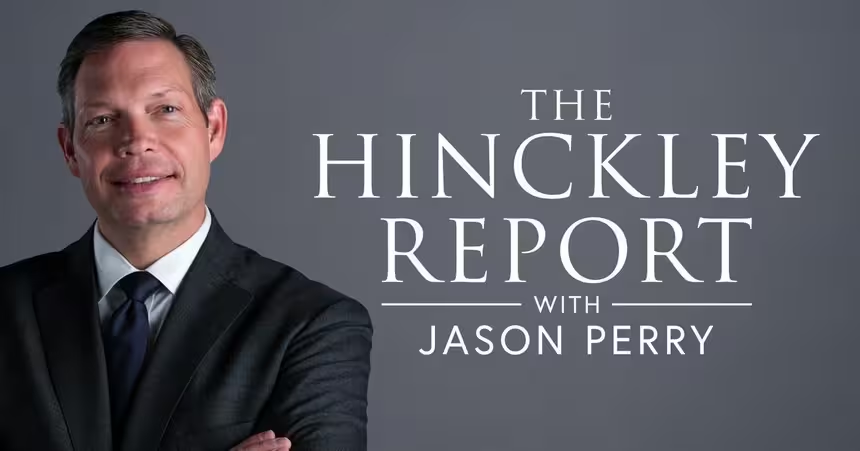
The Hinckley Report
Hosted by Jason Perry, each week’s guests feature Utah’s top journalists, lawmakers and policy experts.Providing Support for PBS.org
Learn Moreabout PBS online sponsorship♪♪♪ male announcer: Funding for "The Hinckley Report" is made possible in part by the Cleone Peterson Eccles Endowment Fund.
Jason Perry: Tonight on "The Hinckley Report:" As the official census data is finally released, Utah's leaders take on the difficult task of drawing new political boundaries.
How Utah's growing population be divided?
What historical issues will drive the debate over new political lines?
And what will become of Utah's fourth congressional district?
♪♪♪ CC BY ABERDEEN CAPTIONING 1-800-688-6621 WWW.ABERCAP.COM Jason Perry: Good evening and welcome to "The Hinckley Report."
I'm Jason Perry, Director of the Hinckley Institute of Politics.
Covering the week, we have Senator Scott Sandall, Karen Hale of the Utah Independent Redistricting Commission, and Natalie Gochnour, director of the Kem C. Gardner Policy Institute.
Thank you for being with us this evening.
This is a special edition of "The Hinckley Report," we are talking all night about redistricting.
The whole state of Utah's going through this, the rest of the country is as well, and the impacts are significant, the stakes are high depending on these lines, particularly for some of these elected officials going into this.
And Senator Sandall, I want to start with you.
You are the Senate chair of the House and Senate Redistricting Committee for the legislature, and I want to talk about sort of the approach you're taking as a legislator itself.
Of course redistricting is grounded in the Constitution itself with the idea that it's one person, one vote, this is the idea.
That's why we count the people in each state, we do an enumeration of the citizens of the state, and so to talk about the approach the legislature is taking as you start looking at that representation, making sure every vote in the state of Utah counts, every voter counts.
Scott Sandall: Sure, thanks, Jason.
The legislature takes this role very seriously.
Obviously, we're by Constitution in charge of redistricting.
Our state Constitution requires that, so we every 10 years, according to what the census bureau gives us, have to readjust according to where populations have shifted.
The average growth of the state of Utah is about 18.2%, so if you're in an area where your population is growing faster than that, your geographical area must shrink.
And if you're in an area where it's varying slower than that, your geography in a line that someone will represent you has to get bigger, and that comes down to the one person, one vote.
And so when we got that census data that was actually delayed a long time, we would normally take six months to do this process.
We've had to condense that now down into about eight weeks of work.
And that's probably the premise is this shifting population base that then has each person's vote become more equal again.
And it's a reset every 10 years.
Jason Perry: Senator Hale, so you are working with the independent redistricting commission.
The group that was established after the state of Utah, citizens of Utah voted to create this independent redistricting commission.
What is the dialogue you're having to a couple of points Senator Sandall just mentioned, particularly kind of given this lens, it was Justice Earl Warren in a court case on one of these before that said, it was this, is legislators represent people, not trees.
This was the idea, right?
So it's not just about the geography, it's about the people themselves.
What does the approach that the independent redistricting commission is taking in that regard.
Karen Hale: Well, it's about fair representation, and in 2018, the proposition passed, and I think what people were voting for and why that proposition passed is because people felt strongly that maps should serve the people, not politicians.
So it's really not the politicians who should be drawing the maps, but it's the people giving input into an independent commission so that they feel like they're is really fair representation in the voting process.
They feel like there's more accountability, they feel like there's more transparency, so a commission was formed earlier this year, and as Senator Sandall said, it's a seven-person commission appointed by the governor and by Republican and Democratic leadership in the House and Senate.
Jason Perry: I wanna get back to a couple of those issues, but what drives this at its heart, Natalie, is population of the state of Utah, and you are the state's expert on population growth and planning for it.
What demographic changes are you seeing in the state that are guiding this process itself, because it really is about where the people are.
Natalie Gochnour: Sure, well, just a broad picture that I'll paint.
We have the fastest growing state in the country.
We grew by 18.4% from 2010 to 2020, and when I say that, we're used to our state being a rapidly growing state, but you know, Idaho grows fast, Nevada grows fast, Arizona grows fast, the south grows fast.
It's actually very difficult to be the fastest growing state, which we are.
And then within the state there's different places that grow faster, and I'll highlight three.
First would be the ring counties, so the greater Salt Lake area is the urban center, but all of these areas around the greater Salt Lake, Morgan County, Wasatch County, where Heber and Midway are, Utah County, the southern part of Utah County, Tooele, these are ring counties, and they've experienced very rapid growth.
And then I'll mention the southwest area of our state where St. George is, very rapidly growing county.
And I've already kind of said it, 'cause it's a ring county, but the most amazing growth happened in Wasatch County were Heber and Midway are.
They almost grew by 50% in 10 years.
So we have a rapidly growing state, and then we have areas of the state growing more rapidly than others, and that's some of the adjustments that Senator Sandall's mentioned.
Jason Perry: I want to get to a couple of these points, but maybe Natalie because you've been part of this political process for a long time and several efforts at redistricting, so you start looking at these population centers that are growing that you had just mentioned as well, and so when the legislature looks at this, it comes down to this idea that's happened for at least for the last the last two cycles is how do you properly represent rural Utah with these heavily-populated and growing areas, which is why Utah kind of has this pizza approach, where you have pieces of Salt Lake County and some of these growing-- other fast growing counties and cities.
Natalie Gochnour: Yeah, well, I mean I'm interested what the other two guests think on this point.
Right now we have a bit of a pizza approach, right?
We've kind of divided the state up into these urban-rural districts that emanate out from the urban center.
You could also take a doughnut approach, right?
Where you kind of make a urban district that's very urban and doesn't have rural components to it and then some very big districts that, you know, capture the ring from that.
And I don't know, I think we should start from a position of guiding principles.
And I know that the common ones are keep communities of interest together, keep the district compact, you wanna make them contiguous, you don't want to have to drive through a narrow patch to get over to another big patch, right?
You wanna keep these compact contiguous districts.
Karen, you've agreed to principles.
Jason Perry: Talk about what those principles are, and then we'll see what Senator Sandall is doing from his side.
So the independent commission adopted several criteria that guide us in our mapping process.
And so Natalie mentioned a few of those, contiguity huge.
We need all parts of one district to touch.
Communities of interest is perhaps what we're really concentrating on the most, keeping communities of interest together, not splitting them up, not dispersing them, but really being aware, and so when we go out to our public hearings, actually, we want to gather that information, we want people to tell us what they believe their communities of interest are.
Geographic boundaries, certainly having boundaries that separate districts make it easier for voters to know where their district is.
Core is a prior district, municipalities and counties.
We're hearing from mayors and from county commissioners that they would like their counties and their cities to be kept whole as much as possible.
So that's been really a guiding principle for us as we've been mapping just to try to make sure that we can.
And of course it all goes back to numbers, too, because we do have, you know, that mandate, one person, one vote, and so we we have some guiding deviation numbers too.
You know, we're only allowed to go out a certain percentage, so that each district number can only vary by just a very short bit.
The legislature adopted criteria for numbers that is 0.1% for congressional districts, and I believe .5% for state House and state school board districts.
So that means that the deviation is very, very small, and that's good.
You want people to feel like, you know, each district has that fair representation.
So we've adopted those criteria.
Jason Perry: Senator Sandall, from your side, any of the commonalities and others.
Scott Sandall: Yes, we do have some commonalities, actually, because redistricting principles, one, began with population, and we have to stay within some of those legal guidelines that the courts have allowed.
We've gotten some additional direction since the last redistricting cycle that allows our state House, Senate, and school board districts to be within 5% plus or minus on the target.
So 10% overall deviation, and that's that's kind of a new guideline.
We also are looking at contiguous and compact.
We also it, from our side, take the perspective that people who have voted in the past, those voting blocks become very important.
I think it'd be interesting to note that right now in the Senate, our average tenure is 6.97 years, and in the House, the average tenure is 5.82 years.
So we have a group of people in each of those core areas that have voted for and replaced a legislator in that-- since our last redistricting cycle at least once.
The House seat that I served in was turned over three times.
So I think it's important that people have chosen those representatives at least once in the last 10 years, and it would be well to kind of consider the fact that they have made that choice, and to reshuffle the deck in a really big, broad way might be disadvantage to those voters.
Jason Perry: So Senator Sandall, how do you approach that then?
'Cause I think it is a really good and interesting point, because as I remember, you know, as Senator Hale when the better boundaries initiatives going forward, I think the phrase was voters should choose their politicians, politicians should not choose their voters.
That was the idea, but what you just said is such an interesting point.
I'm wondering how you reconcile that together as you come up with these maps.
You say, well, we don't consider who the incumbents are.
Senator Hale talked about that a little bit, but in the end this relationship and this tug of war is very interesting, because as Senator Sandall just said, these people in these districts did vote for someone, so it's possible to draw a line which sets the elected official itself, which is different than who the people voted for.
Scott Sandall: So I do think that's-- oh, sorry, sorry, go ahead.
Jason Perry: Please, Senator Sandall.
Scott Sandall: So it is interesting, and so the legislative committee and the courts actually have allowed that you can consider some form of incumbency based on a district or an area where people have traditionally voted in a block for a person, and we think that from a legislative perspective that it could be very valuable that we would incorporate incumbency into some of our decisions, making based on the fact that some continuity is probably very healthy in the legislature.
Based on the numbers I just gave you, if you were to draw maps blind from incumbency-- and we have done that-- you would typically pair 30% to 40% of those that are currently in legislative seats against each other.
So if you take that idea and combine it with the fact that we have a high turnover in our basic legislature-- because we're part time legislators, and the workload is pretty high-- it might be that you would lose some really institutional knowledge in a shuffling of the deck every 10 years in addition to that turnover that happens inside that 10 years.
I think it could be hurtful, and I think that's something that we need to talk about.
Karen Hale: Well, I have-- I was in the legislature during one of those cycles for redistricting, and I've seen the frenzy for incumbent protection there, and I think that is really one of the components of the genesis of the better boundaries journey, because people really don't want politicians to be selecting their own districts.
Like I say, voters want to be served, they want their maps to serve the people, not necessarily the politicians.
And so I think that's what really drives the independent commission, and so we have not adopted any criteria that looks at the addresses of the current incumbents.
I believe-- and I could be wrong, Senator Sandall-- but I believe that you have adopted that criteria to look at the-- at incumbent addresses as you do your mapping.
We feel like as an independent commission-- and but the charge is, too, that the legislature gave us after Senate Bill 200-- we believe the other criteria that we have is really what drives us, these communities of interest, you know, the geographic boundaries, other things that we've adopted that really I think help promote the idea of fair representation.
Jason Perry: Natalie, this is giving a pretty good picture of just how complicated-- Natalie Gochnour: Well, I think for viewers, I think-- so viewers will be very familiar with the four congressional seats, you know, and our Congress people in Washington, but what's behind the scenes and what we're talking about now is the House and Senate that are in our state legislature, where there's 104 of these, right?
75 House, 29 Senate, and that's where it gets really tricky.
So the 2020 census gave us neighborhood level demographics population counts, and that's really important, 'cause we're not doin' county boundaries, city boundaries, we're going into neighborhoods and saying you're represented by so-and-so, you know, you're represented by a different district, whatever, so you know, this is the rub in redistricting.
It's very difficult to draw lines in a way that meets everybody's criteria and everybody's interest.
Jason Perry: That's absolutely right.
Go ahead, Senator.
Karen Hale: Well, I was just gonna say, as Senator Sandall can tell you, too, just keeping within the numbers is a really difficult process while you're redistricting.
I mean, to do all of these different districts and when you get down to 75 house districts, it's a tricky task, and it's very difficult.
Jason Perry: So it is.
Let's talk about that for just a second, too, and maybe give us a hint where people can go.
'Cause we can submit maps, right?
The public can submit a map.
I mentioned this because I want you to talk about this for a second, too, but I've done this exercise myself, trying to do it.
We've even had classes we've taught here at the University of Utah, said try to draw a map.
And what Natalie just said is just so true.
I mean, you can do something that looks a little bit like what we have now that gets these congressional districts, but that's maybe the easier part of this very difficult-- Yeah, you don't have to live in that district, right?
But you do.
Natalie Gochnour: Well, the real thing I mean, Karen mentioned, it but communities of interest.
What does that mean?
What is a community of interest?
I live in Murray City.
Are we a community of interest?
Is that the principal there, you know, keep Murray city together?
There's also an argument-- yeah, there's also an argument that if you divide Murray city-- Murray splits between State Street in Salt Lake County.
If you divide it, then Murray city gets two representatives, and so there's a whole debate about whether that community of interest is better served by one or by two.
Senator Sandall, please.
Scott Sandall: And that's a great point is what is a community of interest?
Is it the high school that your children attend?
Or is it your city boundaries?
Is it the church that you attend, or is it the fire district that you live in?
There are so many different ways.
The puzzle that we have has over 71,000 pieces of these individual what we call census blocks, and you can divide that up any way you want.
Now, the good news is is that both the commission and our committee have used the same contractor, ESRI, and on our websites they have an incredibly user-friendly program that allows you to go in and draw and submit your own map for our consideration.
And I would encourage anyone to go on to our website, which would be Redistricting.Utah.gov and begin that process.
Jason Perry: So as people submit them, I'm just curious just because you've highlighted just how difficult it is, and it is so much more than people realize.
Have people submitted full maps to you?
So they get down to that district, and how do they look?
What seems to be the general approach?
Karen Hale: There have been some really interesting maps that have come in, and there are certain individuals-- and probably Senator Sandall has heard from them as well-- that have done several maps, and this is painstaking effort, you know, how many people have really committed a lot of time and energy to do this.
So yes, we have received those maps.
Those maps from the public are up on our UIRC.Utah.gov site as well.
I think there are probably posted on yours as well, Senator Sandall.
But we have these maps coming in from the public.
We also have maps of the commissioners themselves have been creating, so we've created several maps.
Everything is posted, and we've posted them not to say these are the maps that will be submitting to the committee, the legislative committee.
We're saying these are maps that we've created with input that we've gleaned from traveling throughout the state at public hearings.
We want you to tell us what you think of these maps.
Poke holes at these, give us input so that we can make changes that reflect what you want.
We want to go to the legislature with the maps that we create.
We're mandated to create three of each type of map to submit to the legislature, and we want to go with confidence that the maps that we're taking are maps that really reflect what we've heard from people throughout the state.
We want to be able to reflect the wishes of county commissioners, city mayors, from residents throughout the state that have said we want our community of interest however they've defined it.
We want our maps to reflect what we've heard.
And we want to be confident that when we take those to the legislature, that we've done a good job in listening and creating those maps.
Natalie Gochnour: Jason, I just want to make a point.
At least this is my experience.
I work with population numbers, I work with a lot of elected officials, and I'm sort of tracking following this process, but I really feel for the common Utahn who is watching two separate processes occur at the same time.
So we have our-- and I won't even get the names right, but the redistricting commission that Karen represents and then the legislative process that Senator Sandall represents, and they're going at the same time with different websites, at least they have the same contractor, but they also have public hearings coming-- going on at the same time.
So this is just a bit confusing, and the key here is that, I mean, there may be a lot of reasons why it's confusing, but we're in a pandemic, and the pandemic, you know, made it so we couldn't stretch this out, right?
The census data came far later, six months later than we would have expected, and so everything's happening in six to eight weeks, and it's made it very difficult.
Jason Perry: Senator Sandall, it looked like you had a comment.
Scott Sandall: Yeah, so I think it's interesting.
A couple of points that I think listeners need to be aware of, and one is is that the legislature is charged with creating four different maps, one for the state school board, one for the state House of Representatives, one for the state Senate, and one for our congressional districts.
Those will be done hopefully in a special session before Thanksgiving.
The other point is is we do have-- and because of Proposition 4 and a negotiated settlement that happened after that proposition happened with the legislature and better boundaries-- we do have this dual track that's going on.
Those two tracks will meet on November 1st when the legislature will receive the report from the independent commission in a hearing meeting that is scheduled just for them to report.
Then the legislature will take what we have started to accumulate across the state in our travels with the maps that have been submitted to us, put those together with the independent commission's report, and we will then digest that information and then continue with our constitutional duty to create these maps.
Our committee, then, will submit to the full legislature a recommendation, and then the process will become-- the full 104 people in the legislature with the governor's signature finally being the final piece.
Jason Perry: Senator and Sinner Hale too, so I'm curious about how people can participate.
We can submit maps, but Senator Sandall, you're coming to us today from Vernal, where you're participating one of these hearings.
Talk about the hearings, what happens there, and what you're getting from them across the state.
Scott Sandall: Yeah, the hearing process has been very educational, and we are in the middle of a three-day swing through eastern part of the state, Richfield, Moab, Price, Vernal, and Park City.
Those are five locations in three days.
I'll tell ya what's been extremely interesting is we've had a lot of interest in our state school board maps, and I really appreciate that.
Some people have commented how they would like their local LEAs to not be split in amongst the school boards.
We've talked about those interest of how people align across especially rural Utah and ways that they would like those state school board maps.
We've also had-- and we need to save a little time to talk about our congressional map.
We've had some-- there's kind of two almost opposing ideas that have come as we've gone across the state on how those congressional maps should lay out, and so whenever you're ready to pivot to that discussion, I'll be happy to go there, Jason.
Jason Perry: Well, so I want to get to congressional maps, but maybe it's worth a second to what he's mentioned, Senator Hale, because there was a long time up until his pandemic people you know who their school board members were, and there is a renewed interest now in seeing-- It's just interesting-- Senator Sandall saying people are watching that one, so.
Karen Hale: Yeah, yeah, we're hearing the same thing Senator Sandall is.
It's really been great to have the input, to have people attend these public hearings and voice their opinions, and we've had a lot of educators, we've had parents come who really wants to see their state school board district be inclusive of the local school boards, and so we're hearing a lot of that, and it really has been encouraging to have the public attend these public hearings.
And as you probably have experienced, too, just people are very open about their opinions.
And one thing that I think has been really great about these public hearings is people have been so nice.
These hearings have been so civil and so respectful, and I don't know if you're hearing the same thing, but you know, it's just been so nice.
We're there to listen, and I think people appreciate that and just traveling throughout the state.
We were up in Roosevelt a few weeks ago and just hearing from different corners.
Our chair went and met with some tribal leaders in Mexican Water last week, and just the input is really helpful.
And on thing, too, like you were saying too, Senator Sandall, there have been two very opposing viewpoints regarding congressional districts.
Jason Perry: Okay, what are they?
Let's hear 'em.
Karen Hale: Well, it's you know, urban versus rural.
Jason Perry: Okay, Senator Sandall.
Scott Sandall: So, it's very correct.
So one kind of side of this would be 75% of the population lives in four counties, along the Wasatch front, and thereby we should have three congressional districts that are there in those four counties, and then we should have one grand district across the state that's everything else.
The other camp is that we should divide each of those congressional districts so that they have a piece of urban and rural, and you can see that one or the other both have their points.
The one point that maybe doesn't get expressed as often that we're hearing is because 66% of our state is federally owned and most of the resources that urban Utah depends on comes from those resources, our water, power generation, any mining interests, and including the fact that we recreate out of urban Utah in rural Utah, that each of our congressional districts should have a footprint in rural Utah makes some sense.
The other argument is that those people live in the Wasatch front, and that's their interest, and that's where they should be.
So we'll see where we land on that, but I for my personal perspective, I tend to believe that voice of four united congressional people, who have some footprint in rural Utah is more powerful where the federal government owns 66% of where our resources come from across the state.
Jason Perry: Natalie, the last 30 seconds, let's talk about that rural.
What's at stake for rural Utah in these maps?
You know, rural Utah has a lot of challenges, and their population.
We have seven counties that actually lost population since 2010, and so we've got to figure out ways to lift rural Utah and spread some of the growth from urban.
It'll help both urban and rural if we do that.
Jason Perry: Thank you all for your comments tonight.
We understand it better.
Thank you for what you're doing on behalf of the state and for your insights.
And thank you for watching "The Hinckley Report."
This show is also available as a podcast on PBSUtah.org/HinckleyReport or wherever you get your podcasts.
Thank you for being with us.
We'll see you next week.
♪♪♪ ♪♪♪

- News and Public Affairs

Top journalists deliver compelling original analysis of the hour's headlines.

- News and Public Affairs

FRONTLINE is investigative journalism that questions, explains and changes our world.












Support for PBS provided by:
The Hinckley Report is a local public television program presented by PBS Utah
Funding for The Hinckley Report is made possible in part by Cleone Peterson Eccles Endowment Fund, AARP Utah, and Merit Medical.