
Documentary chronicling the life of community activist Dr. Yusef Bunchy Shakur premieres in Detroit
Clip: Season 54 Episode 25 | 12m 59sVideo has Closed Captions
“Redemption Road” traces his transformation from a young gang member to an author and educator.
Host Stephen Henderson sits down with Dr. Yusef Bunchy Shakur, executive director of the Michigan Roundtable for Just Communities, to talk about the Detroit premiere of his documentary at the Charles H. Wright Museum of African American History. "Redemption Road" traces Shakur's transformation from a life of gang involvement & incarceration to becoming an author, educator & community organizer
Problems playing video? | Closed Captioning Feedback
Problems playing video? | Closed Captioning Feedback
American Black Journal is a local public television program presented by Detroit PBS
Documentary chronicling the life of community activist Dr. Yusef Bunchy Shakur premieres in Detroit
Clip: Season 54 Episode 25 | 12m 59sVideo has Closed Captions
Host Stephen Henderson sits down with Dr. Yusef Bunchy Shakur, executive director of the Michigan Roundtable for Just Communities, to talk about the Detroit premiere of his documentary at the Charles H. Wright Museum of African American History. "Redemption Road" traces Shakur's transformation from a life of gang involvement & incarceration to becoming an author, educator & community organizer
Problems playing video? | Closed Captioning Feedback
Where to Watch American Black Journal
American Black Journal is available to stream on pbs.org and the PBS app.
Providing Support for PBS.org
Learn Moreabout PBS online sponsorship- Welcome to "American Black Journal."
I'm your host, Stephen Henderson.
The Detroit premiere of a documentary that chronicles the life of community activist Yusef Bunchy Shakur takes place on June 25th at the Charles H. Wright Museum of African American History.
The film is titled "Redemption Road," and it traces Shakur's transformation from a young gang member to an author, educator, and neighborhood organizer.
Take a look.
- [Ava] Once upon a time, I had a child.
I named him Joseph.
- [Narrator] This young man grew up hard, not unlike some of your own children.
Grew up on the lower Northwest side of Detroit, Ferry Park, 14th, 12th, Linwood.
Broken home.
Mama, young.
Daddy, young.
Grew up on the streets.
The streets were his mentor.
- [Interviewer] What was his father like?
- He didn't wanna stand up and face his responsibilities in being a father.
- He terrorized people.
He was terrible.
- When I turned to the left, I saw gang bangers.
I saw a guy selling dope, and in the left of me, I see prostitutes, I see pimps.
For a 8-year-old, his hero is Spider-Man, Superman.
My hero is Killer Mike.
So when I become a gang member, it is a direct result because I see Doc Strange gang banging on the block every day.
I'm basically signing up to destroy my neighborhood.
I mean, I'm trying to be filthy rich.
I'm trying to be the drug kingpin around (audio cuts).
(indistinct) So they came up to the church, shooting up at the church.
Shooting up at the church.
- On the charges that Joseph was convicted for, I would have to say that Joseph didn't have nothing to do with that case.
- [Narrator] Yusef found himself imprisoned for a crime he did not commit.
- I'm fighting with, like, every other week.
I mean, I've been in the hole seven, eight times.
(dramatic music) I'd say I was lonely.
I was homesick.
Throughout my life, I had always been searching to these answers to these questions.
So when he writes me back, I feel the love.
I feel the warmth.
It jumps off.
The things that I've been searching for, things that I've been yearning for, I feel in his letters.
- [Narrator] "Redemption Road" is a gripping and authentic narrative of conflict, vulnerability, struggle, and atonement.
- Joining me now is the filmmaker and subject of the documentary, Dr.
Yusef Bunchy Shakur, who is also executive director of the Michigan Round Table for Just Communities.
Welcome back to "American Black Journal."
- Thank you, thank you for having me, man.
- Yeah, so I wanna start with the title of this documentary.
That word "redemption" is a word that gets thrown around a lot.
I think a lot of people have kind of preconceived notions about what it means.
But let's start with what that means for you and in the context of this story that you're telling about yourself, "Redemption Road."
How do you think of that word in that context?
- Wow, that's a great question.
Actually, I'm in the process of writing a new book.
- Yeah.
- In the book, I'm like exploring that.
And for me, to get to redemption comes out of vulnerability, and the vulnerability of the things that you identify, being a former gang member, incarceration, and just my life in general.
And those things don't define me, but the ability to, 'cause vulnerability has been part of my life.
And overcoming that vulnerability has led me to a reckoning.
And that redemption is redeeming myself.
But that redemption is coming out of becoming a better person.
And becoming a better person is not only healing but it's transformation.
And looking at those who love me to allow me to love myself to become the person of who I'm today.
- Yeah, I mean, redemption doesn't have to mean regret or apology necessarily.
It's about growth, I feel.
- Right, absolutely.
- And sort of incorporating who you were into who you wanna be.
And that's really different than the way, I think, our culture and our society uses that word, kind of imposes it on people.
- Exactly.
- To say you have to redeem yourself.
That's kind of a negative.
I think you've think of it in a really different way.
- Absolutely, and a different way mean going back to vulnerability.
And I think that the more we engage our vulnerability, the more freedom we find of ourselves.
And that is gonna redeem.
That is changing.
But everybody changed, but not everybody transformed.
And that transformation is the growth, is to become, and not everybody comes out to be an activist or whatever.
I'm fortunate to do multiple teams, but that's the continued growth, my continued transformation, my continued redeeming myself every day.
And nothing necessarily even bad.
You just wanna be the best person I can be.
- Yeah.
How hard was it for you to tell the story through the film?
I mean, I always think it's hard to tell any story, it's hard to make a movie, but if you're doing it about something so personal, and that something is so much a part of you that maybe adds an order of difficulty to it.
- That's another great question.
Fortunate enough for me, I've written a book.
- Yes.
- And so the book was kind of the precursor and the way the story unfolds.
Everybody here, they see themselves in it.
So that had given me the courage.
And I think going back to the word "vulnerability" again, by me sitting in my vulnerability allows you to see yourself.
And so my story reminds you of someone in your own life, or maybe you in general.
And that's the power of a story or a narrative that is not about an individual, right?
My story is Detroit.
It's just a different version of Detroit that we don't necessarily get.
But my life, my family is at center in this.
So when you learn about this story, you learn about my mother, you learn about my father, the neighborhood I grew up in.
- The neighborhood, yeah.
- And all those things have shaped me and shaped us to be who we've become.
- Yeah.
You've been in Detroit a long time, like me.
We're old men now.
- Yes, correct.
(Stephen laughing) - The Detroit we grew up in though was very different, I think, from the Detroit that my kids are growing up in now or that I live in now.
What kind of things do you think we can draw out of the old Detroit that we experienced that helps people understand kind of where we are now and what we need to do still in our city?
- I think the luxury of having your grandparents, you know.
I mean, I miss walking through the neighborhood and seeing the elders on the porch.
- Yeah.
- And they knew you, right?
And they weren't dirty looks.
They could give you a look and like, "Don't walk on Miss Mary grass."
- (laughs) Right.
- Or, "Before I get home, Mr.
Johnson calls my grandfather."
- Right, right.
- That continuity, that connection, that warmth.
Or again, if find myself I need to use, "Ms.
Johnson, can I use your restroom?"
Like those small little things that we took for granted.
- Yeah, and they're gone.
- They're gone.
And that was the building blocks of a safe neighborhood despite whatever was going on, 'cause all we had was each other.
- Yeah, yeah.
When you are doing the work that you do now, especially with young people, what do you see in them that reminds you of when we were that age or the Detroit that we grew up in?
- What I see in them is that youthful person that's still trying to find themselves.
- Yeah.
- Like for me, I think as a man, how do I go back and continue to bring that little boy who was stripped of his ability to grow up?
- Yeah.
- Normal, right?
And sometime we, and every kid is growing up differently, but are we truly allowing kids to be their full selves as kids?
And many of them are growing up very fast.
And that's damaging.
And that's the part I see.
I think that's a common thread line.
But also, how do we support the parents?
'Cause I hurt when my mother hurt.
'Cause at the end of the day, my safety net was my mother.
And so even though she never told me she was hurting, I can feel it.
- You can see it.
- When she was happy, I was happy.
And so the balance between a child being productive is the balance of how protected of their parents and their household and their neighborhood.
- Yeah, yeah.
I also want to talk about your work with Michigan Round Table.
You're the first African American to lead that organization.
You said it's been about a year.
- [Yusef] Yes.
- Let us know how that's going and how you're finding the work.
- Well, let me first acknowledge that I'm grateful for my board chair, Dr.
Lisa Jackson.
I'm grateful for my deputy director, Joe Drew-Hundley.
And those two, you know, we're forming a strong team.
I think the organization is, I'm realizing some organizations go through leadership change, some organizations go through a shift of its mission.
Very few do both at the same time.
And we did both at the same time.
And so we're grounding ourselves.
And I'm continuing to learn that our work matter.
We are transitioning from our regular office in the New Center area where we'll be moving to the Mama Cook Community House as our permanent residence as our office.
So we'll be one of the very few organizations where our office is where we work.
- Is in the neighborhood.
- Yeah, exactly.
So I'm looking forward to that.
- Yeah.
And if you had to kind of sum up the vision that you're trying to bring to the work, what's different about that?
- So the difference in the vision that I have up under my leadership, we have four anchors: building community power, dismantling stigmas and building pathways, youth leadership and self-determination, and corporations for communities.
And in those buckets is where our work is at.
So I'll give you an example, building community power, there's a lot going on in Detroit.
But even with our new mayor, and she's made a declaration, how do we build up our neighborhoods?
And so our goal is, how do we hold her accountable?
How do we hold administration?
How do we hold corporations accountable?
Not as it's their fault, but again, if downtown is building and is doing great things, then the neighborhoods have to be built and doing great things as well.
But they're two different dynamics, but they have to be in alignment and complementing each other.
And that's where our through line is.
- Yeah, do you feel like that's happening or possible right now, or are still really at the beginning stage?
- I think we're at the beginning stage.
I mean, we're so far behind.
But it's, as you know, (indistinct), starting with conversations.
Having tough conversations.
- Right.
- And sometimes, we may not see it eye to eye, but through that tough conversation, we can get harmony.
Right, and you don't have to be from poverty to care, but you have to be willing to go face poverty to learn why you need to care.
- Yeah.
I feel like a lot of people have to see more of what people's lives look like in Detroit right now to really understand what challenges we have.
- And going back to what we talked about earlier, like growing up, like poverty is not a Black thing.
- Right.
- It's not a white thing.
It is an American thing.
- It's a poor thing, right.
(laughs) - And so we are all responsible.
And once we take more of that responsibility, this is where we're responsible for building a just community.
- [Stephen] Yeah.
- And that's the call to action.
- Yeah, yeah.
Okay, Dr.
Shakur, it is always good to catch up with you.
Congratulations on the documentary.
And you're working on another book.
- Yes, I am, yes, I am.
- What's that book about?
- It's called "Dear Ava Jo and Baruti: A Son's Reckoning and Love Through Letters."
So it's a book that I'm writing to my father and my deceased mother.
- Oh, wow.
I can't wait to read that.
- Thank you.
- All right.
Thanks for being here.
- Thank you for having me.
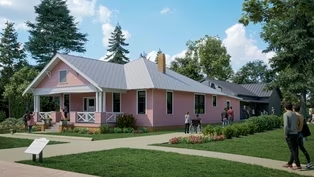
Historic Jackson Home opens at The Henry Ford
Video has Closed Captions
Clip: S54 Ep25 | 10m 53s | The home is the newest addition to the museum’s exhibits showcasing important moments in history. (10m 53s)
Providing Support for PBS.org
Learn Moreabout PBS online sponsorship New Episode
- News and Public Affairs

Top journalists deliver compelling original analysis of the hour's headlines.

- News and Public Affairs

Today's top journalists discuss Washington's current political events and public affairs.




 New Episode
 New Episode
 New Episode




Support for PBS provided by:
American Black Journal is a local public television program presented by Detroit PBS