
Doing the Right Thing in Diversity, Equity & Inclusion
Season 4 Episode 2 | 26m 48sVideo has Closed Captions
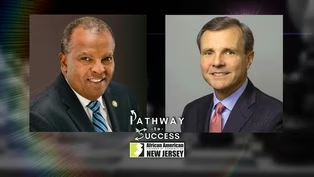
Jack Miller, Pres. & CEO of SOLIX discusses his companies successful DEI initiatives.
John E. Harmon, Sr., Founder, Pres. & CEO of the African American Chamber of Commerce speaks with Jack Miller, Pres. & CEO of SOLIX about SOLIX's extraordinary DEI initiatives, which included the hiring of three Black Investment Firms to handle some of their employee pension options. Produced by the AACCNJ, Pathway to Success highlights the African American business community.
Problems playing video? | Closed Captioning Feedback
Problems playing video? | Closed Captioning Feedback
Pathway to Success is a local public television program presented by NJ PBS
Doing the Right Thing in Diversity, Equity & Inclusion
Season 4 Episode 2 | 26m 48sVideo has Closed Captions
John E. Harmon, Sr., Founder, Pres. & CEO of the African American Chamber of Commerce speaks with Jack Miller, Pres. & CEO of SOLIX about SOLIX's extraordinary DEI initiatives, which included the hiring of three Black Investment Firms to handle some of their employee pension options. Produced by the AACCNJ, Pathway to Success highlights the African American business community.
Problems playing video? | Closed Captioning Feedback
How to Watch Pathway to Success
Pathway to Success is available to stream on pbs.org and the free PBS App, available on iPhone, Apple TV, Android TV, Android smartphones, Amazon Fire TV, Amazon Fire Tablet, Roku, Samsung Smart TV, and Vizio.
Providing Support for PBS.org
Learn Moreabout PBS online sponsorshipannouncer: Support for this program was provided by...
Horizon Blue Cross Blue Shield of New Jersey.
[jazz music] PSE&G, proud sponsors of "Pathway to Success."
♪ ♪ JCP&L and the African American Chamber of Commerce of New Jersey, working together to build a stronger community for all.
Investors Bank, banking in your best interest.
Berkely College.
Education drives opportunity.
Be inspired.
NJM Insurance Group.
The New Jersey Economic Development Authority.
[upbeat jazzy music] ♪ ♪ - Welcome to "Pathway to Success."
This is your host, John Harmon, founder, president, and CEO of the African American Chamber of Commerce of New Jersey.
You know, we're just excited.
We're now in our fourth season and we greatly appreciate your support.
Today's guest is not only a longtime friend, but a great supporter of the mission of the African American Chamber of Commerce of New Jersey.
I speak none other than Jack Miller, CEO of Solix, a company that is doing a lot, not only in New Jersey, but across America.
There's a host of services that Solix provides.
It's helping communities and people get in a better place kind of behind the scenes, so today you'll get an inside look at what they do and what impact they're making in communities across the United States.
Mr. Jack Miller, welcome to "Pathway to Success."
- Well, thank you, John, I'm really, really pleased to be here.
- So we're gonna start, you know, just getting to know a little bit about you-- where you're from, big family, small family, - Okay, John.
Well, I was born in Cambridge, Massachusetts, And I'd say a small family, right?
My mother and father-- I had one sister.
We lived kind of a-- I'd say a modest life, you know?
Didn't really need anything, didn't want anything, but really didn't have a whole lot, if that makes some sense.
Went to grammar school, high school, and college all within Cambridge, so I really didn't travel far until after I got out of school.
But, you know, it was a loving family.
We--you know, we did a lot together.
And as I said, you know, didn't really have a whole lot but didn't need a lot.
- Well, you know, you kind of speak real, real humble and lightly about the community about the community you came up in, but there's an institution called Harvard College in that community, and Northeastern.
Talk a little bit about those respective institutions and why did you choose to go there?
- Well, you know, glad and fortunate that we got in when we did, because we wouldn't get in today.
These kids are so bright and so accomplished and so on and so forth.
I went to a small Catholic grammar school and a small Catholic high school in Cambridge, and did fairly well.
I applied to Harvard because it was local.
Really, I didn't know what it really was or what it meant.
And I went, quite honestly, because it was the cheapest place I could go.
It was cheaper for me to go there than for me to commute to Boston College.
So it was really a financial decision.
And then when I got out of school, a few years later I decided to get a master's degree in business.
And I went to Northeastern and I did that at night.
It, believe it or not, took six years and my wife and I kid about when I started that it was the two of us, and when we finished there was a dog and, you know, one kid, at least another one on the way.
So it was quite an experience.
And, you know, from an educational perspective I'm just glad I did what I did and I can't imagine doing anything else.
- I think that's a great story, you know.
As you were talking-- I come from Trenton, and I have accomplished a lot coming out of Trenton, so it's not where you start, it's where you ultimately end.
And you had a very successful career, if you will, in the telecom industry.
Can you talk about some of the things you did leading up to becoming CEO of Solix?
- Sure.
So when I was getting out of school, and so I did go to work for the phone company.
It was New England Telephone.
And I spent most of my career there in sales and marketing.
About five or six years into it, I decided to kind of take a risk and I went to work for a startup company.
And it was a great experience.
For me, it lasted nine months.
So then I went to work for Digital Equipment Corporation, which was a great company, and spent about four years there and then went back to the telecommunications industry and New England Telephone, which at that point became NYNEX.
Did fairly well.
We moved around a lot.
That was just part of the deal, you know, as I progressed through the ranks of management.
And so then a friend who was down here in New Jersey, someone I worked with when I was at NYNEX, was starting this business that became Solix.
And he said, why don't you come down and help me start this for two or three months and, you know, you can leave whenever you want, but just help me get this off the ground.
And, you know, I sit here 21 1/2 years later, having never left.
- Walk us through that journey, because I think those aspiring business owners would like to get that perspective about taking risks.
- The advice I give to people is, you know, you gotta believe in yourself.
You've got to take chances.
And the other thing about a career which isn't necessarily on the top of mind, especially of some younger people is, what I tell people, the start only align a few times in your career.
And you've got to recognize that and then take advantage of it.
So when I came down here, as I said, I thought I'd be here for, you know, two or three months, help get this business off the ground.
But then when I got to know the business, got to know the people within the business-- and let's face it.
That's what any business is.
It's about people and what you do and how you do it.
I began to like it more and more and I stayed here.
And what I really liked about this is, in a small business, every decision you make really, really matters.
There were four, five people that would get in a room and we'd make every decision that had to be made for the betterment of the business.
And it was just a lot of fun.
- Speak to the types of services that Solix provides, you know, its mission.
- Our mission in life, if you will, is to help our clients help make people's lives better.
And that's really all we do.
And what does that mean?
Solix is a business process outsourcing firm that really focuses and specializes in determining eligibility for a variety of programs and services across the country.
We work in about 40 states and we do things like we helped EDA with the small business grant program after Hurricane Sandy.
Back years ago, we were the back office for the Boston Marathon bombing victim's fund.
And what we did there is we just took all the applications from victims' families and worked based on a set of criteria to decide who should get funds and how much.
Currently, we're working in New Jersey for a number of counties, helping them manage COVID-related emergency rental assistance programs as well as small business grant programs.
We do a lot of work throughout the country in schools, helping schools apply for federal funds that are necessary to defray the cost of providing services to special needs students.
You know--and John, we've talked about this-- in the City of Chicago, we get them over $40 million a year that they wouldn't have necessarily gotten without our services to help fund the services that they provide for special needs programs.
- In some instances, you kind of white label some of the services.
Speak to that a little bit so that our viewers understand what that means.
- People don't know they deal with Solix when you're dealing with Solix.
And so when we go in-- let's take the State of Texas, for example, the program we run for them.
We build a web portal.
People can access the portal.
They can provide application information, documentation on the portal or by phone.
But they don't know they're dealing with Solix.
It's all, you know, State of Texas.
The website looks like the State of Texas.
And that's like what we do for everybody.
So when we do work for Blue Cross Blue Shield of Alabama, our agents answer the phone, you know, "Thank you for calling Blue Cross Blue Shield of Alabama.
How can we help?"
We're behind the scenes.
- Mm-hmm.
- We view ourselves as really just an extension of the organizations and the groups that we work for.
You don't see our name.
You don't see our logo out a lot.
We like to say we help make our clients sleep better at night.
We help our clients in a very real and meaningful way to help people's lives get better.
- You know, as you're talking, I'm listening and I'm making notes.
Our membership is not just comprised of Black business owners or Black people.
It's important that we have relationships with companies like Solix.
- Wanting and needing more than just Black businesses is just so healthy for your organization as well as the state because there are many times-- and you know this.
I've asked you, "John, I don't want to offend you, but--" and you laugh and say, "You can't offend me."
And we have a discussion about an issue or things that are happening.
And for me, you know, and I think for any leader, to have the ability to have an open and honest and constructive communication about things is just gonna be so beneficial, because I think part of the issues we face as a society today is we just-- the inability to communicate.
- So we'll take a break right now here at "Pathway to Success."
We'll be back in a moment.
announcer: The African American Chamber of Commerce of New Jersey is your pathway to success.
We encourage you to visit our website at www.aaccnj.com or call us at 609-571-1620.
We are your strategic partner for success.
- Welcome back to "Pathway to Success."
I'm your host, John Harmon, founder, president, and CEO of the African American Chamber of Commerce of New Jersey.
Talk about culture.
- One thing that's important to us is, you know, we have a very diverse customer base.
So as an organization, we really do have to embrace diversity.
And I remember, it's gonna be 15 years ago or so, we did kind of a study and we found that there were 30 native languages spoken by our employees in the building, out of about a couple hundred people.
So the diversity even 15 years ago was really incredible.
And when I looked at the diversity statistics, I think that gets back to we just did the right thing.
But in talking to John, I said, what could we do to make a difference?
And so we've done, you know, a few things in addition to what we had been doing all along.
We introduced three 401(k) investment options for our employees that were mutual funds run by Black-owned businesses.
- Mm-hmm.
- And I thought that was-- that came from a discussion with John.
I wouldn't have thought of that on my own.
And then the thing that struck me the most about doing that was John Rogers who is the head of Ariel Investments, a terrifically accomplished friend of John's.
John said, "John Rogers wants to talk to you."
I'm like, "Oh, boy.
What's this about, right?"
And it was one of the most pleasant, nicest conversations I've ever had.
And all John wanted to do was thank me for making this decision, because he said, "If a company like yours makes this decision, "maybe others will make decisions like this and we'll really make a difference."
And so it's been--that's the kind of example that, when I talk about bouncing things off of John and what I've gotten from the Chamber, when I look at adding those funds, which, by the way, were a hit with our employees, again, it was the right thing to do.
- You know, just following up on that point about John Rogers and Ariel, the intentionality of you-- one, we had this conversation, but I believe there was a policy change that you had to kind of advocate for internally in order to make it work.
But you realized there was some value making this change.
And sometimes, in these attempts, people get hung up.
"Well, our policy says we can't do this.
And so we would like to do it, but we apologize."
You took a step further and said, hey, let me look into this.
And you settled in a place that was a mutual benefit and I'm publicly thanking you for your leadership and your ability to work through this to come to this place.
So, Jack, you guys made an acquisition of Sivic Solutions, is it?
- Yep.
- What was that all about?
- So we've made a few acquisitions over the past 20 years to help add some capabilities to our business.
What do we need to do to ensure our long-term viability?
So we acquired Sivic, and that's been a great acquisition.
We, you know, rolled them in under the Solix tent.
Their culture is the same.
Their mission is the same.
And as I said, now between our two businesses, we're operating in more than 40 states across the country.
- I'm thinking about New Jersey.
This is where--your domicile.
You're the CEO here.
And many of our communities, particularly communities where the dominant population is low income or people of color, this is why it was important for me to have you on today, because you're like-- Solix is like a hidden jewel in New Jersey.
Why have you not gotten more opportunities here in New Jersey, and how can we help you get more opportunities here.
- I don't know why we don't do more business in New Jersey, quite honestly, because there are bids that come out that are just like the work we do in other states.
We bid on things, but for whatever reason, we're just not able to win business at the state level here.
We've become very successful at the county level.
We've done it very, very well, and it's really the word of mouth that, you know, because of the work we've done in one county, we're getting work in another.
So I'm really looking forward to figuring out how do we crack the code of doing work in New Jersey at the state level, because I think, to your point, John, we're a hidden gem here.
And I'd love to employ more people here in New Jersey.
- So we're gonna continue to be a strong advocate-- and I made some notes of some folks that we're gonna follow up with to see if we can't make some introductions, because I know that many cities or many mayors who have a host of challenges, but, moreover, they have the demographic or the makeup of people from a social, economic standpoint that could connect with the services that Solix provides to help those communities be in a better place.
It's very expensive to do business in New Jersey.
Can you speak to that?
- I would love to employ call center agents in New Jersey.
But with the cost of living and all here, we just can't be competitive.
- You can always do well and do good at the same time.
Can we talk about the philanthropy that you do in the State of New Jersey our throughout your footprint?
- Yeah, no, I think that's part of our core value embedded in, kind of, our employees.
Our employees like coming to work because of the kind of work we do.
They really leave thinking they've helped make someone's life better.
We have one employee, and every holiday season, he runs a coat drive with his friends and employees, donate coats for children.
It's something that I enjoy doing every year.
I actually pick out coats on a website and I buy them and I ship them to his house.
- [chuckles] - We have another employee who is sleeping outdoors to raise money for homeless people, right?
And so this just happens-- that's just kind of who our employees are.
And then as a business, we support a number of causes throughout the state, you know?
We're-- It's just, you know, for a business our size I think we do more than our fair share to help the community.
- So pandemic-- it has impacted companies and people differently.
How has it effected your business model?
- The first thing we did, right, was we said, we can't afford to get this virus in one of our centers.
So we deployed technology, as I mentioned, to enable people to work from home, but we did it in a way that they're supervised, they're accountable, and honestly, our results have improved.
The last quarter, our Net Promoter Score, we had 100%, right?
So it just doesn't get better than that.
So you know, as I look at "how has it impacted us," it's helped us-- we can grow without needing brick and mortar, we've proven we can manage the people, we can onboard them, we can train them.
- I think about the murder of George Floyd, and that is something that you and I have had a number of conversations about.
From a corporate standpoint, how has that effected your strategy as it relates to corporate citizenship investment?
- We became members of the Chamber before the murder of George Floyd.
I'm glad we did, because it's given me the ability to understand things better, right?
And through our relationship, that's been invaluable for me.
I never looked at the diversity statistics.
I just didn't, because-- I mean, I knew we were a diverse business, but I didn't know how diverse we were.
And when I looked, I was pleasantly surprised at the business that we are.
And we got there through, as I said, we just try to do the right thing.
So we do have targets in place.
We have contractor targets where we want at least 10% of our work to be done by minority businesses.
We have staffing agencies.
We need at least 10% of the candidates that they provide to be diverse.
But guess what?
It's more like 40% to 50% diverse candidates.
We talked about introducing the three 401(k) options that were funds run by Black-owned businesses.
And we continue to look at things like this to figure out what is it that we can do to contribute to making New Jersey and the country a lot better.
- What's on the horizon?
Next five years, what can we expect from Solix?
And that's an interesting name as well.
I didn't ask.
Where did that come from?
What does that mean?
- We had an employee naming contest, and we had an employee come up with the name of Solix.
And according to him, and I'm not gonna doubt him, it was a star that shone light on issues, right?
And we wanted something that was memorable, short, an didn't confine us to any kind of industry or geography or whatever.
The name Solix is really-- I think it's been a good choice and I think it's served us very well over the years.
- Next five years.
- So really, we're at the phase now where we've got, you know, all of our system, everything is in place that we've just got to really kind of put the foot on the gas pedal and start to grow.
So I see it as you're trying to enter-- we're in 40 states.
We got a few more states we can go into.
We've got more services we can sell in the states that we're in, but I can also see us making an acquisition or two over the next five years that will bring some more services that we can bring to the table to help our clients provide to their customers.
- So final question.
The significance of the African American Chamber of Commerce of New Jersey and its relationship with you and Solix.
- The significance has been on a bunch of levels.
You've helped me personally.
We became members of the chamber early on, because I saw the benefit of being able to bounce ideas off you, work with you as we looked for candidates for certain positions.
You helped us identify people.
You helped us identify subcontractors.
And we just see our continued support of your organization as vital because what you do for us and what we get from this relationship clearly makes us a better business.
- Well, it's a mutual benefit.
We feel the same way about having Solix as a member of our President's Club and having you as a friend, a confidant, an advisor.
So I'm delighted that we've had the change to have this conversation today.
And until the next time on your "Pathway to Success," this is John Harmon, founder, president, and CEO of the African American Chamber of Commerce of New Jersey.
Thank you for tuning in today.
Today's message is ROI.
For some, that means "return on investment."
For us at the African American Chamber of Commerce of New Jersey, it means resources, opportunities, and information.
You know, every day we seek to, one, advocate on behalf of our members for access to opportunity to attain an equitable participation in the state's economy.
So when we talk about "resources, opportunities, and information," that means our ability to leverage corporations, for example, for board seats, career opportunities, for supplier diversity, or corporate citizenship investment.
So when you look at the makeup of the membership of the African American Chamber of Commerce of New Jersey, it consists of not only Black businesses or Black professionals, it consists of telecom, government agencies, healthcare, manufacturing, retail, construction, infrastructure.
Any dollar that's spent in New Jersey's economy, Black people should be equitable participants.
And leveraging relationships like today, we had Solix here-- this is a corporation.
This is not a Black business.
AT&T, Verizon, they are corporations.
They're not Black businesses, but they're a part of our membership.
They're part of our ecosystem.
And we're working together to derive mutual benefit.
We have a number of financial institutions.
Black people need access to capital.
Black people need access to mortgages-- all vehicles that will ultimately lead to creating wealth.
We talk about the net worth of Blacks at $5,900 versus 315,000 for whites.
Our ability to really work with our financial services institutions or financial literacy programs, getting more Black families and individuals to understand how easy it is to go from a renter to a homeowner.
But also derive more business for our member who is a financial services institution.
Investment--understanding how to put money to work for you With some of our investment banking members.
And we have a number of them as well.
So when you look at the African American Chamber of Commerce of New Jersey as a whole, we are a vehicle that is driven to bring people together, to bring New Jersey together, but ultimately to make New Jersey more competitive.
Let's continue to explore that together.
Thank you.
[upbeat jazz music] ♪ ♪ announcer: Support for this program was provided by Horizon Blue Cross Blue Shield of New Jersey, PSE&G, JCP&L, Investors Bank, Berkely College, NJM Insurance Group, the New Jersey Economic Development Authority.
♪ ♪
Doing the Right Thing in Diversity, Equity & Inclusion
Video has Closed Captions
Preview: S4 Ep2 | 32s | Jack Miller, Pres. & CEO of SOLIX discusses his companies successful DEI initiatives. (32s)
Providing Support for PBS.org
Learn Moreabout PBS online sponsorship
- News and Public Affairs

Top journalists deliver compelling original analysis of the hour's headlines.

- News and Public Affairs

FRONTLINE is investigative journalism that questions, explains and changes our world.












Support for PBS provided by:
Pathway to Success is a local public television program presented by NJ PBS