
Domestic Violence Calls Increase/Detroit Summer Jobs Program
Season 50 Episode 14 | 26m 46sVideo has Closed Captions
Domestic Violence Calls Increase/Detroit Summer Jobs Program | Episode 5014
Domestic violence calls have increased during the pandemic, but what's behind the rise? Host Stephen Henderson talks with HAVEN of Oakland County to find out why we're seeing an uptick in the number of victims seeking help and how Black women have been disproportionately affected. Plus, the City of Detroit's 'Grow Detroit's Young Talent' summer jobs program. Episode 5014
Problems playing video? | Closed Captioning Feedback
Problems playing video? | Closed Captioning Feedback
American Black Journal is a local public television program presented by Detroit PBS
Domestic Violence Calls Increase/Detroit Summer Jobs Program
Season 50 Episode 14 | 26m 46sVideo has Closed Captions
Domestic violence calls have increased during the pandemic, but what's behind the rise? Host Stephen Henderson talks with HAVEN of Oakland County to find out why we're seeing an uptick in the number of victims seeking help and how Black women have been disproportionately affected. Plus, the City of Detroit's 'Grow Detroit's Young Talent' summer jobs program. Episode 5014
Problems playing video? | Closed Captioning Feedback
How to Watch American Black Journal
American Black Journal is available to stream on pbs.org and the free PBS App, available on iPhone, Apple TV, Android TV, Android smartphones, Amazon Fire TV, Amazon Fire Tablet, Roku, Samsung Smart TV, and Vizio.
Providing Support for PBS.org
Learn Moreabout PBS online sponsorship>>Coming up on American Black Journal, we're gonna talk about the rise in domestic violence incidents during the COVID 19 pandemic, we'll hear about why those incidents are going up and about some of the resources that are available for victims.
We'll also talk about the city of Detroit wanting to put thousands of young people to work over the summer.
We're gonna get all the details about Grow Detroit's Young Talent.
Stay right where you are.
American Black Journal starts right now.
(uplifting music) >>From Delta faucets to behr paint, Masco corporation is proud to deliver products that enhance the way consumers all over the world experience and enjoy their living spaces.
Masco, serving Michigan communities since 1929.
>>Support also provided by the Cynthia and Edsel Ford Fund for journalism at Detroit Public TV.
>>The DTE Foundation proudly support 50 years of American Black Journal in covering African American history, culture and politics.
The DTE Foundation and American Black Journal partners in presenting African American perspectives about our communities and in our world.
>>Also brought to you by AAA, Nissan foundation and viewers like you, thank you.
(uplifting music) >>Welcome to American Black Journal, I'm Stephen Henderson.
Over the past two years of the COVID 19 pandemic, we've actually seen another public health threat also on the rise, domestic violence and sexual assault shelters are receiving more inquiries for help.
And a University of Michigan study suggests that domestic violence incidents were more intense during the pandemic.
Centers for Disease Control also says that domestic violence is a leading cause of death for young black women.
I spoke with MiVida Burrus of Haven, a program that offers assistance to victims of domestic violence and sexual assault.
So, you know, I feel like domestic violence, sexual assault, these are things that are with us all the time.
They are problems that we don't focus on as much as we probably should, but I am intrigued by the idea that things have gotten worse during the pandemic.
I guess, I can't say I'm terribly surprised, but let's start with why we think this is an even bigger problem or has been an even bigger problem over the last two years.
>>Well, number one, the pandemic has created that space where there is even more isolation.
So one of the major things with intimate partner violence and domestic violence is that isolation, you're slowly cultivated into stepping away from your family and spending more time with your abuser and then with the pandemic and that period of lockdown and shutdown, it became more pervasive.
So we found at Haven, we found that our crisis line calls increased from family and friends.
How do I extract them from that situation?
But there's nowhere to go.
The hoteling had shut down.
We also were seeing an increase of intake.
So it was harder for people to get out and get extracted.
One of the major things that we found during this pandemic period is that was the perfect storm for an abuser.
They're not working, they're at home more, as we know with abuse, every little thing is orchestrated and it's meticulous and it is manipulative to the point where, you know, just cooking the wrong meal could be an issue.
So that became cause for more, as you see in media, more fatalities, because we're together 24/7 in an already scary and volatile situation.
>>Yeah.
>>So, you know, Haven saw that uptick, our resource calls came in, we were trying to help everyone, especially parents and family members with resources in community that would help.
But again, for a survivor of domestic violence, that choice is ultimately theirs of when they can leave, how they can leave and even safety for their family and friends, because the abuser is going to then start lashing out in those ways.
>>Yeah, yeah.
And so, places like Haven of course then take on added importance at a time like this, because as you point out, it's harder for people to go anywhere to get away.
And so someplace like Haven ends up with more people I would imagine than it normally would.
Give us a sense of, I guess, the range and the scope of the problems that you're seeing.
I'm really particularly interested in these numbers that suggest that for black women in particular.
>>Yes, yes.
>>Domestic abuse and sexual assault are much bigger problems than for other parts of the population.
>>Typically, what is typical is in a situation with a African American woman, black woman, or a person of color, the impetus is, well, it was just a fight or they were just having a discussion.
Whereas with our counterparts, our white, you know, I don't wanna just label it as women, our white victims or our white survivors, they're more believed, right?
That this was an issue, this was a problem.
The nature of the problem is escalated.
So what we found is a lot of the people who come to us, we are the first call, we are the ones who believe, we believe this is happening to you and we invite you in to either have a conversation, we do our crisis line calls, the impact for black women and particularly lower income back women is we don't call right away because we know what that may do to a black man.
So we will sit in a situation just to tad bit longer.
And then again, it goes back to, well, why didn't you leave or why, you know, what do we say, well, why didn't you call earlier?
Well, because who are you gonna believe when you get here 'cause we're both black?
So that has been kind of the scope and the scenario when we're a little bit trepidatious about calling, but the violence is real, the violence has always been real.
It is a societal issue and it's not just a problem for black people or white people or Asians.
It is a societal problem in the way that we handle our relationships and conversations with one another.
But when you look at who we serve at Haven, the plethora of the people who come in are African American, black women, with children, a number of children, small children, toddler age children, and they are lower income with a household to moderate, to high income.
They typically have funds where they can just get counseling from us or they can get that kind of support or help from family members, right?
Because they can lawyer up and they can do those things.
But at Haven, that's what we do.
When you come to us, we provide you with advocacy in the courts, we pay for PPOs, we pay for your clothes, your food, transportation, if your tags aren't right, we pay for those type of things because we know the barriers to extracting yourself from that situation is typically financial.
There's some emotional abuse, but it's typically financial and it's heart based, right?
How am I gonna leave with my children?
And also with my pet, because I'm not gonna leave my dog or cat in that situation.
And we welcome them in and we say, come in and we'll take care of everything for you.
So we do the document retrieval, we make sure that, you know, if you needed SNAP benefits, we're helping you fill those, that paperwork out.
If your children need to go to school, we will help you with the schooling.
And Pontiac public schools have been, has been amazing because they help us with that.
And they make sure that those families are protected and they know that we're there.
So we try to keep them safe.
However, Stephen, we are open facility.
There's no gates, no bars, no, you know, we have protection.
We are protected, but we are open because abusers do not come to us.
In Oakland county, five minutes from the Sheriff's department to create that abuse.
So our, the families that come to us and we do accept men as well, because men are also abused.
The families that come to us are highly protected.
And we are highly confidential.
So even if my child came, they couldn't tell me.
So we keep all of that under wraps.
45% of the women who come to us cross eight mile.
They are families from Detroit and we help them set up, we help them get in their apartments.
We have four transitional houses, so they, some of them qualify for housing.
We're trying to expand that program right now.
So we're working with the partner to make that happen.
And we work with other partnerships with them Pontiac.
And we're talking to real estate companies because there's a bunch of homes that are vacant that we will help renovate and get those families in there.
But our message and our goal is empowerment.
You make the decision for you, because that is the issue with domestic violence and sexual assault, power and control.
>>Yeah.
>>They are trying to take power and control your movements and the people you talk to and the things that you do.
And we also do workforce development and try to help them with their resume building and skill building.
Cause we want people to feel and live a life of safety.
We want you to feel safe wherever you go.
But even after you leave us, we're still there, and we do up to two years worth of counseling after they leave.
Now, speaking of counseling, our calls for counseling, we have a wait list of over a hundred people.
>>Wow.
>>Just for counseling.
And that we continue to expand that program.
And we go out in the community and right now we are in Royal public schools.
We are opening our doors to Southfield public schools.
And we are in classrooms trying to prevent sexual assault and domestic abuse through education.
So we have a whole team that goes out.
We just recently signed a partnership with Bank of America and we will be doing some community work to talk about the social issue and how we can prevent it in our children, so that it eradicates itself basically.
>>Yeah.
>>So I'll be out of a job, but at least people will be safe.
And we know that they're always safe.
>>Yeah, yeah, okay.
>>Yeah, education is important.
>>That is absolutely the key.
And as you say, starting early is really the key.
Okay, MiVida Burres of Haven was really great to have you here on American Black Journal.
Thanks so much for stopping by.
Let's turn now to the subject of the city of Detroit's summer jobs program for young people.
Grow Detroit's Young Talent gives 8,000 people each summer the opportunity to get really important work opportunities as a young person in our city.
>>I am that young man that somebody took a chance on.
Last summer, I was employed by Grow Detroit's Young Talent.
I had no proficiency in the job field.
I had no idea what a resume was.
I had no idea how I would go and land and interview with the company.
I had no idea what I would wear.
I had no idea how I would speak to these people and what Grow Detroit's Young Talent does is not turn you into somebody else.
It simply manifests who you were already created to be.
>>This is the eighth year of the program and applications are open through May 20th.
As part of Detroit public televisions future of work initiative, I sat down with three people who are pretty key to this program, Stephanie Nixon is from Detroit Employment Solutions Corporation.
Shuna Hayward is from Connect Detroit and Joslyn Caron is a high school student and a former participant.
So Stephanie, I'm gonna start with you.
This will be the eighth year of Grow Detroit's Young Talent.
What have we learned about how important these kind of opportunities are for young people in our city to get.
>>Oh my goodness, giving young people an opportunity to explore careers is just priceless.
Young people, 14 to 24 can do anything if they really see that there's true opportunities.
And then we give them pathways.
So what we've learned over these, you know, eight years is that young people are really interested in learning about pathways and careers and opportunities and what it takes to actually be successful in areas that they never knew anything about.
What I really, really enjoy and think is valuable about GDYT is that young people can play in a space safely and if they don't like it, they can choose something else.
You know, a lot of times we get older, we spend money on tuition and college, and then we realize, uh-oh, this is not what I'm really interested in.
So this is career exploration 2.0 and young people are talented and they have so many options.
And this program really gives 'em a chance to do it in a safe space with meaningful adults and earn money to do so.
>>Yeah.
8,000 kids a year participating in this.
Stephanie, did you imagine that it would reach as many people as it had when we started this?
>>Absolutely not, the closest we got to that Steven was during ARRA, if you remember under president Obama, they actually allocated $11 million to the city of Detroit for one summer and we served 7,000 young people.
So I made a statement before it took an act of Congress to match what we're doing now.
So never thought that we'd be able to raise the kinds of funds, a lot of philanthropic and private dollars to be able to reach and exceed the goals that we did.
I think that was in 2008, under the president Obama.
>>Yeah.
>>So, no, not at all, Stephen, just impressed with all of the work and the support, particularly as mayor Duggan as our champion, it really, really made a difference.
>>Yeah, yeah.
So Shuna I wonder if you can talk about from a little bit from the employer side, the kinds of places that are participating and what they're getting out of all of this.
>>Great, it really is a partnership, a group effort to make the program work.
We have community based organizations, nonprofits that wrap their arms around young people and get them ready for these experiences.
And then we have our private sector employers that are ready to embrace and take young people in and offer them as Stephanie was saying, the exposure to what it's like to really be in a work setting, to have a boss, to have a supervisor, to have to be somewhere on time, all of those pieces.
And so, we work hard to match young people to things that they're interested in.
So, if you want to be a lawyer, then we wanna connect you with the law office.
If you wanna explore trades, then we wanna connect you to some training and experiences in the area that you're interested in.
If you're interested in nonprofits or community work, community development.
So, because of the wide range of support that we have in the community, we're able to offer young people an equally wide range of experiences.
>>Yeah, yeah.
And talk about how, I guess, how you have to prepare employers to be able to have young people working in their workplace, is not something that happens all the time.
What are some of the, the challenges, I guess, and some of the opportunities that you've seen there?
>>Yeah, it's definitely a two way street.
So we work hard to get the young people ready to be in the environment and then we also work hard to get the employers ready to have the right expectations, to understand that these are young people that as Stephanie said, it's experimental ground for them.
So it's an opportunity for them to make mistakes and learn and not have to suffer the consequences that we would, you know, in the real world of work.
So, with employers, we want them to understand premises around youth development, positive youth development.
Premises, around teachable moments, patience, tools, and skills to create experiences that match young people's abilities and the levels that they're at and where they're at to learn.
Because our young people, as Stephanie said are 14 to 24, so that's a big range.
And so the experiences need to be customized, so to speak, to where the young people are developmentally.
>>So Joslyn, this is all about you and other young people like you in our city.
So I'm really eager to hear what this experience was like for you, let's start with where you worked and why you chose that place to spend your summer?
>>I worked throughout GDYT I worked through the healthcare program and I chose that because what I want to do when I get older is relating to that, so like when I get older, I want to become a radiologist.
And I chose that throughout the GDYT is because it would help me gain communication skills when I go to that certain field.
And also it taught me pros and cons in the healthcare field that would help me decide on where I wanted to go in the career field.
>>So, tell me what that first day of work was like for you.
Most of us can remember our first days of work.
We were probably a little older than you were when we went and did it, were you nervous, were you excited?
How did that feel?
>>I was excited because it was my first year doing GDYT, but I was also kind of scared because I didn't have any friends to do it with, but I knew that I could meet new people to do it with.
So, that's what helped me throughout the GDYT experience.
>>Yeah.
And what do you think you took away from that first experience?
Things that I guess maybe you still have now, or maybe relationships even that you still have now with the place that you worked?
>>What I took away from it is that it helped me gain my communication skills more.
And also it helped me expand my horizon in the field because I learned multiple concepts that I never knew before I went into the GDYT program.
And also I communicated with a lot of people by doing projects within the field, so, yeah.
>>Yeah, yeah.
So Stephanie, when we think about programs like this, I think it's useful in some ways to think about outcomes and hope for outcomes, and then how close we come to reaching those outcomes.
Give us a sense after eight years of what kind of outcomes we're seeing long term with the people who participated and whether they're measuring up to what we thought might happen?
>>Well, some of the things that we we look for is that young people do connect beyond GDYT to permanent opportunities.
Either they go on to post secondary or they go into permanent work opportunities within the career path that was best for them, from their experience with GDYT.
We see that young people are retaining these opportunities.
They're going back to school.
They're more likely to take their SATs and ACTs.
We've seen where they're there's some math scores, we've seen a difference in people, young people just understanding the importance of education and why, you know, why do I need to learn how to do algebra?
Well, there's some careers where algebra kind of is beneficial.
So we start, we talk about contextualize learning.
So I think that retention in school and seeing the importance of education and remaining all the way through to graduation is, those are some of the things that we're seeing.
And we're looking forward to over the years, young people coming back, being mentors, talking about their experiences.
Joslyn, we hope you'll come back and talk to young people about your experiences and just encouraging them to continue.
So, yes, Stephen retention in school, high school going on to post secondary and then employment opportunities.
And what we see as a participation rate, that's above 80% every year.
So, young people are sticking and staying, and that's important, particularly what we had to go through over the last two years with the COVID and the virtual experience, young people are staying with us and just really just sticking and staying and moving into career pathways to be the feeder to the workforce of the future.
>>Yeah, Shuna Hayward, I wonder if you have other ideas about outcomes and what they look like in the workplaces themselves and the sort of job landscape in Detroit.
>>Right, I think one important part that comes out of this whole experience is letting our young people know that there are opportunities here in the city, that Detroit cares about its young people and is willing to invest in our young people and that we want them to stay here and invest back into the community in which they grew up.
And so we see that through our employers and our philanthropic sector, coming to the table to create these opportunities, young people now are able to see beyond, you know, just their school walls and buildings what the future might hold for them here in Detroit and not have to go elsewhere.
>>Yeah, yeah.
So, Joslyn, I'm gonna put you a little bit on the spot.
What's next for you?
Of course, you have more school to finish, but did your summer experiences tell you that you had the right idea about what you want to do when you are an adult or have you maybe seen something else or changed your mind?
>>No, it has been the same and when I did GDYT it has taught me that I can communicate with others and also, I haven't really changed my mind about what I wanted to do when I get older.
And it always has been to be a radiologist when I graduate high school, so, yeah.
>>Yeah.
Okay, well, Stephanie, Joslyn and Shuna, congratulations on the work, congratulations, especially on this eighth year Grow Detroit's Young Talent.
And thanks for being with us here on American Black Journal.
>>Thank you, thank you for having us, Steven pleasure.
>>Steven.
>>That is gonna do it for us this week, thanks for watching.
You can always get more information about our guests at americanblackjournal.org, and you can always connect with us on Facebook and on Twitter.
We'll see you next time and take care.
(uplifting music) >>From Delta faucets to behr paint.
Masco corporation is proud to deliver products that enhance the way consumers all over the world experience and enjoy their living spaces.
Masco, serving Michigan communities since 1929.
>>Support also provided by the Cynthia and Edsel Ford Fund for journalism at Detroit Public TV.
>>The DTE foundation proudly supports 50 years of American Black Journal in covering African American history, culture and politics.
The DTE foundation and American Black Journal partners in presenting African American perspectives about our communities and in our world.
>>Also brought to you by AAA, Nissan Foundation and viewers like you, thank you.
(gentle music)
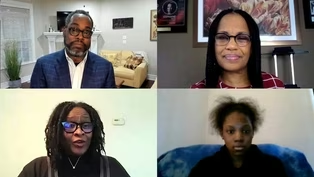
'Grow Detroit's Young Talent' Summer Jobs Programs Returns
Video has Closed Captions
Clip: S50 Ep14 | 11m 35s | ‘Grow Detroit’s Young Talent’ jobs program returns for another summer season (11m 35s)
Providing Support for PBS.org
Learn Moreabout PBS online sponsorship
- News and Public Affairs

Top journalists deliver compelling original analysis of the hour's headlines.

- News and Public Affairs

FRONTLINE is investigative journalism that questions, explains and changes our world.












Support for PBS provided by:
American Black Journal is a local public television program presented by Detroit PBS