
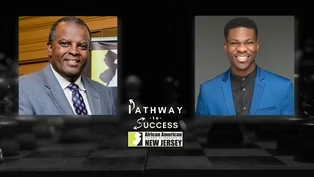
Dometi Pongo, MTV Host, Award winning Journalist
Season 2 Episode 212 | 26m 48sVideo has Closed Captions
Dometi Pongo, Journalist & MTV Host brings together social awareness, art and culture.
John E. Harmon, Sr., Founder, Pres. & CEO of the African American Chamber of Commerce speaks with Dometi Pongo, Award winning Journalist and Host of several MTV shows including the critically acclaimed ""True Life Crime"". His work brings together news, Hip-Hop, art, culture and social awareness. Produced by the AACCNJ, Pathway to Success highlights the African American business community.
Problems playing video? | Closed Captioning Feedback
Problems playing video? | Closed Captioning Feedback
Pathway to Success is a local public television program presented by NJ PBS
Dometi Pongo, MTV Host, Award winning Journalist
Season 2 Episode 212 | 26m 48sVideo has Closed Captions
John E. Harmon, Sr., Founder, Pres. & CEO of the African American Chamber of Commerce speaks with Dometi Pongo, Award winning Journalist and Host of several MTV shows including the critically acclaimed ""True Life Crime"". His work brings together news, Hip-Hop, art, culture and social awareness. Produced by the AACCNJ, Pathway to Success highlights the African American business community.
Problems playing video? | Closed Captioning Feedback
How to Watch Pathway to Success
Pathway to Success is available to stream on pbs.org and the free PBS App, available on iPhone, Apple TV, Android TV, Android smartphones, Amazon Fire TV, Amazon Fire Tablet, Roku, Samsung Smart TV, and Vizio.
Providing Support for PBS.org
Learn Moreabout PBS online sponsorship- Support for this program was provided by Horizon Blue Cross Blue Shield of New Jersey.
PSE&G, proud sponsors of "Pathway to Success."
JCP&L, and the African American Chamber of Commerce of New Jersey, working together to build a stronger community for all.
Investors Bank, banking in your best interest.
Berkeley College, education drives opportunity.
Be inspired.
NJM Insurance Group.
The New Jersey Economic Development Authority.
[jazz music] - Award-winning journalist Dometi Pongo... - Had you ever seen a case like this?
- Digs deep into some of the most disturbing cases... - What happened?
- To reveal the real story behind the headlines.
Tonight, the shocking discovery of two murdered women leads to a jaw-dropping revelation... - Wow.
- No one could have expected.
Here's Dometi.
- Welcome to "Pathway to Success."
I'm your host, John Harmon, founder, president, and CEO of the African American Chamber of Commerce of New Jersey.
We're delighted that you would tune in with us today.
Our special guest is Dometi Pongo.
He is the host of MTV's "True Life Crime."
You know, Mr. Pongo, we're delighted to have you here today.
And why don't we just start off telling us a little bit about your family; large family, small family, and then, you know, where you're from?
- Man, glad to be here, John.
You know, my family are West African immigrants.
You know, they came from Ghana to Chicago in the '70s.
I got two older sisters, Nunya and Ephenia.
You know, all of my family is in healthcare.
I'm the only one that is in the broadcast field.
You know, we moved-- they moved from Ghana to the south side of Chicago, where I was born and raised, up until moving to New York a few years ago.
- Why did you select, you know, Southern Illinois University as your school of choice?
- SIUE was like the perfect school that was just far enough from Chicago to feel like I made a step out of my neighborhood, but still close enough to take that four-and-a-half-hour drive back home if I needed to.
It was just outside of St. Louis.
My sister went to the dental school near SIUE, which was one of the reasons I went there, and the second was I got a scholarship based on my ACT score.
So when I got there, majored in Economics, and, you know, started getting involved with the arts, and that kind of, like, colored my experiences all the way up to this day, going to SIUE.
- You know, you're doing a great job on the show with MTV, but, you know, tell our viewers a little bit about some of the things you did leading up to this very important role that you're playing on this show.
I enjoy it personally.
- Man, thank you.
I appreciate that.
I always say my window to journalism was hip-hop, man.
I wrote my first verse when I was just six years old and before I knew what journalism actually was.
My first journalists were Jay-Z, were Black Thought, were Nas, and so I wanted to be an MC.
You know, when I got an undergrad, outside of my classes, in economics, I was doing different projects with the Black Studies Department.
I was writing poetry.
I was hosting the open mic sets on campus, just building my profile as a writer.
Eventually, I graduate, I work for Target as a business analyst for a year, and I felt so unfulfilled that I quit without much of a backup plan.
I moved back to Chicago, interned at a radio station, which led to me becoming news director at that station, then went on to WGN-TV and radio.
- So you know, how did you land this gig with MTV?
- The show existed as an idea, and they started it off in Chicago and wanted to do the story about the young lady named Kenneka Jenkins, who was found dead in a walk-in freezer.
And as they were doing pre-pro for the show and scouting people who could potentially tell this story, my name continually came up in those circles.
I met with them, and I felt that their intentions were sincere.
And I said, "Let's do it."
You know, we shot the pilot.
And then about a year goes by, and I don't really hear from MTV News for a while.
Then they engage me for a consulting contract as a consulting producer on some other projects.
And then eventually, I get the MTV News job, and then the show gets greenlit.
What I love the most about the work we're doing on "True Life Crime," too, is that we focused on marginalized communities.
Right now, we see these cases where someone like Gabby Petito tragically went missing.
Her family has been, you know, on TV.
There has been wall-to-wall coverage.
We don't see that same type of coverage for someone that's a person of color, whether they're Native-American, African American, or whether they're even someone who may deal with substance misuse or someone from the LGBTQ community.
So we tell stories that elevate, you know, crimes that happen to people from all marginalized communities, people that society has kind of forgotten about.
- You know, just a follow-up, was this a personal goal of yours to one day work on a major network like MTV?
- Working on TV wasn't-- actually, wasn't the goal.
It kind of just happened.
I think when I was working at Target, and I didn't feel fulfilled, and so TV, at that time, didn't seem like it was in the stars.
I was just chasing purpose.
I was just trying to find meaningful work.
And, by God's grace, I ended up finding my way into TV, but that wasn't the goal at all initially.
- Give us a sense of the demographics for the show.
- That's the 18 all the way up to the 35 demo is what we're talking about.
So folks with progressive ideals, young people.
- Young people are our future leaders.
So I'm always curious about their thoughts, their opinions.
- I think young people are gonna be the key to moving us toward a more equitable future because, well, one, they have the energy to get out there.
You know, we need the wisdom of the elder generations, but we need the energy of the young.
They got the energy to go out there and march, and they don't have as much to lose.
I think some of us, who get into an age range where we begin to work and get into the workforce, start to see the costs of activism in a way that young people don't have to contend with.
That's the upside of the passion of this generation, right?
The activism side.
But then you've got the downside, which is we're still dealing with gang culture, especially in my city, my hometown, that is really cutting down youth before they really get a chance to flourish.
You know, it's challenging figuring out how to tackle all of that, how to harness the energy of, you know, progressive activists, young people, and some of these young folks that have found themselves in the streets and feel like they don't have alternatives.
- Can you share with us if you've ever had any interesting viewer shoot you an email?
- The note that I got that touched me most was probably Muhlaysia Booker's mom.
Muhlaysia Booker was a trans person who was killed in Texas.
Found dead after being beaten by a mob of people just a few weeks prior.
Her mother sends me a message and said that, "You guys gave my baby so much justice."
I get a lot of messages from people I've never known who says, "We love the way that you express empathy and relate to folks."
That's some of the best feedback I've gotten.
The only criticism that I've gotten is from people who are overly enthusiastically pro-police, right?
They think that anything that holds an institution accountable means you're anti-that institution.
I'm not anti-police.
I'm anti-bad jobs, bad service.
It comes with the territory.
It came with the territory when I covered Georg Floyd.
So it is what it is.
- So what is a typical day for you when you're on the set executing or putting this show together?
- You know, I know a lot of folks say this, but, you know, no two days are alike, especially in the era of COVID.
So if I'm doing an at-home shoot, my morning starts off with a Slack group chat with--well, first, coffee... - All right.
- And then a Slack group chat with my team that helps to write my episodes for my show "Need to Know."
Then from there, as being at home, I turn into my own lighter-- lighting guy, gaffer, my own DP.
So I'm setting up my prompter, setting up all the lights, making sure the color temperature is right, loading the teleprompter.
Now, when I'm on the road hosting different specials for VH1, or maybe if I'm on the road shooting "True Life Crime," those days begin the night before with a meeting with my producer, where they just give me a download of all of the footage they may have gained to help tell the story.
It's pretty long days, but it's a lot of variety in the work.
And it's very rewarding work.
So it is fun, probably the wrong word to describe the nature of it, but it's fulfilling I'll say.
- Well, you do a lot-- have done a lot of shows.
Is there one in particular that, you know, kind of stands out?
I'm not going to ask you if it's your favorite.
- The "True Life Crime" episode about Darrien Hunt stood out to me the most for two reasons.
I had never seen a true-crime show where the police were the suspect and where we treated them as though they were a civilian suspect.
You know, surveillance footage mysteriously disappeared.
You know, different challenges that we faced.
So that one was really interesting in figuring out how to tell the true crime story, but also a story about police accountability.
And the second reason it stood out to me was how raw the grief was for this family.
This happened seven years ago, and I don't think I had ever spoken to anybody who were still so traumatized by what had happened because they'd been through a lot of other things that we didn't talk about on camera.
- You know, as a follow-up, there was a case with a Britney Cosby.
I thought that was a very interesting show.
If you can share with our viewers a little bit about that.
- Britney Cosby and Crystal Jackson were a lesbian couple who were found deceased next to a pair of dumpsters.
So, spoiler alert, but, you know, one of the victims' fathers actually killed both women.
And that was--that was a difficult story to tell.
We also ended the interview with me talking to one of the victims' daughters.
- Tell me where you saw the blood.
- How often do you think about mom?
- Almost every day.
What comes to mind?
I just think of her smile.
You know, she was like-- she liked taking pictures a lot, like a lot of pictures.
- Well, what do you think you might want to do?
- I want to start a business, and then I want to be a lawyer.
So, like, both of the things at the same time.
- What kind of lawyer?
- I want to work with the family against the criminal.
- What made you want to do that?
- My mom.
- So you want to be able to help other families the way attorneys helped yours?
- Yeah.
- What would you say to other young boys and girls who may have experienced something like what you went through?
- It's okay.
Think about the bright side of it, you know?
If your parent was killed, just think of it as that person they're locked away.
So they're not going to kill more people.
So, in a way, it's like your person, even if they took them away, you are the reason that everybody can be happy because they have you.
You're like the seed.
Like if you cut down a tree, you're the seed that fell on the ground.
- Wow.
- So it just sprouts up, and you look just like them.
- That's beautiful.
And that was my first time interviewing a child about something so tragic and so gruesome.
So it was a--it was an uplifting show toward the end because that little girl, Zaniah Jackson, she's gonna be--she's gonna be something special.
And so I think, in years to come, we'll probably hear her name again.
So that was a rewarding show to do on the backend of it.
- You know, very devastating.
From your opinion, is there any societal benefits?
- Oh, give me one second.
This AirPod just died on me.
Let me switch this up.
There we go.
Pardon me.
But, yeah, there are definitely societal benefits to the show.
We've had hundreds of thousands of petitions signed on behalf of the victims' families.
We've shed light on the MMIW crisis that's happening in Native-American women, definitely redeeming.
And I'm hoping that folks at home are having similar conversations.
- You know, I'm really enjoying our conversation and don't want to stop, but we have to take a short break here on the "Pathway to Success."
We'll be back in a minute.
The African American Chamber of Commerce of New Jersey is your pathway to success.
We encourage you to visit our website at www.aaccnj.com or call us at 609-571-1620.
We are your strategic partners for success.
- Welcome back.
You know, I am really enjoying my conversation today with our very special guest, Dometi Pongo.
He is the host of MTV's show "True Life Crime."
The pandemic.
You know, we talk about how the pandemic has adversely affected Black business.
They're saying, you know, up to 41% of Black businesses will be forever closed as a result of the pandemic.
In addition, you know, there was a lot of individuals that were hospitalized because of COVID and a lot of death in the Black community.
Can you react to that?
- You know, when you're African American, you have a higher rate of comorbidities or, you know, more likely to have comorbidities that make a COVID infection more dangerous.
And ultimately, all of these things, it's not a stretch to say, is a by-product of the fact that we started behind the eight ball, being enslaved, coming here as enslaved Africans, means that when--you know, when white folks sneeze, Black folks catch the flu.
And that's basically what this is.
We're still an economy that really only had an opportunity to flourish in what?
The last generation?
Maybe six decades?
And then this happens.
So it's no--it's no wonder, it's not surprising at all, but it's just a byproduct of the intentional underinvestment in Black communities.
- You know, technology, I found in the case of the Chamber, enabled us to pivot and go to a virtual platform.
Did you have a similar experience?
- I think a lot of Black businesses had trouble pivoting because we don't have the institutional know-how.
Granddaddy didn't start this business, and we--and pass it down to us, and we just knew how to run it.
A lot of us are first-time entrepreneurs, maybe even our first in our families to go to college.
And with that comes a learning curve.
And so, I think a lot of our businesses haven't learned how to pivot into the technology space.
That's a big thing.
So I think, within our community, we need to really look at mentorship both ways, across generations.
- You have Ghanaian roots.
You take an annual trip there.
Can you talk about the annual trips you take back home?
- Man, so it started as a radio promotion in 2016.
We took 25 listeners to go back home to connect with our cultural heritage.
I think a lot of the deprivation we see in our communities is because we haven't really been able to connect to who we are that's been robbed from us.
And my last trip was February 2019.
And over the course of those four years, we took four trips, I should say, took 70 people back to Ghana.
So you're going to the slave dungeons.
You're learning about your ancestry.
You're seeing how the African economy works, how many markets there are in Ghana, what it's like to see nothing but black faces on the billboard.
God, I pray now that you cement this knowledge.
That we don't go home to our comfort and we forget anything that happened here.
It was a total spiritual, economic, and philanthropic endeavor that, you know, I hope to kick back up pretty soon.
- You know, you and I have had some personal conversations about our history, our history here in the United States, and, you know, our ancestors being shipped here shackled to the bottom of a vessel.
Talk a little bit about, you know, history from your perspective.
- You can't know where you're going if you don't know where you've been, where you've come from.
I think there's a pride that even--even the privilege I have as the child of African immigrants, there's a sense of confidence, a pride, a knowing, in being able to know what my name means.
That Dometi means "The backbone of the family."
That Pongo means "workhorse."
That just that small thing, that sense of pride, language--not to say, African Americans, we have our own culture too.
I feel like I'm an African American as well.
We have our own culture.
That's not taking away from that.
But I think the deepening of that culture is why we're able to see so many people who have connections to their home countries move through the world a little differently.
But it starts with knowing that our roots are in Africa.
So that we can have one tree from which the branches come from.
And we better understand who we are.
- The Pongo Strategy Group, share with us what is it all about?
- You know, what Pongo Strategy Group does is we help companies tell better stories through multimedia.
A very broad mission statement.
It started off because I would have nonprofit organizations that may have strong community ties and even strong online followings lack infrastructure to tell their own stories.
So they would pitch a story to me and wonder, "Why doesn't media cover more uplifting stories about Black communities, for example?"
And so I said, "Well, just give me the pitch."
Sometimes the pitch wasn't written well enough.
The website might not be up to date.
So I couldn't get accurate, up-to-date information.
And I said, "Wait a minute, this is a gap that I'm seeing across some Black businesses and, especially Black nonprofits.
Let me provide that service."
And so I started helping organizations, like the Chicago Urban League, build their podcast infrastructure.
I've done one-off partnerships with AARP Illinois, with Donda's House, Kanye West's nonprofit in Chicago.
It's now called The Art of Culture.
Those were some of my clients coming up.
- You know, what's your secret sauce?
You don't want to give it all away.
- It's simplicity.
It's just seeing what needs to be done and just providing it and making it easy.
- There's a lot of demonization to business, capitalism, and free enterprise.
So I'm just curious, as it relates to, you know, individuals within your demographic or younger, maybe 25 to 40.
You know, business-- why business is important?
- And so, I think the conversation needs to be had in terms of how can the business community better and authentically engage activist communities to have that conversation one-to-one?
And I think that's where the disconnect is.
And it's much easier said than done because sometimes there are interests that are at odds.
But that's the key.
I think the business class is sometimes disconnected from the activist movement because of what we discussed earlier in terms of business folks have more to lose.
So it may be more costly to champion certain causes.
But if we were all able, as Black folks, to pool our wealth together, to pool our resources together, there'd be no one to tell us what we can and can't do because the Black dollar is what circulates this.
I, as a company, could say, "I stand with the Black Lives Matter movement because it's Black lives that funds my business."
- And we're also trying to figure out how we could be more appealing to that younger demographic, 25 to 40.
Any thoughts?
- I think the Chamber can draw connections between thinkers of the past, who have been civil rights leaders and trailblazers, and parallel that to activists of today and people that young people look up to today, who are trailblazers in the same way.
And I think if the Chamber had conversations about, "What makes Madam C.J.
Walker like Issa Rae?"
"What makes Tyler Perry an offshoot of Frederick Douglass?"
I think that we would be able to more clearly see that there is a world where civic action and entrepreneurship truly is in tandem.
- You know, that was a very interesting response to the question.
- We need to go to the colleges and the high schools and go to those events and talk to people, where the young people are.
I think the business community talks to each other and has great conversations among each other, but it doesn't reach the people it needs to reach.
Let's go into those communities, let's go into the barbershops, and talk about how folks can, you know, take advantage of tax incentives.
And talk about what they can do to get their credit right.
And then talk about how that moves our generations forward.
- So, you know, as it relates to what you do and what we're doing at the Chamber and with our show, that is the "Pathway to Success," we would love to explore some opportunities, collaborate in some kind of way.
Any thoughts about that?
- That's the question I was waiting for, man.
It's the reason I'm here.
I would love to figure out what we can do.
You know, there--there-- what your show is doing, being that you're making content.
Let's get this information out there.
This is wonderful.
This is--this is what we need, but as soon as we're able to do some in-person activations.
If I can go with you to these colleges, go with you to these high schools.
I'm all down for anything, man.
This is why I'm here, to be a resource to you and to the people.
- But, you know, what are your future plans?
The next five years?
- The next five years, to continue doing diversity of content.
PSG is going to be developing, you know, original documentaries, docuseries, podcast series, telling stories, like the one we're telling, pushing this narrative that we need, in terms of helping our communities, but also monetizing that and owning the content and then selling it to these companies to create a hub for more Black creators to prosper through.
- You know, we're just delighted to have you.
You know, thank you for coming.
And I hope that we can do more stuff in the future together.
- I appreciate your time.
You are a busy man.
So if you making time for me, it means a lot.
A pleasure to be here.
- Thank you for joining us today.
Until the next time on your "Pathway to Success," this is John Harmon, founder, president, and CEO of the African American Chamber of Commerce of New Jersey.
Today's message is, "Where do we go from here?"
The election for governor has been decided.
Black people in New Jersey, the 1.2 million of us, we have the highest poverty, the highest unemployment, low median income.
Our net worth is $5,900, versus whites' of $315,000.
Homeownership is between 35% and 37%.
We gave 94% of our vote last term to Governor Murphy.
So the question is, "What is our agenda?
What are we going to demand?"
We have a host of systemic challenges.
New Jersey, in terms of segregated schools.
No one's talking about it.
I talked earlier about the high poverty, the high unemployment.
No one's really talking about it.
And guess what?
They're not gonna talk about it.
Who's gonna talk about it?
We must talk about it.
We have to demand.
We have to coalesce a relationship with those who have the authority.
You know, it is time for us to really declare what's in our best interest.
You know, we've made some progress, and this is not to indict anybody, but Black people in this country have contributed a lot to the greatness of these United States.
In addition, we've done a lot to make New Jersey a better place, but, nonetheless, we're still at the bottom.
It is time for us to take a stand and rightfully declare what we are entitled to.
Thank you so much.
- Support for this program was provided by Horizon Blue Cross Blue Shield of New Jersey.
PSE&G.
JCP&L.
Investors Bank.
Berkeley College.
NJM Insurance Group.
The New Jersey Economic Development Authority.
Dometi Pongo, MTV Host, Award winning Journalist
Video has Closed Captions
Preview: S2 Ep212 | 32s | Dometi Pongo, Journalist & MTV Host brings together social awareness, art and culture. (32s)
Providing Support for PBS.org
Learn Moreabout PBS online sponsorship
- News and Public Affairs

Top journalists deliver compelling original analysis of the hour's headlines.

- News and Public Affairs

FRONTLINE is investigative journalism that questions, explains and changes our world.












Support for PBS provided by:
Pathway to Success is a local public television program presented by NJ PBS