
Dominique Morisseau Discusses ‘Ain’t Too Proud’ Musical
Clip: Season 50 Episode 34 | 11mVideo has Closed Captions
“Ain’t Too Proud: The Life and Times of The Temptations” plays at the Detroit Opera House.
"American Black Journal" host Stephen Henderson sits down with Detroit-born playwright Dominique Morisseau to talk about the success of her “Ain’t Too Proud: The Life and Times of The Temptations” musical, its time on Broadway cut short by COVID-19, and the significance of bringing the show to Detroit. They also discuss the challenges and successes of African American-focused musicals and plays.
Problems playing video? | Closed Captioning Feedback
Problems playing video? | Closed Captioning Feedback
American Black Journal is a local public television program presented by Detroit PBS
Dominique Morisseau Discusses ‘Ain’t Too Proud’ Musical
Clip: Season 50 Episode 34 | 11mVideo has Closed Captions
"American Black Journal" host Stephen Henderson sits down with Detroit-born playwright Dominique Morisseau to talk about the success of her “Ain’t Too Proud: The Life and Times of The Temptations” musical, its time on Broadway cut short by COVID-19, and the significance of bringing the show to Detroit. They also discuss the challenges and successes of African American-focused musicals and plays.
Problems playing video? | Closed Captioning Feedback
Where to Watch American Black Journal
American Black Journal is available to stream on pbs.org and the PBS app.
Providing Support for PBS.org
Learn Moreabout PBS online sponsorshipWe talked about this show last time we talked, I think it was headed to New York, but it's a bigger deal I think, for something like this especially to play in Detroit because we own this, right?
This is our story and you can't get away with anything.
- No, absolutely not.
- Throwing the story to us.
So, talk about Ain't Too Proud, yeah.
- You know, I just, I'm really happy to have Ain't Too Proud, The Life and Times of The Temptations here in Detroit at the Detroit Opera House, you know?
It's been a long time coming with our Broadway tour, we were supposed to be, Detroit was supposed to be one of the first stops when we were originally gonna do the tour in 2020, but we all know what happened in 2020 and so that delay has shifted things around, and so it feels like it's just been a long time coming to get here to Detroit to do this show and we were on Broadway, you know?
And the COVID shut the show down on Broadway, and so now that we're doing this Broadway tour and we've been to all these cities, it just feels like a new life to be here and it's more important, I mean, being in Detroit, you know, you could just ask the cast, you could see it on their faces when they perform and like it just feels, this feels more important than Broadway, this is like the most important performance you could be doing, is the ones you're doing here in Detroit right now.
- Yeah, yeah.
Well, and the story of course of The Temptations is in many ways, a story of Detroit, of course it's a story of Motown as well, but it is a Detroit story in the sense of that perseverance, that focus on who ya are and where it takes you in life, and the celebration of all the things that make us Detroiters, I mean, The Temptations are Detroit in such a special way.
- That's right and I make sure, and I promise in the show that I'm not gonna let you forget that this is, The Temptations are a Detroit, homegrown Detroit group, you know?
That this group was born and raised here in a city that grew all of the rest of their contemporary's, you know?
And I tried to make sure that, that stamp is really clear in this show.
- Yeah, yeah.
Talk about this being on Broadway as well, I mean that was a very big deal when that happened, how did that audience receive this story?
- Yeah.
You know, it was really special, I mean they went bananas for it on Broadway and honestly if not for Omicron, it kind of ravaged all of Broadway really and a lot of shows closed prematurely, just too many and a lot of them were the Black shows, which is like the heartbreak, but there was a moment in which Ain't Too Proud was on 45th, well the theater is on 45th and 46th Street, because the front of it is on 45th and the back of it's on 46th Street, and then my show Skeleton Crew was on 47th Street, so for a very short period of time, like a month, you know?
I had two Broadway shows taking up three blocks of New York City's Broadway real estate, you know?
And that was kind of exciting, I was like, "Whoa, Detroit is taking over New York right now."
And so it's just been really amazing because it was so well received and it just really, it kinda doesn't make sense that we're not still on Broadway except for you know, just everything came, Almost, Broadway almost came back, I won't say too soon, but too fast, you know?
And without enough foresight of how to like maintain if a surge happens, you know?
And so, but the show was so, you know people loved it and they were, it was one of those specials ones and you can also tell I guess that's kinda rare for Black musical theater artists to be able to be their full selves on a Broadway stage, you know?
They're used to having to like cover or be told that they're singing too, you know make too many runs, and you know how the theater, yet somehow their speech pathology, that they're not speaking articulately enough, you know for Broadway to be on a stage and I'm like, "No, you need to sound like your elders and your ancestors right now in this show, you need to sound like"- - You need to sound like Detroit.
- "You need to sound like Detroit, you need to sound like around the corner and up the block, you know?"
And so, I think it was kind of freeing for all of the artists who were participating in the show to be able to be their full selves, so when you watch it, you're just blown away by all this Black talent that doesn't normally get to be, do what they can do all the time.
- Yeah, I would be remise if I didn't mention that this play also won a Tony for choreography, talk about that, I mean that's, that's an incredible achievement.
- Yeah, I mean it is, I mean you know, it was nominated for 12 Tony Awards and we took the Choreography Tony, and I was like, "If there was one Tony that we needed besides obviously the Book," which I feel like, that I feel like we got robbed on, you know?
Not just because it was me, but because I knew, I felt really strongly and I think other people did too that, that was someone that shouldn't have gotten it, but I was gonna throw my shoe at somebody if we didn't get that Choreography Tony, because I just couldn't, I mean you can't, the choreography in the show was outstanding and you can't even like, you mean it's The Temptations and then there's also a touch of so many more groups that followed them, you know?
Sorta like does this nod to the past and to the generations that came after them, right?
You know, it's a little bit of a new addition nod and there's a little bit of other styles, and I think that, "How could you not go crazy for that choreography?"
(upbeat music) ♪ When my life doesn't complete me ♪ ♪ I'm so good ♪ 'Cause I can't get next to you ♪ ♪ I can't get next to you babe ♪ Can't get next to you ♪ I can't get next to you ♪ I just can't ♪ I can't get next to you babe ♪ I can't get next to you ♪ I can't get next to you ♪ Next to you - That Choreography Tony went to Sergio Trujillo, who was our choreographer and he got that alongside, you know Edgar Godineaux, who was his associate choreographer, I mean it was a lot of gifted minds and talent that went into that choreography that made it stellar.
- Yeah.
Well and thinking, and speaking about the celebration of Black art on Broadway, that nod for choreography, I mean this is obviously, you know, a very Black show in every way and then the choreography reflects our culture in a way that other plays don't do on Broadway and for those reasons that you're talking about, they always say, "You can't, you can't be that, that much on Broadway."
Here you did it and you know, you're recognized with the best award that they have.
- Yeah, yeah.
Yeah, absolutely, I mean it's deserved and then you know, and so, some even more things were deserved as well and I think everybody who got nominated deserved their nomination, like it was a fantastic production, you know?
And so I'm really proud, and this company that we have here in Detroit, some of them were like covers for us on Broadway, some of them came from Broadway, but a lot of them did not, they just joined for the tour and they are, they rival trust me, you're not getting, you know, I get nervous when I look at em like, "Okay are we gonna fall?
Is like something gonna lose some quality?"
and I watch the show, and I'm like, "I've been here from the beginning."
I've been in with this show since we were like in the Bay Area just trying it out before we got to Broadway, we went to like three cities, I've seen a lot of you know, rotations of this show and you're getting a stellar cast, you're getting a stellar cast, yeah this is a great production and a great group of people.
- Yeah.
The success that this had in New York, the success that you've had in New York, do you feel like things are changing in terms of opportunity for African American writers?
African American material?
You know, material that's influenced by African American culture?
I mean, Broadway was so closed to us for so long and now it seems, there's almost a flood of recognition in some ways that, "Hey, that wasn't all right."
- Well you know, coming off of 2022 this past season, 21/22, really I guess it was the end of 2021, but they were, they're in the beginning of eight Black shows on Broadway, which is unprecedented, you know, you'd be lucky if you catch one or two at the same, you know?
In like of several years, you know?
But in one year, all of these Black shows together were on Broadway and while that felt really, it was a milestone and it gives you hope, but I always say you know, don't make that optical, don't make that an optical illusion, you know?
We were also the first ones brought back during the pan, you know, we brought theater back from the pandemic, so we were also the pandemic test dummies, you know what I mean?
So, it was like, "Why, it looks good, but also whose shows all closed first?"
You know?
- Right.
- Whose shows didn't get to stay up on Broadway because of the fraught time that we were having to do theater in, you know?
And so, you can't look at those Black shows and what happened to our shows on Broadway, and then go, "Well we tried."
And move on, you know what I mean?
You have to be like, "Oh no."
You know?
"Look what you put us up against."
And look how even still there was a hunger, and a desire to see this work on Broadway, so imagine when we're not in the thick of a plague that was like more aggressive than the original plague, you know?
Now, imagine what we could do if not for those circumstances and I think if those things are not taken into consideration, then you're not really trying to change Broadway, but you know, but I do think at their time, there's enough being called for and demanded frankly from theater artists to change, not just Broadway, but theater across the country and make it better, and more affordable, and so I believe in that change more than I believe in the optical illusions.
- In addition to Motown, Detroit is of course home to the nation's first Black
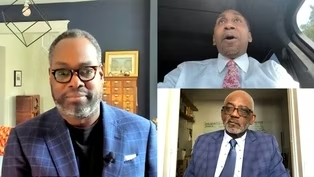
WGPR-TV 62 Celebrates Legacy as First Black-Owned Station
Video has Closed Captions
Clip: S50 Ep34 | 9m 34s | WGPR-TV 62 celebrate diversity in the media at fundraising gala with Stephen A. Smith. (9m 34s)
Providing Support for PBS.org
Learn Moreabout PBS online sponsorship New Episode
- News and Public Affairs

Top journalists deliver compelling original analysis of the hour's headlines.
 New Episode
- News and Public Affairs

FRONTLINE is investigative journalism that questions, explains and changes our world.
 New Episode
 New Episode
 New Episode
 New Episode
 New Episode
 New Episode


 New Episode
 New Episode
Support for PBS provided by:
American Black Journal is a local public television program presented by Detroit PBS