
Don Lemon; Henal Patel
5/15/2021 | 26m 43sVideo has Closed Captions
Don Lemon; Henal Patel
CNN's Don Lemon shares the long-term impact of the death of George Floyd, how people can work to confront racism and sexism in society, and the responsibility of the media in delivering truthful journalism; Henal Patel talks about the distinctions between voter suppression and election security, the impact of Georgia’s new election policies, and the connection between voting laws and race.
Problems playing video? | Closed Captioning Feedback
Problems playing video? | Closed Captioning Feedback
Think Tank with Steve Adubato is a local public television program presented by NJ PBS
Don Lemon; Henal Patel
5/15/2021 | 26m 43sVideo has Closed Captions
CNN's Don Lemon shares the long-term impact of the death of George Floyd, how people can work to confront racism and sexism in society, and the responsibility of the media in delivering truthful journalism; Henal Patel talks about the distinctions between voter suppression and election security, the impact of Georgia’s new election policies, and the connection between voting laws and race.
Problems playing video? | Closed Captioning Feedback
How to Watch Think Tank with Steve Adubato
Think Tank with Steve Adubato is available to stream on pbs.org and the free PBS App, available on iPhone, Apple TV, Android TV, Android smartphones, Amazon Fire TV, Amazon Fire Tablet, Roku, Samsung Smart TV, and Vizio.
Providing Support for PBS.org
Learn Moreabout PBS online sponsorship- [Narrator] Funding for this edition of Think Tank with Steve Adubato has been provided by PSE&G, committed to providing safe, reliable energy now and in the future.
The New Jersey Education Association.
New Jersey Sharing Network.
Prudential Financial.
RWJBarnabas Health.
The Healthcare Foundation of New Jersey.
The New Jersey Economic Development Authority.
Horizon Blue Cross Blue Shield of New Jersey.
Here when you need us most, now and always.
And by Rutgers University Newark.
Promotional support provided by ROI-NJ, informing and connecting businesses in New Jersey.
And by CIANJ, and Commerce Magazine.
[MOTIVATIONAL MUSIC] - Steve Adubato here, but way more importantly on behalf of the public television family we are honored to have my good friend, Don Lemon.
He's a friend to a lot of people.
He's an anchor at CNN, you catch him at every single night.
Tonight with Don Lemon, 10:00 PM to 12:00 AM.
The author of this book.
A lot of people are reading it, This is the fire, What I say to my friends about racism and by the way, influenced by this book.
This is the next fire.
Excuse me, The Fire.
Next Time, James Baldwin.
Hey Don, how're you doing?
- I'm doing okay, Steve.
It's so good to see you, thanks for having me on.
As you know, it's a crazy time and we're all just doing the best we can in this moment.
- That's right.
And so we're taping on the 22nd of April.
It'll be seen later on the 20th.
And by the way, I was reading again the letter to your nephew, say your nephew's first name.
- Shashad.
- You were telling him, you wrote I believe on the 25th of May and you were telling him about George Floyd calling out for his mama as he was killed.
And you said, quote, we know what comes next.
You said that to your nephew.
Do we know what comes next?
- Yeah, well, I said, we know what comes next meaning the weeping and then the complacency - And the hope and prayers.
- and hope and prayers.
And so thoughts and prayers come next.
And then we weep and then we become complacent.
And then until I said another black man is shot on another street, and then the weeping begins again.
I think that that comes again but I am hopeful Steve, that some real reform comes after this because I wrote the book obviously before the verdict, I wrote the book because of in large part because of the unrest, because of the killing of George Floyd.
And so I think that I'm hopeful that this is the beginning to accountability.
I'm hoping that maybe we don't know what comes again.
- The other thing that struck me in reading the book is that so many people use the phrase quote, but Don or not just the Don, but others but I'm not a racist, including the woman I believe it's Amy Cooper in Central Park.
Walk, the dog Walker, Christian Cooper is there.
And she can, calls the cops.
I have a black guy here, but I'm not a racist.
Now, she's just one of many who say that.
Now I want to say, I'm not a racist, but you argue that it's way more complex than saying I'm not a racist, for white folks.
- Yeah, I say pocket that I'm not a racist card because what you're saying to me is that you don't want to deal with it.
What you're saying is don't harsh my high, or my mellow, I don't wanna deal with these things.
So I try to get people to understand it this way.
You and I are both dumb men.
Women have to deal with all kinds of issues when it comes to misogyny, sexism, discrimination that we don't understand because we get to walk around as men at a privileged society that's geared towards men.
And so for a man to say, oh, well, I'm not sexist.
A woman would go, well, there are some things you probably need to deal with.
And so rather than saying, well, I'm not, I'm not, why don't you say well, okay, so then what did I say or do, or how am I operating in a system that is sexist, that is helping to perpetuate the sexism doesn't mean that my full body or my full being a sexist.
So in that same vein, it's the same thing with racism.
I also go on to say, it doesn't matter if you are not racist, our society is racist.
And so if you can think about it that way, instead of being aggrieved by the possibility that someone thinks that you have a bias, whether it's unconscious or not instead of being aggrieved by that, why don't you accept or listen to the person and try to figure out what part that they're trying to help you become aware of to make the whole situation better?
That's it.
And so, so many people become so aggrieved by the possibility that they could be racist or it could be biased that they make it about them rather than about the actual act of racism itself.
And what is more egregious?
The act of racism is more egregious than your perceived aggrievement or racism.
That's it?
It's as simple as that.
- Hey, can you do the title Baldwin's book?
I believe '62 or '63 it came out, The Fire Next Time.
This is the Fire, right?
First of all, why?
I mean, you really talk a lot about Baldwin and he had a great influence on you.
Explain the connection and the fire is racism.
- Yeah.
- So, this is my copy of The Fire Next Time.
From the '90's with all of the notes and everything.
I thought it was the original.
My mom says, no, there's one here somewhere that's all beaten up or whatever.
But why?
Because he says in the book, he says, I think he says written from a Bible verse or whatever, I forget his exact thing but the quote is God gave Noah the rainbow sign no more water, the fire next time.
And so this was written to his, he wrote this letter.
- His nephew.
- His nephew on the 100th anniversary of the Emancipation Proclamation, that you know, we are celebrating 100 years of freedom, 100 years too soon.
And so when he said the fire next time meaning what is going to be worse?
How are we actually going to get people to deal with this issue of racism in this country?
And so when I saw what happened with George Floyd, I said, well, this is the fire that James Baldwin was talking about.
And so if we don't deal with this fire now, if we don't contain it and put it in a fireplace or at least where we can control the embers and the sparks then we are doomed to I don't know, we are doomed to an existence or to a future or to a present that is going to be untenable.
And so that's why I say this is a fire.
So when James Baldwin was impassioned enough to write to his nephew, I was that impassioned because this book, James Baldwin's book was the most influential thing, was the thing that influenced me the most on racism and dealing with sexuality.
A black man who happened to be gay dealing with racism and homophobia, same thing for me.
So when this whole quarantine thing was going down, George Floyd was going down, I could not see my loved ones.
I was feeling guilty about the world that I was leaving for my great nephew, that he was about to inherit.
And I sat down and wrote a letter to him, much as James Baldwin did.
And after I began to write that letter saying I hope you are able to embrace your beauty and blackness in the world in a way that I, in a degree of comfort that I was not able to, the whole book just kind of poured out.
It was, I mean, it just came out fast.
I was just inspired.
I was in the middle of inspiration writing this book.
- By the way, checking us out right now, that's Don Lemon.
This is the book.
This is the Fire.
You can catch Don every night from 10:00 PM to 12:00 AM.
Don, we have you for a limited amount of time so I want to be as judicious as possible.
In the book you say that 2016, that Donald Trump was the president we needed?
- I said he was the president we deserved and quite possibly the president we needed.
- Because.
- President we deserve because we were living in this fantasy land about this post racial society that many people thought existed because we had all of a sudden elected a black president.
And people of color were like, no, we don't live in a post racial society.
Black folks are like, no, the racism is still out there.
And so, and it was just beneath the surface.
So Donald Trump came along and he exposed all of that.
He exposed all the racists, not just the people in the hoods and sheets, but the people who are marching with khakis and polo shirts and Tiki torches, the people who are wearing suits and Chanel dresses to the office.
He exposed all of those people so now we knew who the racists were.
And I would rather be able to, being someone from the South who knows about overt racism.
I'd rather be able to deal with someone at face value knowing who they are, rather than hiding who they are.
And so that's why I said he was the president we deserved because we were living in a false reality and probably needed in order to expose the racist and the bigots and the anti-semites and the Islamophobes and whatever in the society.
- You know Don, the first time you and I met on your show several years ago.
I don't like saying this but before you were Don Lemon meaning you were always Don Lemon, but now you're Don Lemon.
And what I mean by that is the word celebrity is so absurd but your profile, you're the only African-American and late night in the role that you are in, your position is huge.
My question is what responsibility do you feel every night when you go on the air?
- I feel responsibility to tell the truth.
I feel a responsibility to try to bring us back to bring us out of a post truth, post fact world.
I feel a responsibility to speak for marginalized people like me to speak for black people in this country because who else is going to do it?
You're right.
I'm the only person who looks like me in primetime and have been for awhile.
So I do understand the responsibility that I have.
I may not have gotten the gravity of it in the beginning because sometimes you don't get things until you start to receive all the criticism.
And then you realize like, oh my goodness there are people out there who are really... - Obsessed with you.
- Obsessed with every single word, every word that I say.
And so now, I do know how important my voice is and I choose my words carefully.
And I'm a better communicator than when you saw me and when I started.
So yeah, I feel the responsibility.
- Final comment, you know on my wall in our home studio I got a picture of your colleague, our friend, Chris Cuomo, every night the handoff between the two of you is pretty good.
- Is that for pests, roaches, and bugs?
- Yeah, I will not say anything about my Italian American brother in broadcasting but I will say this, the chemistry between the two of you is real.
The friendship is real, the commitment is real.
Between the two of you, what do you want to say about you and Chris together every night.
- Chris and I, we're the show and the voice, voices that people need, that people need these voices because none of it is scripted.
It is probably the least scripted part of the date on cable news anywhere.
And we take chances with each other that other people won't.
We say on television what other people wont, what people are afraid of people are afraid of being canceled.
People are afraid of going too far and that they're gonna get so much criticism.
In that moment, we are relying on our friendship and our understanding of what we understand in the world to guide us through.
And also on the grace that we allow each other and I have his back and he has mine.
And so I think that is probably not in my ego or whatever.
I think that's probably the most important moment on cable television.
Those sometimes three, sometimes 10 minutes that we spend together every night complete.
- No disagreement, other than watching PBS, that's a good thing to catch every night.
Other than you (indistinct) - I didn't say me, I said you.
My ego's big, but not that big.
PBS.
- PBS, but you, listen.
It breaks through.
Even you mentioned that Steve, you are a legend, a living icon.
- That just means I'm old.
- No, you're not.
You don't even age, I'm so mad at you.
- Hey, listen, I'm way past the time your people said we had you, but I got to ask you, please tell me you're hopeful?
- I am, but the book is hopeful.
It's optimistic and it's not accusatory.
It's unifying.
It's not divisive.
We need unity, we need people to be hopeful.
And we also need to recognize who our allies are.
And I think that we have many more allies those of us who want a fair and equitable treatment for all people in this country not to go back to a time when we didn't have that.
I think there are more of us.
And I think there is power in numbers and in unity, not in division.
So yes, I am very helpful.
- That is Don Lemon, this is the book.
This is the fire, What I say to my friends.
- Can I tell you a story real quick?
- You can tell me anything.
- Okay, so you say that what I say, this is what I say to my friends about racism.
So I've double bats this past weekend was the first time that I was able to go to a dinner party with more than three people.
So I went to a dinner party, there was eight of us there.
Everybody double back, so we did the whole thing.
We were seated still.
We still sat a seat apart, right?
And so I gave everyone a copy of this book because I said it's what I say to my friends about racism.
And we started having a conversation, conversations like we had never had at a dinner party before about race and about racism because the book allowed us to be able to have a conversation?
It gave us the mechanism to be able to have that conversation.
And I think everyone should do that.
Whether it's this book or even Kennedy's book or Isabel Wilkerson's book or whatever it is, buy the book, start having the conversation.
And they don't answer all of the questions that you need to know.
It'll give you the knowledge and the vocabulary to be able to do these things.
And with a degree of comfort with your friends you must find friends who don't look like you and don't share your points of view, but I'm telling you it was the most mind blowing experience that I had this weekend, sharing this book with people.
And I said, if other quotes can do this I've done my job with this book.
- You have done your job and you'll keep doing your job.
And I just want to say, thank you, Don.
I wish you and those closest to you, your friends, your family, all the best, and I'm happy for you, but again, more work to be done.
Thank you, Don.
- Thank you Steve, I hope to see you on my side of the street sometime soon.
- You got it.
- Stop turning us down when we call you.
- Yeah.
Check out Don every night as he and Chris Cuomo do their thing, that makes a difference.
Don Lemon and I have a lot in common.
You know the biggest is we're very uncomfortable with self promotion.
Thank you, my friend.
- Thank you.
- I'm Steve, that's Don, stay with us, we'll be right back.
To see more Think Tank with Steve Adubato programs and to listen to Think Tank with Steve Adubato the Podcast, visit us online at steveadubato.org.
If you would like to express an opinion, email us at info@caucusnj.org.
Find us on Facebook at Facebook.com/steveadubatophd and follow us on Twitter @steveadubato.
- We're now joined by Henal Patel, who is director of democracy and justice program at the New Jersey Institute of Social Justice.
Henal, great to have you with us.
- Thank you for having me.
- You know, there's a lot of things going on around the country as it relates to changing voting laws.
We're taping at the end of April, this'll be seen after that.
In your mind, what is the biggest difference between voter suppression initiatives and what some call voter security or election security, biggest difference?
- You know, that's a great question and it comes down to this, this is what everyone should ask.
When making decisions about what voting laws to pass, ask yourself, who is afraid of democracy and who's embracing it?
And when you're thinking about democracy, it's about the voters.
That's it.
It is about the voters.
Are we making things better for voters?
And that's what comes down to whether we are actually making our democracy stronger or not.
A lot of people will say under the guise that we're doing this to make the voter system stronger or not, but it comes down to, are they actually doing it?
Or what's the precipice for their decisions?
What are they actually doing?
What is the impact of it?
And if the impact is hurting democracy, if it's making it harder for people to vote, it's voter suppression.
- From your perspective, how much of what's going on in Georgia, what's going on in other states where state legislatures and/or governors are attempting to significantly change the process of how one votes, and in some cases, some say make more difficult, as the case you're making right now, how much do you believe it's based on the results of the 2016 presidential election, not to mention the senate races in Georgia?
- So much of it, almost all of it's about that.
You can tell it's about that.
And the funny thing about it is in a lot of these states, they're telling you that all of this was, the election worked well, and it did, that the election was safe, secure, it had the highest voter turnout in the country in many, many states.
And yet they're using a lot of the conspiracies we heard, a lot of those lies that were told right from the top from the then president about the system.
They're using that as pretext to turn back voting rights.
And we're seeing that a lot of that is the result of the actual election, what happened in those elections.
And you see that based on how they're targeting what laws to push back, what laws to pull back, where they're making it- - Such as?
- For people to use drop boxes, for example.
- Why is the drop box, I'm sorry for interrupting, why is this drop box thing so important, please?
- It comes down to voter access, right?
In New Jersey, for example, we are right now working to expand drop box access.
We just passed a law to make it more equitable so that you have drop boxes, drop box access in more parts of different cities than we were able to earlier.
And the reason being drop boxes were highly successful, voters loved them.
You were able to vote 24/7 using a drop box.
So working around your schedule.
People work different hours during the day, people have kids, dependents.
It's much easier to be able to use your time to be able to cast a ballot.
Rolling that back, as some States are doing, making it only available for certain hours, making only some drop boxes available for certain times for no justification, drop boxes are secure 24/7.
There's a security camera.
There's no reason to limit them other than you don't want it to be easy for people to vote.
And we're in New Jersey making it easier for people, making it easier for voters to cast their ballot.
- Let me try this, real quick on this, what is the rationale or the reason for why in certain states like Georgia, I believe there's an aspect of their voter, the changes that the legislation proposes, is to bar giving water or providing water to people were waiting in line to vote.
Help me understand what I don't understand right now.
- You know I wish I could, at least in terms of making it make sense.
Right it just comes down to this, if you're trying to do this to make our democracy better, there is no rationale.
If you're trying to make it harder for people to vote, then it does.
Here's why, if you're standing on long lines, and we've all seen it, we've seen it for years, not just 2020, 2016, 2012, in places like Georgia, you see long lines for people waiting to cast their ballot.
People are waiting hours and hours.
When you're doing that, then you're saying someone can't give you water, someone can't give you food.
So in order to take care of your own needs, you have to make a choice, do I keep standing on this line to cast my ballot or do I go get some water?
And when you're making it a choice- - I'm sorry again for interrupting, you believe that it's to get people to opt to get out of that line and not vote?
- It certainly makes it much more of a clear choice doesn't it?
It doesn't give you the thing going here have some water and vote.
- So President Biden calls this initiative in Georgia, the election law, the effort from Governor Kemp and others, and we don't know what's gonna happen, again, we're taping at the end of April.
He calls it the Jim Crow of the 21st century.
How much do you believe, to what degree do you believe, Henal, these initiatives, and they're not all the same, but to change voter laws are based in race, around race, and are ultimately quote, unquote racist?
- They are.
This is a redux of Jim Crow.
We look at history, you know, Jim Crow laws, we hear about them, we study them, we learn about them.
And everyone thinks, I think there's this idea in the country, in New Jersey, in a lot of places that they just had laws that said, "Oh hey, black people can't vote."
They weren't written like that.
They just made it so it was much, much harder for people in certain areas, particularly black voters, brown voters to vote.
And that's what this is.
They are targeting.
They don't like how the election turned out so they're targeting certain areas, they're making it harder for certain places to vote, for certain groups to vote.
They're putting in additional voter ID requirements that harm black and brown voters more.
That is what we're seeing.
- Why is that race-based?
- So you have to see the impact of it.
You have to see how things are doing.
Voter ID laws are a great example of it.
There's people who are like, "Oh, it's just a voter ID law."
- Yeah what would you say to those people?
- What you say to those people is what does it mean when you're saying a voter ID law, right?
You might be able to go to the DMV and get a license.
Not everyone drives, not everyone has a driver's license.
- Not everyone can afford the insurance and don't have a car.
- Not everyone can afford the insurance to get a driver's license.
When we talk about who has those IDs, and then you talk about what are those requirements to get those IDs, you're talking about the forms of identification needed to even get a driver's license, your birth certificate, things like that that make it much harder for people who are economically less secure.
And in a lot of places, including for New Jersey, if this was the case, some of the poorest people, because of the economic disparity we see, are often black and brown voters.
But it's also young voters.
We see voter ID laws harm students more than anybody else often.
- Because?
Got 30 seconds left, because?
- Because students don't necessary have IDs for where they live, they don't have driver's licenses.
It makes things harder for them to vote.
So when we're looking at what laws we're passing for voters, we have to look at their impact.
Is this helping voters?
If it's not, why is it not?
If it's harming people, who is it harming?
Often it's black and brown voters.
- This will not be the last conversation we have about election security, voter suppression, and a whole range of issues having to do with, democracy is at a crossroads.
It's not just a slogan that we have, and this has a lot to do with it, how people vote, whether they can vote, how hard it is to vote and whether you can provide water to people waiting in line.
It's not my job to give commentary.
We'll just put it out there.
Henal, thank you so much for joining us.
We appreciate it.
- Thank you for having me.
- You got it, I'm Steve Adubato.
Thank you so much for watching.
We'll see you next time.
- [Narrator] Think Tank with Steve Adubato has been a production of the Caucus Educational Corporation.
Funding has been provided by PSE&G.
The New Jersey Education Association.
New Jersey Sharing Network.
Prudential Financial.
RWJBarnabas Health.
The Healthcare Foundation of New Jersey.
The New Jersey Economic Development Authority.
Horizon Blue Cross Blue Shield of New Jersey.
And by Rutgers University Newark.
Promotional support provided by ROI-NJ, And by CIANJ, and Commerce Magazine.
- Hi, I'm Joe Roth.
In New Jersey there are nearly 4,000 residents in need of a life saving organ transplant, and one person dies every three days waiting for this gift of life.
One organ and tissue donor can save eight lives and enhance the lives of over seventy-five people.
You have the power to make a difference and give hope.
For information or to become an organ and tissue donor visit www.njsharingnetwork.org, and be sure to talk with your family and friends about this life saving decision.
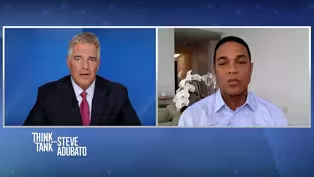
CNN's Don Lemon on Confronting Racism & Sexism in Society
Video has Closed Captions
Clip: 5/15/2021 | 16m 9s | CNN's Don Lemon on Confronting Racism & Sexism in Society (16m 9s)
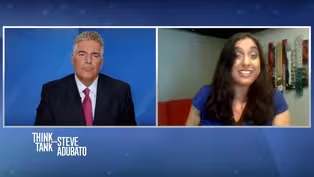
Voter Suppression vs. Election Security
Video has Closed Captions
Clip: 5/15/2021 | 9m 58s | Voter Suppression vs. Election Security (9m 58s)
Providing Support for PBS.org
Learn Moreabout PBS online sponsorship
- News and Public Affairs

Top journalists deliver compelling original analysis of the hour's headlines.

- News and Public Affairs

FRONTLINE is investigative journalism that questions, explains and changes our world.












Support for PBS provided by:
Think Tank with Steve Adubato is a local public television program presented by NJ PBS