One-on-One
Dorrie Papademetriou; Larry Abrams
Season 2024 Episode 2681 | 26m 30sVideo has Closed Captions
Dorrie Papademetriou; Larry Abrams
Senior Correspondent Jacqui Tricarico talks with Dorrie Papademetriou, Founder of MudGirls Studio, about the ways her non-profit serves as a workforce training model for underserved women in and around Atlantic City. Then, Larry Abrams, Founder of BookSmiles, highlights his organization’s efforts to recycle gently used children’s books to address the issue of “book poverty."
Problems playing video? | Closed Captioning Feedback
Problems playing video? | Closed Captioning Feedback
One-on-One is a local public television program presented by NJ PBS
One-on-One
Dorrie Papademetriou; Larry Abrams
Season 2024 Episode 2681 | 26m 30sVideo has Closed Captions
Senior Correspondent Jacqui Tricarico talks with Dorrie Papademetriou, Founder of MudGirls Studio, about the ways her non-profit serves as a workforce training model for underserved women in and around Atlantic City. Then, Larry Abrams, Founder of BookSmiles, highlights his organization’s efforts to recycle gently used children’s books to address the issue of “book poverty."
Problems playing video? | Closed Captioning Feedback
How to Watch One-on-One
One-on-One is available to stream on pbs.org and the free PBS App, available on iPhone, Apple TV, Android TV, Android smartphones, Amazon Fire TV, Amazon Fire Tablet, Roku, Samsung Smart TV, and Vizio.
Providing Support for PBS.org
Learn Moreabout PBS online sponsorship- [Narrator] Funding for this edition of One-On-One with Steve Adubato has been provided by The New Jersey Education Association.
The Russell Berrie Foundation.
Making a difference.
NJ Best, New Jersey’s five-two-nine college savings plan.
Holy Name.
Seton Hall University.
Showing the world what great minds can do since 1856.
Wells Fargo.
New Jersey Sharing Network.
PSEG Foundation.
And by NJM Insurance Group.
Serving New Jersey’s drivers, homeowners and business owners for more than 100 years.
Promotional support provided by Northjersey.com and Local IQ.
Part of the USA Today Network.
And by BestofNJ.com.
All New Jersey in one place.
- This is One-On-One.
- I'm an equal American just like you are.
- The way we change Presidents in this country is by voting.
- A quartet is already a jawn, it’s just The New Jawn.
- January 6th was not some sort of violent, crazy outlier.
- I don't care how good you are or how good you think you are, there is always something to learn.
- I mean what other country sends comedians over to embedded military to make them feel better.
- People call me 'cause they feel nobody's paying attention.
-_ It’s not all about memorizing and getting information, it’s what you do with that information.
- (slowly) Start talking right now.
- That's a good question, high five.
(upbeat music) - Hi everyone, Steve Adubado.
If you've been watching one-on-one on a regular basis, you know that Jacqui Tricarico, that's Jacqui right there.
My co-anchor, colleague, down in Atlantic City for the New Jersey Education Association Convention.
You know, that we interviewed a whole range of folks, educators, keynote speakers, experts, all aspects of education.
Jacqui tee up this first interview that you conducted.
I did the second one with Larry Abrams, the executive director and founder of Book Smiles, but you did this first one with Dorrie.
- Yeah, Dorrie.
Dorrie Papademetriou, who is the founder and designer of MudGirls Studios.
So, MudGirls.
- MudGirls?
Hold on, did you say MudGirls Studio?
- MudGirls, yes.
So, this was the New Jersey Education Association's Charity of the Year that was highlighted at the convention this year.
They had a large booth set up selling their pottery.
What they are is a nonprofit organization right in Atlantic City where the convention is every year.
Dorrie started this nonprofit to help women underserved women, women who are at risk.
Give them a job opportunity to mix an income and use their hands to create art.
And they specialize in clay.
So, you'll see pictures and video of this, but beautiful display.
I actually, went and bought a couple of their pieces for Christmas gifts.
And let me tell you, when I gave those gifts, they were, what I gave was a mug.
I bought a mug, a Christmas mug and some ornaments.
When I gave those to some of my loved ones.
And it comes with a little description of where these came from.
- About MudGirls?
- Yeah, about MudGirls and who they are, really impactful, really great gift to give people and to help spread the word about this organization and the work that they're doing.
- You know what's really great is Jacqui and I, Jacqui's been working with us.
She's been a leader in an organization for, I don't know, 15 years.
She took a couple years off to raise two girls, which you're still doing.
But I'm curious about something.
We feature so many not-for-profit leaders, you know, and MudGirls is a not-for-profit, right?
- Yep.
- And the passion you see in people who lead not-for-profits.
They have to raise money, they have to build a team, they have to keep the team going, they have to through COVID whatever, all kinds of challenges.
What did you see in Dorrie that struck you or that strikes you as it relates to her being a terrific leader?
Because she is clearly.
- Yeah, and we talked a little bit about this in her interview, but she came from designing for some really high end,- - I saw that.
- galleries and folks and doing a lot of things, but she saw this niche.
She was into some, you know, nonprofit work, not her own, but some other things that she was working on.
But she saw this need in Atlantic City and she had this calling to want to help others.
And the work that she's doing there is really impactful and she's getting the word out by making sure other people within the community know about what she's doing.
And she gets referrals, and the women that she's helping, she's really making such a big difference in that community.
And as we know, Atlantic City, it is one of those cities in our state that is really suffering with poverty.
- That's right.
- And people having what they need and really on bad times there.
So, she's making a huge impact in Atlantic City.
And you can tell in this interview the passion that she has to give back.
- That's Jacqui teeing up this interview with Dorrie.
Let's check it out from Atlantic City.
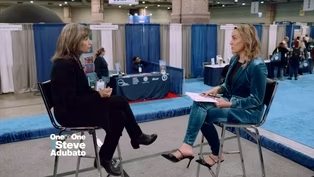
- I'm Jacqui Tricarico on location at the NJEA Convention here in Atlantic City, and I'm so pleased to speak with Dorrie Papademetriou, who is the founder and designer of MudGirls Studios.
MudGirls is the charity this year that's being represented here at the convention.
First, describe to us what MudGirls is.
- MudGirls is a nonprofit clay studio that empowers women by bringing them, creating community, and teaching them how to create ceramicware.
In doing so, they learn basic life skills, and also, they earn an hourly wage, so it's a workforce training program.
- It's employment, really, for some women, and most of the women in your program, 10, now, that are employed by you, are at risk in some way or another.
- Yes.
- Describe that, and how you're - Yes.
- Finding these women and bringing them into what you're doing - Right.
- In your organization.
That's right here in Atlantic City where we are today.
- Yes, yes, yes.
MudGirls started with the idea that we all have a creative spirit, and many people are not given the opportunity to tap into that creative spirit, so we went out into the community, and we embraced women at risk, that is, women in poverty, so, many of them have mental illness, coming out of homelessness, many of them have addiction, perhaps they had been involved with criminal justice system, so those are the people who we're giving second chances to.
We're bringing them into the studio, we're giving them jobs, we're giving them wraparound services, social services, perhaps helping them with housing, perhaps helping them with childcare, and food security, so it's so much more than just a clay studio.
We make beautiful pottery, but we also build lives.
- It's really all about empowerment.
- Yes.
- Empowering these women to really lead a successful life.
Talk about how you came up with this idea.
You have a rich history in art and creating yourself, worked with many high-end companies and designers in your lifetime, how did this idea all come about for you?
- I wanted to do something that brought the joy of creating that I have, and I've experienced my whole life to others.
So, I said, how can I share what I love with people who have never experienced that?
So, I knew that people like clay, it's always fun to work and make something, and I believe that when you make something outside of yourself, you can, it validates your existence, right?
It's now something that you've made, and that's empowering.
It's empowering to just have something that validates you, so I knew it was a great idea.
I knew that people would love being in the studio and making, and people wanna be around people, it's about connection.
It's about connection, connecting with the material, it's connecting with other people, and then it's also pouring yourself into something.
So, not only does making bring you joy, I believe, but it is also healing, so that healing component is why we're bringing it to the population that is a little underserved.
- Underserved, definitely here in Atlantic City, that's for sure, and so many other urban areas in our state and our country.
Talk about how you've seen that reflected in the women that you work with.
Any firsthand stories that you could share with us, obviously, no names, that you've seen that's really impacted you to keep you going with the work that you're doing?
- Yeah, hmm, let's see.
Well, yeah, we've had a lot of success stories.
So, one woman came to us, she had been living under the boardwalk, and she was selling seashells that she had written on or painted on, on the boardwalk, and someone noticed that, and said, "Well, we're gonna bring her to MudGirls."
So, she came to MudGirls, we gave her a job, she was working with us, and then we connected her with one of the casinos, locally, and she was hired in full-time position, and then we also assisted her with an apartment, so then now, she's housed, so she's fully housed, fully employed, and that's someone who was living under the boardwalk, so if we can do that for women and people who are at risk in our community, I mean, that's what we strive to do.
We've helped people avoid eviction.
You know, we've helped, we've gone to court with people as advocates, so there are many ways that we've done that, and I have to say, we are a safety net, so a lot of women that come to our studio that are working with us, they don't have families, so they don't have anybody to share with, to guide them to make wise choices.
- A support system?
- A support system, so we're their support system, - Yeah.
- And that feels good.
- I'm sure, and you talked about collaborations a little bit within the community, some of the local casinos.
Talk about some of the other collaborations that have really been important to the work that you're doing, 'cause I know there's some organizations and companies right here in Atlantic City that you've been working with now?
- Right, well, we work with a couple of different... We work with social service agencies, too, for women to be referred to us, and those would be Covenant House, Jewish Family Services, Volunteers of America, those are how our women actually come to us, - Hear about you, and know that you exist, - And hear about us.
Correct.
- And this is an option.
- Correct.
In terms of work that we've been been doing in the community, which we're really, really proud of, we've worked with Stockton University to create tile murals in their institutions here in Atlantic City.
We've worked with AtlantiCare, and done a really beautiful tile installation there.
We have done a piece at Ocean Casino.
We recently did a piece for Resorts, and we have a very close relationship with Hard Rock as well, so, and now we're here at NJEA, - And now, yeah, new relationships.
(laughs) - Which is really wonderful, and that brings the educational component to what we do, because we do educate our women in many facets.
- Right, and NJEA kind of being a new partner of yours, them selecting you to be the charity of the convention, what does that mean?
And there was a special donation that was given to the organization on behalf of the NJEA, correct?
- Mm-hmm, yes.
We're tremendously honored to be the charity of the convention, which means to us, it opens up a whole new world.
We're a small organization, and NJEA is such a large organization, so to partner with them is really a great honor, and also, to be recognized by educators, and recognized that what we do matters, and given that opportunity to speak on a larger platform, I mean, those partnerships are key to small organizations that really lift them up, and so, if we were to together like that with partners who can lift us up, then we can lift others up, and that's what we're about.
So, we're just about building lives, and just as all the teachers do every day, that's what we do in the studio as well, and so, I think it's a great partnership, and we are extremely happy.
- And you have your table set up here, selling some of the things that the women are making.
Talk about some of the products that people can get, because I know they're available on your website as well.
- Yes.
- We'll put that up, so that if people are interested, they can... - Sure.
- Holidays are right around the corner, so I'm sure a lot of people are walking around, educators seeing the beautiful work that's done, and being able to pick some pieces up.
- Right, right, right.
So here, at the convention, we have all of our pottery, our tableware, all the pieces that we make in the studio, so we're a collaborative studio, and what that means is when you receive a piece, or when you purchase a piece, lots of hands have worked on that piece.
So, someone has rolled that clay, someone has formed that clay, someone has glazed that clay, so many, many hours, and many people's hands have worked that clay, and the great thing about that is the people that purchased that clay now are transformed.
Now, they understand who that maker is, and so now, that end user has a connection with the person who made it, so that's a beautiful thing for us.
We have beautiful ornaments, we have tableware, we have beautiful Christmas mugs, lots of gift giving, and what that does for us, if you give a gift to someone else, then they learn about us as well.
- Right.
- And people actually love gifts with meaning, so, to get something - Definitely.
(chuckles) - And receive something that has a special place in someone's heart is really a beautiful thing, so, it'll work.
- Yeah, spreading the word through that art is really - Spreading the word.
- Beautiful.
- Yes, it is very beautiful.
I mean, we strive really hard in the studio to do the best work we possibly can.
That's something that we talk about.
We talk about design, color, form, functionality.
We try and problem solve, and if something doesn't go right, if something isn't working, we kind of sit together, come together and work on that design, and to make it be the best we can be.
- That's wonderful, well, thank you for everything that you're doing, especially here in Atlantic City, in this community.
So important, the work that you're doing, and it's wonderful - Thank you.
- That the NJEA selected you and your organization - Yes, yes.
- To be represented here this year, so, congratulations on that, too.
- Thank you.
Thank you so much.
- (chuckles) Thanks so much.
- [Narrator] To see more One on One with Steve Adubato programs, visit us online at stateofaffairsnj.org.
If you would like to express an opinion, email us at info@caucusnj.org.
Find us on Facebook at facebook.com/steveadubatophd and follow us on Twitter @steveadubato.
All right, Jacqui wasn't the only one down in Atlantic City doing interviews.
I was able to sit down with Larry Abrams.
I've talked to Larry before, he's been on with us before.
Larry Abrams is the executive director and founder of a great organization called Book Smiles.
Jacqui, we've had him on before, Larry Abrams.
What strikes you about Book Smiles that's so significant?
- Yeah, Larry is actually a past Russ Berrie Making a Difference Award winner.
That's how we first got connected with him.
- That's right.
- With our partners over there at the Russ Berry Foundation.
And he came up with this idea that as an educator, he is teaching right around the Camden area.
It came to his attention that kids, some kids at home don't have books.
And he couldn't believe that.
And he said, "You know, I need to do something about this."
And he started Book Smiles, very, very small and has grown significantly over the past couple of years.
Now, they've donated and distributed over 2.5 million books.
- Oh, and mine says two.
Is it 2.5?
- I mean, sorry, 1.5.
I lied, 1.5.
1.5, I thought they moved another million books in the last few days.
- No, but you know what?
I think we're gonna get to 2.5 not too far away from now, because he is so passionate.
- Really?
- He's driving, he, you know, he's driving this.
He retired from teaching and this is his full-time job now.
He is driving this initiative.
He has a team behind him now in the communities working to get those books out there and get books donated to them that they can distribute to the kids in and around New Jersey.
- Well, by the way, we did the interview, Jacqui.
We did it in November, I did this interview.
- Yeah, maybe they're at 2.5.
- Yeah, we're taping this at the end of January.
They may be at 2.5 billion.
And real quick, as you're watching the interview with Larry Abrams from Book Smiles, one of the things that I know I asked him about is how people can be helpful.
Because it's funny, I realize that we bring used books there's a used bookstore in our hometown here in Montclair.
But Larry makes it clear that there are other ways that you can get books to Book Smiles, which people don't realize, Jacqui.
We can all be a part of this and should be right?
- Yeah, yeah, and you can log onto the website that'll be up.
You can hold a book drive of your own.
You can become an ambassador.
You can hold a Facebook fundraiser.
So, you could do it right from your home.
Like we know everybody loves to remote and get things done.
So, you can do that.
So, a lot of different ways that you can get involved to help with this initiative and get those books in the hands of kids everywhere.
- And for those of us who have books all around us, we're fortunate, blessed, our kids have books.
That's not every kid, that's not every family.
Let's not forget that.
And that's what Larry Abrams lives every day with his colleagues over at the Book Smiles.
Let's check it out from Atlantic City.
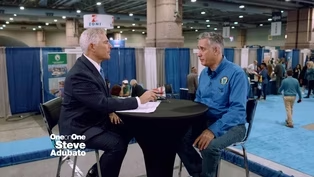
- Hi, everyone, Steve Adubato here in Atlantic City at the NJEA Convention with Larry Abrams.
Larry, good to see you again.
- It is great to be back, Steve.
- I should tell everyone that in 2018, as part of our work with the Making A Difference Awards, the Russ Berrie Foundation's Making a Difference Award, Larry Abrams won one of the 2018 awards.
He was one of the winners.
He's executive director and founder of a great organization called BookSmiles, which is?
- We are a nonprofit that obsessively harvests gently used children's books, diverting them from the trash and landfill.
We sort them and then we give them to teachers and children in need.
- And we should also say that Larry was a 2022 CNN Hero, one of the CNN Heroes.
You know, when I met you, I'm thinking it was about a, now you started with how many books?
'cause I know right now you're about 1.7 million.
- 1.7 million.
And I think when we met, we'd done a few 100,000.
- Yes.
- This thing is really beginning to snowball.
- What's the thing, where do you get the books?
- We get them from a lot of places.
One, upscale a middle school districts to book drives.
We have individual children doing book drives.
We have book bins all throughout New Jersey where people put, deposit their gently used children's books.
But we're now beginning to purchase books by the tractor trailer load from Goodwill, from Thrift Books, from partners who harvest books on an industrial level.
Nobody else is really doing this in America.
This is kind of new for us.
- So now you taught, now you were teaching in Morristown?
- In Morristown, I started my teaching career in Morristown.
- Morristown.
- And then transferred to Lindenwold.
- Down by Camden?
- Exactly.
- So the whole concept of book poverty, right?
Different communities.
I live in Montclair, born and raised in Newark.
But trust me, I know the difference between Newark and Montclair, and other communities as it relates to resources.
- Right.
- So when it comes to resources and books, book poverty is very real in communities like Camden.
Define it.
- Oh, absolutely.
Well, book poverty exists in places called book deserts.
A book desert is a lot like a food desert.
A book desert is a place where huge swaths of neighborhoods will have children who own maybe one or two, or no books at all.
There are kids in New Jersey growing up with no books.
And what we do is we are ending that by making sure that kids have books in their hands and homes.
- How do you get to them?
- We use teachers.
I'm able to speak TeacherEase, 'cause I'm a recently retired teacher.
- Right.
- So we have hundreds of teachers visiting the book bank every quarter.
We also have a bunch of non-profit partners who take books by the truckload, food banks, other do-gooders will come to the book banks, and distribute free books to these kids.
- There's the BookSmiles van?
- That's right.
- Right here in the convention.
- [Larry] Right here in the convention center.
- [Steve] I wanna know how you got that in here.
- It was not easy.
I had to learn how to drive a van, use a liftgate.
I'm a teacher, but I learned all this stuff on YouTube, how to drive a box truck and use- - What's going on in that van?
- What's going on in the van is we use it for two reasons.
One, to go to affluent upschool school districts, upscale school districts.
And we pick up books by the thousands, beautiful books, which we then take back to the book bank, sort them.
And from there, we distribute them.
We, for example, we're just up in Newark.
So inversely, we'll use the book truck to deliver thousands of books to places that really need them, places that can distribute books.
And they're free.
- They're free?
- Yeah.
- Let's make it sure as the website goes up again, if you have books to donate, and they're just sitting around because there's book wealth.
Trust me, in our home with our daughter who is still in grade school, there are a lot of books.
- That's, yeah.
- And a lot of those books are not being read these days, because she's 13 now.
The point I'm making is we're not alone.
There are a lot of people out there.
People need to connect with BookSmiles to give to others.
What is the impact for those young people who live in book deserts and disproportionately urban communities, but others as well.
What's the impact on them in terms of their learning, their development, and their future?
- I'll give you a real anecdote, Steve, as somebody who taught in an underserved district for a long time.
My ninth graders, most of them read at a fourth and fifth grade reading level, and they were in ninth grade.
And I asked them why.
Where you read to when you were young?
Did you own books when you were young?
All of the kids who were failing my class, who were at third, fourth, and fifth grade reading levels, didn't have books growing up.
The honor students, on the other hand, the kids doing well, told me, flat out, "Mr.
Abrams."
"Yeah."
"My mother read to me, we went to the library."
So you can be in an impoverished area or in a very working class area and still do well in school, but that is key.
Getting books into the homes and hands of children who otherwise might not ever have them, compelling parents to read to these precious children is even more important.
- By the way, I'm sorry for interrupting.
I'm looking at the logo under BookSmiles.
It's got on your logo, on your shirt.
It's read it, love it, donate it.
- [Larry] That's right.
- [Steve] Read it.
- So read the book, love reading it.
Read it, love it.
Love the book, but after a while, the books will sit there on the shelf.
And when the kid isn't loving the book anymore, that's when children of means, children who have a lot of books need to practice the kind of philanthropy.
And it's looking out and making sure that kids who may not have the books that they have received them.
- So hold on one second.
Someone right now, they go on the website, they've got books that are sitting on the shelf.
How again, do they donate them?
- Well, they go and they take a look at our collection stations.
Most of our collection stations are in South Jersey, but we do now have collection stations in Short Hills.
We are all the way up in Norwood, across from Yonkers.
So we have a number of other communities- - The website has that information.
- Absolutely.
And if anyone wants to collect books in mass, in their garage, I will empower them to create their own book collection station right in their garage and we will clear them out with our book truck.
- Larry Abrams, executive director, founder of a great organization called BookSmiles.
- Steve, it has been such a pleasure and that's who we are, yes.
- Yeah, you're making a difference.
Thank you my friend.
- I really appreciate your time.
- We appreciate you.
- Yep.
- Well done.
- [Narrator] One-On-One with Steve Adubato is a production of the Caucus Educational Corporation.
Celebrating 30 years in public broadcasting.
Funding has been provided by The New Jersey Education Association.
The Russell Berrie Foundation.
NJ Best, New Jersey’s five-two-nine college savings plan.
Holy Name.
Seton Hall University.
Wells Fargo.
New Jersey Sharing Network.
PSEG Foundation.
And by NJM Insurance Group.
Promotional support provided by Northjersey.com and Local IQ.
And by BestofNJ.com.
- [Narrator] To see more One on One with Steve Adubato programs, visit us online at stateofaffairsnj.org.
If you would like to express an opinion, email us at info@caucusnj.org.
Find us on Facebook at facebook.com/steveadubatophd and follow us on Twitter @steveadubato.
- (Inspirational Music) - (Narrator) Great drive fuels the leaders of tomorrow and today.
Great vision paves the way for a brighter future.
Great ambition goes places, moving onward and upward.
Great empathy finds strength in kindness and in each other, working together to create something bigger than they ever imagined.
Great minds can change the world and great minds start at Seton Hall.
Addressing "Book Poverty" in Less Affluent Neighborhoods
Video has Closed Captions
Clip: S2024 Ep2681 | 10m 36s | Addressing "Book Poverty" in Less Affluent Neighborhoods (10m 36s)
This Non-Profit Uplifts Underserved Women in Atlantic City
Video has Closed Captions
Clip: S2024 Ep2681 | 14m 41s | This Non-Profit Uplifts Underserved Women in Atlantic City (14m 41s)
Providing Support for PBS.org
Learn Moreabout PBS online sponsorship
- News and Public Affairs

Top journalists deliver compelling original analysis of the hour's headlines.

- News and Public Affairs

FRONTLINE is investigative journalism that questions, explains and changes our world.












Support for PBS provided by:
One-on-One is a local public television program presented by NJ PBS