
DPC 2023, Mobile health, Black Church 2023, Gretchen Valade
Season 7 Episode 32 | 26m 46sVideo has Closed Captions
Detroit Policy Conference, mobile resources, Black Church 2023, Gretchen Valade’s death.
Detroit Regional Chamber President/CEO Sandy K. Baruah discusses the 2023 Detroit Policy Conference and its focus on downtown Detroit. A look at how mobile health outreach is addressing homeless needs and health disparities across metro Detroit. An outlook for 2023 from Detroit’s Black church leaders. Plus, remembering Detroit jazz champion, businesswoman and philanthropist Gretchen Valade.
Problems playing video? | Closed Captioning Feedback
Problems playing video? | Closed Captioning Feedback
One Detroit is a local public television program presented by Detroit PBS
DPC 2023, Mobile health, Black Church 2023, Gretchen Valade
Season 7 Episode 32 | 26m 46sVideo has Closed Captions
Detroit Regional Chamber President/CEO Sandy K. Baruah discusses the 2023 Detroit Policy Conference and its focus on downtown Detroit. A look at how mobile health outreach is addressing homeless needs and health disparities across metro Detroit. An outlook for 2023 from Detroit’s Black church leaders. Plus, remembering Detroit jazz champion, businesswoman and philanthropist Gretchen Valade.
Problems playing video? | Closed Captioning Feedback
How to Watch One Detroit
One Detroit is available to stream on pbs.org and the free PBS App, available on iPhone, Apple TV, Android TV, Android smartphones, Amazon Fire TV, Amazon Fire Tablet, Roku, Samsung Smart TV, and Vizio.
Providing Support for PBS.org
Learn Moreabout PBS online sponsorship- [Host] Just ahead on "One Detroit".
Nolan Finley and Stephen Henderson get a preview of next week's Detroit Policy Conference from Detroit Regional Chamber President, Sandy Baruah.
Plus we'll look at how mobile health and hygiene units are meeting the needs of residents and the homeless community.
And Detroit's Black Church leaders talk about the top issues on their mind as we start the new year.
It's all coming up next on "One Detroit" - [Presenter] From Delta Faucets to Behr Paint, Masco Corporation is proud to deliver products that enhance the way consumers all over the world experience and enjoy their living spaces.
Masco, serving Michigan communities since 1929.
Support for this program is provided by the Cynthia and Edsel Ford Fund for Journalism and Detroit Public TV, the Kresge Foundation.
- [Presenter] The DTE Foundation is a proud sponsor of Detroit Public TV.
Among the state's largest foundations committed to Michigan-focused giving.
We support organizations that are doing exceptional work in our state.
Visit DTEFoundation.com to learn more - [Presenter] Nissan Foundation and viewers like you.
(light upbeat music) (light upbeat music continues) - [Host] Just ahead on this week's "One Detroit", mobile health and hygiene units are helping to reduce disparities in the community.
We'll look at two organizations that take their lifesaving services to the people, plus three Detroit ministers talk with American Black Journal's, Stephen Henderson about the challenges they face in 2023 and how a coalition of churches is working together to find solutions.
But first up, the Detroit Regional Chamber's 2023 Detroit Policy Conference takes place on January 10th at the Motor City Casino Hotel.
The focus is on downtown Detroit and what's next for the area's resurgence.
When Detroit contributor's Nolan Finley of the Detroit News and Stephen Henderson from American Black Journal spoke with Chamber President and CEO, Sandy Baruah about this year's conference theme.
(bright music) (bright music continues) - So it's exciting to think about doing this again.
Remind us of the importance of this particular conference.
It's different from Mackinac and I've always enjoyed that difference.
- Yeah, thank you Steven.
And that is exactly why we created the Detroit Policy Conference to be very different than the Mackinac Conference.
The Mackinac Conference, which is obviously a tremendous statewide asset that the chamber and myself are happy to be stewards of.
But it really is a statewide and now actually, kind of becoming a national platform.
That left a real void, which is how and when do we talk about issues specifically to the Detroit region and the city of Detroit.
And we think one of the biggest issues that's facing all of us right now is what is the trajectory of our downtown?
And that is gonna be the theme of this year's conference.
And you know, as always, we're gonna be focused on Detroit issues at the Detroit Policy Conference.
- And I think that's excellent, Sandy.
But before we go any further, give us the logistical details of the conference.
- Yeah, it's Tuesday, the 10th of January, starts at 9 o'clock in the morning.
It'll be held at Motor City Casino.
And you know, the public is welcome.
You can register on the chamber website, which is detroitchamber.com, and you can register there.
- And so, Detroit's gonna be the focus, downtown Detroit's gonna be the focus, which I'm very encouraged to see 'cause we're sitting downtown right now, as you are.
And we look out this window and we're not seeing what we saw three years ago, you know?
The streets are fairly, fairly empty.
You can't say that downtown has come back.
As you look at where we are, what's your assessment?
How do we compare today to three years ago and what needs to happen over the next two to five years?
- Well, I certainly don't have all the answers in terms of what needs to happen over the next three to five years.
That's one of the reasons why we're pulling together this event to get thought leaders to give us ideas as what to do.
Because Nolan, the ethos of your question is exactly right, which is downtown Detroit hasn't come back to what it was prior to the pandemic.
And that's an issue.
And that's not an issue just for downtown.
You know, downtown Detroit is core, not just to the city of Detroit, but the entire southeast Michigan region.
The resurgence of this entire region that started over a decade ago was driven in no small part, to the resurgence of downtown.
And if downtown doesn't recover, that could potentially mean problems for the rest of our region.
It could mean problems for our businesses, attracting young professional talent and they may not even be located in downtown Detroit.
This is gonna impact businesses based in Troy or Ann Arbor or Warren.
This is gonna have a pretty significant impact, so we need to understand one, where we are.
And right now, Detroit is last of all the big cities in the nation for back to the office in its downtown core.
This is based on cell phone data.
And actually, Nolan, your paper ran a couple stories based off of this data, so we do have an issue.
We need to acknowledge that.
And the second thing we need to acknowledge is that until people come back, day businesses, retail, lunch places are gonna continue to struggle.
Fortunately, on the good side, our evening activities are doing pretty well.
Getting a restaurant reservation in downtown Detroit, just about any day of the week, really difficult.
- Right.
- So, I don't have the answers either, obviously, or I'd be mayor or king, or something, or whatever you might imagine.
But it does seem to me that, so we kind of have to think differently about downtown during the day than we had been before, that it's been long enough now.
That if we were going to see people re-populate all this office space that we built out over the last decade, in the same way that it would be there or at least there'd be momentum toward that.
I don't have a lot of confidence that's actually coming.
And so, the pressure, I think is even more on us to come up with, "Okay, well what else do we do?"
- Yeah.
And I think this is very much an and conversation, Stephen.
So one, what are other cities doing?
Or what is it about other city's culture that has allowed or enabled more people to be back downtown in their offices?
Secondly, I do think that, as the economy evolves, I think we're all expecting at least some sort of economic slowdown.
Maybe not necessarily a recession, but we're not gonna necessarily run at the fever pitch that we have been running these last couple years.
Will that change the worker's dynamic?
And then presumably, as the dynamics of the workforce changes or the economy changes, we'll probably see a reduction in concerns about COVID as well too, which still run pretty high, especially in the city of Detroit.
Not so much in the suburbs, but certainly we're seeing it in the city.
So I haven't given up on the fact that more people might be coming back downtown.
But to your point, Stephen, we do have to think very differently about how we utilize space.
One of the issues is that Detroit still continues to lag in hotel spaces.
We don't have enough hotel space to suit what we have the opportunity for.
- The Detroit News had a piece in the paper this week about the sort of boomlet in hotels- - Mm-hmm.
- it's about 20% more rooms or go from about 5,000 to 6,000.
What does a city like Detroit need in terms of hotel room?
What's the magic number?
- Yeah, I don't have the answer to that question, but at the conference, we have Richard Florida, the national, renowned expert on urbanism coming.
But we also have local people, like Eric Larson and Claude Molinari.
I mean, they are knee deep in these issues.
And I'm not gonna try to answer that question, so that's why Claude and Eric are gonna be there.
- So Sandy, I mean, we've done this before.
I mean, we talked for years about downtown Detroit and what it's gonna take to revive it.
And then we hit a pace where it was going tremendously well and the energy and excitement about downtown was there.
We had international, national investors coming in here snatching up property, looking for opportunities.
How much of that do you still see?
- So that oddly, and I say oddly because I'm surprised happily by it, it's still continuing.
When you look at the investment in large-scale projects, it is still coming.
Now, what we have seen is some of the smaller developments, be kind of on the fringes of downtown, or on the fringes of Corktown.
Some of those projects, indeed have fallen through since COVID, but the large-scale projects are still going.
When you look at things like the Hudson side or the International Bridge Crossing, or some of these other major redevelopments that are taking place, they're still going full bore.
And they really haven't lost a step.
I mean, if you talk to the people at Michigan Central Station and what they are doing, they're actually more optimistic now about what they're building and who's interested in than they were prior to the pandemic.
- [Host] Make sure to watch "One Detroit" on January 12th for interviews and stories from the Detroit Policy Conference.
Plus you can catch more of Stephen and Nolan's conversations with community leaders on "The Future of Work" here at onedetroitpbs.org.
Now, we turn to a report on how mobile resources are redefining the future of healthcare for residents and providing solutions to issues impacting the homeless community.
One Detroit's, Rose LaForest looks at two organizations that are meeting people where they are in order to improve health outcomes and reduce disparities.
(light upbeat music) (light upbeat music continues) - [Rose LaForest] Today, just west of downtown Detroit and Corktown, next to St. Peter's Episcopal Church, the Wayne Health Mobile units have brought the doctor's office to the people.
They have eight units total.
Each is equipped to provide health screenings, vaccines, and preventative care to communities to address disparities and barriers to access.
Catherine Goggin is our Mobile Health Unit Manager.
- We eliminate a lot of those barriers, why people don't get healthcare whether it be that they don't have transportation or they're scared to see a physician.
We look at that person as a whole.
Why aren't they getting their medication filled?
Why aren't they going to the doctor?
Is it they have to put food on their table versus making a doctor's appointment and paying that copay?
We take that out.
We bring everything to them in their community where they work, where they worship, and get them the care that they need.
- [Rose LaForest] Disparities and resources, and healthcare have plagued cities like Detroit for decades, but have recent events helped create a possible solution?
Program director, Dr. Phillip Levy explains.
- The Mobile Health Unit Program was designed as an initiative during the pandemic to bring COVID-related services to people in the community.
Understanding that in the early stages of the pandemic, testing, for instance, wasn't readily available.
And what we were finding is that in a lot of neighborhoods, people couldn't get to a location to get testing, so we decided to bring the testing to them.
- Originally, we started with just treating first responders so like the police, fire, EMS, doctors, nurses, people that work in the hospital.
We did that for about a month or two and then we eventually expanded to community testing.
- The response to this has been overwhelming.
We've been on more than 82,000 encounters in the community since then.
And what we've realized is that this idea of bringing services to people with mobile health opportunities doesn't have to stop with COVID.
There are a lot of healthcare needs in the communities in and around the city of Detroit and a lot of people don't have the access to healthcare services they need, especially for things like high blood pressure and diabetes, and high cholesterol.
- [Rose LaForest] Additional needs are being addressed with this new resource model, too.
The Wave Project is another organization using its mobile presence to provide resources in the community.
For them, it's about hygiene.
Detroit has no more than seven public restrooms per every 100,000 residents.
This creates an obstacle for Detroit's homeless community.
This is Todd Gordon, music teacher and Co-Founder of The Wave Project.
- We are just regular people, a group of friends that we're all serving in a local, multi-site church.
And at a certain point, we're meeting, doing small groups and we just felt really led to get out into the community and help.
- [Rose LaForest] Inspired by a group providing mobile showers in San Francisco, it was time to see if Detroit could use these services as well.
- [Todd Gordon] So over time, we started doing local outreach, barbecues in Mount Clemens.
Our goal was to not only serve food and provide clothing and hygiene kits, but to get to know the community and to really build some relationships, and ask and voice to them if mobile hygiene services would be needed.
And overwhelmingly, people said, "Yes".
- This is from an organization called, Blessing Bags Brigade.
And they provide us with a hundred hygiene kits a month, and they stock it with bar soap, deodorant, shampoo, lotion, toothpaste, toothbrush, razor, ChapStick, a washcloth, and a little encouraging note.
We are pretty stocked.
We have everything from T-shirts, underwear, jogging pants, hoodies, socks, plenty of hygiene items.
We even have things like backpacks, coats, thermals, things like that - Sometimes during complete disbelief that, "Yes, we're giving you all this new clothing for free and walk right over there and use our warm, safe, nice bathroom for as long as you need.
And please come back and have a conversation with us."
- We will have people who come to kind of, it's almost like they're just checking things out and maybe they'll just get some clothes the first time, and maybe the next time, they'll talk a little bit.
And it might not be, they may come several times before they're comfortable enough to take a shower, maybe.
Just getting comfortable with the situation and building that trust up is really important to this community.
- There is a lot of dignity in just coming up to another human, looking them in the eyes, allowing them some space to share how their day is going or their story.
And then, we're able to say, "Hey, use our resources.
and there's a lot that goes into that on the back end."
You know, them leaving, feeling loved, feeling fulfilled.
- [Rose LaForest] In order to be successful, these programs need to create connections and build trust.
This means the organizations can't only show up in the community, but must become a part of it.
- I didn't realize how closely with the community that I could work and working with Wayne Mobile Health, actually gives me an opportunity to do some preventative care as opposed to trying to stop the train as it's coming crashing towards me.
- It's really a by-any-means, necessary approach to get the resources to people who need them.
It's great to have community centers and things like that.
They're wonderful, they're great hubs for this type of thing, but they don't work for everybody.
Bringing resources to people is gonna be the best way to alleviate the barriers that prevent them from getting those resources in alternative means.
- When we think about how things have shifted culturally or even the challenges associated with the traditional models, right?
Mobile services are really attractive in that the initial capital outlay tends to be much smaller and then you can provide services to a larger radius of people.
- [Rose LaForest] Not only can these services reach more people, these services can save lives.
- People in Detroit, on average, are dying five to 15 years younger, depending on the community than other communities across the state.
The life expectancy in Detroit is much lower than other areas in the state.
It's called lifespan inequality.
The reason for that is because people develop conditions earlier and they die of complications earlier.
If you address those conditions, not only are you keeping people healthier longer, you're having people who are in part of a more vibrant community.
(wind blowing) - [Host] The new year is a time for churches to set new goals and find new ways to make a difference in the community.
As part of Detroit Public Television's "Black Church in Detroit" initiative, American Black Journal host, Stephen Henderson spoke with three Detroit ministers to find out what is top of mind for them and their congregations in 2023.
(light upbeat music) - I'm gonna start with a really simple question for each of you.
I would love for each of you to talk about two things that are really on your mind as we get into 2023.
Two things that maybe stand out as particular challenges that we have here in Detroit, either in the religious community itself or in the city more broadly.
Reverend Estes, I'm gonna start with you.
- Thanks, Stephen.
I think two challenges that we're facing right now is exhaustion.
And related to that, some re-engagement with leaders in our communities, in our faith communities in particular.
Detroiters are resilient, absolutely resilient, but even the strongest of us get tired.
And I think COVID exacerbated some challenges that congregations and congregational leaders have faced and they're, we're just a little exhausted, clergy included.
And I think, so that, that's one challenge.
And the other challenge is, okay, so since we know that's the elephant in the room, since we've named it, how do we release the creativity and the new imagination, and the fresh expression back into our faith communities, and get our leaders re-engaged and recruit some new leaders, and get them plugged in as well?
I think those are two challenges that I'm looking at.
- Okay, Pastor Massey, you're next.
Tell me two things that are on your mind as we start 2023, things that you think are staring us in the face.
- God bless you, Mr. Henderson, and thank you for having me on.
God bless all the panel and everyone that's involved.
Well, several things going on in our community and as the church, we definitely have to rise up to these challenges.
Some of the challenges and we all know that they are lost, being instituted by our government that are contrary to the Bible.
So now, as a church, we have to address those issues.
We have to address the issues that are condoned by law, but contrary to what we believe.
- Mm.
- So that is one of the big issues.
And it's a challenge to engage our young generation, especially the millenniums.
Mostly our membership comprised of seniors and older people, at least in my congregation.
We are actively trying to involve and attract, and come up with various programs that would attract the younger millenniums, and to emphasize the importance of bringing their children to church.
That was something I grew up with and I find that to be a little bit discouraging that they won't come, and they won't send over their children.
So that's a big challenge in our church community today.
- Yeah, yeah.
- It's all part of it.
Thank you.
- Yeah, yeah.
Pastor Barry, what's on your mind as we get into the new year and think about our city and the religious community in it?
- Well, one of the big things that I'm thinking about right now is mental health.
The last couple years have been really, really challenging on so many different levels and I am really concerned about people's mental health.
We've been dealing with a lot of isolation over the last couple years, but mixed in with that is also, on so many different levels, there's so much technology that I think we're becoming less social.
And we need to really pay attention to how that is playing a role in our mental health and how we interact with one another.
So that's definitely one of the main things.
When it comes to the issue of church, one of the things that I know that we have to deal with is now, technology is part of the way that we're gonna have to do ministry from this day forward.
That's something that we all had to adapt to when it came to COVID and now, it's gonna be a mainstay.
So how do we keep that as part of the regular routine of how we do church?
- [Host] And finally, today, Detroit has lost one of its greatest supporters of jazz and the arts.
Gretchen Valade passed away last week at the age of 97.
She was instrumental in establishing a foundation for the Detroit Jazz Festival, so that it would remain free to attendees.
WRCJ host, Linda Yohn spoke with the Jazz Festival Foundation's President, Chris Collins about the loss of the businesswoman and philanthropist.
- Well, we're talking about a really special friend to you, to me, to people all around the world, for Pete's sake.
And that is the one and only, Gretchen Valade.
- Gretchen Valade, you know, years ago, I used the term, Angel of Jazz in some interview and I don't think we can come up with anything much better.
In fact, the way I've been thinking about is our Angel of Jazz finally got her wings that she well deserves.
In the jazz world, in addition to just expanding jazz opportunities for artists and for patrons, she had a vision of pulling down barriers to participation.
You know, really making it an invitation to everyone to be a part of this art and this music.
I often tell a funny little story that connects with this.
It was around Christmas time, early in our relationship, and I saw people giving her gifts.
And after a couple years I finally said, "Gretchen, what can I do for you?"
You know, my wife and I will always try to find something sweet, you know?
"What can we do that wouldn't be meaningful?"
She said, "You can do two things for me."
She said, "Chris, keep the Detroit Jazz Festival free and keep the Detroit Jazz Festival jazz."
And you know what that means.
That's a whole history and legacy and language behind that statement.
And I thought to myself, "I've come to believe that is what she wanted."
She desired nothing more than that level of opportunity, excellence, of dedication to the art, and accessibility for everybody.
- How wonderful it is that you're running with it and that you're going to keep her legacy alive along with her family and along with all of the volunteers for the Detroit Jazz Festival, the whole Mack Avenue Records roster.
We're never going to forget her.
We knew somebody very special.
- [Host] You can see more of Linda's conversation with Chris at onedetroitpbs.org.
That will do it for this week's "One Detroit".
Thanks for watching.
Head to the One Detroit website for all the stories we're working on.
Follow us on social media and sign up for our weekly newsletter.
- [Presenter] From Delta Faucets to Behr Paint, Masco Corporation is proud to deliver products that enhance the way consumers all over the world experience and enjoy their living spaces.
Masco, serving Michigan communities since 1929.
Support for this program is provided by the Cynthia and Edsel Ford Fund for Journalism and Detroit Public TV, the Kresge Foundation.
- [Presenter] The DTE Foundation is a proud sponsor of Detroit Public TV.
Among the state's largest foundations committed to Michigan-focused giving.
We support organizations that are doing exceptional work in our state.
Visit DTEFoundation.com to learn more.
- [Presenter] Nissan Foundation and viewers like you.
(light upbeat music) (light piano tune)
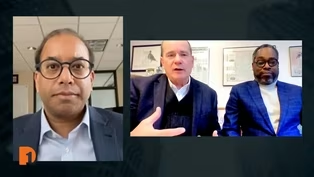
Detroit Policy Conference focuses on City’s resurgence
Video has Closed Captions
Clip: S7 Ep32 | 7m 59s | Preview the 2023 Detroit Policy Conference and its focus on downtown Detroit’s resurgence. (7m 59s)
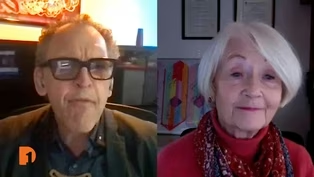
Detroit's ‘Angel of Jazz’ Gretchen Valade passes away
Video has Closed Captions
Clip: S7 Ep32 | 2m 17s | Longtime jazz supporter, businesswoman and philanthropist Gretchen Valade dies at 97. (2m 17s)
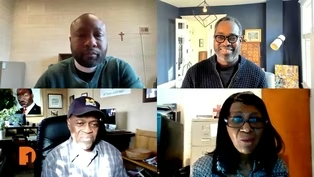
Detroit’s Black church leaders look ahead to 2023
Video has Closed Captions
Clip: S7 Ep32 | 5m 7s | Host Stephen Henderson talks with three local pastors about the Black Church in 2023. (5m 7s)
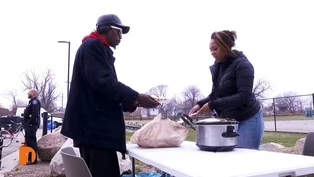
Mobile health outreach helps homeless, health disparities
Video has Closed Captions
Clip: S7 Ep32 | 6m 53s | Mobile health resources serve Detroit’s homeless population and combat health disparities. (6m 53s)
Providing Support for PBS.org
Learn Moreabout PBS online sponsorship
- News and Public Affairs

Top journalists deliver compelling original analysis of the hour's headlines.

- News and Public Affairs

FRONTLINE is investigative journalism that questions, explains and changes our world.












Support for PBS provided by:
One Detroit is a local public television program presented by Detroit PBS