
DPT Moves, Dick Purtan Tribute, Flower Arranging
Season 7 Episode 4 | 26m 46sVideo has Closed Captions
Detroit Public Theatre moves, Dick Purtan tribute and flower arranging with J Schwanke.
The Detroit Public Theatre moves to a new, permanent location. A new "Detroit Remember When" documentary episode pays tribute to Detroit radio legend Dick Purtan. PBS series "Life in Bloom" host J Schwanke teaches viewers how to create beautiful flower arrangements. Plus, a preview of saxophonist De'Sean Jones and the Urban Art Orchestra from the 12th season of "Detroit Performs."
Problems playing video? | Closed Captioning Feedback
Problems playing video? | Closed Captioning Feedback
One Detroit is a local public television program presented by Detroit PBS
DPT Moves, Dick Purtan Tribute, Flower Arranging
Season 7 Episode 4 | 26m 46sVideo has Closed Captions
The Detroit Public Theatre moves to a new, permanent location. A new "Detroit Remember When" documentary episode pays tribute to Detroit radio legend Dick Purtan. PBS series "Life in Bloom" host J Schwanke teaches viewers how to create beautiful flower arrangements. Plus, a preview of saxophonist De'Sean Jones and the Urban Art Orchestra from the 12th season of "Detroit Performs."
Problems playing video? | Closed Captioning Feedback
How to Watch One Detroit
One Detroit is available to stream on pbs.org and the free PBS App, available on iPhone, Apple TV, Android TV, Android smartphones, Amazon Fire TV, Amazon Fire Tablet, Roku, Samsung Smart TV, and Vizio.
Providing Support for PBS.org
Learn Moreabout PBS online sponsorship- [Announcer] Just ahead on One Detroit, the Detroit Public Theater has a new home.
We'll hear from the theater's co-founders about the move and the upcoming season.
Also coming up, leaders of the Jewish and interfaith communities in Metro Detroit provide a Michigan perspective on the Holocaust and antisemitism.
Plus we'll examine the effects of social media on young people's mental health in a special report.
And our Future of Work series looks at affordable childcare and other issues impacting women in the workforce.
It's all coming up next on One Detroit.
- [Narrator] From Delta faucets to Behr paint.
Masco corporation is proud to deliver products that enhance the way consumers all over the world experience and enjoy their living spaces.
Masco, serving Michigan communities since 1929.
Support for this program is provided by the Cynthia & Edsel Ford Fund for Journalism at Detroit Public TV.
The Kresge foundation.
- [Narrator] The DTE foundation is a proud sponsor of Detroit Public TV, among the state's largest foundations, committed to Michigan focused giving.
We support organizations that are doing exceptional work in our state.
Visit DTEfoundation.com to learn more.
- [Narrator] Nissan foundation and viewers like you.
(mellow intro music) - [Announcer] Just ahead on this week's One Detroit.
Detroit Public Television partners with the Zekelman Holocaust Center for a candid panel discussion on Michigan's response to the Holocaust.
We'll have a portion of that conversation with local Jewish and interfaith leaders.
Also coming up, balancing the benefits of social media with a negative impact on teenagers mental health.
PBS Newshour student reporting labs Gwen Ifill Legacy Fellow Zion Williams takes a close look at the issue and some possible solutions.
Plus, more than 1 million women left the us workforce over the past two years, our Future of Work town hall series focuses on the challenges faced by working women.
But first up, the Detroit Public Theater is opening its new season in a new home.
The theater is now located on Third Street in Detroit.
Its first production at the new venue is Mud Row by renowned Detroit playwright, Dominique Morisseau.
One Detroit arts and culture host, Satori Shakoor, sat down with the theater's co-founders and co-producing artistic directors, Courtney Burkett, Sarah Clare Corporandy and Sarah Winkler.
(mellow music) - I am now joined by founders and co-artistic directors, Courtney Burkett, Sarah Clare Corporandy, and Sarah Winkler.
Welcome.
And I know you're getting ready to open and you look so calm.
What's it like?
What's it like to be 54 hours away?
- It's really exciting.
There's just a lot of things still going through our head.
We look calm, but we are not calm.
There are many, many things left to do.
And so, we will be working up till the last minute.
And really we're just getting started even at, at opening night, this is just the beginning of the work that we're gonna do in this space.
So, we're excited.
We're ready, but there's still a lot of things to do.
- Well congratulations.
- Thank you.
- And I mean, you move to a different space, but the vibe is the same.
(laughing) - And if you can move a vibe where a vibe comes, you are the vibe.
- Yeah.
I hope so.
Yeah.
I think we had a really good thing going with our audience and with the artists that we were bringing into the space and you know, it's important to us that we have a good vibe, that this is the place that people want to come and see world class theater and that people wanna work in.
And that we're trying to really create something beautiful, fit with and for our community.
So hopefully people, it was a place that people feel welcomed in and wanna spend time in.
- And I think it's something that we've talked a lot about when we began, you know, we had a mission and a vision and values and there is also an aesthetic to DPT, not just what you feel as an audience member, but what it's like to work here, to collaborate here.
And it was really important to us as we looked at strategic planning and how we were gonna grow, how we keep that close, intimate vibe, how do we keep that heart and soul of DPT as our family grows bigger, as our reach grows wider.
And so, hearing you say that in this moment, when we haven't even opened the doors yet is huge validation that like that soul of us is still here.
And we wanna make sure that when every single person walks through that door, you immediately feel that it.
- It does feel like a hug.
- Yeah.
- Thank you.
That's so beautiful to hear.
We keep saying that we want this space to be a warm and welcoming performance hub.
And so, to say that it feels like a hug is exactly what we were going for.
Thank you, Satori.
- Yes.
What type of shows do you produce here?
- One of our taglines a few years ago was sit down and make yourself uncomfortable.
And that is, that means, can mean a lot of things, but we're gonna, we are gonna challenge our audience and ourselves sometimes with our programming.
And so, it might be a little uncomfortable.
You might think about it.
You might get in an argument about it.
You might get in a deep discussion, you might dream about it, right?
So, we wanna make sure that we're pushing conversations forward and that we're telling stories of Detroiters that our community can relate to and take back out into the world with them and process whatever we're processing together as a community.
- And we frequently used the words bold and relevant and we've added the word urgent as well.
So, it's really, really important to us that these, that the stories that we share with our DPT family and beyond are relevant.
- What performances are going to be happening in this beautiful space?
- So, we opened with Mud Row, which is a very, very powerful and beautiful, and sometimes very funny, story about family and forgiveness and sisterhood.
And then we move into a play called Noura by Heather Raffo, who is coming here to star in the show.
And that will be directed, that will be directed by Mike Mausoleum.
And then we move into the Peculiar Patriot by Liza Jessie Peterson.
And that is a show about, it's a Tour de Force solo piece, you know a little bit about those Satori and that's a show about the prison industrial complex and what the prison system does to both incarcerated people and their loved ones.
- Yes.
- And then I'm gonna let Courtney answer about Passing Strange.
- Yeah.
Then we're closing our season with a musical called Passing Strange, which we are so excited to bring to Detroit audiences.
It's just a phenomenal play that was produced on Broadway a couple years ago.
And it's about a young man journeying to find the real, a young artist and traveling all over the world and looking for, you know, trying to find what really matters, but it's a real good time.
So, we're very much looking forward to closing the inaugural season in our new home with Passing Strange.
- All right.
Well, is there anything else you wanna say before we open?
- Come to Detroit Public Theater, tell everyone, please.
Like, there is a place in your life if there hasn't been before, you don't have to go to Chicago or New York or Stratford to see great plays, you can see them right here in the city of Detroit.
So, please come check out what we're doing at Detroit Public Theater.
- Detroit deserves this.
Yes.
And everyone is welcome.
- Well, thank you so much.
- Thank you.
- [Satori] And we'll see you soon.
- Yes.
- [Satori] All right.
- [Announcer] Ken Burn's new PBS documentary, The US and the Holocaust is generating conversations about America's response to the Holocaust.
Detroit Public Television and the Zekelman Holocaust Center come together for a frank discussion on where Michigan fits into the story.
WDET reporter Eli Newman moderated the conversation with a panel of Metro Detroit Jewish and interfaith leaders.
They talked about Michigan's perspective on the Holocaust and the antisemitism that still exists today.
- I think one of the most difficult topics to kind of broach it in terms of the Holocaust is that there is this idea that it's a singular kind of moment, incredibly complex, and yet we're supposed to learn from it.
We're supposed to be able to apply it to maybe contemporary situations, but yet there is a reluctance to explicitly draw that kind of comparison because of the uniqueness of it.
So, how do we advance that conversation?
What can we take from the series of events and how can we apply to today?
This is, I mean, this is for anybody to kind of weigh in on.
- Maybe I can take a shot at it.
You know, the Polish, Jewish lawyer Raphael Lemkin coined the term genocide in 1944.
And he said, we needed the term precisely because this is something that happened so often.
The problem is that we don't often use the, we don't often call things genocide because we've set the bar so high or so low, I guess, at the Holocaust.
And there are other atrocities, there are other things that Raphael Lemkin certainly would've regarded as genocide, that's why he made the term, but don't rise to the level of the Holocaust perhaps in whatever measures one wants to use.
So, I think we have to recognize that there are other atrocities that take place and use the knowledge that we've gained from the Holocaust.
The Holocaust have been very well studied as a result of which we as historians, political scientists, philosophers, have acquired a lot of tools from the Holocaust, from studying the Holocaust, that we can apply to other atrocities, and that we can use as early warning signs to try to prevent genocides and atrocities from happening elsewhere around the world based on what we've learned from the Holocaust.
- The Anti-Defamation League released a report this year that anti-Semitic incidents have reached an all time high and 18% were connected to domestic extremists.
And in Michigan, the ADL also noted that there was also a sharp rise in anti-Black, anti-LGBTQ, anti-Asian and anti-Muslim hate.
So, and this is, I think, for everybody to kind of chime in on, but how do we make sense of this sharp rise in hate in America?
- I don't know that there is a one thing that we can say that we could change it.
I agree that we need to start talking about it, but as I listened and watch the film and the, and I can't remember his name, the second gentleman that talked about the Statue of Liberty, being the white lady, standing in the midst of the, of the lake and talking about how, you know, what do we stand for?
And this is who we want to come in here.
You know, that's where we have to start.
We have to start changing the message that is out there, because that's one of the biggest lies that we're told, saying that bring us your you're hungry and those that are in pain, because that has never been realized.
- [Announcer] You can watch Ken Burns film, The US and the Holocaust on demand at dptv.org.
Social media used by teens is widespread, but what impact is it having on their mental health?
This summer, Zion Williams, a senior at L'Anse Creuse High School interned at One Detroit.
She went in search of some answers for her assignment as a PBS NewsHour student reporting lab's Gwen Ifill Legacy Fellow for 2022.
The One Detroit team worked with Zion to help her produce this report on teenagers, social media, and mental health.
(mellow music) - A lot on social media we watch other people socializing sometimes, and it's almost, I'm like, okay, well what am I doing?
- [Zion] Social media seems to be everywhere in our everyday lives, which brought me to the question, how is it affecting the young people who use it?
To find out, I sat down with my friends, Sophia, Marissa, and Breanne.
So, my first question for you guys today is what social media platforms do you all use and how often do you use them?
- I mainly use Instagram, would probably be the one I use the most.
And I use TikTok occasionally.
- Just Instagram.
- Okay.
- I use Instagram and Snapchat, but Instagram is just like an art page.
- Do you feel that social media is detrimental?
Or is it beneficial to your mental health?
- I think it's 100% detrimental to me.
I don't like being on my phone, yet, I still find myself on my phone.
I get bored and I turn to social media and I think it just takes up too much of my time when I wanna be doing other things.
And I don't make the conscious decision to do something else when it's right in front of me.
- For me, it's very detrimental.
I had to delete TikTok about two years ago because I was getting a lot of panic attacks from just watching the videos.
When you get onto certain sites of social media, it's a lot of people trauma dumping, and that was not good.
- [Zion] To gain some more perspective, I spoke with Susan Salhaney, the COO of the Judson Center, a nonprofit organization that provides mental health services in the Metro Detroit area.
- Social media really has some positive benefits overall, right?
It keeps us connected with people, it keeps us in tune with news and information.
We can meet, safely meet, new people at times.
But there's also, you know, a downside to it because that becomes our frame of what can be reality or what a teen may think is reality.
- [Zion] Social media can help people gain awareness of certain topics, but when does that awareness start to sway opinions?
Kevin Fisher, executive director of NAMI Michigan, a mental health organization dedicated to improving the lives of people with mental illnesses, says it's important to challenge your own opinions.
- I ask why, if I give you my opinion, if I say, for example, racism is bad, racism is a public health crisis, you have every right to say, why Kevin, why do you believe that?
What are you basing that opinion on?
- [Zion] To learn more about the research based effects of social media, I spoke with Dr. Shama Faheem, chief medical officer at Detroit Wayne Integrated Health Network.
What effects does social media have on a teenager's mental health that they're developing and growing into the adults that they're, they wanna be?
- Multiple studies, there was a study published in Jama Psychiatry in 2019 that actually looked at social media usage and thousands of youth, and found that youth that were spending more than three hours per day on social media were linked to increased risk of mental health problems, particularly internalizing problems like anxiety, depression, negative self image, suicidal parts.
And this was especially prominent for teenage girls and its impact on self esteem.
My advice for parents would be to monitor and limiting the child's social media use.
The more you're aware about how your child is interacting on social media, the better you'll be able to address any problems that may subsequently arise.
- My advice to parents, first of all, is to please listen to your children.
If a child is exhibiting behavior that leads you to believe that they might be experiencing a mental health crisis, whether it is depression, you've noticed that they've become more withdrawn, they're not spending time with friends.
Their quality of their schoolwork is suffering.
Listen to your children.
And if you believe they need help, get them help.
Don't let stigma prevent you from getting the help that your child may need.
- It is incredibly addictive, cause you just want, you just want more.
You just wanna be happy and see those things and get away from the world, but then you get away from it too much.
- [Zion] There's a dependency that comes with social media and Dr. Faheem shares how that can lead to addictive behavior.
- Between ages 10 to 12, there are changes in the brain going on that makes social rewards such as compliments release some neurotransmitter hormones like happy neurotransmitter hormones like oxytocin or dopamine.
All of that can make our youth extra sensitive to attention, admiration from others.
- I feel like it's kind of like chocolate, you eat it, and you like, oh my God, this is so good.
And then like five minutes later, you kind of feel like, oh.
- [Zion] During our conversation I ask Marissa, Sophia and Breanne a more difficult question.
Will social media ever ceases to exist?
- You know, one app, one social media platform can die out and another one will probably come and draw people in again.
So, I think that cycle would probably be really difficult to break with technological advancements.
- It'd probably just have to be a society thing, but is the whole society just gonna decide to do that?
- [Zion] In conclusion, social media is here to stay.
So, the bigger question is how do we manage social media in a healthy way?
- You know, we get caught up in watching other people do thing, other people's lives and not being as focused on our own.
So, I think it's important to, to do things that make you feel as present as possible.
- [Announcer] Our series of important conversations about the future of work in Michigan continued in September with a focus on women in the workforce.
Guest host true Trudy Gallant Stokes, led a virtual town hall discussion about women in leadership, access to affordable childcare, and other topics affecting women in the workforce.
Here's a portion of that conversation with guest panelists, Terry Barclay of Inforum and Charity Dean from the Michigan's Women Commission.
(mid-tempo music) - While women gained 188,000 jobs in January of 2022, they are still short by more than 1.8 million jobs lost since February, 2020.
But in August, Governor Whitmer passed the free childcare expansion, making 40% of Michigan families eligible for free or low cost childcare.
So, that's where we'll start the conversation today.
I'm a third generation working woman and now I have two daughters who are working women.
One is a new mom and I just find it extremely frustrating that we seem like we keep having to have these conversations.
How do the two of you feel?
Does it feel like two steps forward and then one step back?
Are we making any progress?
- The causes for that are many.
But I do think that childcare is a central concern for men and women in the workforce.
The stresses on families, whether they could afford childcare or not, even, in many cases, when they could afford childcare, there was sort of a lack of stability because of the pandemic, you know, and, they would not know from day to day whether those services were going to be available.
So, there's no question that if we wanna solve the talent shortage, we need to look at what services are we providing to support healthy families in Michigan?
- Well, I guess it is encouraging that we do have this bipartisan effort now and been announced by Governor Whitmer and hopefully this providing low cost childcare and 40% of Michiganders, if they qualify, that will make a huge difference, will it not?
Charity?
- We still have so much, so much to go.
Women unemployment rate is still higher than men's unemployment rate.
But you know, the first step is saying, you know, how are we looking at who's eligible for assistance for childcare, right?
And how do we make sure that even the working poor have access to this great resource?
I think, you know, as a Michigan Women's Commissioner, we spent a lot of time when we were first, when the governor was first elected, we went around the state and we held conversations for women and this is pre-pandemic.
And we said, what are your issues?
We had conversations in the UP.
We had conversations in Grand Rapids.
I hosted one in Detroit.
And you know, back then the Michigan Women's Commission was placed in civil rights.
And as a result of all these conversations, what we realized and what we know and what we're talking about today is that women's issues are economic issues.
And so in order to help solve that problem, the Michigan Women's Commission actually moved and now we are placed in Leo and department of labor and economic opportunity.
And the goal is how do we solve for these very critical problems that are impacting half of our population, right?
And so, the first thing is this is bipartisan effort to help expand eligibility for childcare.
And I'm sure that later we're gonna talk about our Trishare program as well, which is another great tool to help women.
- So Terry, you obviously are communicating directly with top management and companies.
What do you hear from them?
And what do you hear from those people who have just decided I can't keep this corporate job.
Do they want onsite childcare?
Do they want vouchers?
What are they looking for?
- Well, I think, oh gosh, Trudy that's, there's layers to that question, right?
So, first of all, there's no question, you know, Charity mentioned it.
Women's leadership is good for the economy and there's study after study that shows that there was a multi university study that was published in April of 2021 that looked at 150 companies.
And they saw that after women joined top management teams, firms became more open to change, less open toward risk and tended to shift away from a merger and acquisition focus to strategies that were more about investing and growing the businesses and growing the jobs, growing opportunities for employees and growing through R&D's.
So, you know, we see that women's participation at all levels of companies makes a positive difference, there's a lot of research there.
But we have a ways to go, you know, Inforum has for 20 years now published the Michigan women's leadership report where we look at the 100 largest companies that are headquartered in the state.
And while there has been some progress for women in board positions, particularly at larger publicly held companies, I think one of the biggest takeaways is how slow that progress has been.
And to Charity's point, how the inequities have just been persistent for all those years.
The percentage of women of color on boards has not changed in 20 years.
And so, it's like, it's kind of like, what's that about?
- Yes.
- So, you know, there's work to be done.
And I think that as companies, we see high level of interest in companies on the part of companies and sort of unpacking this and figuring out what they can do to make change.
And so, one of the things that has really emerged from the talent shortage is that women want more from their employers now in terms of workplace culture and investment in employee wellness and family wellness.
And when they don't see it, they move on.
Or they deselect.
And secondly, they want work that's meaningful to them.
So, we're starting to see data that says that top talent, you know, the workers we need to power our economy in Michigan are looking for companies that are making those investments in childcare support that will help them manage all of their lives so that they can be present at work.
- [Announcer] For more of our coverage on the Future of Work, go to OneDetroitPBS.org.
That will do it for this week's One Detroit.
Thanks for watching.
Make sure to come back for One Detroit arts and culture on Mondays at 7:30 PM.
Head to the One Detroit website for all the stories we're working on.
Follow us on social media and sign up for our weekly newsletter.
- [Narrator] From Delta faucets to Behr paint, Masco corporation is proud to deliver products that enhance the way consumers all over the world experience and enjoy their living spaces.
Masco, serving Michigan communities since 1929.
Support for this program is provided by the Cynthia & Edsel Ford Fund for Journalism at Detroit Public TV.
The Kresge foundation.
- [Narrator] The DTE foundation is a proud sponsor of Detroit Public TV among the state's largest foundations, committed to Michigan focused giving.
We support organizations that are doing exceptional work in our state.
Visit DTEfoundation.com to learn more.
- [Announcer] Nissan foundation and viewers like you.
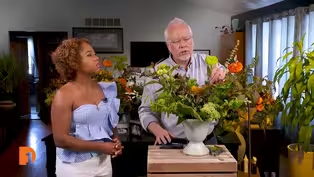
The Art of Flower Arrangements with J Schwanke
Video has Closed Captions
Clip: S7 Ep4 | 7m 5s | J Schwanke create a two-sided flower arrangement, and teaches viewers how to at home. (7m 5s)

Detroit Remember When: A Tribute to Dick Purtan
Video has Closed Captions
Clip: S7 Ep4 | 9m 12s | "Detroit Remember When: A Tribute to Dick Purtan" with on-air co-host "Big Al" Muskovitz. (9m 12s)

Saxophonist De'Sean Jones and the Urban Art Orchestra
Video has Closed Captions
Clip: S7 Ep4 | 1m 18s | Detroit Performs: Live from Marygrove' season 12 premieres Oct. 12 at 7:30 p.m. ET. (1m 18s)
Providing Support for PBS.org
Learn Moreabout PBS online sponsorship
- News and Public Affairs

Top journalists deliver compelling original analysis of the hour's headlines.

- News and Public Affairs

FRONTLINE is investigative journalism that questions, explains and changes our world.












Support for PBS provided by:
One Detroit is a local public television program presented by Detroit PBS