One-on-One
Dr. Bloom & Charters; Hoffman & Alagia; Gaddy
Season 2021 Episode 2462 | 27m 8sVideo has Closed Captions
Joel Bloom & Elisa Charters; Jeanette Hoffman & Phil Alagia; Kim Gaddy
Dr. Joel Bloom and Elisa Charters discuss NJIT’s goal to become an established “Hispanic Serving Institution” by 2025; Philip Alagia and Jeanette Hoffman share the long-term impact of the January 6th Capitol riots and the fracturing of the Republican and Democratic parties; Kim Gaddy talks about her personal connection to fighting against air and water pollution in the Newark community.
Problems playing video? | Closed Captioning Feedback
Problems playing video? | Closed Captioning Feedback
One-on-One is a local public television program presented by NJ PBS
One-on-One
Dr. Bloom & Charters; Hoffman & Alagia; Gaddy
Season 2021 Episode 2462 | 27m 8sVideo has Closed Captions
Dr. Joel Bloom and Elisa Charters discuss NJIT’s goal to become an established “Hispanic Serving Institution” by 2025; Philip Alagia and Jeanette Hoffman share the long-term impact of the January 6th Capitol riots and the fracturing of the Republican and Democratic parties; Kim Gaddy talks about her personal connection to fighting against air and water pollution in the Newark community.
Problems playing video? | Closed Captioning Feedback
How to Watch One-on-One
One-on-One is available to stream on pbs.org and the free PBS App, available on iPhone, Apple TV, Android TV, Android smartphones, Amazon Fire TV, Amazon Fire Tablet, Roku, Samsung Smart TV, and Vizio.
Providing Support for PBS.org
Learn Moreabout PBS online sponsorship- [Narrator] Funding for this edition of One-On-One with Steve Adubato has been provided by The Russell Berrie Foundation.
Making a difference.
RWJBarnabas Health.
The Fidelco Group.
Valley Bank.
The New Jersey Economic Development Authority.
Community FoodBank of New Jersey.
The New Jersey Board of Public Utilities, Clean Energy program.
NJ Best, New Jersey'’s five-two-nine college savings plan.
And by Suez North America.
Promotional support provided by NJ.Com, keeping communities informed and connected.
And by Insider NJ.
- This is One-On-One.
- I'm an equal American just like you are.
- The jobs of tomorrow are not the jobs of yesterday.
- Look at this.
You get this?
- Life without dance is boring.
- I don't care how good you are or how good you think you are, there is always something to learn.
- I did do the finale, and guess where my trailer was?
A block away from my apartment, it couldn'’t have been better!
- People call me 'cause they feel nobody's paying attention.
- (slowly) Start talking right now.
- That's a good question, high five.
(upbeat music) - Welcome, everyone, I'm Steve Adubato.
I want to jump right into this because it's such an important topic.
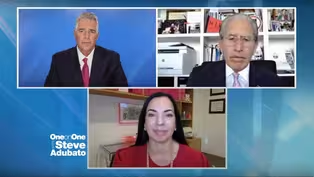
We're joined by our longtime friend, Dr. Joel Bloom, President of the New Jersey Institute of Technology, and Elisa Charters, President of Latina Surge National and council member at NJIT's Hispanic and LatinX Leadership Council.
I want to thank you both for joining us.
- Thank you.
- Joel, put this in context.
What is the council that we're talking about, the Hispanic and LatinX Leadership Council, what is it and why does it matter?
- We know the fastest growing population in the state of New Jersey are of Hispanic and LatinX backgrounds.
We also know those are some of the students that are most economically challenged to go into STEM engineering fields has to do with three- two things.
I'll talk about two, the pipeline issue, which we've talked about a lot, it's improving, but- and the issue, of course, pipeline, we see more and more of our Hispanic population is centered in some of our urban settings.
We're concerned always about the level of preparation to enter the challenging STEM and engineering fields.
In your high school, you definitely need Pre-Calc, maybe even Calc 1.
So we are taking a number of steps as we always had, mostly through our center, for pre-college education.
For example, in the city of Newark, we've talked about this.
The mayor has challenged then NJIT to double its enrollment of Newark students, predominantly minority students, African-American and Hispanic, so we have that in place.
We have it in place, and the mayor's Honors College Scholars, we have that in place with something called MSI, the Math Success Initiative.
So students who can't get access to their Pre-Calc in that count, get it in the summer time, or after the school, through our NJIT center.
We also recognize that there are other barriers.
There are family barriers, there are language barriers, et cetera.
So now we need mentors, and that's what, in part, the council is about.
- Elisa, I want you to jump in here.
But Elisa, I realized that you and I had met many times in connection with the 9/11 Memorial that we do at Eagle Rock Reservation.
You are a 9/11 survivor, and I did not make the connection right away, I apologize for that.
To help us on this, the mentoring part that Dr. Bloom just talked about, talk about why it is so important, and also your personal connection to this initiative.
- Yes, sure, it is critical.
First of all, the state of New Jersey is extremely diverse, and we need to be fully inclusive of everyone in society, and ensuring that we all have access to economic opportunities.
And those steps really involve education, and a pipeline to higher education.
And NJIT has always been at the forefront of this.
I'm so proud of this.
I, myself, was the first-gen to attend college, and NJIT gave me that opportunity.
I participated in the Educational Opportunity Program back in the late '80s.
- Right, that's the equal- the educational- the EOP program.
Why is that so important, by the way?
- It's really important because, you know, it bridges the gap.
There are students that may not have been prepared enough to enter a Polytech Institution with the rigorous programs, with math and physics, the sciences, and that program really allowed for some advanced training before the semester starts.
So it really fortifies the experience of, in my case, LatinX students, so that they can have success when they start their first semester.
They will have already, you know, experienced what it means to study calculus, have study techniques, understand timing, scheduling, and then obviously, all of the information relating to the different courses.
- By the way, a couple of things, NJIT is one of our higher ed partners.
And in that context, Joel, I want to ask you: while at NJIT, I know there's a goal of expanding the number of Hispanic, LatinX students.
What are the numbers, by the way, from what to what, it's from 20 to 25%?
- So we're now at 21%, the goal is to get to 25%, in fact- - Because?
- Well, because again, that's where the population in the state of New Jersey is heading.
It's heading- it's over 20% now, as we speak.
And again, it all comes to, "What's the pipeline of the-" - When you say "the pipeline", Joel, make that clear, because it isn't just the NJIT, I'm also curious about the higher ed community, overall, other universities and colleges, even though yours is different, it's a Polytech, if you will, Institution; what's "the pipeline" mean, Joel?
- "The pipeline" means the students who are graduating from high school, who are prepared, either through any parts of the state system county colleges, the four-year senior institutions, or, as we are, the research university, that they're prepared to enter college, and how they get there.
We can't afford- and we know this from all the data that's out there.
If students aren't prepared, they go into remediation, at particularly, at the four-year institutions.
Many of them will not get out of there.
At NJIT, you're in- if you're in two remedial classes, particularly if they're mathematics, it's highly unlikely that we will see you at graduation.
That's a big investment they make, it's big investment we make, big investments the state and the feds make.
So we need to, again, continue to improve.
I'm gonna brag about our 72% graduation rate.
That's 20% higher than the national norm for our disciplines.
And it's just a little off for the underrepresented, it's about 66, 67%, so we have been working this problem for decades.
- But Joel, real quick, before we go back to Elisa, is this a national movement among colleges, universities, or is it some aberration at your place?
- No, the overall enrollment at colleges and universities, it's significantly down.
Look at the county college data for this, as well.
- [Steve] Right.
- In our case, we had 11,301 application, they're booming.
We're out of space and money, which I do want to talk about at some point today.
- Okay, Elisa, help me on this.
Again, you talked about your personal journey.
Well, you didn't- I didn't give you a chance to talk about it enough, you are a 9/11 survivor.
And by the way, how do you connect the experience of being a survivor of 9/11, and frankly, the challenges of navigating higher education in the Hispanic community and LatinX community?
Those are real challenges.
- Yeah, you know, I guess I can only explain it through my personal experience.
And I have to say, having been an NJIT undergrad, I received a phone call from career services that would not have happened, had NJIT not given me the opportunity to, you know, enroll, and to help me succeed.
So the Port Authority, actually, was my first call for a job.
And that's when I started working there, and progressed into different- I was in the tech services group.
And, you know, as a woman- - So you were at the World Trade Center?
- Yes, yes, and as a woman in tech, to be able to, you know, succeed, obviously NJIT gave me those skills, those life skills, but also the academic skills.
And, you know, obviously I was at the Port Authority for a pretty long time.
And 9/11 happened, and I was actually involved in the rebuilding of the, you know, the Freedom Tower, so in those initial stages.
And NJIT prepared me to make those contributions.
So, you know, my life's course could have been completely different, had I not attended college.
And to me, and NJIT gave me that platform.
- Joel, I got a- I don't want this to be too promotional, about NJIT, because it is a higher ed issue, it's a societal issue.
But Joel, got a few seconds left, let me ask you something.
- Sure.
- Tell everyone who may not be directly connected to the higher ed community, to the Hispanic and LatinX community, why this matters to all of us, as Americans?
Real quick, 30 seconds or less.
- The state of New Jersey is a tech state.
If you don't have the workforce, you don't generate the revenue, either by the income tax, or the corporate tax, it's the survival of our state's economy.
We, NJIT, among all the state colleges and universities, we provide 62% of the minority engineers in the state of New Jersey; add up all of them, 62%.
Problem is, it costs us 50 to 100% more to educate an engineer, as compared to humanities or social sciences major.
Not that they don't need the humanities and social sciences, but recognize the cost differential, our state has yet to do that.
Recognize the cost differential for STEM and engineers.
- Thank you, Dr. Bloom, thank you, Elisa Charters.
Dr. Bloom, also a board member, a trustee of the Caucus Educational Corporation.
Thank both of you for exploring, and talking about, and helping us better understand why this matters so much to all of us, thank you.
I'm Steve Adubato, stay with us.
We'll be right back.
- [Narrator] To watch more One on One with Steve Adubato find us online and follow us on Social media.
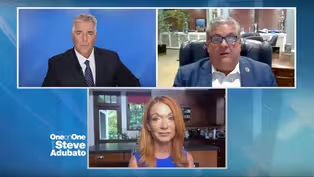
- We're now joined by two of the brightest political minds in the state of the nation.
Philip Alagia is Democratic Strategist and Chief of Staff in Essex County to the County Executive, Jo DiVincenzo.
And also Jeanette Hoffman, Republican Strategist and President of Marathon Public Affairs.
Listen, we had a whole conversation in a different segment.
We kept you here to talk about this.
I'm going to play word association.
Jeanette, I say January 6th, you say- - Disgraceful, disgraceful.
Just, anti-democratic.
Just, really upsetting to me.
- Phil, I say January- I'm sorry, I cut you off, Jeanette.
Finish your word association.
Anything else?
- It never should happen again.
- Phil, January 6th.
- Unbelievably embarrassing to be an American that day.
You know, I had people who, friends from Europe calling me, you know, upset and, you know.
We were the laughing stock of the world that day.
You know, they took over the Capital.
It was inexcusable.
I mean, it's not what politics and government's supposed to be.
We should be able to disagree without becoming violent.
- The reason I wanted to have Phil and Jeanette here is they're not only really great political minds but they're involved and engaged and they want to get things done.
And they're civil and respectful to each other and the people they interact with.
And so here's the question I want to ask.
Hey, Phil, two of us, we grew up in the same neighborhood.
Not exactly at the same time.
By the way, Phil, was, you weren't inducted into the Hall of Fame in Immaculate Conception High School but I know you had a special award there from when you went to school there, right?
- Yeah, I was at the Loyalty Award for Alumni at Immaculate Conception, a small Catholic school that keeps on chugging along.
They do a great job.
- Absolutely, and thank you for asking, Phil, that I was inducted into the Hall of Fame at my high school, Essex Catholic.
I appreciate you asking.
In all seriousness.
He didn't ask.
So, in all seriousness, here's the reason I'm raising this.
So, as we do this program.
Phil, you and I have friends we grew up with who excuse January 6th.
Who say whatever President Trump at the time and further has said publicly about advocating violence, about there're good people on both sides, all kinds of horrific things.
Shoot the vaccine into, shoot the bleach into the arm and get- Crazy stuff.
They not only excuse it, Phil, they say it doesn't matter because quote, they like his policies.
We love our friends, Phil.
We can't talk to them.
You can't talk to them.
We avoid it, don't we?
Trust me, there's a reason for this question.
Go ahead, Phil.
- Certainly it's not the discussion you want to have because emotions are so high and you really can't have a civil discussion on politics or Trump or anything.
- Well, how about the vaccine?
How about the vaccines and COVID?
Phil, these are our friends.
We love these guys.
We grew up with them and it's not like we have different views politically, it's we have different realities.
- But that's why it's important to have those discussions, Steve.
- But can you, Jeanette?
Families aren't talking to each other.
People are avoiding friends because they don't want to get into a discussion.
Not even about Trump.
But it's about all of that.
"That's your world, that's my world.
This is where I get my information.
That's where you get yours.
You're wrong, I'm right."
Come on, Jeanette.
Who's saying, you know, "I want to learn more about your perspective."
Who's doing that?
- Well, I honestly blame social media because there's so much information out there.
And specifically about the vaccine.
I mean, come on, horse dewormer.
This is the solution to taking a legitimate vaccine that prevents COVID-19?
- What was that again?
Thank you, Joe Rogan, for bringing that up and saying that that's how he got- There was some sort of treatment that he talked about.
There was some wacky treatment that horses are treated for if they have worms.
And so people are like, "Yeah, I heard it from Joe Rogan."
I love Joe Rogan, but he's not someone to be trusted.
Why can't we just acknowledge that there are certain facts, Phil and Jeanette, and then there're just opinions people have.
Isn't there a difference, Jeanette?
- I'm sorry, Jeanette.
You look at the vaccine in particular.
- And by the way, Essex County doing an amazing job on the vaccine distribution and testing.
I'm sorry, Phil, go ahead.
- But I will even give you credit.
I think it's the biggest success of the Trump Administration.
I mean, we developed a vaccine, they invested the money necessary.
And within five or six months, the United States of America, I mean, they developed three, four effective vaccines.
I think, Trump took the vaccine.
- But he didn't do it in public.
And there are a whole bunch of people who support Trump who say, "I'm not taking it" But if they had seen him, Phil.
- Exactly.
And he said, recently, "People should take the vaccine."
It doesn't matter.
It's just this whole, as Jeanette said, it just took this strange political, "Don't take the vaccine if you're pro-Trump," But he should, this should be his victory lap.
"Hey listen, I did a lot of things wrong."
I'm sure he wouldn't say that.
But the Trump Administration got the vaccine right.
And even now, they're not even taking credit for it.
People are blasting it.
It's just, it's the world upside down, as someone used to say.
- It's Bizarro World from Seinfeld that you're too young to remember.
Go ahead, Jeanette.
- I am not too young to remember that, but I appreciate you saying so.
But no, Operation Warp Speed.
The Trump Administration bragged about that publicly for a very long time.
It was a terrific private public partnership.
And to Phil's point, President Trump at a rally just a month ago, maybe six weeks ago, said, "You should get the vaccine.
I got it.
Everyone should get it."
And he was publicly booed at his own rally for telling people to get the vaccine.
- But what does that tell you, Jeanette?
- There's so much misinformation on social media and these websites that, you know, the QAnon world believes in, with, you know, these shadowy internet figures who put out this misinformation.
But you know, people believe that there's stuff in the vaccine that, you know, tracks people.
It's just crazy, Steve, is what it is.
- Final question, Phil.
Jeanette mentioned social media.
Some people ask, "Hey, why do you even do this public television thing?"
And not many people are watching television anymore.
They just get their phone and they get their information they need.
By the way, we don't think that's true.
That's why you should support public television.
But Phil, and this is not the kiss-our-butts in public broadcasting.
But what is our role when people are- People often ask us that, Phil.
"Well, Steve, whose side are you on with public-" Whose side are we on?
We're on the side of trying to give out information and let people decide for themselves.
Like you got to have some political point of view.
Go ahead, Phil.
Phil's in politics.
I'm not.
- Particularly in a state like New Jersey, which is sandwiched between Philadelphia and the New York media markets, I think public television is an unbelievably important resource to get our news out, to get the facts out.
And I think that's one of the problems too, with the lack of press and all that.
There's very few investigative journalists out there to keep government in check and all this in check.
You don't see it anymore.
And I think that's created the demise where, you know, a website on social media can dictate what people think.
You know, you no longer look at these big newspapers and say, "Wow, it's the gospel."
It's just, everything's sort of melded in.
And whether you see it.
It's almost like years ago, taking the National Inquirer as gospel.
You'd laugh at the stories they've had, but now if these websites put it up, people believe it.
- As we close this segment on.
Thanks, Phil, and thanks Jeanette.
Jeanette, come on.
I don't want to be negative.
Give me a silver lining.
Let's go.
I'll put you on the spot.
Where's the silver lining in all this?
The reason to be hopeful.
- The reason to be hopeful.
Well, we're here, we're talking truth.
I mean, you know, more and more people are getting vaccinated.
The numbers are climbing.
You know, I feel good about, you know, this public information that we're getting out here, Steve, and you keep doing a great job every day.
So, that's something to be hopeful about.
- I got a compliment out of that.
I wasn't looking for it, but I'll take it.
And by the way, I know nobody cares that I'm in the Hall of Fame at my high school, trust me.
It's self-deprecating humor.
- I'm not in the Hall of Fame of my high school.
So South Plainfield High School has to get on that, if anyone's watching.
- I got in because of age and I think it was a contribution I made.
Hey, Phil.
Phil, Thank you.
Thank you, Jeanette.
All the best to both of you.
By the way, Phil, I don't like to disclose this, is also a New York Met fan.
All right, has nothing to do with anything.
See, I'm a Yankee fan.
See you next time.
- Go Yankees.
- We're just going to a break.
Go to Yankees.
We'll be right back.
- [Narrator] To watch more One on One with Steve Adubato find us online and follow us on Social media.
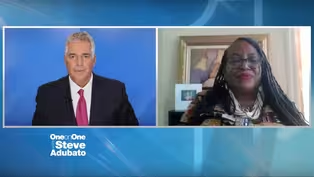
- We are honored to be joined by Kim Gaddy, founder and director of the South Ward.
that's in Newark, South Ward Environmental Alliance, and a Russ Berrie Making A Difference awardee.
So good to have you Kim.
- Thank you for having me Steve.
- For those who don't know, tell everyone exactly what the environmental Alliance is and what you're fighting for and against.
- Sure.
The South Ward Environmental Alliance is an organization consisting of residents and community based organizations whose mission is to ensure that the voices of residents are heard and they are active participants in the decision-making within their neighborhood and their communities.
So for example, the South Ward is the backyard of the port and the airport.
Thousands of trucks come in our port each and every day and the health impacts impact our community.
And so we wanna make sure that our residents have a seat at the table and they are part of the narrative in what they want their community to look like.
- Let's be more clear, We're talking about the South Ward of Newark, we're talking about Newark International airport, if you will, the port, if you will.
And so you've got air pollution problems, which you've got asthma problems, which you know better than most because your family has been personally hurt by this.
What is the asthma problem and why is it part of this discussion, Kim?
- Yeah, you know, raising my three children in the city of Newark we would frequently visit Weequahic Park, which is right on the corner of Frelinghuysen Avenue.
And when you think about it, you're taking a children to a place where you want them to recreate and run around.
And while they are in the activities of soccer, baseball, track, tennis, the emissions from the trucks are spewing in the air and while they're playing their lungs are open as their widest, right?
And so what happens is when we think our kids are not being harmed, they are by the toxics.
And so we wanna make sure that we have kids clean air zones around our parks.
We wanna make sure that when our children are recreating, the backyard is not the pollution of trucks driving in and out of our neighborhood.
We truly- - How you doing that Kim?
I'm so sorry for interrupting you.
How are you doing it?
Give us an example.
- So what we would definitely wanna do is make sure that the cleanest trucks are on those roads.
So there's electric trucks that exist today, the technology is here, but in our communities the dirtiest trucks are still on the road, the dirtiest buses are still on the road.
And when you think about the cumulative impacts from the trucks and the buses, then that increases the asthma rates of our children by the pollution.
- And by the way, to be clear, the South Ward of Newark is disproportionately an African-American community.
If people wanna understand an operationalized example, a real example of institutional racism, just listen to what Kim just said.
In that spirit, you, the organization, you and the organization, won the Russ Berrie Making A Difference Award.
A, what does that award mean, and B, how has it helped the organization?
- Well what that award means is that people are recognizing that our community is a community that needs help and that our story is a story that needs to be told.
And so it was very important for the South Ward Environmental Alliance for individuals to recognize that there are communities, what we call frontline communities, that each and every day suffer from environmental degradation just because of the zip code we live in and the color of our skin.
And by receiving the Russ Berrie award individuals have been reaching out and they've been saying, "oh my God, "I didn't even know "that that was a problem in your community.
"We thought it was only over here or over there."
And we say, "no, "it's everywhere within our South Ward community."
And so our story has been elevated, our members have been rejuvenated and they really feel that their voices have been heard and that we can change the situation that we suffer from now because we have other individuals willing to engage and help us change around our community.
- Before I let you go, Kim, I've known of your work for a long time.
Our paths have crossed, we're both Brick City, if you will, natives.
Newark is, for those who don't appreciate or understand the Newark thing, I often say to other people, it's in your veins, it's in your blood.
It's something about growing up and being a part of Newark.
That being said, your passion, your deep abiding passion for this cause, one minute or less, comes from where?
- My children, being a mother who had to raise three asthmatic children.
When you see one child gasping for air, you know that you are helpless.
And so when I had to experience that, not once, twice, but three times, I knew that I had to begin to fight to change this so that not only will it make a difference for my children, but for all the children in the South Ward, the city, and the country.
- That is Kim Gaddy.
She's a leader, she's making a difference, and, by the way, I know in post-production we'll put the website of the South Ward Environmental Alliance up so people can find out more about the work of the organization, and if they wanna be helpful, how they can be helpful.
Kim Gaddy's also a Russ Berrie Making A Difference Award honoree.
Kim, you honor us by joining us on public broadcasting to share your story and the story of the people and the community of the South Ward of Newark.
Thank you so much, Kim.
- And thank you for having me.
- You got it, I'm Steve Adubato, that's Kim Gaddy.
We thank you so much for watching us and we'll see you next time.
- [Narrator] One-On-One with Steve Adubato has been a production of the Caucus Educational Corporation.
Funding has been provided by The Russell Berrie Foundation.
RWJBarnabas Health.
The Fidelco Group.
Valley Bank.
The New Jersey Economic Development Authority.
Community FoodBank of New Jersey.
The New Jersey Board of Public Utilities, Clean Energy program.
NJ Best, New Jersey'’s five-two-nine college savings plan.
And by Suez North America.
Promotional support provided by NJ.Com, And by Insider NJ.
The Fight Against Air and Water Pollution in Newark
Video has Closed Captions
Clip: S2021 Ep2462 | 7m 11s | The Fight Against Air and Water Pollution in Newark (7m 11s)
The Fracturing of the Republican and Democratic Parties
Video has Closed Captions
Clip: S2021 Ep2462 | 9m 48s | The Fracturing of the Republican and Democratic Parties (9m 48s)
NJIT on Track to Become A "Hispanic Serving Institution"
Video has Closed Captions
Clip: S2021 Ep2462 | 10m 57s | NJIT on Track to Become A "Hispanic Serving Institution" (10m 57s)
Providing Support for PBS.org
Learn Moreabout PBS online sponsorship
- News and Public Affairs

Top journalists deliver compelling original analysis of the hour's headlines.

- News and Public Affairs

FRONTLINE is investigative journalism that questions, explains and changes our world.












Support for PBS provided by:
One-on-One is a local public television program presented by NJ PBS