
Dr. Heather Norris
1/12/2026 | 26m 46sVideo has Closed Captions
Dr. Heather Norris, chancellor of Appalachian State University, discusses leading the Mountaineers.
Dr. Heather Norris, the eighth chancellor of Appalachian State University, discusses the highlights, growth and challenges that the university has faced in recent years.
Problems playing video? | Closed Captioning Feedback
Problems playing video? | Closed Captioning Feedback
Focus On is a local public television program presented by PBS NC
Dr. Heather Norris
1/12/2026 | 26m 46sVideo has Closed Captions
Dr. Heather Norris, the eighth chancellor of Appalachian State University, discusses the highlights, growth and challenges that the university has faced in recent years.
Problems playing video? | Closed Captioning Feedback
How to Watch Focus On
Focus On is available to stream on pbs.org and the free PBS App, available on iPhone, Apple TV, Android TV, Android smartphones, Amazon Fire TV, Amazon Fire Tablet, Roku, Samsung Smart TV, and Vizio.
Providing Support for PBS.org
Learn Moreabout PBS online sponsorship- Hello, I'm David Crabtree.
In a moment, we'll be talking with Dr.
Heather Norris, the eighth chancellor of Appalachian State University.
Dr.
Norris has shown strength and leadership through her time at App State, guiding the school through the COVID pandemic as the executive vice chancellor and through Helene as chancellor.
Coming up, a conversation with Dr.
Heather Norris.
Quality public television is made possible through the financial contributions of viewers like you, who invite you to join them in supporting PBSNC.
(upbeat music) ♪ Welcome and thank you for joining us.
We are here with Dr.
Heather Norris of Appalachian State University.
Chancellor, thanks for taking the time to talk with us.
- Well, thank you, David, for the opportunity to share something about a passion of mine.
- Well, let's talk about that passion.
Higher ed doesn't just land on you all of a sudden and you say, "Here I am."
Tell me about the journey that has led you to where you are.
- Well, it's been a wonderful journey and one that really started in my childhood.
My parents were deep respecters of education and really wanted to instill that in their daughters, myself and my sister.
And my sister was recalling recently at my installation as chancellor at App State, a time when we would play with each other as children and me always wanting to play school.
And so from a very young age, education was a passion of mine, a dream of mine to be in a classroom and spending that time with learning and discovery and just how magical and how opening up the world to young people education really is.
- Is your sister older or younger?
- She's two years older than I am.
- So who was principal and who was the teacher?
- Well, I think she was my student and I was the teacher.
- Well, it looks like it worked out, worked out very well.
- It did.
And you know, the beauty of pursuing that passion of mine is that I got to teach at the collegiate level.
And when I discovered Appalachian State University and its mission of academic excellence and student success, I couldn't have found a better match for what I was looking for and really what Appalachian offers.
- When you were teaching, what were you teaching?
- You know, I don't really recall the specific topics.
I'm sure it was reading, writing and arithmetic.
- And you have been at App State how long now?
- I have been at App State for over 22 years.
I came to the university in 2005 as a professor of finance in the Walker College of Business.
Never dreamed of becoming an academic administrator.
To be honest, I really didn't know what that was.
And a couple of years into my time there, the Dean of the Walker College of Business at the time was at open house with me.
And we were enjoying inviting prospective students and their families and telling them about all of the wonderful offerings we had.
And he said, "Do you want a job?"
And I said, "Well, sir, I'm confused.
"I have a job and one that I love.
"I get to be with students in the classroom every day."
And I said, "What are you talking about?"
He said, "I have this opening for an assistant dean "and I could really use your help."
And so it took me a little time to think about that and contemplate that and to learn really what that meant because I loved what I was doing.
But in the end, I decided to take a risk, to try something new.
And what I discovered was I could serve students in an even bigger way by serving in that role.
So I was able to oversee our scholarship support and our advising and our career counseling and just able to provide that support to students in so many bigger ways in some ways.
- A significant part of your journey at App State centered around the pandemic.
- Oh, yes.
- Hard to believe now that was five years ago, but it was.
We were learning something every day.
We were frightened again every day.
We didn't know how to deal with things.
Let's talk about that for a little bit.
What was that like and how did you become the point person you became?
- Of course.
And so in February of 2020, actually a little bit before the pandemic caused all of us to move things online within a two-week period, I was asked to step into the role of interim provost for the university.
And David, I believe in saying yes.
When your institution asks you to serve and has a need for you to serve, if there's a way that you can be helpful to the mission and to serve in that way, my answer is going to be yes.
So I said, of course, I will do whatever I can to help support the mission of this institution.
So I took on that interim provost role in February of 2020.
And in that role, I had plans of going out and meeting all the departments and all the groups and organizations that I wasn't as familiar with outside of my home college.
And three weeks later, the job was something very different.
As you've just mentioned, we were learning new things together.
We were facing uncertainty together and we were able to do that through different ways of communication, online, phone calls, in-person, six feet away or more.
And we got to the other side.
And not only did we get to the other side, but along the way, we were always thinking about what can we do now that will make us stronger?
Because this is something we will get through.
It is something that we will survive as a community.
And what can we do now in the moment to position ourselves to be even stronger when we get through it together?
- What do you think the greatest lesson was for you as you look back on that time?
- I think the greatest lesson is you really need to communicate often.
You really need to pull people together to lean into the support networks that you have.
I can remember meeting with my deans regularly and telling them if I had the ability to talk with each individual faculty member, each individual staff member, and each individual student each and every day to provide assurances and to talk through what we were following, which was the health and safety protocols established by the experts that changed as new information came in every day, if not every hour of every day.
But what I shared with the deans was, it's not physically possible, and so I have to rely on deans and department chairs and others to carry forward and to communicate with me and with us and to provide that support.
And I can remember vividly saying, it's okay to be scared.
It's okay to be scared of the unknown, but we have to remember what our mission is.
And our mission is providing an exceptional education for our students.
And that is our focus and that is our job.
And we have all the experts in the world helping us with the health and wellbeing of our community.
- And now fast forward five and a half years.
- Yes.
- You are the chancellor.
You're the eighth chancellor.
Seven people preceded you.
- Yes.
- How many students now?
- 21,798 as of our official census date, which is a record for us.
And that is on our Boone campus, that's on our Hickory campus, and that is through our online programs.
And we're really managing our enrollment strategically, knowing that there are many different types of students with many different types of needs at all different stages of life.
And so we have our traditional college age student body that likes a residential experience.
We have our students who are adult learners that need a very different kind of education and the amount and the frequency of the meetings and the meeting patterns and how that's delivered very different from the traditional full-time residential experience.
- So out of 21,000-- - 798.
- Okay.
How many of those are freshmen or first year students?
- We have around 4,000 first year students.
I don't have that exact number with me, but it's a tremendous group of individuals who are living in our residence halls and experiencing life on a university campus, which is just full of so many opportunities.
We have over 400 clubs and organizations for them to get engaged in and with.
We have outstanding athletics teams, the mountains, the outdoor opportunities, and of course, exceptional classes and faculty and instructors.
- So you remember when you were a freshman?
- I could probably clear some cobwebs and remember those years.
- Where did you do your undergraduate?
- I am a graduate of James Madison University.
- So you can identify with people coming for that first time.
- I can.
- How intimidating and exciting it can be.
- Absolutely.
- How do I fit in?
What am I going to study?
Oh my gosh, can I do this?
- Yes.
- It can be quite intimidating again and exciting at the same time.
- You're right.
And the nice thing is we have so many supports in place and in our residence halls, our resident advisors who are there to help students navigate from being in a high school setting, likely at home, to coming to a college campus and living in a very different environment perhaps than what they've been accustomed to.
- You know, one of the things that President Peter Hans talks about a great deal when he's addressing chancellors and the board of governors and anyone in the community who will listen, centers around mental health and the well-being of students.
Particularly with your experience with the pandemic and then now as Dean, I would presume that has to be one of your top priorities.
- Oh, absolutely it is.
And you know, it's been a long standing system of supports at App State that we want to enhance and really strengthen even more so than it already is.
Lots of support for mental health and counseling and well-being.
During the pandemic, our Beaver College of Health Sciences had an outreach program because what we were learning is, even though we had so many supports available to students, they weren't always comfortable and confident about reaching out to use those supports.
And so our students in, our graduate students in our Beaver College of Health Sciences developed a peer-to-peer outreach for students to say, "You know, here's what's available and we're happy to talk with you about what that looks like and to encourage you to take advantage of all of the many resources."
And of course, as you mentioned, the pandemic doing a lot of that virtually and providing that virtually to the students for wherever they might be.
- A significant part of the landscape for higher education is affordability.
That's a word we hear a lot about, maybe even more so today than we have in the past, yet affordability for schools and universities within the UNC system, again, has been front and center and continues to be at App State.
- Absolutely, and as you and I both know, our system has held our tuition constant for almost 10 years now, and our affordability in the state of North Carolina is very, very, very low and very affordable.
At App State, we believe in that, and of course, the mission and the constitution of the state of North Carolina, which has been so very supportive.
We're one of the states in the nation that does have that investment from our legislature in our schools of public higher education, and we're very thankful for that.
And our ability to keep things affordable for our students and their families.
- Is App State the largest employer in Boone?
- We are one of the largest employers, yes.
- Which means you are significantly engaged in the community on a consistent basis.
Talk about what that partnership looks like now.
- Well, it's really nice because we are a driver of economic support and have a huge economic impact in Boone, Watauga County and the surrounding region.
Our economic impact as measured back from 21, 22, which as you'll recall, was still an era of getting out of the COVID years, was over 600, or close to $600 million and about $2.2 billion statewide in economic impact.
And so we are very thankful for our partnership with Boone and Watauga County and the surrounding region and being able to provide opportunities for employment and support and service in research, in educational partnerships.
And I meet frequently with leaders in the town, in the county.
We're talking about our upcoming strategic planning and master planning and how we can do things together that benefit our region.
- When a student graduates from App State, no matter where they're from in the state, do many of them stay in the area?
Are you preparing them as part of a workforce or a career force for that region?
- We're preparing them for wherever they want life to take them.
Honestly, many of them do want to stay in the region.
It's beautiful there.
There's a reason that people like to stay and we have the term Boonerang for people who leave and come back, because it's a draw.
Once you're in the mountains and a member, a mountaineer, part of the Appalachian community, you take a piece of that with you and it never really leaves you.
And so we're preparing students for wherever life takes them.
Close to two thirds to three quarters of our Appalachian alumni are still living and working in the state of North Carolina, but some choose to go beyond our borders and are much farther away.
And so we like to provide them with the skills, the knowledge, the abilities to be able to take that wherever life leads them.
- I often talk about the intersection between tradition and innovation.
You don't want to leave behind what brought you where you are.
- Agreed.
- But you're always looking for new ways to innovate.
And in the world of higher education, that means new academic programs, new research programs, new achievements.
So if I were to walk onto the campus of App State today and you wanted to sell me on the innovation that's happening there, what would you tell me?
- Well, I would tell you first of all, that tradition is important.
We just celebrated our 125th anniversary last year.
And our founders, B.B.
Deedy and Lily Shull-Doherty really believed in providing access to education to what was once known as the Lost Province of the state of North Carolina.
And so that is true to today.
And being part of the Lost Province of North Carolina means that there were adversities that that part of the state faced.
There were innovations and resilience that were necessary to survive.
And so as part of that culture that our founders established in 1899, that carries through to today.
So we're very much a blend of that traditional culture of discovery, of resilience, of innovation.
We recently attained R2 status as an institution.
And that's due to the work of our faculty and their innovative problem-solving spirit.
We have a lot of applied research happening on our campus.
Our undergraduate students are involved in that.
Our graduate students are involved in that.
And we're developing academic programs that speak to the needs of the future.
We don't know what those industries are going to be five, 10, 20 years from now, but we do know that we need to be offering educational programming in areas like artificial intelligence, cybersecurity, and many things related to health and wellness.
And so those are the things that are being innovated.
Those are the new things you'll see in our academic programming, just thinking ahead to the needs of the future, using the tools we have now, combining areas in different ways.
One example of a recent research project that a faculty member has received some funding for is an application of artificial intelligence in parasite detection of livestock.
And so what used to take scientists in laboratories with microscopes two to five days to detect whether a parasite existed in your cattle now takes a matter of seconds.
Revolutionary.
- I spoke to a group just yesterday.
AI always comes up.
- Yes.
- And it often comes up with people in a fear of the unknown, what it could do to plagiarism, what it might do to take the place of actually learning on your own.
My approach is, sure, there are ways we have to guard and gauge what we're doing with AI, but to not embrace it would be a misstep.
Now, I realize you have your challenges on campus with writing and so on and so forth, but it sounds like the embracing of it, you're there.
- Yes, and in fact, when I was provost, I put together an AI task force because I wanted us to have that discussion as a campus and as a community about what this was going to mean for teaching and learning, what this was going to mean for research.
And so we had some faculty come together and really explore, and I said, I don't want policies that declare that we cannot use this, but rather I would like guidelines that give us some guardrails related to integrity, related to ethics, related to learning what is available, how it can be applied, and how it can be used for good in teaching, learning, and research.
And then as chancellor, I put together an AI task force to look at the broader areas of the campus, including our business processes, to explore how can we use AI to make our business processes more efficient, faster, more customer relation driven, and to take away some of the headaches that some of our processes were creating for people.
- When you're out walking the campus and you see students, what do you see?
- I see students who are so very talented, so very engaged, and many times so very happy.
I love seeing our students.
They give me energy.
Interacting with them gives me joy.
And I love to just stop and check in and see what their interests are and see what that next project looks like.
You'll see in my message tomorrow to campus, we have a little video clip of our students studying in the library and talking about their favorite Thanksgiving traditions.
- What's your favorite Thanksgiving tradition?
- Okay, well, I'm told by my family that my recipe for sweet potato casserole is their very favorite.
A little secret about that, it's more like a dessert than a vegetable.
- I understand that.
I often save mine for dessert.
So do you use marshmallows?
- No marshmallows.
- Well, it's more like an apple crisp topping.
- You didn't bring any today, I think.
- No, but I'll bring you some next time.
- Okay.
I have witnesses who've heard you say that.
Couple of more things I want to get to before we wrap up.
We both attended the latest Board of Governors meeting.
And we heard the chair, Wendy Murphy, say a few things addressing the group.
Of course, Chair Murphy has a longstanding support of higher education, public education in the state.
But she said, "Life never stops teaching."
And I thought, how profound that is, because we know that at the professional level.
But every day at a personal level, there is something else to learn.
- That's absolutely true.
And back to my passion for higher education and education in general.
It's something that we can continually offer and is ever-changing.
And in our jobs, there's always something new to learn as well.
And so it's that mutual learning.
I mean, my love of being in the classroom with our students was not just me being able to share with them and empower them on their future journey, but also to learn back from them about the future world that they see and embrace.
- Little less than a minute left.
For a student, a potential student, who may be thinking about a four-year education, they're not quite sure, they may be thinking about out of state, how do you encourage them?
- Well, first, they need to come and see all that we have to offer.
My first day on that campus, my first five minutes on that campus, I knew it was the place for me.
And I hear that time and time again from prospective students and their families.
I would offer the advice of come with intellectual curiosity, come with a growth mindset, make sure that you take advantage of all of the resources we have to offer.
I was talking with a student group a couple of weeks ago who are graduating seniors, and I said, "What would "you tell your freshmen, your first-year student self, "now that you've been here for four years?"
And they said, "I would tell myself "to reach out and accept help, because I wasn't willing to "do that in my first years here, "and now I am, and I see "how much it has served me, and I ask for help "every chance I get, and this university "has poured into me all that I need in "order to be successful in my next steps."
- We wish you great success as you continue-- - Thank you so much.
- As the eighth chancellor of Appalachian State University.
Dr.
Heather Norris, thank you for your time and insight.
- Thank you so much for the opportunity.
- And thank you for joining us.
(upbeat, gentle music) ♪ - Quality public television is made possible through the financial contributions of viewers like you, who invite you to join them in supporting PBSNC.
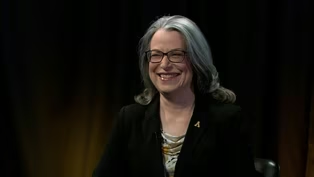
Dr. Heather Norris on Her Educational Upbringing
Video has Closed Captions
Dr. Heather Norris, chancellor of Appalachian State, discusses her educational upbringing. (45s)
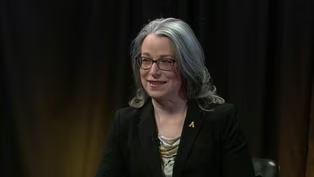
Dr. Heather Norris on Innovation at Appalachian State
Video has Closed Captions
Dr. Heather Norris, chancellor of Appalachian State, discusses balancing innovation and tradition. (1m 47s)
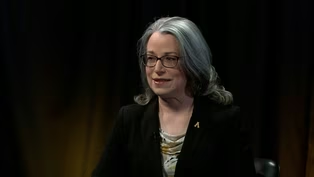
Dr. Heather Norris on Mental Health at Appalachian State
Video has Closed Captions
Dr. Heather Norris, chancellor of Appalachian State, discusses the school’s mental health support. (1m 8s)
Providing Support for PBS.org
Learn Moreabout PBS online sponsorship
- News and Public Affairs

Top journalists deliver compelling original analysis of the hour's headlines.

- News and Public Affairs

FRONTLINE is investigative journalism that questions, explains and changes our world.












Support for PBS provided by:
Focus On is a local public television program presented by PBS NC