
Dr. Jacobs; Sigmund; Findley & Ferraro
2/20/2021 | 27m 14sVideo has Closed Captions
Dr. Laurie Jacobs; Stephen Sigmund; Patricia Findley & Carrie Ferraro
Dr. Laurie Jacobs discusses “long-haulers,” those dealing with long-term complications of COVID-19 infection and treatment; Stephen Sigmund talks about the importance of the Gateway Project and its impact on the region and the London Bridge report; Patricia Findley and Carrie Ferraro share how climate change can lead to anxiety in kids and the importance of teaching them about climate science.
Problems playing video? | Closed Captioning Feedback
Problems playing video? | Closed Captioning Feedback
Think Tank with Steve Adubato is a local public television program presented by NJ PBS
Dr. Jacobs; Sigmund; Findley & Ferraro
2/20/2021 | 27m 14sVideo has Closed Captions
Dr. Laurie Jacobs discusses “long-haulers,” those dealing with long-term complications of COVID-19 infection and treatment; Stephen Sigmund talks about the importance of the Gateway Project and its impact on the region and the London Bridge report; Patricia Findley and Carrie Ferraro share how climate change can lead to anxiety in kids and the importance of teaching them about climate science.
Problems playing video? | Closed Captioning Feedback
How to Watch Think Tank with Steve Adubato
Think Tank with Steve Adubato is available to stream on pbs.org and the free PBS App, available on iPhone, Apple TV, Android TV, Android smartphones, Amazon Fire TV, Amazon Fire Tablet, Roku, Samsung Smart TV, and Vizio.
Providing Support for PBS.org
Learn Moreabout PBS online sponsorship- [Narrator] Funding for this edition of Think Tank with Steve Adubato has been provided by The New Jersey Education Association.
The Russell Berrie Foundation.
Making a difference.
New Jersey Sharing Network.
MD Advantage Insurance Company.
The New Jersey Economic Development Authority.
Operating Engineers, local 825.
New Jersey Board of Public Utilities, Clean Energy program.
The North Ward Center.
And by The Adler Aphasia Center, Promotional support provided by Meadowlands Chamber.
Building connections, driving business growth.
And by Insider NJ.
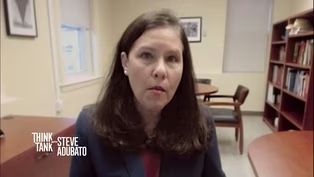
[MOTIVATIONAL MUSIC] - This is Steve Adubato it's my honor to welcome for the first time with us talking to you about an incredibly important health-related topic Dr. Laurie Jacobs.
Is Chair and Professor Department of Internal Medicine at Hackensack Meridian School of Medicine and Hackensack University Medical Center.
HMH is one of the major healthcare system supporting what we do.
Dr. Jacobs long haulers, I've been hearing it more and more.
My younger sister Michelle will not be upset me disclosing this I have the okay.
She's a long hauler, she had COVID early on she's still dealing with it.
For those who have tested positive and been treated for COVID what is a long hauler and why does it matter so much?
- So most of us define people with chronic COVID as greater than three months.
A lot of people have a COVID-19 infection and recover immediately within a few weeks, maybe have lingering symptoms six weeks to three months.
But after three months we grow concerned that they have a more chronic syndrome that we're seeing more and more often.
We've been running our post acute COVID recovery center at Hackensack Meridian Health now since July and we had our outbreak starting in March we're seeing patients with symptoms eight, nine months in duration.
- By the way we're taping on December the 8th.
We're in the middle of this, "second wave" I'm not sure which wave we're supposed to call it but I'm gonna go through this, help us on this Dr. Jacobs, some of the long-term complications from COVID-19, difficulty breathing speaking or swallowing, difficulty walking or performing self task, feeling of extreme fatigue, tiredness, cognitive changes such as problems thinking and concentrating, mental health concerns, anxiety, depression, that's serious stuff.
- It is serious stuff and unfortunately for a lot of individuals no one has taken them seriously up til now.
But now there's been more media attention and it's being recognized that this is a real syndrome.
We don't entirely understand it yet but it is probably a generalized response to the infection with various manifestations that you described the most common being extreme fatigue, so tired you can't get up and go about doing your daily activities and it kind of waxes and wanes.
It can go for a few days and then suddenly you have a day you feel great and you think you're on your way to getting better and whammo the next day or that evening that terrible fatigue returns.
There are a bunch of people who have with that this cognitive issue called COVID fog in the public speak and this is a sense of not being sharp, not being on your game, having difficulty thinking through issues, knowing what's going on may impair your ability to manage your work or your finances.
So it's very real.
Then there are people with shortness of breath, cough, chest pain who may have cardiac or pulmonary manifestations.
We saw these after the SARS outbreak many years ago most of those patients recovered pretty much at a year but they still complained of shortness of breath even though on measurements they seem to have recovered.
We don't know what will happen with those who had been infected with COVID-19 and still have these symptoms.
And this whole syndrome occurs probably in a minority of patients, maybe 2%, maybe more we don't actually know that yet.
The NIH has just convened a conference to determine the scientific underpinnings and the prevalence.
So no one really knows, but even if it's 2%, that's 2% of millions of people worldwide who've been infected, so that's a lot of people.
- Let me try this.
You're part of a COVID recovery center as part of the COVID recovery center, the COVID rehabilitation program at JFK, JFK is one of the hospitals within the HMH system I'm not mistaken, they have a rehabilitation institute.
So the reason why I'm mentioning that and I know JFK well is that there are programs, there are initiatives as these folks who are dealing with long-term implications of COVID, there are places for them to go, correct?
- Yeah.
So we've set up a multi-pronged program, there's a general intake number 833-565-0405 And we evaluate-- - [Steve] Could you do it again doctor.
Do it again.
- 833-565-0405.
- And what's that for?
- That's a general intake number where one of our providers will do a telehealth visit usually and try to help someone figure out what are their symptoms, how impaired are they and what are their needs?
And then we have a variety of settings and interventions that we're offering.
So they can see a primary care provider, they can see behavioral health and have telemedicine for anxiety, depression.
There's a tremendous psychological burden associated with just feeling fatigued and ill in addition to all that is going on with COVID.
In addition, we have groups of pulmonologists, cardiologists, neurologists who are working with us and then the rehabilitation programs, both outpatient and inpatient rehabilitation.
And some of the treatment is rehabilitation.
For example, patients with a cardiac syndrome that we've seen it's similar to something called-- - Patients with COVID.
I'm sorry for interrupting.
Patients with COVID (indistinct) cardiac issues?
- They can have cardiac issues but we don't know the extent of it or how long it will last.
There are some studies that show that they had inflammation of the heart muscle or the lining of the outside of the heart a couple of months afterward, but that may resolve we don't know.
But then there are individuals who have palpitations and lightheadedness so bad that they have to lie down, they can't do their activities.
And some of those patients are treated with rehabilitation as well as cardiac interventions.
- Dr. Jacobs, I'm sorry for interrupting.
Before I let you go quick thing I wanna ask you because we are committed at the Caucus Educational Corporation, a cooperation with our brothers and sisters in public broadcasting to be engaged in the most effective public awareness, public education around the vaccine.
Now we're taping on, the COVID vaccine.
Now we're taping at the end of 2020 it will be seen in 2021.
What's the message you have for those out there who are skeptical, some have legitimate questions about it, what would you say?
- I think this is a very serious disease.
Even if you had a mild case you could have severe post COVID syndrome.
The best thing is to prevent getting this disease.
Vaccines have been the way that we have prevented disease for decades in the world.
And it has prevented more disease than medical treatments.
This is the very serious disease and prevention is our best way out of this.
- Are you gonna take it?
Are you gonna take it?
- Absolutely.
- Would you do it publicly doctor?
Would you do a publicly to send the public message?
- Absolutely.
I think it's critical.
- It's interesting we're gonna be talking to... We actually talked to Dr. Shereef Elnahal over at University Hospital who told us that a significant percentage of their clinicians are skeptical.
It seems to me that the public awareness campaign I'll get off my soap box right after this is not only with the general public but with clinicians because people are gonna watch what you and your colleagues do and Dr. Laurie Jacobs, the Chair and Professor Department of Internal Medicine at Hackensack Meridian School of Medicine and Hackensack University Medical Center.
I wanna thank you so much for joining us.
We appreciate it, all the best.
- Thank you Steve.
Appreciate it.
- I'm Steve Adubato we'll be right back.
To watch more Think Tank with Steve Adubato, find us online and follow us on social media.
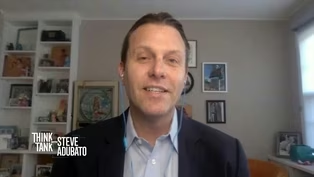
- We're now joined by Stephen Sigmund, Chief of Public Outreach, Gateway Program Development Corporation.
Good to see ya, Steve.
- Good to see you.
Thank you very much for having me.
- Our pleasure.
We're talking, at the end of 2020, be seen in 2021.
What is the Gateway Project?
Why does it matter so much, particularly as we move into 2021?
- Yeah, I mean, look, we're still dealing here, in almost 2021, with 100, now 110 year old, one track in, one track out system between New York and New Jersey, that is the busiest part of the entire Northeast Corridor, that carries 800,000 people a day, certainly before COVID, and we expect it to again.
And it is a vital link to 10 to 20% of the nation's economy.
So as you well know, Steve, we've been talking about replacing this train tunnel and this system for 20, 30 years at this point.
It's really well past time that it gets done.
And now there's an extra reason to do it, in the economic stimulus that it brings the project, the tunnel project alone in the EIS that we submitted over two years ago.
- What a EIS, again Steve?
- I'm sorry, Steve, the Environmental Impact Statement, which we need to keep the project moving forward.
And by the way this administration this current administration, USDOT has been sitting on it for almost three years, but it shows 72,000 direct jobs from the Hudson tunnel project and 19 billion in economic activity.
And there's no better time to get a project like that started when we're trying to come out of the and recover from the COVID crisis.
- So let's do this.
This will be seen before President Biden, President-elect as we speak do this now, but he'll be the president by the time this is seen in repeats if you will.
Here's the thing, I'm actually just as we're literally doing this program in the middle of a December.
Governor Murphy had a specific call with the President-to-be Joe Biden.
Talked about a range of issues, obviously the coronavirus top of the list.
Gateway was right up there.
This is a top priority.
What makes you believe, Steve and you've been at this for a while Jerry Zaro and your colleagues, - Yeah.
- that a President Biden, I actually saw him on Amtrak many times back and forth, (laughing) who understands transit, who understands transportation and the related issues.
What makes you believe, and your colleagues, that a President Biden would be more responsive to the Gateway Initiative?
- Well, the nice thing is he's already said he would, I mean, in 2017 at the RPA conference, he said the Gateway, - Is that the Regional Plan Association - The Regional Plan Association conference, he said Gateway project is the most important infrastructure project in the country and in his infrastructure plan his campaign infrastructure plan he specifically called for the Hudson River tunnel a new Hudson River tunnel project.
So, we don't just have to guess we actually know it.
And you, as you said, he's called Amtrak Joe for a reason, right?
He knows the system up and down.
- That's right.
He knows it well.
He knows the people.
He knows the dedication that the people have given.
And most importantly, he understands its importance as a link to the regional and national economy that can't be allowed to fail.
- You know, we focus on public policy, less politics.
It's not our thing, but it's very hard to separate at times, you know, Steve Sigmund.
So, I'm gonna ask you about New York and New Jersey, working together, our two governors.
My understanding and I could be wrong.
Is that a report that came out recently called is it, the London Bridge report?
- Yes.
London Bridge associates, yeah.
- Yeah.
Talked about the possibility of doing the repairs on the existing tunnels while they're in use.
Now, Governor Murphy said absolutely not.
I believe Jerry Zaro, who is a leader of your organization, said absolutely not.
Unless I'm wrong.
New York Governor, Andrew Cuomo has said Meh, let's look at that.
That's a problem.
- Well, look, the report that you refer to is is a feasibility study that we had done and actually started way back in 2019.
And the consultant's conclusion, as you suggest, is that you could do a full rehab in place while you built the new tunnel.
So let's understand a couple of things.
One, the project is the same project, no matter how we sequence it.
The project is, build a new tunnel, two-track tunnel under the Hudson and fully repair and rehabilitate the existing tunnel, so it lasts another hundred years.
- Right.
- So you have four tracks into and out of New York, and that'll connect with an expanded Penn Station, et cetera.
So this feasibility study was to look at whether you could do all or pieces of the of the rehab sooner.
And maybe there are pieces we can do.
We wanna take a look at the report and determine its feasibility.
You have to remember what's happened here is that we've spent the last four years, instead of building this project, just trying to keep it alive, through the Trump administration.
- Is it a lost opportunity?
- And we've done that.
- Oh, absolutely.
It's been a lost opportunity for 30 years.
this is not anything new.
We should have built ARC 20 years ago.
- Steve do me a favor.
Stay right there.
Stay right there.
and Nicole, our producer, do me a favor, as we're speaking we haven't done justice to this.
Let's show some pictures of what the tunnel looks like.
Because Steve Sigmund can talk about it.
It's another thing to see it.
Keep talking.
We're gonna show those pictures.
What are these, how bad is it?
Could you talk about these 30 years?
How bad, Steve?
I can just give you some numbers.
The Northeast Corridor Commission did a did a study, over five years, that showed I think it was 2,500 hours of delay.
And as much as equivalent of five days and there were 50 or sorry 85 incidents that where there are more than five hours of delay.
So, the existing tube, it is 110 years old as of November 27th, 2020.
Happy birthday to it, but it has done its job.
(laughing) I mean, it has more than done its job.
It has done everything we've asked of it and more and obviously it's now to getting delayed and failing and crumbling in lots of places and needs to be repaired and rehabilitated.
And we need two new tubes into and out of New York.
First of all, that was the original plan in 1910.
It was always supposed to be four tracks going into and out of New York and the rest of the Northeast corridor, which is the corridor that carries 800,000 people is four or five or six tracks.
So here at the busiest part of the corridor it necks down to one track in and one track out including a tunnel that is 110 years old.
And it was inundated by hurricane Sandy.
It gets wet.
It has old ballasted tracks, rock tracks that send off false signals.
The signal system needs to be replaced.
The concrete lining needs to be shored up.
The overhead system needs to be replaced.
I mean, look, it's 110 years old.
You can't ask it to do the same job it did on day one.
- So let's do this, Steve.
We've had many conversations about this initiative.
It's not new, but it's more important than ever.
We'll stay on top of it.
We'll keep creating public awareness around it and particularly, because we are seen in the tri-state region, the New York, New Jersey connection is what it is.
And it's so critical to be able to go back and forth in a way it makes sense.
It's transportation, it's environmental, it's quality of life.
It's nothing that you, it affects every aspect of our lives.
- And it's economic stimulus.
It's all of those things.
You said better than I could.
It is all of the things that we want to accomplish as policymakers is really contained in this one project.
- Steven Sigmund, Chief of Public Outreach, Gateway Program Development Corporation.
Steve, I want to thank you so much for joining us.
We really appreciate it.
- Thank you, Steve.
I appreciate the time and I appreciate all your attention to this.
Even during a period of time when we were all trying to keep it alive.
So, now we look forward to it really getting started in a real way.
- Thank you.
By the way, check out our sister program "MetroFocus."
They've been doing a lot of work on this as well.
- I know it.
Yeah.
- Check out "MetroFocus" because they do a lot of work around the region programming.
Hey, we'll right back right after this.
To watch more Think Tank with Steve Adubato, find us online and follow us on social media.
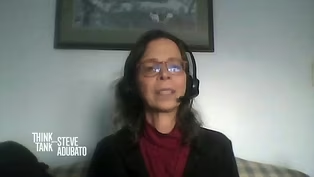
- We're honored to be joined by two very distinguished academics.
Dr. Patricia Finley, Associate Professor and Director, Master of Social Work Program at Rutgers University School of Social Work.
And also Dr. Carrie Ferraro is Associate Director, Coastal Climate Risk and Resilience Initiative at Rutgers University Center for Ocean Observing Leadership.
You think the university, you think Rutgers has titles that are long enough?
(everyone laughing) - You need to buy a vowel so you can pronounce it.
(everyone laughing) - Professor Finley, let me ask you this.
Your area of expertise around climate change, or excuse me around the whole question of climate change?
- Actually bringing the mental health side and trauma, impact of trauma.
- Here's the problem for me.
I hear climate change, then I hear stress, echo anxiety, I'm confused, help me.
- Yes, the world is changing and people are very concerned about the impact on the earth and people are having a lot of anxiety around that.
- Okay, so Dr. Ferraro, let me ask you this.
How do you collaborate together with your two different entities within this very big state university Rutgers?
- Yeah, it's actually, we were fortunate to be brought together by Marjorie Kaplan of the Rutgers Climate Institute.
And I have an interest in the science as well as education.
And so it's been great to work with Patricia on how climate change will really impact children.
- And Patricia, you presented at the New Jersey Education Association Annual Convention remotely, right?
- Yes, Carrie and I did yes.
- What kind of reaction did you, what was the message A?
And B what kind of reaction do you get?
- Lots of validation that this is very a concerning area for these teachers.
We had a wide range of kids, teachers, from kindergarten through high school all expressing concern about what the children, the adolescents are experiencing, and sharing in their classrooms and wanting help with some solutions to help manage behaviors.
- Solutions, such as?
- That's where we kind of work together.
Carrie and I really enjoy this part of our work is we take, first of all, look at the child and their developmental stages.
And then we offer a solutions of ways that kids can manage their anxieties that are age appropriate.
For example, Carrie, if I had a six-year-old what kind of activity would you give a six-year-old to learn about the environment?
- Yeah, definitely exposing children bringing them outdoors and really exposing them to nature and appreciate nature at that age is the way to go.
And to really speak to them in an age appropriate manner, not to overwhelm them.
- You know, here's what I'm... Well, let me follow up on that.
And by the way, I have a feeling you two did that, have done that before, that handoff?
(Professors laughing) It was very smooth, I noticed.
But here's what's interesting.
Our daughter Olivia is 10, and she does talk about climate change.
Not climate change anxiety I will be clear.
but I will say this, I'm often more hopeful that those who are younger are more receptive to climate science and are believers because they believe science and data.
And am I making too much of that, Patricia?
- Oh no, I'm so, so glad to hear you talk that way.
That's probably our biggest hurdle, is to really speak the truth to the children.
A lot of people protect kids from what's actually happening but really telling them about science and educating the kids are so important.
- Okay, but along those lines, kids are one thing but some of their parents, right.
And children hear things in their home, they learn from a lot of different places, a lot of different sources including parents in their home life.
What would you say to parents right now watching who say, "I don't know, I think we make too much of this whole climate change thing.
I, yeah I believe it, but come on with COVID and everything else the problems are much bigger than that."
You say what Carrie?
- Yeah, I would say that 99% of the scientists agree that climate change is happening, and it's because of human activities.
And all the data suggests that this is what's occurring and that it's gonna continue to occur until we take some actions.
- And in terms of anxiety Patricia, to those who say, "Well, I do believe, but you know, I feel like it's too late."
That's not gonna get us where we need to go," fair?
- Absolutely, it's giving up.
- And let's talk about that.
Why do you think some people take that road?
"Hey, come on it's too late."
Why do you think that happens?
- I think because a problem is overwhelming.
They don't know how to begin and how to work collectively to create some solutions.
And that's a problem that it might not be in their own neighborhood, but it will be, you know.
It's almost the way we dealing with COVID until it comes and effects your own life, people aren't realizing how important it is.
- And every little decision we make, we were joking before that I had this plastic bottle up here.
I'm not gonna show the name of the.
In all seriousness I had this water here and we're taping.
And I was like, I was embarrassed because it hit me right.
And I went, "Okay, I guess I better put it in this mug" right?
(laughs) Right, and you would say, "Well, what does that have to do with climate change?
What does it have to do with our environment?"
And the fact is Carrie, every decision we make or don't make has implications.
- Yeah, absolutely.
Everyone makes choices every day that can impact the environment.
And it's really important to think about what you're doing.
And also by taking these steps, you know, you could support your children in feeling like they're actually accomplishing something to make it better.
So being more conscious of what you're doing and especially when you're showing your children what you're doing is important to helping both combat climate change but also this kind of eco anxiety.
- So it's interesting, Patricia, we have about a minute left.
I'm curious about this.
You can sit there obsessing over climate change, having anxiety over climate change.
Saying, "Oh my God, it's the end of the world."
That which actually isn't a strategy or actually do something.
And I'm not an expert on mental health, but I will, I do believe that if you're doing something you're actually dealing with the anxiety itself.
Is that... - Absolutely.
Am I oversimplifying it?
Go ahead please.
- Absolutely not.
- We believe that anxiety... We all have anxiety, it's how we choose to manage it is what helps us be successful.
So we can choose to do nothing, and this makes us more anxious.
If we do anything to help alleviate that, we'll feel better.
- So doing something has the potential by itself if not eliminate, reduce anxiety.
Is it fair to say Patricia?
- Absolutely, yes.
Okay.
So Dr. Patricia Finley and her colleague, Dr. Carrie Ferrara, who presented at the NJEA New Jersey Education Association Conference Annual Convention.
By the way, every year we've been there for the last many, many years.
We did this one remotely.
We're continuing to do interviews with people who presented at the convention, and we'll cross our fingers that we can be there in 2021.
Yeah.
- Hopefully, yeah.
Patricia, Patricia, and Carrie, I wanna thank you so much and go Scarlet Knights.
- Yes, yay!
- Thank you.
- [Professors] Thank you, all right- - Listen, great having you I'm Steve Adubato.
Thank you so much for watching.
We'll see you next time.
- [Narrator] Think Tank with Steve Adubato has been a production of the Caucus Educational Corporation.
Funding has been provided by The New Jersey Education Association.
The Russell Berrie Foundation.
New Jersey Sharing Network.
MD Advantage Insurance Company.
The New Jersey Economic Development Authority.
Operating Engineers, local 825.
New Jersey Board of Public Utilities, Clean Energy program.
The North Ward Center.
And by The Adler Aphasia Center, Promotional support provided by Meadowlands Chamber.
And by Insider NJ.
- I could feel my lungs fill with oxygen, and I got my life back.
- The Sharing Network means to me hope, life, and everything.
- The Sharing Network was a lifeline to me when I really needed it.
- We are an organ procurement organization.
- The core purpose of the New Jersey Sharing Network is to save and enhance lives, - To honor those who gave, - Pay tribute to those who received, - Offer hope to those who continue to wait, - And remember the lives lost while waiting - For the gift of life.
The Impact of the Gateway Project New York & New Jersey
Video has Closed Captions
Clip: 2/20/2021 | 9m 40s | The Impact of the Gateway Project New York & New Jersey (9m 40s)
The Importance of Teaching Children About Climate Science
Video has Closed Captions
Clip: 2/20/2021 | 9m 7s | The Importance of Teaching Children About Climate Science (9m 7s)
Long Term Implications of COVID and How To Treat Them
Video has Closed Captions
Clip: 2/20/2021 | 9m 19s | Long Term Implications of COVID and How To Treat Them (9m 19s)
Providing Support for PBS.org
Learn Moreabout PBS online sponsorship
- News and Public Affairs

Top journalists deliver compelling original analysis of the hour's headlines.

- News and Public Affairs

FRONTLINE is investigative journalism that questions, explains and changes our world.












Support for PBS provided by:
Think Tank with Steve Adubato is a local public television program presented by NJ PBS