
Dr. Jasmine Zapata on the impacts of having a preterm birth
Clip: 11/2/2023 | 3m 24sVideo has Closed Captions
Dr. Jasmine Zapata on the state's high Black infant and maternal mortality rates.
Wisconsin Department of Health Services state epidemiologist Dr. Jasmine Zapata considers the state's high Black infant and maternal mortality rates given her personal experience with preterm birth.
Problems playing video? | Closed Captioning Feedback
Problems playing video? | Closed Captioning Feedback
Wisconsin in Black & White is a local public television program presented by PBS Wisconsin
Funding for Wisconsin in Black & White is provided by the Ira and Ineva Reilly Baldwin Wisconsin Idea Endowment, DeAtley Family Foundation, Joe and Mary Ellyn Sensenbrenner, Lau and Bea...
Dr. Jasmine Zapata on the impacts of having a preterm birth
Clip: 11/2/2023 | 3m 24sVideo has Closed Captions
Wisconsin Department of Health Services state epidemiologist Dr. Jasmine Zapata considers the state's high Black infant and maternal mortality rates given her personal experience with preterm birth.
Problems playing video? | Closed Captioning Feedback
How to Watch Wisconsin in Black & White
Wisconsin in Black & White is available to stream on pbs.org and the free PBS App, available on iPhone, Apple TV, Android TV, Android smartphones, Amazon Fire TV, Amazon Fire Tablet, Roku, Samsung Smart TV, and Vizio.
Providing Support for PBS.org
Learn Moreabout PBS online sponsorship>> When I was in my second year of medical school, I got pregnant with my second child, a little baby girl.
I was so excited.
And she was due on January 2nd, but on September 20th, I had a sharp pain in my lower abdomen and I was sitting in class and I remember calling the doctor's office and they said, "Oh, it's just false labor, don't worry."
But it didn't go away.
And I called multiple times and then I saw blood and I knew, "Okay, something is very wrong."
Ultimately, within two hours, I was in an emergency C-section and I delivered a one-and-a-half pound baby who didn't cry when she came out.
When babies come out, they're supposed to be kicking, screaming, crying.
It was completely silent because she was not breathing and they had to put a breathing tube down and she had to get rushed away to the neonatal intensive care unit.
And she was in a lot of life-threatening situations and needed a lot of critical care.
It was so hard for me at that moment because I knew all the statistics about Black birth outcomes and to actually, in a day's time, turn into one of those statistics about how college educated Black women have higher rates of preterm birth and poor outcomes compared to white women who have a high school degree or even don't even finish high school.
I knew all those statistics.
I had studied it, but then when that turned into me, it really hit home.
I also knew from my statistics and studies that I knew that complications of prematurity and low birth weight is the leading cause for infant mortality in Black babies in Wisconsin.
So when I was in that ICU, it was so scary because not only did I feel like this baby got ripped out of me, I was now one of these statistics.
I did not know was she gonna live or die.
And even if she made it out of the ICU, I knew her risk for dying before her first birthday were higher.
And that is really one of the biggest things that led me into the career path that I am, to go into pediatrics and work in the newborn nursery, even working at Wisconsin Department of Health Services, working on social determinants of health.
And when she made it out, she was in there for three months, after she came out, I was so excited that she made it, but I knew that it was a honor that she was there with me because there are so many other birthing people and families, particularly Black women, Black birthing people who do not have that same outcome.
And I really took that at that moment to say, "I'm gonna dedicate my career to this.
"We're gonna figure this out.
"Why?"
Exactly the question you are asking me, I'm still asking that question.
And we're working to do everything that we can to solve it here at DHS and then in the other work that I'm involved in, why are Black women and birthing people having higher rates of prematurity, premature labor, infant mortality rates, even maternal morbidity and mortality rates, and what can we do about it?
And I'm definitely committed to that and I'm at the right place to work on that at DHS 'cause that is their commitment as well.
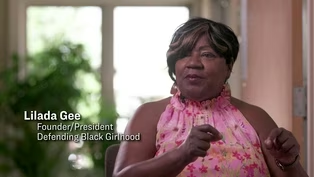
Lilada Gee on generational trauma and the Black experience
Video has Closed Captions
Lilada Gee on the struggle to pursue healing for the traumas of racism and injustice. (1m 33s)
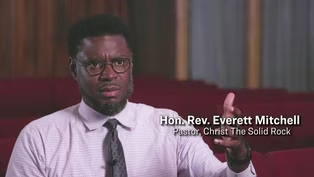
Hon. Rev. Everett Mitchell on Black communities and church
Video has Closed Captions
Everett Mitchell on the significance and impacts of Black churches and faith. (1m 59s)
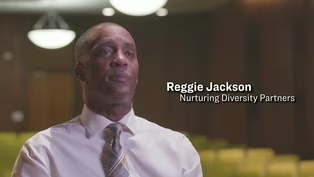
Reggie Jackson on life expectancy among Black Wisconsinites
Video has Closed Captions
Reggie Jackson on Wisconsin's persistent racial disparities in life expectancy. (2m 10s)
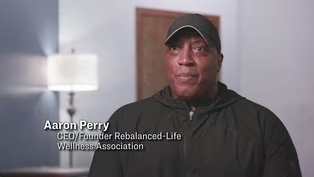
Aaron Perry on obstacles to Black men's health in Wisconsin
Video has Closed Captions
Aaron Perry on an array of chronic health problems among Black men around Wisconsin. (2m 32s)
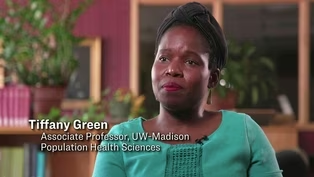
Tiffany Green on racial inequities in delivering health care
Video has Closed Captions
Tiffany Green on trust and racial biases among medical providers for pregnant patients. (2m 30s)
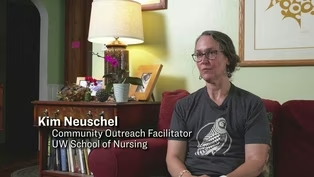
Kim Neuschel on safety and outcomes for children in school
Video has Closed Captions
Kim Neuschel on an effort to help elementary school students in Madison feel safer. (2m 43s)

Dr. Tito Izard on tracing racist roots of health disparities
Video has Closed Captions
Dr. Tito Izard on continuing health disparities and barriers to care in Black communities. (1m 47s)
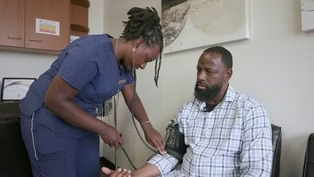
A mission to expand health access for Black men in Wisconsin
Video has Closed Captions
One athlete is developing a health care model that expands access options for Black men. (7m 8s)
The public health crisis faced by Black Wisconsinites
Video has Closed Captions
Racism has left Wisconsin's Black residents suffering disproportionate disease and death. (6m 15s)
Racism, cycles of trauma and the importance of mental health
Video has Closed Captions
Generational trauma harms the mental health of Black children and adults in Wisconsin. (6m 8s)
Wisconsin's racial disparities in maternal, infant mortality
Video has Closed Captions
Deaths of Black infants, mothers in Wisconsin are shaped by access, biases in health care. (7m 16s)
Providing Support for PBS.org
Learn Moreabout PBS online sponsorship












Support for PBS provided by:
Wisconsin in Black & White is a local public television program presented by PBS Wisconsin
Funding for Wisconsin in Black & White is provided by the Ira and Ineva Reilly Baldwin Wisconsin Idea Endowment, DeAtley Family Foundation, Joe and Mary Ellyn Sensenbrenner, Lau and Bea...