Inside the Cover: Expanded Edition
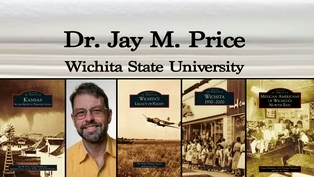
Dr. Jay M. Price - Wichita State University
Season 3 Episode 305 | 26m 15sVideo has Closed Captions
Dr. Jay Price discusses his career and writing process with Ted.
With many published works to his credit, Dr. Jay Price has become one of the most prominent historians in Kansas. Jay sits down with Ted to discuss his life, career, and writing process.
Problems playing video? | Closed Captioning Feedback
Problems playing video? | Closed Captioning Feedback
Inside the Cover: Expanded Edition is a local public television program presented by PBS Kansas Channel 8
Inside the Cover: Expanded Edition
Dr. Jay M. Price - Wichita State University
Season 3 Episode 305 | 26m 15sVideo has Closed Captions
With many published works to his credit, Dr. Jay Price has become one of the most prominent historians in Kansas. Jay sits down with Ted to discuss his life, career, and writing process.
Problems playing video? | Closed Captioning Feedback
Where to Watch Inside the Cover: Expanded Edition
Inside the Cover: Expanded Edition is available to stream on pbs.org and the PBS app.
Providing Support for PBS.org
Learn Moreabout PBS online sponsorshipGood evening.
So nice to have you with us for another expanded edition of Inside the Cover.
Jay M. Price is a professor of history at Wichita State University, where he also directs the local and community history program with a focus on local and community history, especially as expressed in the built environment.
His academic works include Temples for a Modern God: Religious Architectur in Postwar America, and Gateways to the Southwest: The Story of Arizona State Parks.
His biography of former Kansas Governor John Carlin, Leadership Shared, will be coming out in 2027.
Jay has authored several phot based community history books, many of them including his students as part of the writing team.
These include Wichita, 1860-1930 and El Dorado: Legacy of an Oil Boom.
He has coauthored Wichita's Legacy of Flight, The Cherokee Strip Land Rush, Wichita's Lebanese Heritage, Kansas in the Heart of Tornado Alley, Wichita 1930-2000, African Americans of Wichita, Mexican Americans of Wichitas North End, and LGBTQ Wichita.
He recently worked with a team to create the Walk with WU graphic novel as well as working with a team to develop an accessible exhibit for the Pizza Hut Museum on campus.
His recent projects include Exploration of Entrepreneurship in Wichita, a graphic novel that tells the story of the community through the eyes of a Longhorn named Luke, and the Somos de Wichita: stud of the local Latino community.
He currently serves on the Kansa Historic Sites Board of Review, the Kansas Historical Society Board of Directors, and the editorial board for Kansas History.
And as you probably know, Jay Price is a huge fan and a large supporter of PBS Kansas.
Jay.
So nice to have yo on the show tonight.
Thank you.
Great to be here.
Thank you so much.
We really appreciate your taking time out of your busy schedule, as demonstrated in that introduction.
It's a pleasure to have you on this expanded edition of Inside the Cover.
So let's-- where does the Jay Price story start?
Where is home?
I am originally from Santa Fe, New Mexico.
My parents are originally from Michigan.
They came to the southwest part of the military, and then they moved up to Santa Fe when I was very, very small child.
My dad's a veterinarian and so I grew up in a city where history and identity and culture are just part of the DNA.
Oh no kidding.
No kidding.
Sounds like a wonderful place to grow up.
It was a fun place to grow up and a challenging place to grow up at the same time, especially from a rootedness conversation.
Because when you're talking to people whose families have been ther for generations and centuries, and then there is a sense of, okay, well, who am I?
And as being a transplant actually prompted me to be very conscious of who is in and who is out in a community and how does that get unpacked.
And so that really shapes some of the things I look at.
Oh, I guess.
I love that.
Were you a reader in your youth?
Sort of tell us what that means?
Sure.
My first real fora into thinking about history came from my grandparents, who happened to live about a half mile away.
And so when I would visit them and spend the weekend there, instead of reading me bedtime stories, they would lay down next to me and tell me what it was like when they were growing up.
Oh, wow.
And so they would go through the depression and what it was like in 1930s Michigan.
And what do you mean you didn't have TV?
And grandpa served in World War Two.
He did land at D-Day and survived.
I was mainly intereste in the troop ship at the time, but but we were talking about those types of stories.
And then I remember being introduced to a used book sal at the Woman's Club in Santa Fe, and I was just floored at all these different books and opportunities to explore anything.
We had this How old is Jay Price right now?
He would be about 12.
Okay.
And so yeah, this would be a time of wow, look at what all is here an these different opportunities.
And so I found myself fascinated by book that would talk about history, especially buildings and ships and trains.
And I love the visual sides of things.
I was also a kid in the Cold War.
I mean, I remember The Day After, I remember that film, I remember- Lawrence, Kansas.
And I remember the idea when when you're growing up and you can see Los Alamos, you can see the lights of Los Alamos from your grandparents front porch, and you realize that if somethin But also the realization that if something happens in our society, the only people who will survive are the ones who remembered how we used to do things.
And that actually prompted m to get interested in daily life.
So, okay, well how did somebody make something?
How did they use a tool?
And it got me to thinking in that kind of practical side of things as well.
I would say just editorially Jay, that that relationship with your grandparents you were a very lucky young man.
It was very lucky.
A lot of us didn't have that opportunity.
Absolutely.
Was there a specific time when you started thinking about a life in academia?
I knew I loved history and I knew I loved social studies, which was certainly what they called it in junior, back when it was junior high.
I remember Mr.
Hill at Capshaw Junior Hig being a real inspiration for me and so many other team, Sternberg and John Zinn and so many other folk who got me interested in that.
Menzie Cox was one of my mentors in high school.
You know, I've read that the people who influence us in our teenage years have a huge influence about what direction we go.
And so I knew I was in the social studies realm, and we had dear friends nearby, the Muchmores, the both artists, he worked very much in the local archives in Santa Fe.
And so yeah, this sounds like a really cool thing to do.
And then when you talk t your family and they say, okay, this is great.
What do you want to do?
And well, I don't know.
And do you want to teach?
Well, maybe I don't know.
I actually thought I was going to go like into the diplomatic corps.
I was going to live overseas, and I was going to be one of those diplomats who was dealing with international situations.
It's probably safer for the world that I didn't.
You didn't want to be CIA?
Well, I thought about it for a second then.
Yeah.
No.
And so it was sort of that sense.
Well, I thought maybe I'll do policy or government.
And so I got involved in lookin at policy types of activities.
I decided I would go to into histor at the University of New Mexico as an undergraduate.
And people said, oh, well, that's a great foundation.
That's good.
So what next?
Well, I decided I would try for a master's in government at William and Mary in Virginia, and I thought, hey, this will be right next to Washington, D.C.
this will be perfec for a policy wonk type of thing.
And it was fun to be able to be part of Williamsburg.
I mean, I studied for my comprehensive exams in the gardens of the Governor's Palace in Williamsburg.
I mean, this was really cool.
So why not?
... hiring freeze.
Okay, so I come back to Santa Fe, work for the court system as human resources person.
Talk to the Muchmores.
Say, hey, there's this thing called public history.
Maybe I would take a look at that.
And Arizona State was a big schoo for that coming up in the field.
And so I talked to Noel Stow who was very, very, very patient in putting up with my very lon winded conversations with him.
And I got accepted at Arizona State in the public history program, which is a very unusual conversation in this academic piece, because public history is about engaging audiences in nonacademic settings.
And I've taught public history courses, which is really weird because it's me sitting in a lecture hall saying, okay, don't do what I'm doing right now.
And so then I graduated with that.
I worked in some policy areas.
I worked for the governor's office for Arizona for a tiny bit, and then I worked for the Arizona State Parks Board on oral history project after graduation, worked for the Army for two years as a historian looking at Asian American World War II veterans and then looking at opportunities.
Because that position was going to be short lived.
I decided that, okay, let's see what else is out here.
And turned out there was a public history program at Wichita State.
So I applied for it.
And as it turned out, I got accepted.
And okay, I'm going to come on out and let's see how this works.
And that's what brought me here.
Well, you've answere a number of the questions I had.
I wanted to know abou your educational background, and I wrote this as I was thinking about our program.
Jay and I wanted to I'm going to say it now: ‘I had the privilege of meeting Jay Price at the beginning of his career at WSU.
He struck me then as energetic, enthusiastic, engaged, and committed to education.
However, I could not have predicted the significant and important contributions he has made to scholarship, education and the quality of life in Wichita and Kansas.
So those are my thoughts about Jay Price.
You're very kind.
Wow.
So when did when was that year when you came to WSU?
1999.
Okay.
I'd been here three years.
At that point in time.
We got it.
Yep.
And do I recall that you have or were or have been chair of the department?
Yep.
I was chair of the department starting in 2012.
And so I continued for four terms and then decided tha it was time for someone else to guide the departmen and put some fresh first blood into things.
You know, our son is chairman of the English department down at Texas A&M San Antonio.
And from him, and from my own experience, I would tell you that department chair is one of the toughest jobs in academia.
It's a challenge.
It really is.
I think a lot of times people think that it's very straightforward and you do this and you have these forms and it's all about relationships, really, and you have a lot of responsibility.
And I would say this quite-- this is my opinion, a lot of responsibilities with little power.
Yep.
Jay, we could just talk forever.
But I want to get into some specifics as I can, particularly about your scholarship.
But one question in the introduction we talked about community history, especially as expressed in the built environment.
What does that mean?
For me, I love buildings and architecture as a way of understanding values and how things have shaped in society.
And so again, coming back fro Santa Fe, you're walking around and you see these building that look like they were built four hundred years ago.
And then the kid take his parents SUV, puts it, drives into the the governor's palace in Sant Fe and takes out the front porch and you realize, oh, there' Victorian brick underneath it.
Wait, what did that what happened with that?
And so kind of thinking about who makes the decisions about what we build and why and what are those values look like?
And how it influences later generations.
Absolutely.
And so that becomes, for me, a bellwether into a lot of cultural and social pieces, which is why I'm very passionate about historic preservation.
For me, this is a source piece and if you tear down a building, it's like you're tearing up a photo.
It's gone forever.
It is.
And I really understand that and I appreciate that.
So with your many varied interests, how do you decide on a book project and what is your writing process?
I've often said that I don't pick projects.
Projects pick me.
I like that, and I think working in local and community history, because that became the centerpiece of how I function at the university.
The number one thing people I think under misunderstand about writing is that it's not you sit here and you write out everything and it's done.
It's about editing, it' thinking going back and forth.
It's processing and going and rehashing and going back into things.
And invariably this is one of Prices law of research monikers, which is that no matter how hard you research no matter how thorough you are, you will always find the key piece of information within three days of your piece being due.
It will just happen.
I understand, I yeah, I totally understand because it's like writing a legal brief and you'r trying to get every authority, every citation to support your case.
And then ultimately, after your brie has been submitted to the judge.
Oh, did you talk abou the case of Jones versus Smith?
I didn't know about it.
So I totally get that.
We were talking earlier.
Jay I think you indicated you teach a course about how to write a book.
Tell us about that.
Sure.
In the first year o seminar program, at which state, I developed a course called ‘So You Want to Publish a Book And it's guiding these students through the writing process.
And a lot of students think it's a it's about let's talk about the story, let's talk about writing.
And there's an element of that, but it's really about thinking through the writing process.
And if there's one big piece of informatio that comes out of this course, I hope they come away with, it's that the writing is actually the easy part.
That's the straightforward part, because that's something you can control.
Or you're working with a team and you control that and it's up to you.
The challenge i you're working with a publisher or you're working with a printer, and those are different critters.
Publishers and printers are not the same thing, both cool, but different.
How do you think about audience?
How do you think about market?
How do you thin about the distribution system?
How do you think about, okay, you're going to release it, what's the time frame?
And that leads to another questio I want to ask, but also what's on the cover of the book.
Totally.
And so sometimes for these for the photo histories we just knew there were certain like the Mexican-American photo as soon as I saw that picture, which is of Chatas, which is where Connie, which is where Connie's is today, it's like, that's it.
Yeah.
It was that was cool.
Obvious.
Others we wrestled with and.
Well, what what do you want to be saying about this?
And photo histories are especially challenging because you're basing your work on what survives visually.
So take for example, in the E Dorado book on the oil fields.
There's a part of the story that's about labor issues, and we didn't have big labor strikes in the fields for a number of reasons.
And we could have in in a standard set of paragraphs, you can talk about that.
What does a photo of a strike not taking place look like?
Indeed.
Well, and I am o course, familiar with the photo based books, and the book about African Americans in Kansas and Wichita is one of my favorites.
But I we recently did a show on Inside the Cover about different forms of ways to read, and one of those included graphic novels.
Absolutely.
So I've got to ask, what is the background on A Longhorn Named Luke That came out of an anniversary.
It was the 150th of the Chisholm Trail.
And so we were talking about ways to commemorate the Chisholm Trail.
And at one meetin I was thinking, what if we had a mascot and I mulled that over and about that point, later on in the meeting, Luke ambled into my life.
And what if we had a Longhor as a character who stays around, doesn't get turned into hamburger, and becomes the voice of what's going on in Wichita?
And I happen to work with some really cool people, including Darren DeFrain, who is the go to person at Wichita State in graphic novels.
Does stunning work.
Tell Darren I said hello.
Definitely.
I'm just so impressed at his creativity in thinking through that.
And so he shows in his presentations that it's not just, hey let's draw some pretty pictures.
I mean, you really are conveying things in this.
And so he connected me with a student who was, actually a team of students at the time, who were abl to start working on the writing and the the visuals of it.
And one of the thing that came out in the discussion is I brought some of my students on board with this on the history side, remember one time we had a meeting and sat down and the question came up, how did Jesse Chisholm move?
And that was a record scratch moment.
It was like, what do you mean by that?
Well, was he pompous?
Was he humble?
Was he bigger than life?
How would he have moved?
And you have to start thinking about that.
Interesting.
Yeah, it's like a movie.
If you were to cast him as a character in a movie, what would he be like?
And so when we talked about it and we decided we talked to the family because the Chisholm family is still here in Wichita, and they said, well, the family stories, He was sort of lik his grandson, Calvin Chisholm.
And he had this person of gravitas, and he was one of those people you respected.
So we kind of depicted hi as if he were Calvin Chisholm.
So we kind of went with that.
And so then we starte working on these in this story.
And so we created this three part series of the Chisholm Trail, The Birth of Wichita.
And then Wichita is a cattle center.
And so we put those together as a trilogy to kind of mark the city's 150th connection to the Chisholm Trail.
And then I started taking classes in Spanish.
Initially, I took classes in Spanish to learn how to do online education as well, learn how a class works.
And then one class le to another and led to another.
And then I met folks like Julie Henderson, who was in charge of the translation teaching at MCLL at Wichita State.
And that led to a translation project where we translat Luke the Longhorn into Spanish.
Very nice.
Time is our enemy here, Jay.
But I feel personally and for our audience, the book about former Governor John Carlin sounds like a significant research project.
I was approached by Raymond Powers, who was the founder of the Kansas Oral History Project, about doing this.
And so, ‘are you sure you want me to do this?
I felt there were many other people who are much more qualified.
But he said, you talk to the governor.
And so I did, and I met Governor Carlin, and we started talking about this.
And this tied to so many things, m Kansas history side, my policy history work, so many different angles seem to come together.
So, all right, let's you know this.
I could see what that story would be like.
And so I one of my very first meetings was with Governor Carlin, we, I wanted to meet with him in Lindsborg.
And I wanted to say, okay, where did you grow up?
What is this place like?
So going back to place, it really is about place.
And so we talked about this and as time continued, I've gone through governor's papers, I've gone through archives at the National Archives because he was Archivist of the United States.
I've talked to 30 to 40 different people.
There was this collection of individuals who all knew him, and I was able to interview so many of them.
And Governor Carlin had this phenomenal ability to surround himself by genuinely nice people.
They were lovely people to work with.
My sense that he was a nice guy.
And I did a little bit of research.
Think he's going to be 86 later this year.
And one of my questions for you was, was this an authorized biography?
I mean, is he saying go for it or is he supportive?
What's the relationship wit him?
He's very, very supportive.
I've worked with him, you know, hand in hand throughout this process.
So it needed to be.
And I've worke with the people around him and and I've worked with his family on these areas.
I didn't want to do something that wasn't respectful and wasn't accurate.
This is one of the things about doing local history.
You know, my colleagu who talks about ancient history doesn't have to worry about Cleopatra emailing her back.
My subject matter talks back, and so I wanted to do justice to this.
I want to do do right by this.
And for me, there's a significant stor because it's about John Carlin, but it's really not about John Carlin.
It's really this window into Kansas and the United States in the late 20th and early 21st centuries.
I'm going to stop you right there, because first of all, I want to get a signed copy of the book when it comes out.
You got it.
But I'm also thinking, Jay, that if you're willing, that might be that book, and your work, And Carlin, might be a wonderful topic for another edition, expanded edition of Inside the Cover.
That would be phenomenal.
That would be a great way to to talk about this.
So in our closing moments I didn't say in the introduction I should have, but one of your other duties and responsibilities, honors, if you will, is being a member of the Kansas 250 Commission.
Tell our audience a little bit about that.
Sure.
The 250th anniversary of of US independence in 1776 is 2026.
Every state has their own body that handles affairs with the the 250th.
How was that?
Who made that decision?
Well, there was a 250 body, which is a congressional body that really guided a lot of this.
And then it was up to each state.
Some states, its History Colorado really spearheads it for Colorado.
Others it's a particular person.
We in this state created a commission based on the Bicentennial Commission.
Largely.
It was kind of a riff on that.
And so I'm one of the members of that.
And so it's been a chance to to talk about, well what does this look like today?
And I mean, this is a time where we're reflecting, okay, where have we been?
And also where are we going?
And this-- Big question, where are we going?
Totally.
And so we decided early on to have a logo or a logo and a motto.
And our motto is Per aspera.
And I insist tha the operative word here is ‘per through difficulties, not stopped by difficulties, not ignoring difficulties, through difficulties.
And that really guides a lot of our different activities.
Well, and we have talked about this a little bit, doing a wonderful job.
And to me, part of that effort or byproduct is the Kansas 250 Bookshelf.
And we've talked about it on the show.
We'll be talking about it throughout the year that the Kansas Public Library has developed a recommended reading list.
Absolutely.
For every month with based on themes relating to Kansas and its, well, themes about Kansas and Kansans.
And it's a wonderful list.
Jay.
I'm going to have to end our program.
As I knew you would be you've been a fascinating guest.
Thank you for being on this expanded.
This has been great.
Ladies and gentlemen, a our show, we've had the pleasure of speaking with and listening to Professor Jay M Price of Wichita State University, a person who knows and love books, and we were privileged to have him with us.
Good night.
See you next time.
Dr. Jay M. Price - Wichita State University
Preview: S3 Ep305 | 30s | Jay Price sits down with Ted to discuss his life and writing process. (30s)
Providing Support for PBS.org
Learn Moreabout PBS online sponsorship










Support for PBS provided by:
Inside the Cover: Expanded Edition is a local public television program presented by PBS Kansas Channel 8