One-on-One
Dr. Jhawer & Dr. Leong; Tim Sullivan; Joe Strupp
Season 2021 Episode 2466 | 27m 10sVideo has Closed Captions
Dr. Jhawer & Dr. Leong; Tim Sullivan; Joe Strupp
Dr. Minaxi Jhawer & Dr. Rachelle Leong discuss the importance of ”Survivorship Talk” to help patients navigate their life after cancer; Tim Sullivan shares the impact of Hurricane Ida on small businesses in New Jersey; Joe Strupp talks about why he chose to tell the story of Carol Ann Farino, a 17 year old high school student murdered in 1966.
Problems playing video? | Closed Captioning Feedback
Problems playing video? | Closed Captioning Feedback
One-on-One is a local public television program presented by NJ PBS
One-on-One
Dr. Jhawer & Dr. Leong; Tim Sullivan; Joe Strupp
Season 2021 Episode 2466 | 27m 10sVideo has Closed Captions
Dr. Minaxi Jhawer & Dr. Rachelle Leong discuss the importance of ”Survivorship Talk” to help patients navigate their life after cancer; Tim Sullivan shares the impact of Hurricane Ida on small businesses in New Jersey; Joe Strupp talks about why he chose to tell the story of Carol Ann Farino, a 17 year old high school student murdered in 1966.
Problems playing video? | Closed Captioning Feedback
How to Watch One-on-One
One-on-One is available to stream on pbs.org and the free PBS App, available on iPhone, Apple TV, Android TV, Android smartphones, Amazon Fire TV, Amazon Fire Tablet, Roku, Samsung Smart TV, and Vizio.
Providing Support for PBS.org
Learn Moreabout PBS online sponsorship- [Narrator] Funding for this edition of One-On-One with Steve Adubato has been provided by The New Jersey Education Association.
Choose New Jersey.
Berkeley College.
Celebrating more than 90 years of preparing students for lifelong careers.
MD Advantage Insurance Company.
The Fidelco Group.
The North Ward Center.
The Russell Berrie Foundation.
Making a difference.
The Adler Aphasia Center.
And by Community FoodBank of New Jersey.
Promotional support provided by Northjersey.com and Local IQ.
Part of the USA Today Network.
And by BestofNJ.com, all New Jersey in one place.
- This is One-On-One.
- I'm an equal American just like you are.
- The jobs of tomorrow are not the jobs of yesterday.
- Look at this.
You get this?
- Life without dance is boring.
- I don't care how good you are or how good you think you are, there is always something to learn.
- I did do the finale, and guess where my trailer was?
A block away from my apartment, it couldn'’t have been better!
- People call me 'cause they feel nobody's paying attention.
- (slowly) Start talking right now.
- That's a good question, high five.
(upbeat music) - Welcome everyone, I'm Steve Adubato.
and I introduce right out of the box two very important physician leaders who have an important message to share.
Dr. Minaxi Jhawer is the chief of the Department of Hematology and Oncology at Englewood Health and also her colleague Dr. Rachelle Leong who is a breast cancer surgical oncologist at Englewood Health, good to see both of you.
- Pleasure to be here.
- Thank you for having us.
- Let me talk about this, breast cancer survivorship, Dr. Leong what do we mean by that?
A and B why is it so important for all of us to understand?
- So breast cancer survivorship is kind of the end of their treatment.
It's when they start to begin to resume their normal life with their family, kinda get back to their day to day, trying to get back to what they were pre-diagnosis, as much as they could.
- Dr. Jhawer beyond breast cancer, breast excuse me, cancer survivorship overall, is it different depending upon the cancer you're talking about A and B, or there are just some similar similarities across the board?
- Absolutely, so the word survivorship has evolved it's from the time of diagnosis through treatment and beyond, and essentially each diagnosis, even within breast cancer, everyone has unique types of breast cancers.
So their survivorship journey or plan is very different and unique.
Breast cancer is obviously the most common survival cancer that you see in women.
But prostate in men is actually the most common and colon being second across the board.
So each type of disease will have its own survivorship plan and journey.
- What about caregivers?
What about the role of caregivers for those who are survivors of cancer?
Dr. Leong what is the role of caregivers and what should we understand about that?
- So the caregivers is a unique role because I think a lot of times we think of the patient, but we have to remember that they are connected to a husband or a parent or a daughter or a child.
And so they kinda go through the whole entire journey with the patient and it is important to support them as it is to support the patient 'cause they're goin through the same stresses, if not more stress, 'cause they feel a little bit helpless in the sense that they can't really make it better.
And the family always wants to make it better for the patients.
So it's important to kinda support them and give them whatever resources that they need to kinda travel through the same journey as the patient itself.
- Dr. Jhawer let me try something.
It's impossible for anyone to be watching, to say that there's no one, let me put it this way.
Everyone watching right now is either directly been affected or a close family member, including myself and I remember I'm not gonna say who it was because she has a right to privacy obviously.
But I remember when she got the diagnosis, just the diagnosis itself is so devastating.
So jarring on so many levels, the question of how to talk to someone who is facing cancer and then ultimately a survivor of cancer, is there Dr. Jhawer is there a way to talk that the rest of us need to be more sensitive to and aware of, or am I making too much of this?
- I guess what you're asking is in terms of family and the social support or you asking from (indistinct) - Family and friends.
- So I think it's a really loaded question.
And I think it's so important because as you can see, everyone has a different perspective and way of dealing with news.
The first thing is the shock, the denial of the information that's given to them.
And then there's the rally and I think during that rally, people sometimes want all their close-knit friends and family to huddle around them and support them.
And sometimes patients don't want to be asked too many questions.
How are they doing, how are they feeling they just wanna cope and move forward.
- But if we don't ask, I'm sorry for interrupting, but if we don't ask, and either one of you can jump in here to respond.
If we don't ask, does that not send the message that we as non-breast cancer or non-cancer survivors or people who are not facing that personally, that we don't wanna talk about, that we don't potentially care or empathize that much.
Dr. Leong, correct?
I mean, that's the dilemma.
- I think it really depends on the person.
A lot of my patients I can see when they start to get used to coming to visit or to follow up, they start to come by themselves because I think in some sense they want some normalcy and they don't wanna be reminded of the diagnosis all the time.
So they start to try to regain a little bit of their normal life without the cancer diagnosis.
So it's a little bit, it's always great to follow up with everyone to make sure that they're dealing with everything okay.
To make sure they don't need anything, but then after that, I think a lot of times, it's just a matter of trying to give the patient or their loved ones some space just to kinda regain whatever they can in their life and their day to day.
- Dr. Jhawer let me ask you in terms of survivorship, beyond the communication aspect of it, and by the way Englewood Health is one of the many health care organizations that support our health care programming.
Just wanna put that out there.
There's a whole range of things beyond the communication, such things as, and whatever I'm not getting right.
You'll tell me or whatever needs to be added.
Nutrition, mental health related issues, physical therapy, et cetera.
And what else Dr. Jhawer?
What else is needed?
- So, there's almost two phases after they're done with the active treatment.
There's an acute phase where you're still dealing with some of the side effects and the most common at that point tend to be anxiety, (indistinct) pain or neuropathy, which is tingling numbness.
And these symptoms tend to require a lot of support along the way, whether it's a referral to psychosocial, a psychiatrists to help cope or to, in our case, integrative medicine, we really incorporate that in that survivorship model that we have where an integrative physician who's a MD will actually sit down, talk to the patient, understand what their needs are, and then refer them to nutrition, reiki, massage, acupuncture, some of those alternative pathways to help them regain their normalcy, improve their chances of reducing the risk of the cancer coming back with better diet, exercise.
So all those things are then really personalized for that particular patient and their needs, but we do have all those services at Englewood.
- Okay and finally, Dr. Leong I'm curious about this.
We're on the back end of 2021 as we tape.
The pandemic, COVID has impacted our lives and in ways that are not even, you can't even calculate all of them, but in the world that both of you work in, to what extent and it's a loaded question I know to ask but it's important.
Is it fair to say that too many cancers are being diagnosed later than they should be diagnosed because of what's happening in the healthcare system, and that ultimately impacts survivorship, is that correct?
- Yeah, for sure I, the pandemic definitely added a lot more leader stage diagnosis.
A lot of patients, including friends and family and myself were very hesitant to go get their mammograms because of COVID being in the hospitals, being exposed to other people, so a lot of people presented much later than they should have, a lot of people missed their annual screening.
A lot of people missed their follow-ups with the doctors, which is just an important part of being a survivor.
So a lot of the delay, we saw a lot of delay because of the COVID pandemic and we still are.
We're still trying to get out of this backlog.
- Dr. Jhawer, Dr. Leong, I wanna thank you so much for joining us an important conversation, and I look forward to a follow-up, thank you so much.
- Thank you.
- Thank you.
- All the best I'm Steve Adubato, stay with us we'll be right back.
- [Narrator] To watch more One on One with Steve Adubato find us online and follow us on Social media.
- Back by popular demand, there he is, Tim Sullivan, who's the CEO of New Jersey, the New Jersey Economic Development Authority.
The EDA, good to see you Tim.
- Great to be with you, Steve, hope you're well.
- I'm doing great and I'm gonna to jump right into this.
We're taping this pretty close to the back end of 2021, which is hard to comprehend.
A, hurricane Ida relief, let's get right to it.
What is it that the EDA is putting out there to offer folks and why is that so significant?
- Yeah, from the minute the storm struck Governor Murphy who was focused on helping small businesses get the relief they needed from these terrible storms, not just Ida, but Henri as well.
It just meant the last thing small businesses needed after having come through the worst of COVID was another challenge, like a tropical storm of flash flooding and all that.
So, Governor Murphy announced $10 million of cash grants to support small businesses impacted by these two storms.
Those approvals are now underway, we're getting cash out the door and into the hands of businesses that need it within a few weeks of the storm even hitting.
- Tim, how difficult has it been for, and I don't wanna assume everyone understands this, the role of the Economic Development Authority.
Let everyone understand that.
Then I'm gonna ask you about the impact of COVID, where we are right now on the work that you and your colleagues are doing.
- Yeah, so, under Governor Murphy's leadership, the Economic Development Authority is really focused on a few things.
One, growing our innovation economy, attracting and retaining good paying jobs here in New Jersey, investing in our urban community, supporting small business and making sure that everyone has an opportunity to participate in the economic strength of New Jersey, which has really strong momentum right now.
- By the way Tim, you mentioned Governor Murphy a couple of times already, and we're doing this program right before there's a gubernatorial election.
We separate our conversation from that election, but the EDA is not a government agency per se.
To me, you are in but not of, of but not in, how would you describe it?
- Well, we are in, but not of the Department of Treasury.
So we are part of the state government.
We are, we serve a public function.
We're an instrumentality the state and so we are a part of the public sector.
- But the EDA exists regardless of who the governor is?
I wanna be clear.
- So the EDA existed in statute and the governor, whoever the governor is appoints a majority of our board, you know, as along with senate, president, the speaker of the assembly.
- Got it, now go back to the question of COVID.
To what degree has COVID impacted the ability of the EDA to help businesses, just in terms of the sheer amount of resources you have to do that?
- Yeah, as it relates to small business, COVID has, you know, our team has stepped up in a big way.
Largely because Governor Murphy has allocated an extraordinary amount of resources to support small business.
New Jersey ranks third in the country, not by, not per capita, not per square foot, not per for anything, third overall.
Small business grant dollars that have been distributed.
It's just California then New York then New Jersey.
So, in a typical year, we'll usually work directly with maybe 300, maybe 400 businesses, in each of the last two years.
But those numbers have each been higher than 40,000, almost 50,000 in both years or so, individual businesses that we're interacting with on a financial basis, so that's been a huge effect.
The other thing that COVID has done and it's created both challenges and opportunities for kind of the workplace environment in New Jersey.
Our cities much like, you know, Jersey City and Newark and Paterson, Camden, Trenton are facing some of the same challenges that New York and Philly are, in terms of what happens when office towers aren't as full as they used to be.
And so that's the challenge.
Opportunities wise, we've also seen, some of our suburban office space have much more interest from corporate clients that maybe want to have a little bit more control over their space.
Be a little closer to home, a good example that's Fiserv, which is a Fortune 50 company.
Just announced a couple of weeks ago that they're gonna put 3,000 jobs, 2,000 new jobs in Berkeley Heights.
In a suburban office park that had been under utilized for a good number of years.
- That's Fiserv, of F-I-S-E-R-V?
- Correct.
Not to be confused with people who make the vaccine.
- Exactly, so what does Fiserv do?
- Fiserv is a financial technology company, they are a big credit card payment processor and financial security, financial technology company, one of the largest in the world.
- So, I'm curious about something, we've been doing public awareness around innovation in New Jersey for the last several years, the EDA as well, as Choose New Jersey, part of that initiative as well.
Choose New Jersey is in fact a separate entity, not of state government, but you and your colleagues work closely with Choose New Jersey, which is a not-for-profit organization, supporting business retention, but also business attraction.
I don't know if I'm saying it the right way, recruiting of businesses, right?
But what's the EDA, what's Choose's role?
- Yeah, it's a real partnership and we work and me and my team work extremely closely with Jose Lozano and his great team and their great board.
I was just with Jose's board yesterday talking about some of our shared successes.
So Fiserv is a great example, as is HAX is another great example.
We just wanna - - HAX, H-A-X.
- Coming to Newark, New Jersey.
We won a national competition that we the EDA and Choose New Jersey pitched together.
We had a great partnership and how we attacked that opportunity, led by the governor and his direct and personal engagement with that company and encouraging them to make the smart choice, which was to choose New Jersey over six or seven other states and cities that participated in that competition.
And so, it's a real balance of both kind of inside government, which is what our team of the EDA does and then outside government from Choose to bring together the best of both worlds.
- Hey, give me 30 seconds on the Return and Earn program cause people again will go on the website, find out more, but tell everyone why that matters.
What is it, why now?
- Return and Earn, Governor Murphy announced that a few weeks ago.
It's actually run by the Department of Labor and my good colleague and good friend, Robert Asaro-Angelo.
It's an encouragement for companies to hire people.
So it's a bonus to people to go back to work, but most importantly it's about a training and up-skill.
Cause we know that one of the reasons there's a mismatch between the folks who are looking for work and the folks who are hiring, is they may not have exactly the right skills that a given industry is looking for.
And so Return and Earn is a great opportunity to pair kind of an incentive to get back into the workforce with long-term training and skill development.
- Before I let you go, Tim we've had so many leaders in the arts community, not-for-profit arts organizations that have been with us talking about how the pandemic has affected them, but also how they're coming out of all this right now.
The EDA, I know has been engaged with the arts and entertainment community as an economic engine or multiplier, if you will, in the state, right?
- Absolutely, the arts and culture sector, one, is important just as residents and people who live here, it adds vitality and quality of life and makes New Jersey a great place to be.
That's important in its own right and should be praised for its own sake.
It's also a huge part of our economy, the creative economy, whether it's arts and culture, institutions themselves, or the skills that are cultivated there, whether that's design and graphics and all those things that are valuable in a broad segment the economy come from the arts culture sector.
And so supporting that has been a really important priority for Governor Murphy and for our team, for Secretary of State Tahesha Way and her team at the Council of the Arts.
We've been pulling together to try and make sure there's the resources that the sector needs to get through this terrible time.
Because, being in person at a museum, being in person in a theater, is just different than a virtual experience and so it's been a tough time for that sector, for sure.
But Governor Murphy has wanted to make sure we get the resources where they need to be.
- That's Tim Sullivan, CEO of the New Jersey Economic Development Authority.
We have been doing public awareness programming around innovation in the state together with Choose New Jersey, the EDA, and also N-J-I-T, New Jersey Institute of technology.
Tim, thank you so much for joining us, best to you and your team at the EDA.
- Steve, great to be with you as always and thanks for having us on.
- You got it.
We'll be right back right after this.
- [Narrator] To watch more One on One with Steve Adubato find us online and follow us on Social media.
- We're now joined by Joe Strupp, who is the author of A Long Walk Home: A Young Woman's Unsolved Murder and Her Sister's Lifelong Search for Answers Joe, how are you doing my friend?
- Great.
Thanks for having me, how are you?
- I'm doing great.
Joe is an award-winning journalist.
He's the best at what he does.
Joe, this book about Carol Ann Farino, on November 3rd, 1966, Maplewood, New Jersey.
She's murdered.
- Yeah.
- And no one ever figured out what happened to her?
- No, in the book, I come up with some scenarios and suspects and even a likely situation involving a suspect who was never arrested for this crime, but was arrested for another crime nearby, who has a lot of evidence pointing to him.
But, correct, Maplewood police and Essex county prosecutor's office, who still consider the case to be open and have been not extremely helpful in providing information, really had no clues.
And as I researched, I found over the years, they really had an ongoing desperation that seemed to be backed up by a lack of looking at all potential suspects.
They seemed to really focus on her family.
She was 17 year old student at Columbia High School in Maplewood.
She worked in a downtown diner, and was walking home one night and disappeared, and her body was found just less than an hour later, about a half mile away, strangled with her own stocking, left in a driveway, and still warm, by those who found her, and the police, described her as really being freshly killed.
And the manhunt generally looked at people she knew.
Asking her friends and relatives and other students, but never really looked at people who might have been involved through Maplewood Village.
As you know, and others may know, as small kind of downtown area in Maplewood, that may have worked or seen her or been connected through that proximity.
They focused mostly on people she knew and didn't really take into account people she didn't know, at least according to the research we found with friends and relatives of hers, as well as the limited police reports.
- Hey Joe, her sister, Carol Ann'’s sister, Cynthia, she's a big part of this book.
You spoke to her extensively.
Talk about her.
- Yes, she was 11 years old at the time.
She was Carol's only sister, and essentially really traumatized by this, according to her own account.
When I started researching, I tracked down a lot of people that knew her.
Her parents are deceased.
But Cynthia was still around.
She's actually very, very much around.
A lively woman in her sixties, but very gregarious and friendly and still going strong.
I thought at first I might just get some general comments from her and her view, but it turned into really her story as much as Carol's.
She turned 12 years old just two weeks after the murder, and it ended up affecting her in many ways.
She ended up getting married and divorced, having an affair that she details very openly, and later on, gets married to her husband of 20 years who actually passed away less than two years ago.
Not from COVID related, but during the COVID outbreak.
But she really talks in depth about how it affected her, affected the family.
Her parents had a real mix of guilt, and over-protectiveness to the point where it really caused some difficulties in the family dynamic, and in her ongoing efforts to go to school and have a life in marriages and relationships, and always really worrying and wondering what happened.
Not only did she lose her sister, but she really had no clue as to what happened.
And there was also talk by her and others who knew Carol at the time that her father became a suspect kind of unofficially, even though he had a clear alibi because he was home at the time-- - Carol Ann's, wait a minute, Carol Ann Farino's father was a suspect?
- According to her and according to friends, there was always this sort of underlying view that he might've been involved, even though he had a clear alibi and there was really nothing that could tie him specifically to the killing.
But she felt, and others felt, he was focused on too much.
In the years that followed, they ended up actually moving to another part of Maplewood and then they ended up moving down to the shore because they really didn't want to be around Maplewood because they felt they got so mistreated.
- Hey Joe, let me ask you something.
You've been a journalist for a long time.
You understand media, you understand journalism.
You're just a really good reporter.
And so I've always been curious about what caused you to be interested in this story, this case?
- Good point.
I've lived in Maplewood for 21 years.
I actually grew up in New Jersey elsewhere and I've lived here for more than two decades.
My son still goes to Columbia high school.
I did a story about 20 years ago on another murder in Maplewood.
A woman named Christine Burns, who was brutally killed in her home.
That was unsolved for about three years.
I did a story on that for New Jersey Monthly at the time, and all during the time I researched that story, I kept hearing about Carol Ann Farino.
She was the only other unsolved murder in Maplewood history, so her name kept popping up.
That murder eventually got solved.
A man was arrested for the crime and not even put on trial, he pled out.
So every year in the years that followed, whenever we had a murder, which we've had our share, but this is hardly an unsafe town as you know.
The mention of Carol would come up.
People would say, oh, it's the only unsolved case, this high school student.
And then when I covered Maplewood for my website I used to run, maplewooding.com, it would always come up whenever there was a crime of that kind of caliber.
So I started looking into it and the more I looked into it, the more I found out, as you know, as a man in the news, you talk to one person, that leads to another person, to another person.
And eventually I got the whole story and really thought it was worth doing something to maybe try and get some resemblance of a solution and maybe find out what happened.
And then when I met Cynthia, it became a whole other interest to me as a person who's been in Maplewood and obviously has children who, one who is in Columbia High School, one who graduated a couple of years ago.
- Hey, Joe, I just want to remind folks, the name of the book is A Long Walk Home: A Young Woman's Unsolved Murder and Her Sister's Lifelong Search for Answers Joe, I wanna thank you for joining us.
Joe, early on in my career, I think he did a profile of me.
I think you did.
You don't even remember?
Yeah.
- I hope it was in a good memory.
- It was great.
- It would've been a good memory on my side.
'cause the other piece of this story that is interesting is that it involves Newark and Vailsburg.
Her family was in Vailsburg before they came to Maplewood.
And I know you have actually strong roots in Newark with your family.
So I think it's interesting for people from that regard as well.
- check out Joe Strupp.
He's also a reporter with the Asbury Park Press.
Good stuff, Joe.
Thank you so much my friend, all the best to you.
- You too Steve, be well.
- I'm Steve Adubato, that's Joe Strupp.
Thanks so much for watching and we'll see you next time.
Strupp doesn't even remember doing a profile on me, that hurts.
(laughs) - [Narrator] One-On-One with Steve Adubato has been a production of the Caucus Educational Corporation.
Funding has been provided by The New Jersey Education Association.
Choose New Jersey.
Berkeley College.
MD Advantage Insurance Company.
The Fidelco Group.
The North Ward Center.
The Russell Berrie Foundation.
The Adler Aphasia Center.
And by Community FoodBank of New Jersey.
Promotional support provided by Northjersey.com and Local IQ.
Part of the USA Today Network.
And by BestofNJ.com.
- Choosing a new family doctor can be confusing.
Check with your health insurer to see which physicians near you participate with your plan.
Find out which hospitals the doctor uses, and who covers when the doctor is away.
And remember to schedule an appointment with your new doctor in advance, to fill out any paperwork without the added stress of being sick.
The Impact of Hurricane Ida on NJ's Small Businesses
Video has Closed Captions
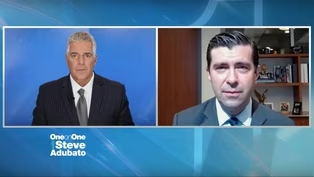
Clip: S2021 Ep2466 | 9m 27s | The Impact of Hurricane Ida on NJ's Small Businesses (9m 27s)

Navigating Breast Cancer Survivorship
Video has Closed Captions
Clip: S2021 Ep2466 | 9m 54s | Navigating Breast Cancer Survivorship (9m 54s)

The Story and Impact of Carol Ann Farino's Murder in 1966
Video has Closed Captions
Clip: S2021 Ep2466 | 8m 27s | The Story and Impact of Carol Ann Farino's Murder in 1966 (8m 27s)
Providing Support for PBS.org
Learn Moreabout PBS online sponsorship
- News and Public Affairs

Top journalists deliver compelling original analysis of the hour's headlines.

- News and Public Affairs

FRONTLINE is investigative journalism that questions, explains and changes our world.












Support for PBS provided by:
One-on-One is a local public television program presented by NJ PBS