One-on-One
Dr. Jonathan Holloway; Sen. Holly Schepisi; Pete Oneglia
Season 2022 Episode 2502 | 28m 6sVideo has Closed Captions
Dr. Jonathan Holloway; Sen. Holly Schepisi; Pete Oneglia
Dr. Holloway shares the significance of being the first Black president of Rutgers and the role of social media in the political divide across the nation; Sen. Schepisi discusses Gov. Murphy’s leadership and handling of the pandemic and the mask and vaccine mandates throughout NJ; Pete Oneglia talks about affordability issues in New Jersey and Gov. Murphy’s plans for his second term in office.
Problems playing video? | Closed Captioning Feedback
Problems playing video? | Closed Captioning Feedback
One-on-One is a local public television program presented by NJ PBS
One-on-One
Dr. Jonathan Holloway; Sen. Holly Schepisi; Pete Oneglia
Season 2022 Episode 2502 | 28m 6sVideo has Closed Captions
Dr. Holloway shares the significance of being the first Black president of Rutgers and the role of social media in the political divide across the nation; Sen. Schepisi discusses Gov. Murphy’s leadership and handling of the pandemic and the mask and vaccine mandates throughout NJ; Pete Oneglia talks about affordability issues in New Jersey and Gov. Murphy’s plans for his second term in office.
Problems playing video? | Closed Captioning Feedback
How to Watch One-on-One
One-on-One is available to stream on pbs.org and the free PBS App, available on iPhone, Apple TV, Android TV, Android smartphones, Amazon Fire TV, Amazon Fire Tablet, Roku, Samsung Smart TV, and Vizio.
Providing Support for PBS.org
Learn Moreabout PBS online sponsorship- [Narrator] Funding for this edition of One-On-One with Steve Adubato has been provided by RWJBarnabas Health.
Horizon Blue Cross Blue Shield of New Jersey.
Here when you need us most, now and always.
New Jersey Sharing Network.
The Turrell Fund, supporting Reimagine Childcare.
Wells Fargo.
The Healthcare Foundation of New Jersey.
PSE&G, committed to providing safe, reliable energy now and in the future.
Choose New Jersey.
And by NJ Best, New Jersey'’s five-two-nine college savings plan.
Promotional support provided by NJ.Com, keeping communities informed and connected.
And by AM970 The Answer.
- This is One-On-One.
- I'm an equal American just like you are.
- The way we change presidents in this country is by voting.
- I'’m hopeful that this is the beginning to accountability.
- Life without dance is boring.
- I don't care how good you are or how good you think you are, there is always something to learn.
- I did do the finale, and guess where my trailer was?
A block away from my apartment, it couldn'’t have been better!
- People call me 'cause they feel nobody's paying attention.
-_ It'’s not all about memorizing and getting information, it'’s what you do with that information.
- (slowly) Start talking right now.
- That's a good question, high five.
(upbeat music) - Hi, I'm Steve Adubato and welcome to a very compelling discussion we're having with Dr. Jonathan Holloway, who is the president of Rutgers University, the 21st President of Rutgers, its first African-American president, is a historian and understands higher ed and American history better than most.
Doctor, good to have you with us.
- Thanks so much.
Thanks so much for having me.
Happy to be here.
- Doctor, I wanna quote you in a piece that you wrote for The New York Times.
It was an article tied up with a whole series of other articles about the challenges America faces.
Quoting you, "There are many problems in America, but fundamental to so many of them is our unwillingness to learn from one another, to see and respect one another, to become familiar with people from different racial and ethnic backgrounds who hold different political views."
Why is it so hard for us, A, and B, what happens if we don't get better at this?
- Well, I'll start with B actually.
If we don't get better at this, I'm worried about the state of this country.
And that may sound hyperbolic, but I've seen so many things happen in the last four or five years, and really the last two years in particular that I never would have imagined happening before.
And I've always believed in service, but the idea of a calling for national service is really a direct response to the level of, you can call it despair, certainly concern that I have about this country.
We're living in a democracy, but it's not guaranteed.
So that's a concern.
How we get to this place, we are hardwired as individuals, it seems to me, to want to be like our own, around our own, and share with our own, whatever our own happens to mean.
And I just think we're at a moment of heightened anxiety for all kinds of reasons, whether it's racial, social, economic, where the idea of sharing feels like a threat.
And I think that is to our great detriment as a society.
So this is why I think we are where we are.
- Doctor, what do you see on campus?
Again, we're taping this in late January.
It will be seen a little bit later.
So on campus, to what degree do you see students, black, white, Hispanic, a whole range of ethnic and racial backgrounds, all kinds of diversity, one of the most diverse universities in the nation, what kind of interaction do you see in terms of people being open to each other and other points of view, other perspectives?
- You know, there's a lot of heat about how cancel culture is going rampant, especially on college campuses and making it hard to share.
And that is true in many ways.
When it comes to day-to-day, in-person interaction, I think people are, you know, we see our best selves often.
I think that the problem comes in as when we hang on to our social media devices, our smartphones, however we wanna interact in the world through social media, which has its place, but that place has been overcome and overwhelmed, and we don't know how to process it.
When I see our students in person, I'm seeing curious, interesting people ready to engage.
When they get behind the screens is when I think we have real problems.
- Dr. Holloway, you've talked about the importance of a national public service program for young people.
A, what is it, and B, what does it have to do with, people will see Democracy at a Crossroads because it seems to me, it isn't just about doing service.
It's about serving our country.
Please.
- Yeah, well, you're exactly right.
It is about serving our country, but there's a larger goal in calling for national service.
One, it is a way to get an individual outside of him or herself, instead of thinking about me, me, me, or people just like me, it's a way of saying, wait a second.
I can actually make a contribution by helping somebody else.
One, it's a good feeling.
But also, it means that if I were to do it, make it simple, I would have to learn about somebody else.
I'd have to engage with somebody else.
And I think the more that we actually cross that boundary, whatever it may be, it could be gender or class or race, whatever it is, the more we will recognize that we actually share more in common with each other than we are trained to believe.
As parents, we want a world that's better for our children.
As individuals, we want a safe place in which we can live, where we can find food, where we can feel comfort.
Everybody wants these things.
And once we recognize that, if you and I were in politically different positions, let's just say, and we were in some service product that required us to work together, we would recognize that we actually share some things in common, but when it comes time to disagree, which is inevitable and it's okay.
In fact, it's healthy, because we know we share something in common, the nature of our disagreement will be different.
And really, it is as simple as that.
By recognizing commonalities, we will be able to better prop one another up during times of distress and be able to get through those moments of difficulty when we disagree.
- Doctor, you came to Rutgers at a critical time.
COVID raging, changing higher ed forever.
Do you have any regrets?
- It depends on the day.
(Steve laughs) No, in truth, I have no regrets.
I will say that when I was announced in January 2020, COVID was a thing that we thought was not in the United States yet.
It was, we just didn't realize it yet.
Six weeks later, everything shut down in the country.
And I will confess, for a couple of days, I felt very sorry for myself as if this were about me somehow.
- Join the club.
- I'm sorry?
- Join the club.
- Yeah, yeah.
Then I grew up a little bit.
And then I'm like, okay, look, this is not about you, Jonathan.
How can you be of service to help Rutgers in my new home?
Worked itself out.
So I arrived a few months later and got down to work.
So it's hard, I'm not gonna lie.
It is hard, but on most days, I recognize there is something really good to be done, and it's become easier as Rutgers came back to in-person existence.
Then it became much easier to understand why I pursued this job and why I was so grateful to have it is because I can make a difference in a constructive way.
- You know, again, for people who know our programming, we do not try to time what is going on or talk about, this week, you can check out NJ Spotlight News on NJ PBS, WNET and also Metro Focus.
That great daily program at WNET, WLIW, what our colleagues in public television.
We try to take a longer view of it, so yes, we are doing this.
I believe on the, yes, the 18th.
You'll see the graphic the 18th of January.
But I wanna ask you this.
As a Rutgers alum at both the Eagleton Institute and then the doctoral program at the School of Communication, it strikes me that, let me try it this way.
You're the first black president of Rutgers.
What significance does that have, particularly at this time, not just for the higher ed community, but for all of us who are tied to the Rutgers family?
- Well, when it's, I mean, it's a question I've been asked before, of course.
And I don't get out of bed thinking black thoughts, thinking black service, thinking so on and so forth.
I'm simply me trying to do my best in the world.
However, I'd be naive to ignore the fact that I am the first African-American to hold this position.
And so there's an opportunity here.
And for me, it's an opportunity to talk about this country.
Rutgers is older than the United States, and for whatever reasons, for many reasons, it took 254 years before Rutgers felt they found the right person who happened to not be white to take the reins of the institution.
I think I'm good at my job.
I don't think I'm that good at the job.
I'm sure there've been other people with great talent who could have been named, but we're at this moment in time.
And so what are we to do?
I mean, we're supposed to take this thing seriously and take it as an opportunity to bring, I think, mature conversations about raising the United States, certainly, an area of my personal and professional expertise.
But for me, it's what does it mean to be an American?
Again, Rutgers is older than this country.
If we take Rutgers seriously, think about it seriously, we can look at through lines in terms of how we understand ourselves as a country and we can make things better.
So I think Rutgers embodies the promise of the American ideal.
We just have to do the work of it.
- Dr. Jonathan Holloway, President of Rutgers University.
Dr. Holloway, I wanna thank you so much for joining us.
We appreciate it.
All the best to you and the family at Rutgers.
- Thank you so much, I appreciate it.
Take care.
- You got it.
We'll be right back.
- [Narrator] To watch more One on One with Steve Adubato find us online and follow us on Social media.
- We are honored to once again be joined by State Senator Holly Schepisi from the 39th Legislative District.
Holly, good to see you.
- Good to see you too, Steve.
- Senator, let me get right into this.
We're taping this at the end of January, 2020.
You have said that, you just don't understand why Governor Murphy, continues to need emergency powers, executive powers, if you will.
But, we're nowhere near the end of this craziness with this pandemic.
Why not, "Okay governor, do what you think is best, "you're the chief executive in the state," devil's advocate, go ahead.
- Devil's advocate, we're two years into this.
Yes COVID is serious, I personally, I had it twice.
Was hospitalized the second time around, but we're also, you know at a point where I think we all agree we've gotta live with this and we've gotta work together in order to live with it.
We are members of the legislature.
We've abdicated our duties and our responsibilities as a co-equal branch government for two years now.
And, I think we're at a time and a place where we need to have open, honest, discourse in debate about what we do moving forward.
And, by just extending the emergency powers, extending the executive authority, we take that out of the public realm and essentially we give up our co-equal branch of government for the governor to continue doing what he wants to do rather than us doing our jobs.
- Okay, most importantly senator, you're okay, your family's okay right now as we're taping?
- I and we are, and I spent four days in the hospital last March, with the Delta variant and got out actually two days before I got sworn in as senator.
So it was a scary time.
- And PS, if you wanna check out some previous interviews we've done with Holly Schepisi when she was in the state assembly, some very powerful and personal interviews about Holly's journey and some health issues she has dealt with.
And, it's very inspiring and powerful and has nothing to do with politics.
But let's go back to politics.
We're doing a series called Democracy at a Crossroads, the chyron will be on the screen.
January 6th, the significance of it as it relates to our representative democracy and preserving and protecting it, please.
- When January 6th occurred last year, real time, I condemned what took place.
I've never wavered on that.
I think that we have been at a crossroads, for quite a few years in our country.
And, we need leaders who are willing to stand up and try to bridge those divides, recognizing that without our leadership, and without us trying to do what's right for all people, we're never gonna get to a place of... reasonable debate on issues instead of personal attacks.
And I think it's really important that we all strive to do better.
And we all condemn things that shouldn't occur as they occur, regardless of political affiliation.
- Holly, we've known each other for many years, have many, we've had many conversations on the air, off the air.
And one things that always struck me about you and I've said this before in public, on public broadcasting with you, is you're always so gracious even when you disagree with your colleagues.
That is not the norm, it appears not to be the norm with a whole range of folks.
What do you say to those who say, "If you are, "if you disagree with me, if you're not with Trump, "if you're not with Biden, if you're not with me, "on these things, you're my enemy."
You've never seen it that way, and you see that as dangerous.
What do you say to those folks watching right now and say, "No, you're not with me, you're not with Trump, "you're not with Biden, you're my enemy."
- No, and I think that it's wrong in so many ways.
There is not, one person on this planet that I agree 100% of the time with, on any issue nor should we.
That's what makes us individuals, that's what makes us human.
And, - Right.
- the inability to be able to have, you know, public policy discussions without people labeling you as some extremists on either side, I think really stops, you know, good policy for moving forward, it stops the ability for people to engage in conversation, to talk about on independent consequences and to really do what's best for the people we represent.
And so, it's become this all or nothing battle.
- I think that we have to stop the personal attacks.
We have to stop saying, because you may disagree with me on a subject, you know, you're this, or you're that.
- You are my enemy.
- Yeah, and you are my enemy.
- You are my enemy.
- And you know, I do blame to a certain extent, the 24 hour day news cycles, I think, and I'm not talking about your show, but in a lot of media now-- - What about social media?
- Social media's broken our world.
To social media, people will say and do things that they would never have the guts to say to somebody's face.
And my own Facebook wall is a microcosm of that.
Some of the stuff that comes across is just unconscionable.
I had a guy just about two weeks ago, come after me and tell me if I wasn't quote unquote 'so fat,' I wouldn't have, you know been so sick from COVID and why don't I, you know and it's stuff like that where you look at it sometimes, and you're like, "Are you serious?"
You know this is the sort of stuff that you were saying publicly as a professional, against some elected representative.
And, we need to, once again, you know, we are human, sometimes I will clap back at somebody, but we need to show a better pathway moving forward, instead of feeding into the divisiveness.
You can fight vigorously on policy, you can fight vigorously on things that you believe in, but stop with the personal stuff.
- Can we fight vigorously about COVID in this sense?
Mandates, do you believe in mask mandates?
And if so, where and what circumstances do you believe in them?
- Okay, I've for hospitals, for vulnerable populations.
I think it's prudent, but one of the biggest issues I think that the public has other than battle fatigue and PTSD from living with this for two years, is the ever-changing guidance with really no explanation as to the ever-changing guidance.
So first it was, you know we're gonna do two weeks then it was, you need a shot, then you need a second shot then you need a third shot.
Wear a mask, it doesn't matter what mask it is.
Now it's no don't wear those masks, they do nothing-- - Excuse me Holly, but one thing we do know is, sorry for interrupting.
One thing we do know is vaccines do keep people from getting very sick and dying.
Should we just mandate the vaccine?
If you were the governor, if you were the president, would you say, "You know what, that's one thing we know.
"Let's mandate it?"
- I, I'm against mandates.
I am pro-vaccination.
I personally am vaccinated, even though I have horrible reactions to vaccines.
My first shot, I got taken out for four days.
I was really scared to get my second shot.
Not withstanding that I got my second shot.
I got taken out for three days after my second shot.
I just became eligible for the booster under the new guidelines for Pfizer a couple of days ago.
And I'll be very honest.
I know I should get it, but I'm also scared to death to get it, and I'm trying to find like a three-day window where I don't have meetings, or something I need to do, recognizing that I might get pretty violently ill from my third shot as well.
But just today, there was a study that came out of Israel, where now there's a push in certain sectors for a fourth shot.
And, the preliminary study in Israel, has indicated that, you know the fourth shot that they be giving people, actually really has no impact on Omicron.
So I think we need to, you know start taking a step back before we just keep saying people need a shot every three months.
- So you, just to be clear, getting out of this segment, you're not for mandates across the board on vaccines.
- I, absolutely not.
- Okay.
- I've always been about medical choice on pretty much everything, and, while I personally have advocated for people particularly those with underlying conditions, to do the right thing for themselves, speak to their doctor and get vaccinated.
I don't believe in government mandate saying that you can't come to your job, if for some reason you can't or won't get this.
- Senator Holly Schepisi as always, thank you.
- Thank you.
- All the best to you and your family.
- You too.
- Yeah, I'm Steve Adubato, that's Senator Schepisi and we'll be right back.
- [Narrator] To watch more One on One with Steve Adubato find us online and follow us on Social media.
- We're now joined by Peter Oneglia, who is General Manager of Insider NJ, one of our media partners.
Good to see you, Pete.
- You too, Steve, thanks for having me.
- It's great having you.
We're doing this at the end of January 2022.
Hey, listen, while we put up the website for Insider NJ, give me 30 seconds so everybody knows what it is, and why it's got valuable information.
- Well, Insider NJ is, I like to think of it as a political intelligence network and information source for really people all over the state, but certainly political insiders, people who work at the state house, lobbyists, activists, advocates, union leaders, people in all sorts of positions of influence, from elected officials to staffers and pretty much runs the gamut and of course political junkies too, love to get their fix of New Jersey political news.
- How dare you call me a political junkie, it's right there.
- On some level we're all political junkies, right?
- It's right there on the app trust me, you're absolutely right.
Hey Pete, let's do this, 2022 New Jersey politics.
We don't like to do horse race insider, insider stuff, but this is the question.
With a new Senate president, with Nick Scutari as the Senate President, with a new leader of the Republican Senate, with a new leader of the Republicans in the assembly.
Again, Speaker Coughlin is there for the Democrats in the lower house.
And the governors, the governor, what do you see in New Jersey in terms of things getting done that matter, Pete?
- Well, I'm sure things will get done whether or not they may.
- Will they?
- Well, it depends on what they decide to focus on.
I mean, if Speaker Coughlin at the reorganization, pretty much hammered home the point of affordability, and kitchen table issues that we've never heard elected officials in New Jersey talk about the idea of kitchen table issues or issues that effect everyday New Jerseyans as they're going about their lives, as we have in the last couple of months, since the gubernatorial election when, whether or not it's true or not the perception and the takeaway a lot of people are saying is that, people are angry, people are fed up certainly people in the suburbs, over the lack of the state addressing, "affordability issues," property taxes, other fees, and budgets that continually increase.
- Am sorry for interrupting Pete, you think Governor Murphy got the message that significant number of New Jerseyans disproportionately in the suburbs are not happy and many of them are thinking about leaving if they can?
Do you think Governor Murphy got that message?
Or does he interpret it differently?
He says, "The only reason he won is because of his progressive agenda."
- Yeah, and on the one hand he said that, he's promising more progressive priorities in his second term, which are finding certainly dovetail with the number of different affordability issues.
A big problem as you know, really with both parties certainly with Democrats is the sort of messaging.
During the election, during the gubernatorial campaign, I'm not sure that the governor did the best job of explaining why a lot of his "progressive priorities," do in fact help the state at large.
So yeah, the one hand we're talking about progressive priorities whatever they may be, but he's also talking about affordability.
He says, he's got the message, that we'll see over the course of the next year or so, how he's gonna translate that into legislative action which clearly legislative leadership wants to see that.
Senate President Sweeney's loss, or former Senate President Sweeney's loss in November might be probably the biggest shocking, upset, certainly in the top five, I think in New Jersey political history, right?
What was the last time we saw something like that?
And one of the takeaways from that race is that, yeah, it's fairly Republican on paper, but people were just fed up with frankly things that are going on in Washington or not going on, and at the state level.
And there was a trickle down effect in a lot of places.
- By the way, we have actually as we're taping today on the 18th of January, we have the former Senate president joining us for an in-depth policy discussion.
By the way, Pete's colleague Max Pizarro, they started Insider NJ together check out, not just Pete's work, but also Max who's one of the best political reporters around.
Real quick, we're talking about a lot of names that a lot of people know, but I'm struck by the Insider Power 100, 100 Power List of 2021.
Also the Power of Millennial list.
I did not make the Millennial list for reasons I cannot-- I have no idea why.
But let me ask you this, the Power List, and our friends at public television, Briana Vannozzi is on it, David Cruz NJ Spotlight News, a lot of our colleagues in the media.
But here's the question on the Millennial list, are there some folks in New Jersey we should be aware about, aware of who we aren't aware of now, who are gonna make a big impact in 2022?
- Sure specifically with regards to the Millennial List?
- Yeah, anyone jumping out at you there?
- Yeah, I mean, listen, I think, I don't wanna say any names because.
- Don't say any names, but why is it important that we know about millennials who are potentially influential?
- First to clarify, I kinda use millennials as a catchall, generally meaning 35 and under the under 40, the people who were starting to break through.
And why should we pay attention to them?
Guys my age and younger is because they're the future of the state.
They're the ones who are starting to pick up the mantle, a number of them are in high elected office already.
Senator Vin Gopal is a perfect example, I mean, he's mid 30s, and he's already a veteran legislator.
Maybe Senate president someday, or governor, Congress who knows, but these are the guys who are guys and women who are gonna pretty much be shaping the future, we're starting to shape it now.
And who is going to get into the various cracks and crevices of government?
It's not just elected officials, it's, you know, we're talking about activists, we're talking about young union leaders, were talking about staffers and people are getting elected at the local level we're gonna be moving up.
- That's right.
- So very important.
- Listen folks, if you wanna check out what is not only going on inside the state house, but why it matters and who matters, Insider NJ is a great place to do that, so you saw the website right there, they're one of our media partners Pete to you and to Max and everyone at the team at Insider, thanks so much for joining us, we appreciate it, buddy.
- Thank you, Steve, always a pleasure to talk with you.
- You got on Steve Adubato, that's Pete.
Thank you so much for watching, we'll see you next time.
- [Narrator] One-On-One with Steve Adubato has been a production of the Caucus Educational Corporation.
Funding has been provided by RWJBarnabas Health.
Horizon Blue Cross Blue Shield of New Jersey.
New Jersey Sharing Network.
The Turrell Fund, supporting Reimagine Childcare.
Wells Fargo.
The Healthcare Foundation of New Jersey.
PSE&G, Choose New Jersey.
And by NJ Best, New Jersey'’s five-two-nine college savings plan.
Promotional support provided by NJ.Com, And by AM970 The Answer.
- Hi, I'’m Joe Roth.
In New Jersey there are nearly 4,000 residents in need of a life saving organ transplant, and one person dies every three days waiting for this gift of life.
One organ and tissue donor can save eight lives and enhance the lives of over seventy-five people.
You have the power to make a difference and give hope.
For information or to become an organ and tissue donor visit www.njsharingnetwork.org, and be sure to talk with your family and friends about this life saving decision.
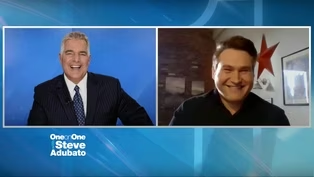
The Affordability Issues in New Jersey
Video has Closed Captions
Clip: S2022 Ep2502 | 8m 12s | The Affordability Issues in New Jersey (8m 12s)
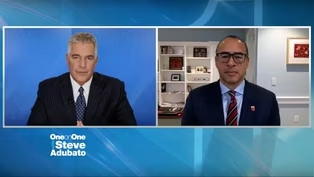
The Role of Social Media in the Political Divide
Video has Closed Captions
Clip: S2022 Ep2502 | 10m 15s | The Role of Social Media in the Political Divide (10m 15s)
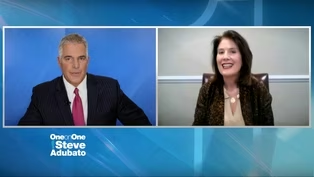
Sen. Schepisi on the Mask and Vaccine Mandates in New Jersey
Video has Closed Captions
Clip: S2022 Ep2502 | 10m 13s | Sen. Schepisi on the Mask and Vaccine Mandates in New Jersey (10m 13s)
Providing Support for PBS.org
Learn Moreabout PBS online sponsorship
- News and Public Affairs

Top journalists deliver compelling original analysis of the hour's headlines.

- News and Public Affairs

FRONTLINE is investigative journalism that questions, explains and changes our world.












Support for PBS provided by:
One-on-One is a local public television program presented by NJ PBS