One-on-One
Dr. Josh Coren; Dominic Carter; Rick Gorab & Darrin Anderson
Season 2021 Episode 2414 | 27m 33sVideo has Closed Captions
Dr. Josh Coren; Dominic Carter; Rick Gorab & Darrin Anderson
Dr. Joshua Coren shares the role of Rowan University in vaccine distribution and increasing access to the vaccine in minority communities; Dominic Carter talks about our divided nation, the Trump administration and the challenges President Biden faces; Rick Gorab & Darrin Anderson discuss fundraising for nonprofits during COVID and providing emergency childcare for healthcare workers.
Problems playing video? | Closed Captioning Feedback
Problems playing video? | Closed Captioning Feedback
One-on-One is a local public television program presented by NJ PBS
One-on-One
Dr. Josh Coren; Dominic Carter; Rick Gorab & Darrin Anderson
Season 2021 Episode 2414 | 27m 33sVideo has Closed Captions
Dr. Joshua Coren shares the role of Rowan University in vaccine distribution and increasing access to the vaccine in minority communities; Dominic Carter talks about our divided nation, the Trump administration and the challenges President Biden faces; Rick Gorab & Darrin Anderson discuss fundraising for nonprofits during COVID and providing emergency childcare for healthcare workers.
Problems playing video? | Closed Captioning Feedback
How to Watch One-on-One
One-on-One is available to stream on pbs.org and the free PBS App, available on iPhone, Apple TV, Android TV, Android smartphones, Amazon Fire TV, Amazon Fire Tablet, Roku, Samsung Smart TV, and Vizio.
Providing Support for PBS.org
Learn Moreabout PBS online sponsorship- [Narrator] Funding for this edition of One-On-One with Steve Adubato has been provided by Horizon Blue Cross Blue Shield of New Jersey.
Here when you need us most, now and always.
The Turrell Fund, supporting Reimagine Childcare.
PNC, Grow Up Great.
The New Jersey Education Association.
The Healthcare Foundation of New Jersey.
Atlantic Health System.
Building healthier Communities.
New Jersey Sharing Network.
NJM Insurance Group.
Serving New Jersey's drivers, homeowners and business owners for more than 100 years.
And by Fedway Associates, Inc.
Promotional support provided by The New Jersey Business & Industry Association.
And by New Jersey Globe.
- This is One-On-One.
- I'm an equal American just like you are.
- The jobs of tomorrow are not the jobs of yesterday.
- Look at this.
You get this?
- Life without dance is boring.
- I don't care how good you are or how good you think you are, there is always something to learn.
- Do you enjoy talking politics?
- No.
- People call me 'cause they feel nobody's paying attention.
- Our culture, I don't think has ever been tested in the way it's being tested right now.
- That's a good question, high five.
(upbeat music) - Hi, I'm Steve Adubato.
Once again, a very compelling important conversation about COVID about the vaccine situation.
So many questions, trying to find the correct answers and we're honored to be joined by Dr. Joshua Coren, Chair and Professor of Department of Family Medicine, Rowan University School of Osteopathic Medicine.
Good to have you with us doctor.
- Thanks so much Steve, good morning to you.
- Doctor, first to describe your role down at Rowan which is one of the higher ed institutions we collaborate with.
- Sure, I'm a Chair and Professor of Family Medicine within the school.
So I teach medical students, I also see patients there.
Most recently I've been working on a lot of our clinical affairs roles as the interim Associate Dean for Clinical Affairs as well.
- Doctor, what is the role of university in this case, Rowan as it relates to vaccine distribution particularly in the Southern part of New Jersey?
- Such a great question, Steve.
So we've been really fortunate.
We have a large facility and since last March it's been underutilized because our students have been doing a lot more remote learning.
So we knew we had the facility space and we also knew we had a lot of large teams, medical students, faculty and staff, that have both the professional knowledge and the willingness to try to help people out.
So we had both ingredients and we went back to the Department of Health and said, we're ready to help out with vaccinating the South Jersey area.
- We are taping on February 16th.
You'll see a couple of websites up, and I know people are frustrated by the websites.
I know it's sometimes hard to navigate.
Then there's a telephone number which is potentially harder to navigate.
We're gonna put up our great team behind the scenes, puts up the CDC website followed by the State Department of Health COVID website.
Lemme ask you this on February 16th, as we tape this will be seen March and beyond.
What are the greatest challenges you and your colleagues face down at Rowan as it relates to vaccine supply/distribution?
- Yeah, so I think the supply right now is a challenge for New Jersey and at large.
They've been really only getting about a 100,000 doses per week.
We're receiving only about 1,500 doses per week.
That's 300 doses per day for the five-day work week.
So we really can do a lot more than we're getting, but we are doing.
- How many doctor, I'm sorry for interrupting, how many more than 300, how many more?
- We could probably, we could do about a 1,000 a day.
So we could do 700 more a day but we're really only receiving 300.
So we unfortunately are using what we have and the state's giving us what they can provide.
Now, I imagine the next couple of weeks we'll start to see that ramp up, but we've been only receiving about 300 a day for the last four or five weeks.
- So to be clear, if there were to be a greater supply and the Biden administration as we speak right now, is promising a much larger number of vaccines than has been made available yet, we'll see what happens.
Are you saying that you and your colleagues, as it relates to Rowan and vaccine distribution could comfortably do a 1000 a day versus 300 a day, which is three times the number, correct?
- 100%, so we're that ready to go hockey team that knows where the puck is, knows how to use all of our sticks and once we get those shots, we can actually get them in arms.
- Doctor, this is an interesting, troubling question.
And you're gonna see a graphic up on our screen that you may say, hey, why is it up there as you're watching it's gonna be Confronting Racism.
And you're gonna ask what does race or racism, institutional racism have to do with vaccine distribution.
As we tape this program about 5% of all of the vaccines that have been administered are to people of color, particularly African-Americans.
A why, B what is being done down by you about that?
- Sure, so I think that there's been institutional healthcare disparities that have been happening over the course of healthcare within the US for underrepresented minorities.
And we know that as an institution as well as within healthcare.
Rowan SOM has been all over this.
We're doing panel discussions with our, the school of medicine is doing panel discussions with our community.
We're involving our community within the Rowan vaccination center.
We're reaching out to those who are underrepresented minorities and we're really trying to do our best to make sure we get people from underrepresented minorities and vulnerable communities into our site - But you understand the resistance and frustration based on the history of how the African-American community has been treated by not just the medical community, but by government by institutions of power.
You understand that, right?
- I do, and that's why we make sure we have our white leaders, our brown leaders, our black leaders in front of the population getting vaccinated, it is very important for us as doctors to be there and get vaccinated to show our community of diversity, why it's important right now to make sure that we beat this disease.
- Help us on this.
There are so many people and we happen to have two teenage boys and a young daughter and we represent so many of the parents out there for whom our kids say, when will we quote it back to normal?
As I've read with Dr. Fauci and others who have said, listen that may not be the right question.
We may be living with COVID for the foreseeable future and adapting to COVID for the foreseeable future.
And after the vaccines, there are these boosters that potentially relate to these variants.
You say, back to normal or way of life.
- Well, I think that there's gonna be some back to normal and some way of life with this one.
So we're gonna have continued vaccinations.
We're gonna get to some percent that we feel comfortable with function, within movie theaters and within restaurants and other locations that have a lot of people, stadiums I know we miss our baseball games, et cetera.
But I think that there's some place to be said that right now, we're just not there yet.
So until we can get to that 70 to 85% herd immunity meaning that so many people are vaccinated or have disease that we're protecting each other.
We won't be be able to.
- What's that percent doctor, again I'm sorry for interrupting.
What's the percentage, is it 60, 70, 80, 90?
What is the herd immunity percentage that you see as what our target should be?
- So a lot of the details been in that 70 to 85% zone.
So I think that's gonna continue to get narrowed down but it looks like it's in that window of 70 to 85% of the population.
So fortunately, they're working on, you brought up kids, they're working on vaccine trials right now for children.
- Is that AstraZeneca - Yeah, AstraZeneca There's so many different vaccines that are out there.
There each gonna start to look at trials Moderna and Pfizer have clinical trials in pediatrics right now as well.
So I think we're gonna see that this is gonna be the 2021-2022 next push which is pediatrics as well.
- I wanna remind folks we're taping on the 16th of February.
Things will change quickly, frankly, hopefully quickly in a better direction in terms of supply and distribution.
And most importantly, you know that expression shots in the arm, if you are a Dr. Coren, I wanna thank you so much Joshua Coren down at Rowan University.
One of our higher ed partners that helps us particularly produce programming around healthcare.
Doctor thank you so much for everything that you and your colleagues are doing.
- Steve, thanks so much, have a great day today.
- You too, I'm Steve Adubato, we'll be right back.
- [Narrator] To watch more One on One with Steve Adubato find us online and follow us on Social media.
- We are honored to be joined by a media icon!
Dominic, you like that?
30 years in the business, political journalism.
He is, right now, he is hosting, one of the many things he does, every Sunday from four to five pm.
You can catch him on 77WABC, his views, listening to others' views.
He's written extensively for "The Huffington Post."
He's been on "Face the Nation," CNN, Fox News, and his 2009 memoir called "No Momma's Boy."
Our good friend, my good friend, Dominic Carter.
Good to see you, Dominic.
- Steve, it's great to see you.
I have to be honest with you, man.
I feel almost like a groupie, a tremendous fan, because I have enormous respect for your work.
You mentioned "Face the Nation," all the other shows.
I'm more excited right now to be here with you than any of those shows.
- Dominic, I just hope you feel that way after this is over.
(both laughing) Hey, Dominic, let me ask you this: been covering politics for 30 years.
You know it better than most, New York, New Jersey, the nation.
Are we, as we tape on the 16th of February to be seen after, are we as divided?
Are we the Divided States of America, A and B?
Is that the way we're gonna live moving forward, and how the heck's that work?
- I hope not.
I hope it's not the way, Steve, that we're gonna live going forward, but we have to be honest in assessing this situation.
Politically, things are bad in our country, and that's one of the points that I try and make all the time on WABC, so if I argue point A, 50% of the country disagrees with that point.
If I argue point B, 50% disagrees with that.
We have got to find a way, Steve, for all of us to come together.
We have got to- You mentioned my longevity in terms of broadcasting.
I have never seen it this bad.
We have got to find a way to lower the temperature politically so that what happened January 6th at the Capitol, that can never happen again.
You and I both know that, but we've gotta find a way.
Republicans have to stop pointing at Democrats.
Democrats have to stop pointing at Republicans.
Independents, we can go on and on and on, but it has to stop, Steve.
We've got to find a way to lower the temperature.
- Let me ask you this, Dominic, 'cause at WABC, we've had John Catsimatidis, the owner of the parent company a few ago.
We've had Curtis Sliwa on recently.
I just did Curtis' show.
Frank Morano, a great friend.
Also check out the "NJ Globe" program that's on the weekends as well, with David Wildstein, but here's the point of the question: the station leans right.
Your audience leans right.
You are a very open-minded, progressive guy who's not a dogmatic political commentator.
How do you deal with an audience that for many of them, they're inclined not to agree with you just because they think they know who you are and what you believe in?
- Absolutely, and that's why I tell it the way it is.
We've gotta be honest with the American people, and that's what, Steve, you've done for a number of years, for decades, as a matter of fact, with your show.
We cannot sugar-coat the issues.
It is what it is.
I do my honest best to call it for exactly the way it is, not with a Democratic-leaning effort, not with a Republican-leaning effort.
It is what it is, and in that vein- - But Dominic, hold on.
I'm sorry for interrupting, but here's my question: December, excuse me, January 6th happens.
We run the clips of President Trump and what he said, and it's not about relitigating the trial in the Senate.
It's not about that.
It happened, okay, but we hear what's being said.
We hear what others are said, and we see the mob, and we see the insurrection, and we see cops killed.
We see others maimed.
We see members of Congress running for their lives.
If you say that's what happened, that's not your opinion.
That's not my opinion.
Those are facts.
Do you have a significant number of people who say, "Well, you're just the enemy of the people," as Jim Acosta's book at CNN says, and we have some ax to grind, or are we stating, do we have a right to just our own facts, Dominic?
Can we just make up our own facts because they comport with our worldview?
- And see, Steve, that's my point about how you're dead on.
One of the things that bothers me to my core being is that in this day and age, you can find a news channel that's going to tell you whatever it is you want to hear, not based on all the facts, but they're going to give you a slant, no matter what your position may be: left, right, middle.
They're going to give you the slant of what you're looking for.
We have got to get away from that.
One set of facts.
I think my friend, the late Senator Patrick, Daniel Moynihan made that point.
Steve, one set of facts.
We have got to tell the truth, and that's what I try to do on television and on radio.
- And by the way, for our friends at CNN and MSNBC, that means when the Biden administration screws up, when the Lincoln Project, who are the folks who are anti-Trump, trying to stop him, and they have a scandal going on, you cover it.
You don't cover it up.
You don't sweep it under the rug.
You cover it because, - Amen.
- as Dominic's saying, if we don't, I don't have a, we don't have a horse in the race in public television.
Dominic does not either.
There are a set of facts.
Let me ask you this, Dominic: what do you believe the legacy of President Trump will be moving forward, and then I wanna ask you about President Biden and his challenges, the legacy of the Trump administration, your view.
- I think President Trump, history will judge him as someone who was not a conventional politician, someone who did things differently, someone who has an enormous, successful track record in some areas, restoring the economy in terms of getting the virus, the vaccine for us sooner than expected even though the experts told us it was not going to happen, but I think that history is also going to judge him as somewhat of a polarizing figure.
What happens, Steve, in 2024?
I am telling you, you've known Donald Trump.
I've known Donald Trump.
I would not write him off.
We'll see what happens.
- You would not?
- I would not write him off.
I really wouldn't.
I think he's a long shot- - Do you think the Republican Party, Dominic, sorry, Dominic.
Do you think the Republican Party is the party of Trump, or we had Chris Christie on the other day.
There's Nikki Haley.
There are others.
There's the Mitch McConnell speech after the Senate vote to acquit the president.
Do you believe there are gonna be two Republican Parties, the Trump Party and every one else?
- I think we're looking at a very divided Republican Party, and that may not play well, but I do wanna say this: remember, Steve, in 2016, Donald Trump was one of what, 15-16 candidates, and he emerged with the nomination, so all I'm saying is 2024 is a long time from now, but I would not write him off.
- Dominic, one minute left.
Greatest challenge and greatest opportunity that President Biden faces in our nation is?
- The greatest challenge Biden faces is that he has got to find a way to unite America.
That is the greatest challenge, and the economy, and to restore America, given this pandemic.
That's the greatest challenge.
You know, right now, he's still in this honeymoon stage.
We'll see what happens, Steve, but I think we can agree, things are going to be, at least right now, a lot quieter than the last four years.
- So before I let you go, Dominic, every Sunday when you go on at four to five and I never miss it, you never ask yourself, "Hey, do we have enough to talk about?"
- (laughs) Absolutely not.
First of all, we can go on with President Trump, former President Trump, for quite some time, and to folks that listen to me, I'm not just talking about, don't peg me as some bleeding heart liberal.
There have been a lot of good things that Trump has done!
So we could talk about Trump, we could talk about Biden, we could talk about the out-of-control crime in New York City- - Cuomo, de Blasio, Murphy in our region.
- Cuomo, yes, yes, Steve.
- Yeah.
Hey, Dominic.
- We can go on and on and on.
- Dominic, you are the easiest guest to have because you're a self-starter.
You're engaging.
You challenge me.
You challenge our thinking.
We look forward to having Dominic Carter, our good friend, every Sunday four to five pm on 77WABC.
Dominic, I look forward to joining you on your show in the near future.
All the best, my friend.
You take care.
- Thank you, and I am a big fan of your show, Steve.
Thank you very much.
- It goes the other way as well, Dominic.
I've Steve Adubato.
That's Dominic Carter.
We'll be right back.
- [Narrator] To watch more One on One with Steve Adubato find us online and follow us on Social media.
- We are honored to be joined by Dr. Darrin Anderson, Sr., CEO of the New Jersey YMCA State Alliance and Rick Gorab, President and CEO of Metropolitan YMCA's of the Oranges - the largest YMCA in the state.
Now I'm a Montclair YMCA guy but yours is the biggest, Rick.
Hey, let's do this.
For those who don't know, I mean, I was just saying before we get on the air, the Y has been for our kids, for my dad before he passed, swimming at the Y was a huge part of his life.
We're YMCA people.
For those who do not know, Rick, how would you describe your Y and why it matters so much in the community?
- Well, Ys in general, and our Y in particular, our mission is to strengthen community through youth development, healthy living and social responsibility.
And our Y and an all Ys throughout the state are really pillars in their community, providing much needed community services in a normal environment.
But I should say, and I'm sure Darrin will add more to the conversation that the Ys really have stepped up to the occasion without doubt throughout this last 11 months of the pandemic.
And we can certainly speak to the various things that the Ys have done throughout the state to really positively impact all the communities throughout New Jersey.
- Well said, by the way, we're taping on February 16th, it will be seen later.
And Darrin, let me come back to you because our good friends at Horizon, they support you, they support public broadcasting.
They're good in that way, but it brings me to this question, Darrin.
Throughout this pandemic all nonprofits struggle with a lot of areas.
One of them is fundraising.
How challenging, Darrin?
- Well, I think it's challenging across the board for all nonprofits.
Look, this is unprecedented.
This is the pandemic that has wreaked havoc in our communities.
Wreaked havoc in our homes, and has also wreaked havoc within our organizations.
And nonprofits, just like any other entity, we need support.
We need community support.
We need philanthropic support.
We need support from everyone that's willing to to donate their time.
However, those that usually would volunteer for YMCAs and other organizations are now finding themselves with need.
Need that the YMCA's providing.
Such as food programs, such as emergency childcare, virtual programs.
And in fact, many of our facilities was used for not only COVID testing, but also for blood drives.
So we really have repurposed our facilities that are resources to meet community needs.
- You know, it's so interesting.
Darren mentioned so many emergency services.
One of them mentioned childcare.
Our longstanding initiative, and our team will put up the graphic in post-production, Reimagine Child Care, the Turrell Fund leading that effort with others.
The Y in our town, huge in terms of emergency childcare.
Rick, is that part of your Y as well and who's taking advantage in a good way of those childcare services?
- It was definitely a part of our early mobilization to support our community.
And, Steve, if you don't mind I wanna tell a quick story here, because we- Early on when we first were able to go out and visit our childcare centers, I happened to come upon one of our centers that happened to be at Livingston, where we were providing emergency care for essential workers.
And I was greeted by two of our staff members and to their right was seemingly a mom and she was dressed in scrubs and I was introduced to her by our staff members and the woman, who I later found out was a nurse, thanked me for what we were doing for her.
Now I was taken aback quite a bit because here she is saving lives but the Y was an integral part of allowing her to do that.
And it was an amazing moment for me.
And it was really telling to then understand the impact the Y, our Y, was having in Livingston and Ys we're having throughout the state of New Jersey for essential workers.
- Well said.
Darrin, as I come back to you, Let me ask you this.
The economics is a big part of this in so many ways, but also employment.
The Ys employ a lot of people.
From your perspective statewide, Dr. Darrin Anderson, have you let people go, A?
And B, what would it take to bring some of them back?
- You know, just like any other organization the YMCAs experienced tremendous economic decline.
You know, we're estimating that we probably lost about a hundred, between 150 to $160 million across the state.
That's 32 corporate YMCAs.
We had to lay off between 85% to 95% of our staff.
- 85% to 95% of the staff you had to lay off?
- Correct.
(Steve's voice drowns out Darrin's voice) - Because of COVID the Y's were physically closed.
- No, well, I think that's one of the misnomers that's out there.
Our YMCAs never closed.
Our wellness centers were temporarily shut down through the executive order, but our facilities remained up and vibrant.
We were still providing essential services to the community.
- So even if you couldn't go into the gym there were other things going on, correct?
- Correct.
The YMCAs are not just a swim & gym.
It is a place where health and wellness is as part of our portfolio, but we are a human services organization.
So we're meeting the dire needs of our community regarding food access and emergency supplies and essential things that families needed.
Look, we were getting contacted left and right by the community, by the needs that are out there.
And COVID not only uncovered more need but it exacerbated others.
And the YMCAs stepped up.
Even when we didn't have the same level of staff we stepped up and got as much support as we could to continue to provide this to the community.
- You know, it's so interesting.
And I don't take the Y in Montclair for granted and and those who are connected to it.
I'm confident, I'm hopeful that they don't.
But, and I don't wanna be negative here, but the economics matter.
People hear the word nonprofit, we're a not-for-profit production company affiliated with great folks at public broadcasting, but you know, no money, no mission.
You know, it's, and again I know I keep talking about money but here's why.
Do you think people realize what would happen if, big if, if YMCAs were to in fact, begin to close down?
Not just lay people off for struggle financially, but but actually, Rick, couldn't exist.
People have any idea, the impact on our communities?
- I think the pandemic has exposed a lot of things that are essential in the community.
And I think one that has risen to the occasion has been the YMCAs.
And I think people, if they weren't aware of the impact and the mission of the Y, I think we have certainly re-emphasized and amplified the third pillar of our mission.
And that is social responsibility.
- By the way, I'm sorry for the interrupting.
As we were taping on the 16th of February, 2 million meals in New Jersey delivered by the Y.
That's just one example, but go ahead, Rick, we have a few seconds left.
- Yeah, two million meals and three quarters of a million of them were delivered by the Metro Y of the Oranges throughout Western Essex County, Passaic County, Sussex County, Bergen County, and even going into Warren County.
And I'm gonna build upon this point, because one thing about the pandemic is that it didn't discriminate.
So it didn't matter if you lived in East Orange, or Livingston, or Wayne, or Sussex County.
Every single family in New Jersey has been impacted.
And the Y's had been there to meet the mission and to meet the moment.
- Every day.
And so to Rick and Darrin, I want to thank you and all of your colleagues at the YMCA.
YMCA Alliance across the state.
We've been blessed in our family and we're just one of millions of others.
Gentlemen, thank you so much.
We appreciate the work you're doing.
- Thank you, Steve.
- Thank you for having us.
- I'm Steve Adubato.
We thank you so much for watching.
We'll see you next time.
- [Narrator] One-On-One with Steve Adubato has been a production of the Caucus Educational Corporation.
Funding has been provided by Horizon Blue Cross Blue Shield of New Jersey.
The Turrell Fund, supporting Reimagine Childcare.
PNC, Grow Up Great.
The New Jersey Education Association.
The Healthcare Foundation of New Jersey.
Atlantic Health System.
New Jersey Sharing Network.
NJM Insurance Group.
And by Fedway Associates, Inc.
Promotional support provided by The New Jersey Business & Industry Association.
And by New Jersey Globe.
- [Young Girl] I was diagnosed with Cystic Fibrosis when I was two.
It's hard to grow up with CF.
But I have an awesome care team at Goryeb Children's Hospital.
Helping me do the things I want to do, like play lacrosse.
And now, I've been recruited to play in college.
- Where you go for pediatric care matters.
- [Announcer] Atlantic Health System, because every moment is a moment that matters.
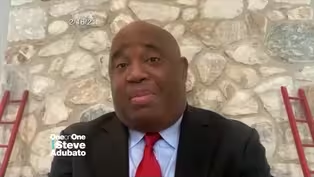
Dominic Carter Discusses Our Divided Nation & Truth in Media
Video has Closed Captions
Clip: S2021 Ep2414 | 9m 48s | Dominic Carter Discusses Our Divided Nation & Truth in Media (9m 48s)
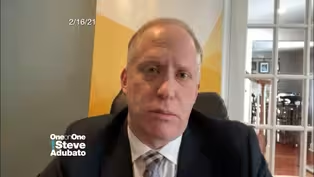
Rowan University's Role in COVID-19 Vaccine Distribution
Video has Closed Captions
Clip: S2021 Ep2414 | 8m 49s | Rowan University's Role in COVID-19 Vaccine Distribution (8m 49s)
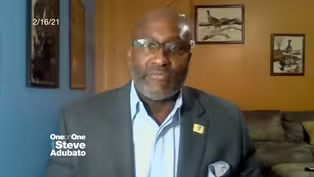
The YMCA's Role in the Community During COVID-19
Video has Closed Captions
Clip: S2021 Ep2414 | 9m 44s | The YMCA's Role in the Community During COVID-19 (9m 44s)
Providing Support for PBS.org
Learn Moreabout PBS online sponsorship
- News and Public Affairs

Top journalists deliver compelling original analysis of the hour's headlines.

- News and Public Affairs

FRONTLINE is investigative journalism that questions, explains and changes our world.












Support for PBS provided by:
One-on-One is a local public television program presented by NJ PBS