
Dr. Karrie G. Dixon
10/21/2024 | 26m 45sVideo has Closed Captions
Dr. Karrie G. Dixon, chancellor of NCCU, discusses higher education with PBS NC’s David Crabtree.
Dr. Karrie G. Dixon, North Carolina Central University’s 13th chancellor, discusses her experience, her ties to the school and the future of higher education with David Crabtree, PBS North Carolina’s CEO.
Problems playing video? | Closed Captioning Feedback
Problems playing video? | Closed Captioning Feedback
Focus On is a local public television program presented by PBS NC
Dr. Karrie G. Dixon
10/21/2024 | 26m 45sVideo has Closed Captions
Dr. Karrie G. Dixon, North Carolina Central University’s 13th chancellor, discusses her experience, her ties to the school and the future of higher education with David Crabtree, PBS North Carolina’s CEO.
Problems playing video? | Closed Captioning Feedback
How to Watch Focus On
Focus On is available to stream on pbs.org and the free PBS App, available on iPhone, Apple TV, Android TV, Android smartphones, Amazon Fire TV, Amazon Fire Tablet, Roku, Samsung Smart TV, and Vizio.
Providing Support for PBS.org
Learn Moreabout PBS online sponsorship- Hello, I'm David Crabtree.
In a moment we'll be joined by Dr. Karrie Dixon, the new chancellor at North Carolina Central University.
We'll be talking about her experience, her ties to NC Central, and the future of higher education in North Carolina and beyond.
- [Announcer] Quality public television is made possible through the financial contributions of viewers like you, who invite you to join them in supporting PBS NC.
[bright music] [charming upbeat music] [charming upbeat music continues] - Thanks for joining us.
We're here with the 13th Chancellor of North Carolina Central University, Dr. Karrie Dixon.
Chancellor, thank you.
- Thank you.
Thank you for having me.
- Here you are in this role, 12 people before you.
- Yes.
- You're the second woman- - Yes.
- in this position.
A year ago, you had no idea you'd be here.
- No idea at all.
- What was it like for this job, this position to find you?
- Well, it was a very interesting time, David, because we've had so many successes during my tenure at Elizabeth City State University where I served as chancellor prior to coming to North Carolina Central as the 13th Chancellor.
And so, as I thought about it, you know, I knew that I would miss the area, I would miss the people, but I also, everything I do, I do it with servant leadership in mind, and what I can do to make an impact and make a difference.
So when the North Carolina Central position became available, I said to myself, "Oh, maybe it's time for me to go back to the Triangle area and see what I can do at North Carolina Central and this university is very rich in history and legacies and how it's positioned itself.
And to be right here in the Triangle has a lot of great opportunities.
- Higher education is not new to you.
Before your six years at Elizabeth City State, you worked in the UNC system office.
- Yes.
- For 10 years?
- 10 years.
10 years.
- Higher education is important.
And yet it's often misunderstood at times, isn't it?
- It is.
It is.
And so when I worked at the UNC system, that 10 year period gave me a lot of, you know, experience and ideas around higher education.
It had me in a position where I saw it from a macro level, working with the UNC system campuses, the North Carolina Community College System, DPI, the privates and independent colleges and universities.
So it really gave me a macro look of higher education in North Carolina.
And, you know, we're in a age where the students we serve, you know, the mindset is often instant gratification.
So when you think about higher education, you know, they see entrepreneurs, they see people doing well in their careers who may not have gone to college.
And I think it's our responsibility as leaders in higher education just to show, "Here's the benefit.
It may not be instant, but you will see the benefits of your education, of your degree, the value and what that means as you think about your career."
So I think we have a responsibility to make sure that we tell that story and talk about the impact that higher education makes in people's lives.
- It rounds us out in ways that we cannot see when we are 18, 19, 20 years old.
- Exactly.
- It takes years later to think, "Oh!
I realized what she was talking about."
- Yes.
Yes.
That when you think about social mobility, economic mobility, you know, those things are, measures that we look at in higher education.
And we wanna make sure that we're offering quality academic programs and that we are preparing our students to have outstanding careers.
And we see that as evidence in our alumni base.
- Talk to me about the students.
I met several on my way in today.
Happy to be here.
We learn things from students.
- Yes.
- As well as them learning from us.
But it would surprise people.
- Yes.
The students, the energy is absolutely amazing.
And at North Carolina Central, this university is about three times as large as ECSU.
So to see the students when they came back to campus was just wonderful.
It was absolutely amazing to watch them as they navigate the campus and to get to meet them.
And, you know, that was one of my goals when I started here at North Carolina Central, is I want to know the students, I want to get to know them.
I see myself as that chancellor that they can walk up to and talk to me and give me feedback on their experience.
And I wanna, you know, let them know that I'm listening, I'm listening, and however I can help them navigate their college journey, I want to be able to do that.
But the energy here at North Carolina Central is absolutely amazing.
And we have over 8,000 students total enrollment.
And this year we saw an increase in our enrollment.
So to have all of them on campus, to see their faces, I even told one student, I said, you know, "I could have the worst day in the office, and I'll get up and walk outside and talk to the students.
And it makes everything better."
Because it helps me to say to myself, "This is why I do what I do."
I do it for the students.
I do it for the quality of the education that we're providing.
I do it for the impact that it makes in their careers as they think about graduation and earning that degree.
- You know, I remember being in class one day, and as an older student, was amazed at not only the energy, but also the fertility of the mind- - Yes.
- Of young people.
- Yes.
- And listening to someone, not pontificate, but go on and on about something very idealistic.
And I thought, "Oh my gosh, I used to sound just like that.
What happened to me?"
She had no idea she was challenging me- - Yes.
- just by showing the positivity of her beliefs.
- Right.
- I'm curious, as a chancellor, you have to allow yourself to be open to be challenged by students as well.
- Oh yeah, definitely.
And at the start of my career in higher education, I actually started in the classroom.
And so I understand what that looks like- - What do you teach?
- You know, the classroom- I taught public speaking, interpersonal communication, as well as small group communication.
And so being in that position, you know, providing knowledge and then also being subject to hearing our students and what they think as part of the learning process, you know, I really value what happens in the classroom.
Our faculty get up every day wanting to make sure that they are providing that wisdom, that knowledge for our students to take in and to go off and do great things.
So I understand the baseline of that and what that means as to what takes place in the classroom.
And with our adult learners, you know, the UNC system office has an emphasis on adult learners as an initiative.
We wanna see an increase in adult learners.
And so to have our non-traditional age students come back to the classroom has been absolutely amazing to see them, to see them earn that degree.
'Cause many of them didn't have that opportunity when they graduated from high school.
And I think about my parents, my parents both did not have that opportunity immediately after high school.
You know, they were focused on raising my sister and myself and they went back to college later in life, actually, after 60 years old.
And so my mom is enrolled now at Elizabeth City State University, working on her undergraduate degree.
So the Adult Learner Initiative is something that I'm really, really, you know, pushing, and I wanna see an increase, and provide flexibility for those who want to earn their degree now 'cause it's never too late.
- Isn't that great?
- It is.
- We are always learning something every day, aren't we?
- Always learning.
We are.
- Always learning something.
You were talking about having spent time in the classroom and what you were teaching.
Some folks watching may not realize that you also had a stint in television.
- I did.
Actually, as an undergraduate student at North Carolina State University, I majored in Communications, and I had an emphasis in marketing, public relations, and an interest in television.
And what led to that is my senior year, I was actually able to be appointed as an intern at WRAL Capitol Broadcasting.
And it was great because that gave me a foot into television and understanding how things are done.
And I made some amazing people there, yourself, of course.
And then also Sonja Bennett who hired me as an intern, for working with "5 On Your Side."
So it was a great start to my television career.
- Think about it, you could have been in my job.
- [laughs] Yes.
- But I never could have been in your job [both chuckling] That's the difference.
And you could still come in and do my job now.
- Well, you know, I understand television.
I understand, now it's changed a lot.
You know, I think about the late nineties and how technology has really brought television with digital, TV and cameras and everything, you know, has really brought us a long way in that regard.
But, you know, I really value that experience and that experience at WRAL led to my first job after graduating from NC State at an NBC affiliate, WXII in Winston-Salem, where I served as an associate marketing producer.
You know.
So all of those experiences really helped me, I believe, as being an effective chancellor because I understand the value of protecting the brand, and understanding what that looks like as we provide excellent service to our students, faculty and staff.
- You're surrounded by Eagles everywhere you go on this campus.
Young people, smiles.
- Yes.
- You're in Durham, 8,300 students.
- Yes.
- Yet there's still challenges.
There will always be challenges in higher education.
Fortunately we are post COVID, so that's behind us.
- Yes.
- But if you look at the landscape today, what are you facing?
- Well, post COVID has changed the landscape of higher education, in my opinion.
You know, the students we serve today are very different from the students that we served prior to the global pandemic.
And what I mean by that is, yeah, we really have to focus on meeting students where they are.
And I think about the students who are graduating, well, just this past May of 2024 were our COVID students.
You know, they came in in 2020 and many of them didn't have high school graduation, didn't have a senior prom.
And so mental health, it has to be a priority in where they are and where we are.
And so I am committed to meeting students where they are.
And being part of that is talking to them, understanding, you know, the challenges they face, how they see the world.
I think those are things that we, as educators, have to consider.
And from the standpoint of how it's changed operationally as we lead campuses, we've had to look at things differently.
We cannot look at how we run our campuses in such an antiquated way, as we may have done before.
And the COVID, you know, pandemic really forced us to look at more online offerings, look at ways in which we can utilize technology more.
It forced us to really think about how we're teaching and the flexibility around that.
And so I think it's been very beneficial to the university from an operational standpoint, but also to our students and helping them understand that resilience is something that we should all really value and think about.
Because we've been through a lot as a country, and getting through a global pandemic and still being able to be successful is something we should be very proud of.
- Think about this area.
I was about to ask you how Central feels embraced?
Does it feel embraced by the community?
By Durham?
But you have Central, you have Duke University not far from here.
- Yes.
- Not far from here is Chapel Hill.
- Yes.
- And then into Raleigh.
A lot of competition for higher ed students and a lot of expectations by the community.
- Yes, and I think where NCCU is positioned, we have great opportunity that we need to tap into.
And looking at our partners from an educational standpoint, we have Duke University right here in the Bull City.
We have Durham Tech right here in the Bull City.
We are here together, all of us in, and we should be working together.
You know, as I think about the pipeline of transfer students from Durham Tech, you know, we want them to go to Durham Tech and complete their associate's degree.
But then we want them to think about coming to North Carolina Central, you know, and complete their bachelor's degree, and they can transfer in under the CAA and come in as juniors.
And so, you know, as I think about those partnerships, we need to have strong partnerships with Duke and with Durham Tech.
And we're working on that.
You know, just being about 60 days in on the job now, we've already set up meetings where the three presidents are gonna get together and we're gonna talk about strategy and talk about being intentional.
And for North Carolina Central, we have to really push forward in being at the table, being a voice at the table, being a part of the conversation.
There's a lot of history here in Durham.
We're a big part of that history.
And we wanna make sure that we continue to work together and that we continue to do great things for Durham citizens as well as the entire state and the country and beyond.
- 60 days in.
Can seem like a blur.
- [chuckles] It does.
- And I know you bring a lot of energy with you to the room.
You want to get things done but you know the value of being prudent with time.
In those 60 days that you've been on the job, have you been able to really pull your vision together for what you want this university to be?
- 60 days on the job, it has been...
I've had to remind myself that it's only been 60 days.
'Cause you're right, I am a person who wants to get it done and wants to get it done like tomorrow.
What I do understand about myself as a leader is that, you know, sometimes I do need to work on pacing myself when it comes to that.
But you know, as I think about the vision for North Carolina Central, you know, things that I want to focus on, I wanna focus on infrastructure.
I wanna continue to focus on growth.
There are some resource needs that I have here at the university as we think about some of our facilities.
So I've been able, in the 60 days, to assess where we are as an institution.
And historically, HBCUs have been underfunded for many years and making our case and being good stewards of every resource, every dollar that we get from the state and we get from donors and partners, you know, I wanna make them understand that they can trust NCCU and that NCCU is on the rise and we're gonna be doing some really great things.
And I do acknowledge that I stand on the shoulders of many giants who came before me as chancellor, but now it's time for me to elevate that foundation that they established.
And I'm ready to do that and take on that challenge.
But I know I can't do it alone.
NCCU has to be at the table.
We have to tell our story.
We have to advocate for the needs, the resources of the institution, work closely with the legislature, work closely with the Board of Governors and the UNC system, and all of us together can really make some great things happen.
I've seen it done before.
We did it at Elizabeth City State University and we can do it here.
And North Carolina Central has great potential.
And I just wanna tap into that and really take it to the next level.
- Chancellor, you referenced HBCUs and you referenced being in communities that have been underserved.
- Yes.
- For those of us who do not live in those underserved communities, we may not see and understand, my eyes are different than your eyes, of what those needs are.
Talk to folks, talk with me a little bit about the challenges that will be different here and at other HBCUs versus being at Carolina, being at State, being at UNCW.
- Well, historically, our institutions have a responsibility to the communities that we serve.
And many of us are in the heart of those communities as far as our location.
And one thing that I have discovered is we have young people who live in less, you know, radius.
two miles or less from the campus who've never stepped foot on a higher education institution campus before.
And I want to do something about that.
I want to expose them.
I want to help them understand a higher education can be a reality.
It's not just something you see on television, it's something that's right here in your community.
An institution that has been here for many years, and NCCU has been in place since 1910.
And so to have an institution of higher education right here in your community, we have a responsibility to build those relationships.
When we have students on campus, I went over to our BRITE Building and we had students, it was sponsored by GlaxoSmithKline, a program that they brought that brought the students on the campus to have them in, you know, just explore STEM and science.
And to see those students there working over the summer and working on their little projects was just a wonderful sight to see.
And to see that those minds just continue just to, to explore everything that was put in front of them.
You know, they were put, there were objects put in front of them.
They said, "What can you make out of this?"
And to see the excitement around the creativity as they were thinking about, "Well, what can I make out of these items that are in front of me?"
So those types of things are things that expose young minds, expose our youth in the community to opportunities that they can get if they enroll here at North Carolina Central, and ways in which they can go back to their communities and change their community, their families.
All of that is social and economic mobility.
- I'm curious, as chancellor at Elizabeth City State and now chancellor here at North Carolina Central, you've seen, you'll continue to see first generation students.
- Yes, yes.
- As chancellor, when you watch those first generation students, the first in their family, walk across that stage and you hand them the diploma, what is that like?
- It feels wonderful.
It feels great.
I congratulate them.
I give them a hug.
Yes, I do hold up the line sometimes.
But they deserve it.
[David chuckling] They deserve it.
- Yes.
- And you know, I know what that feels like as a first generation student myself.
Now of course, now my parents are engaging in college and my father has completed his degree and my mom working on hers.
But when I was applying for college as a high school student, my parents, you know, they tried to help me as much as they could, but they also had to go to the local church and the community to get us the help that we needed to fill out the FAFSA, for me to complete my application.
So I know what that feels like.
And to get to the finish line of a dream that many in your family have wanted to be able to achieve, but maybe just couldn't because of various circumstances.
But to be the first to do that is absolutely a wonderful feeling.
And so I make sure that I celebrate with the students and give them a big hug and say, "I'm so proud of you."
And when I tell you, I tell every student, every single student that at Elizabeth City State, I did, you know, I wanted them to know that what they have accomplished, this milestone is something they should be really, really proud of.
And you can see it in their faces, you can see it in the audience as the family members cheer them on, and the bright smiles.
And those things are really meaningful because they really touch home with how I felt when I walked across the stage the first time.
- You've talked about your parents.
Tell me a little more about growing up.
- So growing up was, my parents always instilled the importance of education.
- And where was home?
- In Winston-Salem.
- Winston Salem.
- North Carolina.
Yes.
Born in Forsyth County.
And my parents always instilled higher education or education in general, in my sister and myself.
And they knew the power of education, even though they were not able to complete, you know, or go off to college themselves due to need to work and other things that they needed to do to provide for us.
I'm just really thankful and very blessed to have had parents who understood the power of education and understood that they needed to do whatever they could to make sure my sister and I were both well educated.
And to see them now, you know, I'll never forget when my dad called me and he said, "You know, I never had an opportunity to go to college and I would like to pursue that dream I've always had."
He said, "Do you think I'm too old?"
I said, "Of course not.
You're never too old."
And so just to have that courage to have that conversation and to say this is something he wanted to do.
And he was at that time, past 60 years old, but still had that dream.
I said, "Dad, whatever you need from me, from my sister, from your grandchildren, we will make sure that you have what you need to get through this and to reach that goal."
And so it was very exciting to see him walk across the stage.
And he also went on to get a master's degree.
And so it was very exciting to see that.
- I'd like to meet him because I was 68 when I finished my master's.
- Really?
- Yes.
- Yes, yes.
So here's about the- - Took me 10 years.
One semester.
- Yeah.
- One course a semester for 10 years.
- Oh wow.
Yes.
- But it changed my life.
- You took your time.
Exactly.
And you paced yourself.
- Yeah, it's... You mentioned servant leadership.
You mentioned the church, you mentioned that you used the word "blessed" a moment ago.
- Yes.
- My presumption is faith is very important in your life.
- Faith is very important in my life, very important.
And that's something I never shy away from because I know that I've been put in place to serve as a servant leader, to do the right thing for higher education, for public education across North Carolina.
I'm a product of public education across North Carolina.
And to really understand what that looks like, my journey has been absolutely amazing.
To be just shy of 50 years old, and on my second chancellorship, I can't ask for anything more.
But I do believe that I've been put in place to do a job or as I would say, you know, to have an assignment and to be obedient to that.
And so I feel very much so as though this is a blessing for me, and I'm very thankful for the opportunities.
- And if a young person or an older person is watching and thinks they would like to try, but have never had the courage, in 10 seconds, what do you say to encourage them?
- Preparation is key.
Prepare yourself, network.
Have a mentor.
Have a sponsor in place.
These are people that are gonna help you achieve the dreams that you have.
And once you figure that out, you may not know right away, but that light bulb will go off and you'll know this is what you need to be doing.
- Dr. Karrie Dixon, the 13th Chancellor of North Carolina Central University.
Again, we thank you for your time, and congratulations.
- Thank you.
Greatly appreciate it.
[bright music] [bright music continues] [bright music continues] [bright music continues] - [Announcer] Quality public television is made possible through the financial contributions of viewers like you who invite you to join them in supporting PBS NC.
[bright music]
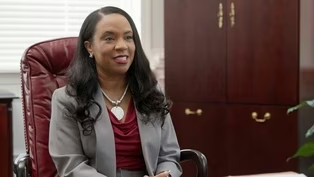
Dr. Karrie G. Dixon on First-Generation College Students
Video has Closed Captions
Clip: 10/21/2024 | 1m 35s | Dr. Karrie G. Dixon, chancellor of NCCU, discusses first-generation college students. (1m 35s)
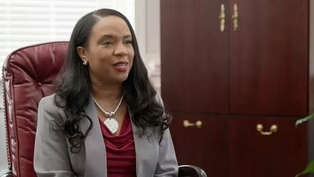
Dr. Karrie G. Dixon on NCCU Students
Video has Closed Captions
Clip: 10/21/2024 | 1m 29s | Dr. Karrie G. Dixon, chancellor of NCCU, discusses getting to know the students on campus. (1m 29s)
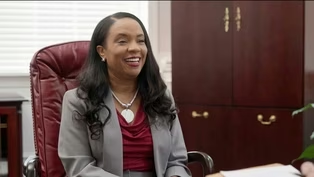
Dr. Karrie G. Dixon on the Value of Teaching
Video has Closed Captions
Clip: 10/21/2024 | 1m 45s | Dr. Karrie G. Dixon, chancellor of NCCU, discusses the value of teaching. (1m 45s)
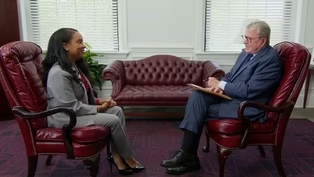
Video has Closed Captions
Preview: 10/21/2024 | 15s | Dr. Karrie G. Dixon, chancellor of NCCU, discusses higher education with PBS NC’s David Crabtree. (15s)
Providing Support for PBS.org
Learn Moreabout PBS online sponsorship
- News and Public Affairs

Top journalists deliver compelling original analysis of the hour's headlines.

- News and Public Affairs

FRONTLINE is investigative journalism that questions, explains and changes our world.












Support for PBS provided by:
Focus On is a local public television program presented by PBS NC