
Dr. Kimberly van Noort on Hurricane Helene at UNC Asheville
Clip: 1/13/2025 | 3m 12sVideo has Closed Captions
Dr. Kimberly van Noort, chancellor of UNC Asheville, discusses the impact of Hurricane Helene.
Dr. Kimberly van Noort, UNC Asheville’s ninth chancellor, discusses the impact of Hurricane Helene on the students, campus and community.
Problems playing video? | Closed Captioning Feedback
Problems playing video? | Closed Captioning Feedback
Focus On is a local public television program presented by PBS NC
Dr. Kimberly van Noort on Hurricane Helene at UNC Asheville
Clip: 1/13/2025 | 3m 12sVideo has Closed Captions
Dr. Kimberly van Noort, UNC Asheville’s ninth chancellor, discusses the impact of Hurricane Helene on the students, campus and community.
Problems playing video? | Closed Captioning Feedback
How to Watch Focus On
Focus On is available to stream on pbs.org and the free PBS App, available on iPhone, Apple TV, Android TV, Android smartphones, Amazon Fire TV, Amazon Fire Tablet, Roku, Samsung Smart TV, and Vizio.
Providing Support for PBS.org
Learn Moreabout PBS online sponsorship- It's had a great impact, David.
So I was here in this house, in this room actually, during the hurricane in communication with folks on campus.
And at about 8:10 that Friday morning, I got the call that no chancellor wants to get.
The campus was entirely blocked, there were no accessible roads, and I had 1,300 students on that campus.
If we'd had a fire or a medical emergency, we wouldn't have been able to get help up there.
And we also had to call back the saw crews because it was too dangerous.
There were trees falling, so we were not able to clear anything.
And so, that moment, I realized we are in a very serious situation.
We knew it was gonna be serious, but it wasn't until we actually saw the rainfall that we'd had the night before, the power of the winds, and then everything that happened after that.
But what was truly amazing was the way that our entire community came together.
So they got my road cleared at about 2:30 that afternoon.
In the meantime, the teams on campus had managed to feed those 1,300 students with no cafeteria workers.
They went into the refrigerators and the freezers, found what they could.
That night, for dinner, we pulled out camp stoves and grills, we borrowed some propane tanks from the art department, and we fed those students.
Fortunately, we had ordered about 10,000 bottles of water and 20 porta-potties earlier that week, 'cause we knew things were gonna be bad, because we lost power and then we lost water.
But most importantly, we lost communication.
We had no communication on campus.
We were using walkie-talkies, literally.
I happened to have one here at the chancellor's residence that I was able to use to communicate during those hours.
And so for the next three, we had one focus and one focus only, which was to make sure we knew where our students were on campus, make sure that we were feeding them, giving them water, and making sure that they were mentally in a good place.
And so we had teams of people.
There were probably 40, 50 people who spent 24 hours for probably five days on campus, sleeping overnight.
But the students showed up in ways that I had never imagined.
When you don't have cell phone service, and you don't have the ability to call people, you have to communicate in different ways.
And they did that.
They helped each other.
They played games.
They volunteered.
Whenever we had a supply truck to roll up, there would be students there helping us unload that truck.
There were students who volunteered in the cafeteria.
It was absolutely amazing.
Then there were students who helped us...
When we decided it was important that we needed to relocate the students, we needed to get them into a different region in North Carolina, helped us writing out directions.
Students who had no GPS; they didn't know how to even get to the highway, so we equipped them with a handwritten map, $20, and made sure they had at least five gallons of gas in their tank.
We had parents, we had community members who came, picked up their children, and leave with four other kids.
We had a parent land a helicopter on our track to pick up her son and took the roommate away, too.
And so the ways that the community came together and the ways that we were able to connect with the greater city of Asheville and the county of Buncombe, constant communication.
I've never seen a community in a region come together like this.
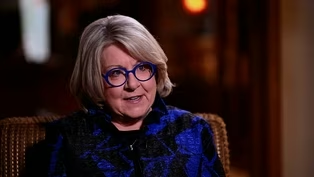
Dr. Kimberly van Noort on AI in Education
Video has Closed Captions
Clip: 1/13/2025 | 1m 15s | Dr. Kimberly van Noort, chancellor of UNC Asheville, discusses new technologies in education. (1m 15s)
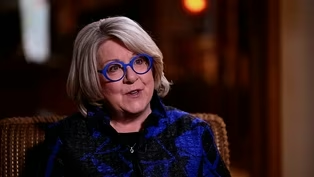
Dr. Kimberly van Noort on Encouraging Students’ Passions
Video has Closed Captions
Clip: 1/13/2025 | 2m 1s | Dr. Kimberly van Noort, chancellor of UNC Asheville, discusses her approach to inspiring students. (2m 1s)
Providing Support for PBS.org
Learn Moreabout PBS online sponsorship
- News and Public Affairs

Top journalists deliver compelling original analysis of the hour's headlines.

- News and Public Affairs

FRONTLINE is investigative journalism that questions, explains and changes our world.












Support for PBS provided by:
Focus On is a local public television program presented by PBS NC