One-on-One
Dr. Matthew Whelan; Olivia Hutcherson; Eric Boehlert
Season 2022 Episode 2501 | 25m 45sVideo has Closed Captions
Dr. Matthew Whelan; Olivia Hutcherson; Eric Boehlert
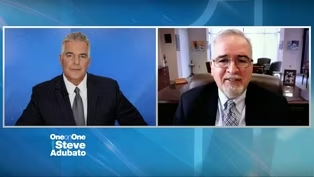
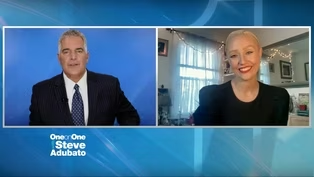
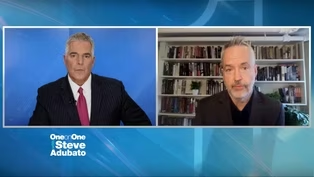
Dr. Matthew Whelan talks about the importance of helping Hispanic and low-income students pursue careers in STEM; Olivia Hutcherson shares her experience being diagnosed with breast cancer at 26-years-old and how the journey motivated her to publish her poetry book, “The Show Must Go On!”; Eric Boehlert discusses the role of Democrats, Republicans, and public broadcasting during the pandemic.
Problems playing video? | Closed Captioning Feedback
Problems playing video? | Closed Captioning Feedback
One-on-One is a local public television program presented by NJ PBS
One-on-One
Dr. Matthew Whelan; Olivia Hutcherson; Eric Boehlert
Season 2022 Episode 2501 | 25m 45sVideo has Closed Captions
Dr. Matthew Whelan talks about the importance of helping Hispanic and low-income students pursue careers in STEM; Olivia Hutcherson shares her experience being diagnosed with breast cancer at 26-years-old and how the journey motivated her to publish her poetry book, “The Show Must Go On!”; Eric Boehlert discusses the role of Democrats, Republicans, and public broadcasting during the pandemic.
Problems playing video? | Closed Captioning Feedback
How to Watch One-on-One
One-on-One is available to stream on pbs.org and the free PBS App, available on iPhone, Apple TV, Android TV, Android smartphones, Amazon Fire TV, Amazon Fire Tablet, Roku, Samsung Smart TV, and Vizio.
Providing Support for PBS.org
Learn Moreabout PBS online sponsorship- [Narrator] Funding for this edition of One-On-One with Steve Adubato has been provided by NJM Insurance Group.
Serving New Jersey'’s drivers, homeowners and business owners for more than 100 years.
New Jersey Sharing Network.
Summit Health a provider of primary, specialty, and urgent care.
NJ Best, New Jersey'’s five-two-nine college savings plan.
PNC, Grow Up Great.
The Healthcare Foundation of New Jersey.
Horizon Blue Cross Blue Shield of New Jersey.
Here when you need us most, now and always.
Fedway Associates, Inc. And by Choose New Jersey.
Promotional support provided by Promotional support provided by Meadowlands Chamber.
Building connections, driving business growth.
And by New Jersey Globe.
- This is One-On-One.
- I'm an equal American just like you are.
- The way we change presidents in this country is by voting.
- I'’m hopeful that this is the beginning to accountability.
- Life without dance is boring.
- I don't care how good you are or how good you think you are, there is always something to learn.
- I did do the finale, and guess where my trailer was?
A block away from my apartment, it couldn'’t have been better!
- People call me 'cause they feel nobody's paying attention.
-_ It'’s not all about memorizing and getting information, it'’s what you do with that information.
- (slowly) Start talking right now.
- That's a good question, high five.
(upbeat music) - Hi, I'm Steve Adubato and we are honored to be joined by the President of Caldwell University, Dr. Matthew.
Whelan, Matt, good to see ya.
- Great to see you and Happy New Year, as I said.
- Absolutely, we're taping this at the end of January, It'll be seen a little bit after.
I know it's ridiculous to ask you, where are we right now with COVID in the higher ed community, because it's changing so quickly, you know, whatever, what do you see the longer term implications, the impact on higher ed being of COVID two years in, plus?
- I think, Steve, it's taught us to be nimble.
It's taught higher ed, which moves sometimes at a glacial pace, has had to become much more nimble in order to get our job done, to meet the responsibility we have to the students, to the faculty, to the people who live on campus.
So, we've had to become incredibly nimble, which is not something higher ed is known for.
And I think if we carry that forward, that will be a good thing for American higher education, the ability to be nimble and move quickly through different issues that present themselves.
- Yeah.
So we're going to do a separate interview with Matt on the issue of leadership on our Lessons and Leadership platform, but I am curious about this because to me, a lot of leadership is about communication, a lot of communication is about where you're doing it.
We're doing this in this format, as we speak right now, we're doing this remotely, out of our studio, Dr. Whelan's where he is, in his office, at Caldwell University, but also teaching.
I'm curious about this, even when things get better with this pandemic, remote education will continue to be a part of our world.
What are we doing and actually to disclose, I'm actually teaching a course up at Caldwell University in a doctoral program for educational administrators, and it's going to be remote.
And I've to work, there's a question here, trust me, if I had to work on this kind of communication, connecting remotely, how are we helping our educators, our professors, get better at that and our students get better at that?
It's a long-winded question, I'm sorry, Matt.
- So I think that with the educators, I think it's a little bit easier because we have the educators and we've put them through various classes, if you will, to say, okay, here are some of the techniques you can use to really engage your class and the faculty responded wonderfully to that.
So how you might engage a class remotely and how that's different, how you need to ensure you're looking at the camera and verbally connecting with students and still using your eyes to connect to those students who may not be as engaged, that's important, I think for the faculty to learn and our faculty picked that up very, very well.
The students, it's more difficult, Steve.
It's a great question, how do we do that?
But I think it's some of the same.
It's to ensure that the A., the content has to be phenomenal.
Students have to want to be engaged.
That's probably no different than it is in a regular class.
But still using those eye connections and those verbal connection and as I say to a lot of people, listen with your eyes.
If we're speaking, and we can see students wandering off, well, it's time to double back and then try and reconnect with those students.
So it's a much more, I think, demanding part of it, but a much more fulfilling part.
- Now, Caldwell University, one of our higher ed partners, we know has gotten a grant from the United States Department of Education, a $5 million grant that would help Hispanic and low income students planning on careers in stem, science, technology, engineering, and math.
Talk about that, Dr. Whalen.
- Well, a., we're very proud of that.
It is a certainly recognition of who we are and what we do as a Hispanic serving institution.
More than 25% of our students come from Hispanic families and that number is growing, Steve, as the population in the area grows.
And so we want to be able to reach out to those students, so we're hiring a bilingual admissions counselor.
We had one already, but we're hiring specifically, a bilingual admissions counselor, a bilingual advisor, a bilingual social navigator, who can help the students through some of the issues of dealing with higher education when they've come from families, as I did, that may not be familiar with higher education.
I would have loved to have a navigator.
And so it's going to be, allow us to hire new faculty.
It's going to allow us to refurbish classrooms and labs.
It's going to allow us to start a small matching endowment.
It's a phenomenal opportunity.
It's about a million dollars over five years, for us to really grow our services, not just take the money and say, "Okay, we're a Hispanic serving institution", but grow our services so we can help more students benefit from a Caldwell education.
- But before I let you go, Matt, the disproportionate impact on black and brown students in terms of college affordability, accessibility, give me 30 seconds on that.
We should give you more, but go ahead, I've got a time issue.
- Our approach in one way and this is not just for black and brown students, but it's for any student who is both Pell and TAG eligible in the state of New Jersey.
- Those are government programs that are either, are they grants, loans, what are they?
- They are grants, full grants.
No repayments, Steve, but if students come to us with those two qualifications and a 3.0 GPA, we're going to meet their full tuition, they won't pay one dime in tuition.
And so those students will be allowed the ability to come to the university and not have to worry about that tuition payment.
And that's our commitment to ensuring that students, low-income students, many of whom unfortunately, happene to be black and brown, have the ability to attend a university.
- That is Dr. Matthew Whelan, President of Caldwell University.
Matt, thank you so much for joining us.
We appreciate it, all the best to you and the family at Caldwell University.
- Great to see you, Steve, thank you.
- Stay with us, we'll be right back.
- [Narrator] To watch more One on One with Steve Adubato find us online and follow us on Social media.
- We are honored to be joined by Olivia Hutcherson, who is a dancer, choreographer.
She's a published author of a book of poetry.
It is called "The Show Must Go On," and she is a breast cancer survivor.
So good to have you with us.
- Thank you so much.
It's a pleasure to be here.
- Olivia, do us a favor.
Can you show that book cover?
We'll show it in graphic, but you have it right there.
- Yes.
"The Show Must Go On."
- Where, where did the title, now listen, you've danced for the San Francisco 49ers.
You were a cheerleader there.
You've danced with Madonna, J.Lo, et cetera, et cetera.
You got this great background.
But is it the show must go on, not just for dancing, but in life.
- Yes, the show must go on in dancing and also in life.
It's kind of become my motto over the last six and a half years.
- Well, let's talk about your journey.
You were 26 years of age when you were first diagnosed with aggressive breast cancer.
Numerous surgeries, chemotherapy, went into remission, came back.
How many years has it been that you've been dealing with breast cancer?
- It has been six and a half years from my first diagnosis.
And now it's been a total of three diagnosises.
So, yeah, it's been a six and a half year journey of just a total rollercoaster of up and down.
- Describe that rollercoaster, because you were told and you came to us through our friends in the healthcare community, through Hackensack Meridian Health.
And one of the things they told us was that you have faced your cancer at different stages, and you were free of cancer at a certain point, but you had to obviously keep getting screened and tested.
The rollercoaster.
How do you manage that?
- That's a big question.
Well, so two parts to that.
Part one is that I was originally diagnosed in my mid-twenties and it was very unexpected.
As you said, I was kind of like at the prime of my career as a professional dancer.
So it was completely unexpected.
I had no family history.
I was a non-smoker and it just hit me like a ton of bricks.
It was just, even to this day, I remember first finding out and I just, my first words out of my mouth were they have the wrong girl.
And it was a one-year battle of just non-stop doctors appointments and fighting and fighting and fighting.
And I won that battle.
And I always say, I didn't win it alone.
I won it with an army behind me.
And that army was my family, my friends and my faith.
And those were really the only three things that helped me get through it.
And I was cancer free for four years.
And then it came back with a vengeance in 2019.
And then again in 2020, it attacked my bones.
And that was an even bigger shock than the original diagnosis because anytime you hear bone cancer, it is another level of fear.
And it was ironic because when I wrote this book, I felt like it was just more so a moment for me to be cathartic and to let things out and to write poems for other people so they wouldn't feel so alone.
But I have found myself going back to my words, and now they're kind of like therapy for me.
And I'm like, wait a minute.
I need those words to help me get through these challenging moments.
And I have to remind myself and stir myself up and be like, wait a minute.
I need that faith lived to keep going because I've faced some really, really tough moments.
So yeah.
- What made you wanna do this interview?
I know you were asked by the folks at HMH, so the John Theurer Cancer Center, but what made you wanna do this?
Because clearly you have a desire to help others.
- Yeah, I'm just really committed to a lifelong journey of giving back and being a voice to the community of anyone suffering with breast cancer specifically, but especially the younger community.
It's been really isolating over the last six and a half years to consistently be the youngest patient in the hospital, in the infusion center, to always have the medical team say, "Oh, you're so young.
How did you get here?
How did you wind up with this?"
And I always say, "There are some things that we're not gonna know on this side of the eternity and that's okay."
But as long as I'm here and as long as I have breath in my body, I wanna be a voice to say, "You're not alone.
And you will get through this."
- You're also, right now, you are doing so many things in addition to the book, "The Show Must Go On," a book of poetry, and I'm not gonna put you on the spot by asking you, unless you choose to read a short poem, you're more than welcome, but I know you're teaching dance online to young children.
Is that right?
- Yes.
That's correct.
- What's that like?
Describe it.
- It's just a true joy to be able to continue teaching.
It really pushes me to be able to say, "You know what, cancer doesn't define me."
And I believe in, again, I believe in giving back and God gave me this gift of dancing since I was a young child.
And it's time for me to give it back to the next generation.
I feel like I kind of got to live my best life over the years, especially in my teens and in my twenties, and it's time to pass it forward.
So seeing the kids evolve and grow is just really amazing.
And they're so excited all the time to learn and perform.
And that hypes me up and gives me something to be excited about too, instead of just laying in bed.
- I hear you, and ironically, to disclose this, our daughter, Olivia, is 11 and is obsessed with dance and loves it.
And to see her dance with these other young women and some boys, is, and to see the joy and the happiness in their face, I can't even imagine what it's like for you to get that out of kids as well, and to have experienced it yourself.
Listen, before I let you go, HMH is one of our healthcare underwriters and partners, and it's important that we get a message out to everyone right now about staying on top of being tested and early detection even though we are still facing this pandemic.
30 seconds on that before I let you go, Olivia.
- Yeah, I would just say, be your own biggest advocate.
When I was first diagnosed, I was told that I was just working too hard and to go home and rest.
And I wasn't gonna be given a mammogram because I was 26.
And I insisted at one of the top hospitals in New York City.
And I said, "I'm not leaving until you give me the mammogram."
And it's part of why I'm still here today.
So just fight for yourself and be your own biggest advocate.
You know your body better than anyone does.
- Olivia, most importantly, we wish you and everyone close to all the best, good health.
Particularly good health and good luck with a book of poetry.
It is called "The Show Must Go On."
If you can see, look on our website in steveadubato.org and you see the interview with Olivia, you'll see a connection to that book.
All the best, Olivia.
Thank you for joining us.
- Thank you so much.
Bye.
- Stay with us.
We'll be right back.
- [Narrator] To watch more One on One with Steve Adubato find us online and follow us on Social media.
- We're honored to be joined by Eric Boehlert, who is the editor and founder of Press Run Media.
Eric, great to have you with us.
- Thanks for having me.
- Describe Press Run Media, and we'll put up the website as you do that.
- Sure.
Press Run is a newsletter I started.
It's published three days a week.
It's a, what I call, a proudly progressive look at the political press, dissecting how the administration is covered.
What's getting overlooked, double standards, things like that.
Also looking, I spent many years at Media Matters, so I have a long history in terms of monitoring the right wing media, and misinformation, and all of that.
- As a regular reader of the e-blasts that I get from Press Run Media, one of the themes that I've been picking up, and I want you to talk about this, too many of us in the media, and I'm not sure if that means those of us in public broadcasting, are obsessed with Donald Trump, and I think you just had a piece that said, "Why is the 'New York Times' continuing," we're taping this at the end of January, 2020, "'The New York Times' keeps interviewing Trump supporters.
What's up with that?"
What's wrong with it, A?
And what do you think the obsession's about?
- What's wrong with it is the lack of context and lack of proportion, and where are all the Biden voter stories?
I'll get to that in a minute.
But this really started right after Trump won his surprise victory.
You know, most people were surprised he won.
And I think that a lot of the mainstream media was embarrassed and shocked, and so, the way they compensated, is they just flooded these red states with reporters, and it became a running joke on Twitter, in terms of these diner interviews.
I don't know how many "New York Times" articles that ran from 2016 to 2020, you know, in Ohio diners, Wisconsin diners, Iowa diners, and it was, "Tell us how much you love Trump.
Tell us how much you love Trump."
This is when he's polling at 36%, 37%.
And so they continue to do it.
And my problem is, it elevates white, rural voters, as the most important people in America.
As a voting block, they're not especially important, but to me, it was the press saying, "Oh, we missed this big story.
Now we're gonna overcompensate, and just shower these people with attention."
And then the flip side, where are the Biden voter stories?
Biden won 80 million votes.
He got more votes than any president in our history.
I don't see lots of stories of Biden voter stories, and how much they love Joe Biden.
- Well, let me push back this way, Eric, in the effort to play devil's advocate, if we will, because, as you know, for those of us in public broadcasting, unlike some of our colleagues in the media, we actually have no horse in the race.
We just want to try to make sense of all this.
But let me ask you this.
That was the election, November, 2020.
And last time I checked, the big lie is still a lie.
That being said, is the media doing, across the board, and the media monolithic entity, not really accurate, in terms of President Biden's, I'm a student of leadership, many argue legitimately that he's failing on the leadership front on lots of levels.
How are we doing in the media, across the board, covering not just how and where the president's falling short, but what he needs to do to improve things?
- Look, I, as a liberal, I have no qualms with any Democrat being criticized, and, the difference, I think, a liberal critique of the press, versus the right wing critique of the press was, "You can't touch him.
You can't say anything about Trump."
Any leader should be held accountable.
I think there's a double standard.
Look, the Biden and the test thing- - What is it?
- I think the government- - What is it, Eric?
- Should have had way more tests ready for the next variant.
So, that's perfectly fine.
I think the double standard is, in terms of failed leadership, if we wanna talk about COVID, for instance.
The press, I see these stories, the year-end stories, "Biden one year into this.
Why hasn't he fixed COVID?"
There's virtually no context for any of the reporting, that we have an entire Republican Party, we have an entire Fox News Network, we have an entire right-wing media, that is committed to interfering with the vaccine.
It's committed to not getting people vaccinated.
Joe Biden is the only leader on the planet who has to face such an organized and powerful force, in terms of, "Don't get vaccinated."
Turn on Fox News, they'll tell you the vaccine might get you killed.
So, I understand people are frustrated the vaccination rate in the US is only 60%.
Everyone wishes 80%- - As we speak, and I wish I were to say, if this aired in a month, or two months, it would be dramatically higher.
- It's not gonna be- - But the trend, it's not.
But here's the pushback, Eric.
You're saying that the job is hard.
You're saying that President Biden, okay.
But should that change the way that we in the media ask tough questions, analyze, try to make sense?
Should it change any of that?
- Sure.
Another point I will make.
The job is hard.
He is facing a lot of crisis.
It's a tough job right now.
But again, so, a lot of the one-year anniversary, you know, Biden came into office a year ago.
"Well, he can't get his legislation passed.
Why can't he create a working relationship with half a dozen moderate Republicans?
Biden's been in the Senate his whole life."
This is not your father's or grandfather's Republican Party.
This is a Republican Party that is committed 100% to obstructing a Democrat.
And I'll give you a perfect example.
COVID Relief passed last year.
That had a public approval rating of 80, 90%.
Unheard of to have bipartisan support for any piece of legislation these days.
Every Republican in the House, every Republican in the Senate, voted No.
How is Joe Biden supposed to carve out this bipartisan niche, if you have an entire Republican Party who seem, it seems to be, their only goal is to make Joe Biden fail?
And if that means prolonging a pandemic, I think they're willing to do that.
- But, again, by the way, Eric has been so good to stay another segment with us.
We're gonna end this segment in just about 30 seconds, but I also wanna talk about media coverage of January 6th, the implications of that, and a series we're doing called, "Democracy at a Crossroads."
PS, what's the role in the media in promoting and supporting a free country, a democracy that's working?
Real quick before I let you go.
Role of public broadcasting.
30 seconds.
Are we different from everyone else?
And should we be different?
- Yes.
I think you are different from everyone else, and you should be different.
Honestly, you should be better, because you don't have, in theory, you don't have that click bait.
I know everyone wants to get ratings.
I know everyone in public broadcasting wants to be successful, but you don't have that driving demand to put up numbers, to put up this, to get those click rates.
So, in my theory, public broadcasting has a bit of a extra layer of comfort, and they should be even better, and more aggressive, and I hope they always are.
- Yeah.
As long as the funding's in place.
But that's another story.
Listen, Eric- - That's another story.
- Yeah, by the way, Eric Boehlert, I wanna thank you so much for joining us.
Editor and founder of Press Run Media.
We'll do a separate segment with Eric.
Make sure you go on our website, SteveAdubato.org, to find out where he's gonna be talking about more immediate issues.
Eric, thanks so much for joining us, my friend.
- My pleasure.
- We'll see you next time.
- [Narrator] One-On-One with Steve Adubato has been a production of the Caucus Educational Corporation.
Funding has been provided by NJM Insurance Group.
New Jersey Sharing Network.
Summit Health NJ Best, New Jersey'’s five-two-nine college savings plan.
PNC, Grow Up Great.
The Healthcare Foundation of New Jersey.
Horizon Blue Cross Blue Shield of New Jersey.
Fedway Associates, Inc. And by Choose New Jersey.
Promotional support provided by Promotional support provided by Meadowlands Chamber.
And by New Jersey Globe.
(Music playing) NJM Insurance Company has been serving New Jersey policy holders for more than 100 years.
But just who are NJM'’s policy holders?
They'’re the men and women who teach our children.
The public sector employees who maintain our infrastructure.
The workers who craft our manufactured goods.
And New Jersey'’s next generation of leaders.
The people who make our state a great place to call home.
NJM, we'’ve got New Jersey covered.
Helping Caldwell University Students Pursue Careers in STEM
Video has Closed Captions
Clip: S2022 Ep2501 | 7m 34s | Helping Caldwell University Students Pursue Careers in STEM (7m 34s)
Olivia Hutcherson's Breast Cancer Journey
Video has Closed Captions
Clip: S2022 Ep2501 | 9m 52s | Olivia Hutcherson's Breast Cancer Journey (9m 52s)
The Role of Politics and Public Broadcasting During COVID
Video has Closed Captions
Clip: S2022 Ep2501 | 8m 52s | The Role of Politics and Public Broadcasting During COVID (8m 52s)
Providing Support for PBS.org
Learn Moreabout PBS online sponsorship
- News and Public Affairs

Top journalists deliver compelling original analysis of the hour's headlines.

- News and Public Affairs

FRONTLINE is investigative journalism that questions, explains and changes our world.












Support for PBS provided by:
One-on-One is a local public television program presented by NJ PBS