
Dr. Nikolai Vitti, Ballet Folklorico Detroit, Weekend events
Season 8 Episode 11 | 26m 46sVideo has Closed Captions
DPSCD Superintendent Dr. Nikolai Vitti, Ballet Folklorico de Detroit, and weekend events
Detroit Public Schools Superintendent Dr. Nikolai Vitti talks about this summer’s The School at Marygrove’s first graduating class and what he’s prioritizing for the new school year. For Hispanic Heritage Month, a look at a Southwest Detroit dance troupe that is preserving Mexican tradition and culture. Plus, check out some fun and entertainment in and around Detroit this weekend.
Problems playing video? | Closed Captioning Feedback
Problems playing video? | Closed Captioning Feedback
One Detroit is a local public television program presented by Detroit PBS
Dr. Nikolai Vitti, Ballet Folklorico Detroit, Weekend events
Season 8 Episode 11 | 26m 46sVideo has Closed Captions
Detroit Public Schools Superintendent Dr. Nikolai Vitti talks about this summer’s The School at Marygrove’s first graduating class and what he’s prioritizing for the new school year. For Hispanic Heritage Month, a look at a Southwest Detroit dance troupe that is preserving Mexican tradition and culture. Plus, check out some fun and entertainment in and around Detroit this weekend.
Problems playing video? | Closed Captioning Feedback
How to Watch One Detroit
One Detroit is available to stream on pbs.org and the free PBS App, available on iPhone, Apple TV, Android TV, Android smartphones, Amazon Fire TV, Amazon Fire Tablet, Roku, Samsung Smart TV, and Vizio.
Providing Support for PBS.org
Learn Moreabout PBS online sponsorship- [Announcer] Coming up on "One Detroit."
Detroit Public School superintendent, Dr. Nikolai Vitti, talks about this summer's milestone graduation at the School of Marygrove, and the current state of the district.
Plus, in recognition of Hispanic Heritage Month, we'll visit a southwest Detroit dance troupe that is preserving Mexican tradition and culture, and we'll offer some options for fun and entertainment this weekend and beyond in metro Detroit.
It's all coming up next on "One Detroit."
- [Promoter] From Delta faucets to Behr Paint, Masco Corporation is proud to deliver products that enhance the way consumers all over the world experience and enjoy their living spaces.
Masco, serving Michigan communities since 1929.
Support for this program is provided by the Cynthia and Edsel Ford Fund for Journalism and Detroit Public TV.
- [Presenter] The DTE Foundation is a proud sponsor of Detroit Public TV.
Among the state's largest foundations committed to Michigan focused giving, we support organizations that are doing exceptional work in our state.
Visit DTEFoundation.com to learn more.
- [Announcer] Nissan Foundation, and viewers like you.
(ambient synth music) - [Presenter] Just ahead on this week's "One Detroit," we're kicking off Hispanic Heritage month with a story on a Detroit dance troupe committed to celebrating and preserving a rich and colorful Mexican tradition.
Plus, Cecilia Sharp and Dave Wagner, 90.9 WRCJ have a list of events and activities to enjoy this weekend and beyond in metro Detroit.
But first up, a new documentary airing on Detroit Public Television on Friday September 15th at 9:30 PM places a spotlight on the first graduating class from the school at Marygrove.
It's called "The Pioneers of Marygrove."
The high school represents a unique educational partnership between Detroit Public School's Community district, the Kresge Foundation, the Marygrove Conservancy, Starfish Family Services, and the University of Michigan School of Education.
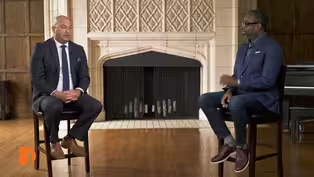
"One Detroit" contributor and American Black Journal host Stephen Henderson sat down with DPSCD superintendent Dr. Nikolai Vitti, to talk about the success of the school at Marygrove, and to get an update on the status of the entire district.
(ambient synth music) - Let's start talking about where we are.
We're at Marygrove and you guys have a really, really interesting school here now.
Really successful experiment, I think, with a different approach to education, a partnership with the University of Michigan.
Talk about what is happening with the school at Marygrove.
- Yeah, it was exciting, this past spring we had our first graduating class, about 90 students, 95% graduation rate.
- And we should take immense pride in our achievements.
- The vast majority of students going to college or one of our trade schools, so a very successful first graduating class, the pioneers of what we're building here, which is going to be a really early learning to 12th grade continuum.
- Firstly, my dad heard it over radio, and he heard that University of Michigan is actually gonna be on site on campus.
So that was the real attraction of being at Marygrove.
- What's unique about the partnership with Michigan is not only our different work with the curriculum.
So we use our core, a lot of project based learning and teacher development.
So we are training future teachers, mainly for DPSCD, but even, you know, throughout the state.
And the real opportunity is just the continuity of learning with the partners.
And that'll expand into support for the community with a health hub and, you know, stronger parent engagement, and revitalizing the community, you know, long-term through the schools.
- The majority of the students are from the city of Detroit.
So we have an examination process where they have to take an exam in order to qualify to be admitted into the school.
- It's very intentional about recruiting families from the neighborhood.
So it's a nice blend of a more application exam school, but with the neighborhood component.
- It was a lot of trial and error.
We're figuring out like, what should the building look like itself?
So we get to, we did have a lot of construction, but we get to see like literally the school from the ground up.
Like the lounges that's on every floor, we got to do that.
We actually came up with that idea in our engineering class, and then it was implemented into the building.
- And one of the questions that I hear when people talk about the school is what we're learning from this that we might see show up in other schools.
You've got a blend of kids here from around the city, but there are so many kids who could use the the opportunity.
How do we grow that?
- Well, you know, it's still early, but I think we'll definitely see the advantages of working with students at early ages.
Even before pre-K, kindergarten.
And I think we're also starting to see some exciting things around engagement and student voice, through the curriculum enhancements that we're using through University of Michigan.
When we think about the past, and there are certainly negative things about the past, but one of the positive things about the past when we think about DPS is that people went to their neighborhood school, and there was a continuity of learning and that comes with stronger relationships.
It comes with stronger trust, it comes with people staying in their neighborhood, investing in their neighborhood, you know, buying the home in the neighborhood.
And I think that's one of the, I think, future positive aspects of the Marygrove initiative, is that people are moving into this neighborhood, will stay in the neighborhood, and hopefully see their children going here from the early grades all the way to 12th grade.
And this is really about preparing children for college, and the world of work as well.
But, you know, those are things that can definitely be replicated.
And obviously the teacher pipeline work that we're doing with University of Michigan is also something that can be replicated in other feeder patterns.
- Yeah, yeah.
That's a big part of U of M'S involvement here is about teacher prep, and making sure we have enough teachers to teach in the system.
Again, how does that impact DPS more generally?
- Well, I think, you know, certainly there will be, it'll be easier to recruit teachers here through that pipeline as we build out the younger grades.
So, you know, obviously we have now 9 through 12, but we're also K to 3.
And so as we go into further grades, we need more teachers, and as we increase enrollment, so there's a direct pipeline through the teacher development program with University of Michigan, and the program here at Marygrove.
But even other schools, what we have found even beyond the University of Michigan partnership with teaching, is that we're probably better off growing our own talent as far as teachers within DPSCD.
- Let's talk more about teachers.
Teacher contract is always an issue, something we always think about here in Detroit.
You've got a new one.
Talk about the features of that, the things that you think are real positives.
- Yeah, you know, I think, you know, it's always difficult to agree on a contract, because there is realities on what our teachers deserve, and in our budget, that allows that to happen.
And I think we've done a great job of being fiscally responsible.
The good thing is DPSCD and DFT agree that our teachers need to make more money.
So we don't sit at the bargaining table saying, you know, we're gonna throw cents to you.
We know our teachers need to make more money.
So this last contract moves our most veteran teachers to $90,000 a year, much more competitive when you look at the suburban school districts, the teachers on the top, or the most veteran teachers, are still not quite where the suburban school districts are.
And, but we're getting closer, and we need equitable funding from the state to get to that place.
But our beginning teachers are the highest paid in the area, in the region.
You know, our, our most veteran teachers have gone now from about $68,000 a year to $90,000 a year.
And we start this year, which 70 teacher vacancies which is higher than we've had the past couple of years where we've been fully staffed.
But 98% of our classrooms have a certified teacher, and the 70 are mainly special education teachers, which we you know, through some waivers, we will get most of those filled in the next couple of weeks.
So we're strong when it comes to filling classrooms, but we have to think to the future.
And that's why, you know, the program here at Marygrove with University of Michigan and our On the Rise Academy program is developing our own talent for the future.
- What about other things that teachers think about?
Things like class size, the things that they have to manage every day.
How are we doing with making sure that those are the way they need to be for them to be successful?
- Yeah, we're one of the few districts across the country, and even regionally, that define class size.
So we allocate teachers per school based on the number of students.
And so for the high school, our target is about 25 to 35 students.
And then when we go above that, we add a teacher to the allocation, a little bit lower in the middle school and elementary level, but we define that, we publish it, it's how we build our budget and our personnel.
Most districts don't do that.
Our class sizes have dropped over the last six years, because we have that model.
Teachers also want to be supported, you know, by their leader.
And I think our relationship between our principals and teachers have improved.
We do a survey which asks teachers how professional development is going, how are things like classroom management, and support for that.
And we analyzed that survey data, and then we work with our principals to improve just climate and culture.
- What about enrollment right now in the district?
I know we took a big hit during COVID in terms of not just keeping kids enrolled, but keeping them engaged in school.
Are we seeing much of a rebound from that?
- So we have, we're still now where we were before the pandemic.
Before the pandemic, we had reached an all time high in DPSCD history and really DPS over the last 20 years, over the last 20 years, we never saw improvement in enrollment.
We did improve enrollment by 6,000 students before the pandemic.
And then that fall after the pandemic hit, we lost about 3,000 students.
Since then, we've picked up an addition, or 1,000 of those 3,000.
So we're still down about 2,000.
On the positive, we used Covid relief money to fill the gap of our budget, you know, at a lot of new initiatives that we've always wanted to do.
Most of those are continuing post Covid funding, but our budget is balanced based on the reality of losing 3,000 students, without one time infusion of Covid relief funding.
So I'm not worried budgetarily, about where we stand with enrollment, but obviously we want to enroll more students.
So right now, I would say with, you know, about two weeks of school in, we are at budget level going into this year, and I think we'll increase a little bit more by the end of the year, but I don't think we'll be at pre-pandemic levels with enrollment.
- So when you talk about making the budget essentially match that expectation for kids, I mean, in this state money follows students.
If you don't have the students, you can't get the funding.
What kind of choices does that look like?
What kind of sacrifices?
- Yeah, so those, that was already done, that we budgeted going into this year, the '23-'24 year, based on the spring enrollment of the previous year, - Last year.
- Right.
So we don't have to do any more cutting going into this year or future years, 'cause we're completely balanced.
If we increase the amount from the spring, which really will just be extra revenue.
So what we had to do is reduce the number of central office positions we had.
We also had to reduce some of our staffing at schools.
Not classroom impacted, but refine things around for example, school culture facilitators, paraprofessionals.
And I believe the kind of improvement that we saw last year which was really our first year back to the reform, I have no doubt that we're gonna just accelerate our student achievement progress, despite the cuts that we made.
If I worry about something, I worry more about attendance, student attendance, 'cause it's dramatically impacting student achievement.
But I'm not worried about our budget vis-a-vis enrollment.
- Yeah, let's talk about absenteeism.
You can't talk about that problem without linking it to the mobility issue.
The number of kids who start school in one place and end up somewhere else.
Talk about where we are with that.
Of course, that hit a real crisis during the pandemic, but even after you guys have had a real challenge with it.
- Well, as you know, DPSCD, DPS has always struggled with chronic absenteeism, and that's linked to the concentration of poverty in the city.
And that's linked to the amount of movement that families experienced through eviction, through trying to find jobs, you know, pool resources, but with living with each other, so students can move two to three times a school year.
We've tried to combat that by creating some more uniformity throughout the district around the curriculum.
It's standard across the district from really pre-K to 12.
So even if a student moves, they can really pick up where they left, as far as the curriculum is concerned.
You know, we've put a lot of dollars into data systems to track students, to follow up with home visits.
I think all of that has improved over the years.
And, you know, we've seen improvement in chronic absenteeism since the pandemic, but our numbers are still higher than they were before the pandemic.
Average daily attendance has improved but chronic absenteeism is one of really three areas that have not improved from the pandemic.
One is enrollment, two is chronic absenteeism, and three, we still have some work to do in mathematics and in the elementary, middle school level.
But all our other areas have improved since the pandemic.
Literacy rates are higher than for the pandemic, college readiness defined by the SAT is higher than it was, our average daily attendance is higher.
So the district has really rebounded from the pandemic outside of those three areas.
- You've been here now, remind me, - Going into year seven.
- [Stephen] Year seven, okay.
- The second longest superintendent, - I was gonna say, - serving superintendent.
- that's a long time for a Detroit superintendent.
- Yeah, yeah.
- At least in modern terms.
Give me an overall assessment of the time you've been here, and what you, I guess are looking forward to as you get longer and deeper into that tenure.
- Yeah I think, you know, even the sharpest critic would say that we've gotten better over the last seven years.
You know, we've improved enrollment, improved staffing, we were at 500, 400 teacher vacancies, you know, to talk about 70 is a major improvement.
Teacher compensation has dramatically improved.
The quality of our principals has improved.
Graduation rates now have improved.
You know, the financial status of the district has improved with, you know, back before I became superintendent, we would have almost thirty audit exceptions, with millions of dollars in penalty.
And now, you know, two audits, we're completely clean.
We have a reserve, actually, funding on the side, which we're slowly investing in facilities.
Well, I think for me, it's about accelerating student achievement.
I want to be not only the most improved large urban school district in the country, but I want to get closer to being the best large urban district in the country.
I want to get very intentional about succession management, not only for the school board, but for myself, for principal leaders, and central office.
So, you know, we've turned around the district, but I want this to be sustainable.
I don't, you know, when my time is done, I don't want all of this to fall apart.
And, you know that's how a a well-functioning organization operates.
And that's what I believe DPSCD should look like.
- [Presenter] And again, you can see the half hour documentary "The Pioneers of Marygrove" here on Detroit Public Television on Friday, September 15th at 9:30 PM.
Let's turn now to Hispanic Heritage Month.
The celebration of Hispanic culture, history, and contributions runs from September 15th through October 15th.
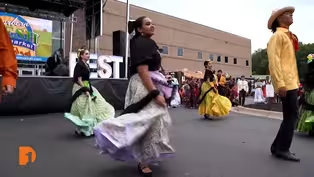
Locally, a dance troupe in southwest Detroit is bringing awareness to Mexican traditions by preserving a unique style of dance.
When Detroit contributing producer deja Moss visited Ballet Folklorico de Detroit to learn more about the inspiration behind this talented and passionate group of dancers.
(ambient synth music) (speaking in foreign language) - Our mission is to emphasize, or to bring to southwest Detroit and Michigan and our community an awareness of the Mexican folkloric culture, like Mexican dancing and its traditions.
(singing in foreign language) - You know, Folklorico is alive in Mexico.
It's not over here.
And so one of our missions, right, our students, predominantly have Mexican heritage.
You know, they're Americans, but they have Mexican heritage, and we want to give them a sense of pride in their culture.
You know, they can't experience it here, they have to go to Mexico to experience it, you know, so we kind of try to bring it here, so that way they can be like, oh, this is what it's like, you know, to be over there, to be over there and to experience all of this stuff.
So we're trying to give them, like oh, have pride, you know, especially in these days and times.
It doesn't feel good a lot of times, in the news and everything to be Hispanic.
- If you've ever gone to a Mexican Folkloric performance, that you'll see the girls wear, or the performers wear different costumes.
Like one time, you know, one time they might have a big dress on, another time a small dress on.
That's because all the states of Mexico, and regions within those states, all have different styles of dance.
So, and with those different styles, sometimes there was an influence, like an indigenous influence, or a Spanish influence.
And it's very serious, the keeping those traditions alive and not changed.
So there's a whole culture behind it.
Like if you're doing this type, like right now we're learning Sinaloa, and Sinaloa Mestizo, and there's different posture, there's different ways to do the dresses.
There's different ways, the steps, everything is unique to that.
(upbeat folk music) - The role that dance plays in Mexican culture, there's really three, right?
It's recreation because it's fun to dance, right?
Everybody goes and they love to dance.
It's educational, because you're preserving the traditions and the culture, right?
Because it can still, like, if they weren't, like making a concentrated effort to preserve it, right?
It could change, it could just change.
So it's educational.
And then the third thing is that it's good for your health.
(upbeat folk music) So anyone can join Ballet Folklorico de Detroit, right?
One of the first things I ask people if they're, especially if they're not Mexican, right, they're like, oh, well I'm not Mexican.
I was like, well, do you like Mexican food, right, and most of the time, because Mexican food is so good, they say, yes, I love Mexican food.
And I'm like, but you're not Mexican, so why do you have to be Mexican to love Mexican dance?
(upbeat folk music) - We've been part of the Ballet Folklorico de Detroit for six months.
I like being a student, because there's like so many kids there.
'Cause in our other dance group that we were in there was like not that much kids, so I like being like part of like the group of kids that are in this group, but what most connects me to the Mexican culture is the movement, because there's like these different types of movements with like putting your skirt really high, or like low, stuff like that.
(upbeat folk music) I've been a part of the dance group six years.
Before I joined the dance group, I did not know much about the dances and the culture.
What inspired me to join the dance group is watching my sister dance, and how she was having fun.
- I've been in the group seven years ago.
My favorite part of being part of it is getting to dance, getting to perform, and getting to know, getting to know new places.
(folk music) - So we really want the crowd to feel like if they're watching us perform Sinaloa Mestizo, that they're in Sinaloa watching a performance from the people in Mexico doing the dance.
So that's what I want.
I want to transport them them to Mexico, and so they can experience it, and then they they'll be in awe, like, oh my God, I just went to Mexico, in these three minutes on stage.
(upbeat folk music) When we're dancing on stage we're really trying to keep these traditions alive.
And there's people here who haven't experienced it who even though they know Southwest Detroit has this vibrant Mexican culture, right, they don't know it.
So when they come in, they see us, I really want to impact them.
Like, yes, Southwest Detroit, there's this culture that's alive here, right?
And that when they come and they see us, they can really feel it, right, when they go to one of our shows, they feel Southwest Detroit.
Like, oh yeah, this is why Southwest, they're always talking about Mexico town, because it's there, we're there, you know?
- Hey!
Hey!
(upbeat folk music) (applause) - [Presenter] There are events celebrating Hispanic Heritage Month taking place in metro Detroit along with other fun activities and entertainment this weekend and beyond.
Cecilia Sharp and Dave Wagner from 90.9 WRCJ have some suggestions on how you can spend your free time in today's One Detroit weekend.
- Hey Cecilia, do you smell fall in the air?
- Hey Dave, we gotta slow it down now.
There are still a few summery days left.
- Okay.
- At least I hope.
Either way, we have some amazing events happening around metro Detroit this weekend.
Let's start with the North American International Detroit Auto Show, running through September 24th at Huntington Place.
We can still take in some warmer weather and see the new model vehicles for the upcoming year.
- [Dave] You're right, Cecilia.
It really was a great decision to move it away from winter.
Well, another weeks long and loved event kicks off today in downtown Grand Rapids, it's ArtPrize, where for 18 days, art is exhibited in gallery storefronts, parks, speakeasies.
You name the space in downtown Grand Rapids, and there's probably art to be seen there.
- It's such a great celebration of artists and really, any artist can enter.
There's also $400,000 in awards given to artists during the event, through popular and jury voting.
The Detroit Public Library will be hosting several events in honor of Hispanic Heritage Month.
The first is a story time and Papel Picado craft that kids can make on Friday.
- [Dave] And on Saturday and Sunday, the Arab American National Museum hosts JAM3A Music and Arts Festival at the Heinz C. Prechter Educational and Performing Arts Center.
The event will have an all-star lineup of Arabic musicians and a curated vendor market.
- Hey Dave, who you gonna call?
- What Cecilia?
- Ghostbusters.
- Oh yeah.
Oh yeah.
- Yeah.
Well, Ghostbusters live in concert comes to the Orchestra Hall September 20th and 21st.
- That does sound like fun, Cecilia.
And you know what?
There's much more going on this weekend.
So let's check out a few other events right now.
(synth music) - [Presenter] That will do it for this week's "One Detroit."
Thanks for watching.
Head to the one Detroit website for all the stories we're working on.
Follow us on social media, and sign up for our weekly newsletter.
- [Promoter] From Delta faucets to Behr Paint, Masco Corporation is proud to deliver products that enhance the way consumers all over the world experience and enjoy their living spaces.
Masco, serving Michigan communities since 1929.
Support for this program is provided by the Cynthia and Edsel Ford Fund for Journalism at Detroit Public TV.
- [Presenter] The DTE Foundation is a proud sponsor of Detroit Public TV.
Among the state's largest foundations committed to Michigan focused giving, we support organizations that are doing exceptional work in our state.
Visit DTEfoundation.com to learn more.
- [Presenter] Nissan Foundation, and viewers like you.
(synth music) (cheerful piano music)
Ballet Folklorico de Detroit Keeps Mexican Traditions Alive
Video has Closed Captions
Clip: S8 Ep11 | 6m 56s | A local Southwest Detroit dance troupe keeps Mexican folkloric dance alive in Mexicantown. (6m 56s)
DPSCD Supt. Dr. Nikolai Vitti shares 2023-24 school updates
Video has Closed Captions
Clip: S8 Ep11 | 13m 25s | Detroit Public Schools Supt. Dr. Nikolai Vitti shares his priorities for the school year. (13m 25s)

One Detroit Weekend: September 15, 2023
Video has Closed Captions
Clip: S8 Ep11 | 2m 36s | Check out local events happening in and around Detroit this weekend and next week. (2m 36s)
Providing Support for PBS.org
Learn Moreabout PBS online sponsorship
- News and Public Affairs

Top journalists deliver compelling original analysis of the hour's headlines.

- News and Public Affairs

FRONTLINE is investigative journalism that questions, explains and changes our world.












Support for PBS provided by:
One Detroit is a local public television program presented by Detroit PBS