
Dr. Robert A. Underwood
Season 2023 Episode 1 | 26m 45sVideo has Closed Captions
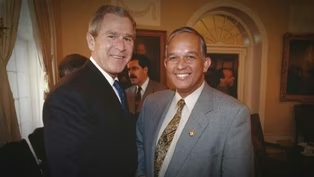
The Honorable Robert Underwood has served five terms as Guam’s Congressional Delegate.
The Honorable Robert Underwood's advocacy, public service and legacy reflect his passion for his homeland, the broader Pacific, commitment to high educational standards and devotion to issues of justice and equity.
Problems playing video? | Closed Captioning Feedback
Problems playing video? | Closed Captioning Feedback
SAINA is a local public television program presented by PBS GUAM
This program has been made possible by the Government of Guam Education Stabilization Fund.
Dr. Robert A. Underwood
Season 2023 Episode 1 | 26m 45sVideo has Closed Captions
The Honorable Robert Underwood's advocacy, public service and legacy reflect his passion for his homeland, the broader Pacific, commitment to high educational standards and devotion to issues of justice and equity.
Problems playing video? | Closed Captioning Feedback
Where to Watch SAINA
SAINA is available to stream on pbs.org and the PBS app.
Providing Support for PBS.org
Learn Moreabout PBS online sponsorshipWhen I was in the 11th grade, we had a speech class and Ms.
Hebe was our speech teacher We would rate each other and she says, "I want you to just rate each other- don't rate on the content, doesn't matter what they're talking about just rate on the style and the flexibility and their ability to talk and communicate.
So then one time she asked for suggestions.
So my suggestion was, "why don't you let us give speeches in CHamoru?"
Well, in 1964, this was like unheard of, radical, crazy idea.
She came back the next day and intimated that someone had accused her of being a racist.
I ended up in the principal's office for my suggestion.
I wanted- really what I wanted out of it was to challenge myself.
I wanted to speak as much CHamoru as I could.
I kept insisting that people have conversations with me in CHamoru.
While everybody else was trying to increase their knowledge in English and I'm just like, "Ah!
I know that."
So that's that.
[MUSIC PLAYING] If people look at you differently, don't get mad.
Just think of how much better you are or draw on your strength.
That's the lesson that I learned from my parents.
I left Guam when I was nine years old.
And of course, it was- it seemed like a great adventure but of course, it tore me pretty much apart from everything that I'd known here, almost all my classmates from that time and teachers I've seen some of the notes.
"Roberts always telling stories about Guam."
At that time period of my life, I was involved as my older brothers were, involved in Chicano youth culture, kind of hung around with a lot of Chicanos learned how to talk a little bit pachuco talk, cholo talk, "Orale vato!"
You know, all that kind of stuff.
So it was kind of part of our up and our sense of self, but always mindful of who we were and where we came from.
My parents are sort of unique individuals.
They had a very contrarian approach to things, always a little bit feistiness in them.
My parents spoke CHamoru to each other almost all the time and my mother almost always spoke CHamoru to me; my father in more formal settings.
Actually, my CHamoru was pretty good.
I was aware of who I was and that I had this kind of unique experience and we would use it.
My father, one time I was- we were walking in downtown LA and people always speaking Spanish to me.
And I would tell him, "Well, what should I say?"
He goes, Don't feel awkward.
Feel proud.
Counter it.
My father had a kind of a wry sense of humor and a way of poking people.
And I kind of learned that.
If people thought that we were unusual, so what?
If people thought that we were different, so what?
This is who we are.
Don't give in to them.
Don't let them think that they got you.
Just be who you are.
And who you are is always going to be strong enough.
So I came back, I was 15.
I was at Tumon Junior-Senior High School as an 11th grader.
So kind of a whole brand new experience for me coming from the states.
And for me, the most interesting part was of course, was me and language.
I had a pretty good knowledge of CHamoru.
And then I found out that- not many, but there were maybe 5 or 10% of the students who were my contemporaries, who are CHamoru, who couldn't really speak CHamoru.
I was shocked.
I said, "Why can't you speak CHamoru?"
Here I've been gone all this time and I can speak CHamoru.
What's the problem here?
I wasn't a good speaker.
Most of my contemporaries at the time spoke way better CHamoru than me, but I was willing to get engaged.
So now those same people, ironically.
Those same people that were really accomplished speakers in CHamoru when I was in high school.
When I talk to them today, they're not so good.
It's kind of sad, it's really kind of sad, because they've been spending all their time talking to their children and grandchildren in English and they're forgetting.
That's sad, because language is a kind of a key to understanding who you are.
It ties you into a whole level of knowledge that goes back centuries that you don't really even begin to understand.
So all of that really cemented my- my great interest in the CHamoru language.
There is no no facet of CHamoru existence more embedded in our history than the language.
You have to get in tune with it.
You have to kind of understand the power of it.
You have to understand its history.
You have to use it.
You have to get involved in it.
And you have to make mistakes in it.
My gosh, of course.
Of course you're going to make mistakes.
Of course one of the things that kind of impede learning CHamoru is CHamorus just like to make fun of each other.
So you make a mistake, they just have no mercy on you.
They embarrass you.
My uncles would say- my mother's brother, "Hey!"
You know, just the kind of demanding and the tone of it and the- just the whole ambiance of it was not exactly conducive to me learning it.
Or trying to get more engaged in it.
So don't let those barriers get in your way.
And so, I'm so grateful that right now we have hundreds of younger people who are second language learners of CHamoru.
They didn't grow up speaking CHamoru, but they speak it now and some of them speak better CHamoru than their parents.
So you have to hang on to that because that's the single thread that takes you back 3500 years.
I tell my own children that when get older and I'm laying in bed, I'm not going to use English.
So be ready.
Get ready.
Well, here on Guam, my adolescence was great, because you know, I was cute.
So- I got a lot of attention from girls which I never had before.
But other than that, I was not rebellious, but I wasn't exactly a conformist.
So I wasn't really a good boy.
I remember walking into a biology class.
Mr.
Zumwa, he said, "I've seen your kind before."
And what kind?
[LAUGHS] I just got here.
I went back to California.
I went to community college and I went to Cal State LA.
I had a job.
I sustained myself.
I didn't rely on my parents for any support.
I paid for everything myself.
I worked at UPS; United Parcel Service.
For a time there at work, everybody called me the "The Agitator," cause I'd be always asking poignant questions, "What are you doing to help your people?"
"What are you doing to stop the "Do you know the UPS is ripping us off?"
I was always sort of kind of poking and prodding people.
All that kind of political turmo which I was involved with, I participated in a lot of demonstrations against the war; against the Vietnam War.
I got to meet Muhammad Ali.
He came to our campus to speak, and he was very much against the It was the day before I left California to come back to Guam, I watched the March on Washington.
I watched it live on TV, sitting there watching Martin Luther King giving his speech.
And, of course, a guy named John Lewis, who later on became my friend when I was in Congress, That's like one of the most amazing experiences I ever had.
Of course, I didn't know that John Lewis later on became the leader of the marching across the Pettus Bridge and the march on Selma for voting rights and he got beaten up.
So all of that history that I was later on to become- not part of, but to come in touch with.
Were things that I think my life had prepared me for, like trying to understand things trying to understand social change.
In the back of my mind, I knew I was always going to go back to Guam.
So when I go back to Guam, I do something different.
I had been an activist.
Protesting this.
Arguing about this.
Going to the United Nations.
I came out for independence.
On the front page of the PDN, Underwood says he's for independence.
How can anybody like that win an election for U.S.
Congress?
Well, I did it.
And I went into the House and I ran into all kinds of issues.
The main issue, which is still an issue is land; land return.
Mr.
Speaker, today I am introducing legislation to provide a method of returning excess lands no longer needed for defense purposes on Guam.
And some of the legislation which I passed which have given back, ironically, thousands of acres to lots of families.
Some of these families have become rich by getting back their land.
In an ironic way, I asked one of them to put up a campaign sign and they said, "No, I'm not allowing you to put up your campaign sign on my property."
I guess you could get dispirited about that, but I don't.
I had a district director.
We were counting it at one time.
We think about 40 families got their land back.
I said, "How many families have come back and thanked us?"
He said, "Three."
I said, "Yeah, I know one of them."
Because even his son stopped me at the airport one time.
"I just want you to know that we're grateful.
My father always told me that we should be grateful to you."
But the others?
It's just a sign of how people, short term memories and that again, in politics, as in life, you better have an internal mech that allows you to deal with both the great adulation that you get and the great disrespect that you get.
And I always tell people who run for office and are in politics.
If you don't want the exaggerated blame, which you'll get, people will blame you for everything.
Then don't accept the exaggerated praise.
So in my interaction here, in politics in Guam, is I've had people who invest- emotionally invest their future into you and it is such a burden in politics that they've invested their future with you.
They think of you that you're going to solve a bunch of problems that you never can really solve.
And you try to counsel them, but they get involved in that moment.
So when you run for office and you win, then they're with you.
You enjoy it.
When you run for office and you lose, I'm hurting for them more than I'm hurting for myself, because I can always go do something else.
Because I have something inside of me.
It can be in you.
It's in every human being; inside of you that allows you to be the best that you are.
As long as you're managing yourself.
As long as you're controlling yourself.
That's the kind of ultimate self-determination.
And you're just a human being just doing what you can and knowing in your heart of hearts that you're trying to do something.
So I ran for Congress, my strong stance on behalf of CHamoru self-determination.
I was portrayed as a racist.
I was portrayed as a racist against Filipinos, that I didn't like Filipinos.
And of course, this was a kind of a political buzz that they tried to create.
So when I ran for governor, again it was the same thing that I had experienced back in 92'.
So they ran some really awful ads and they put out a flier.
If you got it in the mail, it looked at it and it says- it had on it a one way trip to Manila, implying what Robert Underwood wanted to do was to give Filipinos a one way ticket back to Manila.
My reaction to that initially was that it can't- it was so- crazy that nobody would believe it, but it kept eroding and eroding my support.
So after I lost that election, I thought, "Wow, what am I going to do next?"
Well, I'll run again.
So I prepared to run again in 2006, which I did.
And I ran with Frank Aguon.
And again the same kind of tactics were pulled out.
Most indicators were that that election we were going to win.
And I went to Election Day thinking I was going to win, and then we ended up losing by a couple of thousand votes.
So pretty disgusted about that.
That's politics.
But you never know what happens with people.
Some people get straight.
Some people never get straight.
I had a friend in high school in California in Norwalk High.
Then later on in community college, I saw him a couple of times and he gave me a ride once and he said to me, "Robert," and he used the N-word.
He goes, "I wish I had me an N-word killing machine, because I'd just throw them all in there and they'll all get killed.
And then once in a while, I'll throw a Mexican in there just to grease it up.
I never talked to him again.
That guy today is an immigration attorney who's helping immigrants come into the United States for free.
So something must have happened in his life that helped him reshape these things.
Nelson Mandela was given the congressional award.
So I was sitting there near the front.
He was accepting the award and in the audience was Strom Thurmond.
He's the senator from South Carolina, and he was the leading Dixiecrat.
The biggest defender of segregation; racial segregation.
And when I saw this happen, I remembered both were boxers.
Nelson Mandela was a boxer.
And Strom Thurmond was a boxer.
Strom Thurmond went up to Nelson and raised his hand and said, "You're the champion."
Well, I thought I'd never see something like that, but then there it was, so you never know.
You can't just apply one set of judgments to people and kind of understanding that at the end of the day, sometimes the goodness of people triumph.
I came back to Guam in 1972.
The way we were reared was that both of my parents were always Democats.
My mother's brother is Richard Taitano, who was like the conceptualizer of the organization of the Democratic Party.
He was like the- kind of the brains of the outfit We were always raised to respect him.
Respect his intelligence and respect his integrity as a person and to be like him.
Uncle Richard, like my mother, was a Baptist, which meant that they were a part of a small sort of nonconformist community of CHamorus.
So what did Uncle Richard teach me in this?
Every time he was elected to the legislature, just like they do now, as soon as they're done getting sworn in, they go across the street to the cathedral to go to mass to get blessed.
He wouldn't go.
He said, "I'm not going to that."
He said, "that being a Catholic has nothing to do with being in the legislature."
"And I'm a Baptist."
Then he also told me, he goes, "Robert when I die, I'm not going to have a state funeral, because I don't want all those people standing up there and lying that they like me when I know they were trying to ruin my life my whole time."
He said, "you have to be honest with yourself."
So I've told Nerissa and I've told all my children, when I die I don't want a state funeral either.
I'll just be buried and I'll be happy and that my whatever record I have I don't need the glorification.
But that comes from having an inner sense of strength and clarity about who you are.
In my own religious background, raised a Catholic, but really understood the power of faith, even from my mother's perspective, even in that tradition where you talk to God like a friend and I do that every morning, That keeps me strong.
So you need to kind of dig deep to find that inner spirituality.
As certainly my mother told us over and over and told me over and over, "The fact that you're a smart persn is not something you earned.
You didn't work at being smart.
It was a gift.
It's a gift from God."
And it could be anything, it could be your intelligence, it could be your personality, it could be your relationship with your children.
Whatever that gift is, God gives you gifts and you have to find that gift.
And then you have to use it in the purpose for which why it was given to you.
You know that- that's the core of CHamoru values.
When people say inafa'maolek or they say chenchule' or ayudu or any of those things, all of those things are about reciprocal obligations And it has that mamåhlao.
So mamåhlao is sometimes just translated as being ashamed.
but it's really being reticent.
Don't be brash in your interpersonal actions.
Be even tempered.
Don't show off.
Of course there were times that I showed off.
There were times that I was brash, but those didn't work out as well as the times when I was a little bit more reflective and followed my mother's advice.
If anyone can keep me grounded, it was my mother.
Because, you know, my mother was very direct.
She could tell you, "You're getting fat."
Or "You're not taking care of yourself."
"You look terrible."
I don't- I don't really remember my mother ever saying, "Wow, that's a great job.
You make me so proud."
I just don't ever remember that.
I knew she must have been, especially when I got elected to Congress.
So when she came to Washington, DC and she witnessed the whole thing and we made sure she had a good seat in the gallery.
And, you know, we paid attention to her.
And I wrote her a letter in which I said, "I may be wrong in this, and I'm sure people are telling you that you must be very proud of your son.
But I just want to let you know, the thing that I'm most proud about is that I am your son."
I'm always curious.
So that's been the basis of my life.
I have a lot of curiosity, so if I see something, then I want to learn something about it.
If I go someplace, I want to learn as much as I can about that place, so that I can enjoy it more.
I also want to know that I'm pretty ordinary.
I don't have a lot of money.
I don't have a lot of resources.
I'm not looking for any.
I'm just satisfied with what I have.
I lead a kind of an ordinary life that's fed by curiosity, that's fed by interest in Guam and fed by lots of love from those that are close to me.
I'm eager to help.
I mentor a lot of people.
I don't know how good it is, but a lot of people come to me on a regular basis and tell me about different situations they have professionally, not personally, because I'm not equipped to mentor anybody about their personal lives but their professional lives.
And I'm happy to help anybody who also shares a kind of a desire, a curiosity for learning things.
We're responsible to others.
Every generation is responsible for protecting what we have in order to make sure that the next generation has something.
If they understand that whatever talents they have are gifts, then they understand that a gift has to be treated as an obligation to use in the service of others.
I've written so many things.
I've said so many things.
I've done so many things.
By any kind of indicator, I'm the most quoted person in dissertations about Guam.
I'm the most quoted person in theses about Guam.
I have a lot of personal publications, but I'm quoted in literally hundreds and hundreds of publications.
That part of my legacy and my contribution will far outlive me.
Maybe students in 20 years or 30 years will continue to kind of study things and say, "I wonder what Robert Underwood was thinking about this issue at this time.
And there's a long record of that and it's an important record.
And so I have to take my satisfaction in that.
And I do.
So my contribution to the island and my contribution to the CHamoru people and my love for the CHamoru language is not at all affected or threatened by the fact that I won some elections and I've lost some elections, because at the end of it I'm still here and I still have more to give.
And that's a fulfilling part of my life.
But, you know, the most fulfilling thing I did this past week was watch my granddaughter, Tavia Underwood, run a 100 meter dash up at JFK track.
She came in number four out of five.
I couldn't be happier and I couldn't be more proud.
[MUSIC PLAYING]
Video has Closed Captions
Preview: S2023 Ep1 | 30s | Dr. Robert Underwood speaks about adulation and disrespect within politics. (30s)
Providing Support for PBS.org
Learn Moreabout PBS online sponsorship












Support for PBS provided by:
SAINA is a local public television program presented by PBS GUAM
This program has been made possible by the Government of Guam Education Stabilization Fund.