Utah Insight
Drought Disaster
Season 2 Episode 4 | 26m 23sVideo has Closed Captions
With extreme drought plaguing most of Utah, what will it take to turn things around?
Utah is the second driest state in the country, but still leads the nation in water consumption. Earlier this year, Governor Cox declared a state of emergency due to extreme drought conditions. With a growing population and changing weather patterns, we look at what can be done to make sure Utah doesn’t dry up. Plus, the one industry using a majority of the state’s water.
Problems playing video? | Closed Captioning Feedback
Problems playing video? | Closed Captioning Feedback
Utah Insight is a local public television program presented by PBS Utah
Utah Insight
Drought Disaster
Season 2 Episode 4 | 26m 23sVideo has Closed Captions
Utah is the second driest state in the country, but still leads the nation in water consumption. Earlier this year, Governor Cox declared a state of emergency due to extreme drought conditions. With a growing population and changing weather patterns, we look at what can be done to make sure Utah doesn’t dry up. Plus, the one industry using a majority of the state’s water.
Problems playing video? | Closed Captioning Feedback
How to Watch Utah Insight
Utah Insight is available to stream on pbs.org and the free PBS App, available on iPhone, Apple TV, Android TV, Android smartphones, Amazon Fire TV, Amazon Fire Tablet, Roku, Samsung Smart TV, and Vizio.
All Episodes Now Streaming
Hosted by Jason Perry, each week’s guests feature Utah’s top journalists, lawmakers and policy experts.Providing Support for PBS.org
Learn Moreabout PBS online sponsorship[bright music] -Funding for Utah Insight is made possible by: - [Raeann]: Tonight on Utah Insight: A State of Emergency - It's really bad.
It's as bad as it's ever been.
Utah is preparing for the worst drought conditions on record.
How is the state taking action?
- It rains a little.
So... Yeah, I'm pretty mindful of conserving water myself.
- And what you can do to help save water.
Experts join us to weigh in on Utah's drought disaster.
Welcome to Utah Insight.
I'm Raeann Christensen.
Utah is the second driest state in the country but still leads the nation in water consumption.
We haven't gotten a lot of snow or rain, and we've had hot temperatures.
This year, we are now in one of the worst droughts we have ever seen.
Take a look at this drought condition map of Utah.
About 62% of the state is in an exceptional drought.
90% extreme and nearly 98% severe.
The entire state is in a moderate drought and abnormally dry.
Joining us to talk about the extreme drought and what can be done to help, Zachary Frankel, the executive director of the Utah Rivers Council.
Joining us by Skype, Lexi Peery, Southwest Bureau reporter for KUER, and Todd Adams, director of the Utah Division of Water Resources.
Thank you so much for being here with us today, and Zach, I wanna start with you.
What's going on this year?
What is the big problem?
- The big problem, of course, is that we're in the middle of a climate change mega drought, and the last 20 years, we've seen our snowpacks shrink down, because our winter time air temperatures are so much warmer.
So that means winter is a shorter season.
It starts later, and it ends sooner, and so those effects mean we have less snow, and that's a big problem for our water supply for all of Utah, because about 85 to 90% of the water we drink and apply on our farms and apply on our landscapes outside our homes and businesses that comes from snow melt runoff.
So that's really why we're in a drought this year.
- And it's gonna be ongoing.
This is just gonna continue year after year.
- Absolutely.
That's right.
You know, climate change is here to stay.
The question is how much worse is it gonna get?
In the Colorado River in the last 20 years, we've seen a 20% decline in flows, and many scientists are saying we can see a 40% decline over the 20th century average of flows.
So we really need to batten down the hatches and get prepared for the new reality we're in today.
- Okay, and Lexi, I know that you are a reporter in your area, and Southern Utah is in a D4 drought, the worst that it can be.
Have you seen it this bad?
- Yeah so, I'm based in St. George.
I've only been here just under two years, but you know, this year it's a lot more pronounced.
You know, everywhere you look, this is something that you can see at a very visible, in a very visible way.
You know, I've been out to Sand Hollow and Quail Creek reservoirs that Washington County are known for, and you know, they're a lot smaller.
You know, beaches are a lot bigger, which may be good for beachgoers, but you know, the reservoirs have a lot less water.
Another way that we're seeing the impacts of the drought in a very visible way is wildfires.
You know, I was out at Zion National Park at a burn scar of the first February fire that the park has ever had, and you know, drought and wildfires are very connected, and so in Southern Utah, we're seeing it much more pronounced this year, and it's concerning.
- Okay, and Governor Cox just this week issued more executive orders regarding the drought.
Limiting water on the state home facilities.
Also calling for residents to conserve more.
Todd, do you think that the state is responding adequately, or do we need to do more?
- At the governor's press conference yesterday, he called on all Utahans to do their part as well as municipals and water providers to do their part, restricting water at the state facilities in the North two days a week and three days a week in the South, but has also asked that the local water providers provide restrictions in their local area based on their conditions to do their part also as well as things that us as citizens can do to reduce our water use.
- Okay, and Zach, how do you feel that the state is doing?
- The state's really doing an inadequate job in preparing us to get out of and get through this climate change mega drought.
There's just no question.
The most important thing to understand about water in Utah is that it is a moneyed interest.
It is a special interest like any other.
So any American knows that once you start proposing billions of dollars in new spending, there are winners and losers, and the winners are the ones that hire the lobbyists to get those contracts and to get that spending approved, and so what we have seen in Utah water policy on the state level for decades now is real inaction on reducing our nation-leading water use.
We've seen opposition to water conservation in the halls of the state house, literally for more than 20 years, and so it's not just about facts and information.
It's not about policies and technologies.
It's about what do we need to do for the people to be represented against what the interests are of the moneyed special interests in the state house.
- Okay, and we asked you on social media.
Utah is in a drought emergency.
Our reservoirs are low, and officials are warning of the dangers of a particularly bad fire season.
What do you think about drought and water use in our state?
Barbara Crandall on Facebook writes, this city actually pays people to drive around to check your recycle, and if you have the wrong items in it, they don't take it.
Hire someone to drive around and ticket residents watering their lawns in the middle of the day.
Now, Nevada just put a ban on nonfunctional grass.
We're already starting to see mandatory restrictions being put in place in Lehi, some places in Weber Counties.
Todd, do you think that these things will help?
- Absolutely they will help.
You know, Weber Basin Water Conservancy District just put out a press event talking about three strikes, and you're off, and I believe that's gonna help.
I've seen, where I live in Davis County, I've seen a lot of reduction in water use over the last little bit.
With that said, we need to do more.
- And this is gonna be enforced.
- Yes, it will be enforced, and it will be enforced at the local levels.
- Okay, Lexi, are you seeing any mandatory restrictions in your area yet?
- There aren't any mandatory ones yet.
There's quite a few voluntary ones, you know, related to time of day watering.
You can't water, you know, between 10:00 AM and 8:00 PM, but I think that mandatory restrictions could be coming up.
Municipalities have already implemented firework restrictions and other fire restrictions.
So you know, I think that water restrictions could be, you know, on the horizon.
- And we saw that some areas are gonna shut down their secondary water early.
Do you think that will help us, Zach, towards the future of the secondary water?
Is that something we should be metering?
- Yeah, so Utah's the biggest secondary water user in the United States, and secondary water systems are extremely wasteful.
So what are we talking about here?
We're talking about old farm canals that got converted to sprinkle grass or flood irrigate grass, mostly in the suburbs, okay?
So most of those users are un-metered, meaning there is no measurement of how much water they use.
Okay, so it's like an all you can eat buffet.
So you wouldn't send someone on a diet into an all you can eat buffet, and say go have 50 plates.
Go have a hundred plates of food.
We have no idea how much you're gonna eat.
Go ahead and do it.
It's counter-intuitive to saving water, and there have been numerous bills at the state house to try and require meters on the secondary water users, and they've been defeated again and again and again.
So these secondary water users are paying a hundred, $200, sometimes more, in a one-time annual fee for all the water they can use.
So there's as much of this water being used in secondary water use as the entire, almost the entire Salt Lake Valley uses in a year, and the state's basically just been unable to enact restrictions to even just measure the use, not even pay for it.
When you look at the economics here, that's what we're failing to really utilize.
These secondary water users pay 10 cents, maybe they pay 20 cents per thousand gallons for the water that their neighbor using potable water to water their lawn might pay $2 or $3 or $4 per thousand.
So we're not even taking the first basic steps to really use economics to our advantage to save water, and it's time we tried.
- Okay, and Governor Cox at his last news conference here on PBS Utah says he sees the potential for mandatory water restrictions for residents, but those will happen by district, and he says most people over-water their lawns, and everyone needs to cut back.
- Let me just state unequivocally guys, it's really bad.
It's as bad as it's been.
We need everyone in the state to understand right now that we're heading into one of the worst drought and potentially worst fire seasons that we've seen, and we've seen some bad ones.
- So back to that secondary water discussion, Todd, residents should prepare for this, because it's coming.
In the press conference yesterday from the governor, he said, you know, we're working on this.
- Absolutely.
The legislature, in fact in this last legislative season, Zach, we work together on secondary water bill.
It's happened over the last several years, but we actually got funding for secondary metering in class one and two counties.
There wasn't a secondary meter developed 10 years ago.
Those meters have been created, and where they've been installed and provided smart billing and people the information, we've seen reductions in the 30 to 40% range.
- [Raeann] Okay.
- It's promising technology.
- Okay, and the state put together a new river board authority this year, possibly looking into tapping more into the Colorado River.
Zach, the Colorado River Compact is from 1922, and it's reported Utah isn't taking all of it's shares.
Do you think that's the answer to our water problems?
- Yeah so, you know, again, we're back to that money and interest, and the propaganda campaign it's created, which is a total false, fantastical claim.
The reality to the situation is Utah's used 100% all of its Colorado River water use.
The claims to the contrary are part of a lobbyist propaganda campaign, and it's shameful.
There is no more water in the Colorado River.
Everybody in the basin that takes water seriously knows the Colorado River is declined 20%.
The Bureau of Reclamation data from the federal government indicates clearly the river is declining, and as it declines, it's just like going to a diner to get a slice of pie.
You know, Utah gets a percentage of the pie.
If we go to that diner one night, and the chef has made a smaller pie pan, the pie is smaller, and our slice is smaller.
That's what the legal 1922 Colorado River Compact says.
It does not say we are owed a certain size slice.
It says we get 23% of what's left over.
There is no more extra water in the Colorado River for Utah to develop, and it's sad that the lobbyists have so much power that they've misinformed Utah legislators into believing we have some surplus in the middle of a climate change mega drought.
It's an embarrassing statement, and it's why the other six states in the basin are putting their foot down and saying no Lake Powell Pipeline.
- Okay, and I know Lake Powell is at historic lows.
Lexi, do you think a Lake Powell Pipeline is the answer to our water problems in your area?
- Yeah, it is concerning to see what's happening at Lake Powell.
You know, that bathtub ring that everyone talks about is just getting bigger and bigger, and is it the answer?
I mean, that's what local leaders think.
The Washington County Water Conservancy District, you know, this is their way of, you know, preparing for the growth and, you know, helping with the water supply that we have down here.
We only have one main source of water, which is the Virgin River which is also being heavily impacted by climate change, and so water leaders really want to have another source, you know, an alternative to the Virgin River.
You know, it's still concerning what's happening at the, you know, to the Colorado River, but leaders say, you know, it's better than having no other alternative.
So is it the answer?
I'm not really sure, but water leaders down here definitely think so.
- And Todd, how do you feel about the new river board authority?
Do you know what their purpose is?
Are they gonna be trying to tap more into the Colorado River?
- The Colorado River Authority Board, the new one that was passed in the legislation this year, will increase our capacity to work together on Colorado River issues with the other basin states.
The other basin states have created similar types of boards to negotiate and to work on the Colorado River issues.
- Okay, and with Utah's population expected to keep growing, many homeowners are trying to do their part to conserve water.
Liz Adeola takes us to Riverton and introduces us to an education program that is helping Utahans cut back in their yards.
- I have no talent with my hands.
- [Liz] That's not totally the case for Rodrigo Gonzalez, a chief designer behind some of the tall buildings you see in downtown Salt Lake City.
It's just that when it comes to his own backyard.
- That's when I show my lack of handiness.
- [Liz] That's when things get a little tricky.
- It was unfinished.
It looked just, it was just soiled, right?
Like it look awful like desert but really dusty.
So we were really uncomfortable for about seven months.
- [Liz] That is until a coworker told Rodrigo about Localscapes.
Now for full disclosure, PBS Utah is an educational partner with the program.
What Localscapes does is helps homeowners learn how to designate an open shape in their yard, create gathering areas and activity zones, paths, and planting beds, all while taking Utah's unique climate into consideration.
- They are great, and they're really mindful, and they really wanna help the homeowners too with the projects.
- [Liz] Participants make their way through the five-step program, taking classes that are now online at their own pace.
- Well I'm always excited to do something new.
Squash, jalapenos, (indistinct), and tomatoes.
They're growing fast.
I think they are gonna do great.
- [Liz] Yards simply covered in rocks.
Well, they're a thing of the past.
Instead, people are creating eye-catching landscapes that are also eco-friendly - It's amazing.
Every year now we cannot wait for the good weather to come by, you know, because we enjoy being here in the backyard and have some coffee.
Sometimes we eat outside.
- [Liz] Without having to worry too much about also feeding the foliage.
- Whenever it starts budding, it looks amazing.
- Yeah, it's beautiful.
- And then it's gonna grow like really big.
- It gets really big.
- It's really big.
- [Susana] It's beautiful.
- We live in Utah.
It's like a desert.
it rains a little.
So... Yeah, I'm pretty mindful of conserving water.
We have drip system for the bushes and the trees, and so far so good.
It works really well.
- [Liz] It's a benefit that could eventually offset the cost of local scaping a yard.
- You don't have to be a designer.
These guys give you all the pointers.
- [Liz] Rodrigo's wife Susana says it also helped them avoid costly mistakes.
- With those classes, you learn things that you have no idea about, like how to measure the trees, how far they have to be from the plants.
- I think it is organized, cause I am OCD myself.
We enjoy the process of course, right?
Seeing the transformation from having nothing here and having looking it like that.
I like it.
We could have done better though, now I keep thinking back, but I just, it is what it is I guess.
- [Liz] You're a perfectionist!
- Yeah.
Yeah, I'm terrible.
- [Liz] A perfectionist who found the perfect way to get out of doing too much yard work.
- Fertilizing the plants and bushes, the trees, the grass, and mowing.
That's about it.
This is gonna sound bad, but I don't like mowing.
I get allergies, you know?
Yeah.
- [Liz] Because less time mowing leaves more time for their pups and that perfect cup of coffee.
- [Susana] We love being outside.
- [Rodrigo] It's worth it.
It's really worth it.
So far so good.
I think we spend less water, and the maintenance is little other than keeping an eye on the bushes and the trees.
- [Susana] The dogs love it.
We love that they love it too, and yeah, we really enjoy being outside.
- I don't know if anybody likes mowing but.
So Localscaping, this is a super helpful way to incentivize residents to change landscaping at their homes.
Todd, we see this in Salt Lake County.
Any plans maybe to take it statewide?
- We've been working with the legislature on some new policy towards this.
I think the governor talked a little bit about what was going on yesterday with that in his discussions with legislative leadership, and we're working towards that.
- Okay, and turning to another social media comment.
J'lene Alexander says, I have so much to say on this.
How about rebates for homeowners to use drought tolerant landscaping and to encourage people away from thirsty lawns?
How about new construction having mandated to be xeriscaped?
How about more education on the sources of our water?
I would bet many don't know everything we use comes from our snowpack.
How about more education on the impact of our ever lowering Great Salt Lake on our ecosystem, and what will happen to Utah if it dries up?
Zach, that's a big, big question there, but do you think Utah's gonna dry up?
- Utah's not gonna dry up, at least not in our cities.
You know, most of the water we use in our cities is outdoors on our landscape for an ornament, something completely optional.
It's not really essential to our economy.
So you know, this idea that our grass is gonna die is kinda ludicrous.
What grass does is it goes into dormancy.
You might remember during the great recession when there were all those bank foreclosures, and homes lawns, it turns yellow.
When the home, it stayed that way for a year, and the new homeowners would come in and flip the sprinklers on, and suddenly it's green again.
So this obsession about grass is totally a silly thing.
You know, it's, again, there have been bills run by, in fact, powerful legislators at the state house, trying to remove the requirement that cities have to require grass to be constructed, and those bills have been defeated by the special interests of the state house.
There are many communities where grass is a requirement to be installed, and that's a problem.
The Localscapes program is a good solution, and it's one of many.
Look, the reality here though is we've got to stop watering concrete, and it's not gonna be stopped by advertising campaigns and finger wagging and asking people not to.
It's got to be done in the bill.
Utah has the cheapest water rates for municipal water in the country.
We gotta stop that.
We gotta stop subsidizing those rates with property taxes and sales taxes, which just bring down the cost of water.
Again, if we have this cheap, all you can eat buffet that we're charging people, we gotta expect they're gonna overeat, and you know, I can't drive across a neighborhood in the summer without seeing gutters full of water, because people are watering concrete.
There's no reason to water concrete.
- And Lexi, how are you seeing it in your area?
Are people xeriscaping, or are you seeing sprinklers on a lot down there right now?
- You know, actually Localscaping is becoming more of a thing down here.
I'm in the Southern end of St. George, and just south of me, there's quite a few developments that are going in.
Desert Color being one of them, and they're the first plan development in the state that's xeri- or Localscape certified.
So you know, driving around, new developments are being more conscientious about their grass.
You know, it's more in functional areas rather than decorative areas, and you know, I talked to a researcher though at Utah State University about Localscapes, and you know, she's on board.
They're great.
It's a great way to conserve water, you know, at your home, but she said that's not the solution for this year.
You know, tearing up your lawns and changing your plants out is gonna take more water to replant.
So she says wait until the fall, or wait until we're, you know, out of the worst of this drought, and that's the time to start thinking about Localscaping your lawns.
- Okay, and population growth is a really big factor here in Utah, where we're growing, and Todd, do you think that we have the water supply to support this new growth?
- Well the population growth in Utah, two thirds of it comes from within.
That's our kids and our grandkids that want to stay here, and who doesn't want to be with their kids and grandkids?
We need to conserve more.
We need to do more.
We need to become more efficient.
All those things in order to meet those population growths.
- Okay, and 80 to 90% of our water usage is agricultural, but much of it's being lost in canals and pipes.
So how do we go about fixing this, either of you?
- Yeah, you know, lining canals or putting them in pipes to make sure the water's not seeping into the ground is the name of the game, and when it comes to water supply, there's really just two numbers you need.
The one is the one you've named.
85% of the water we use in Utah's for agriculture.
Our population is growing into the agricultural land sector, and so we should be converting the water.
Unfortunately, we're ignoring that water source.
There's 40 canals in the Salt Lake Valley alone that are full of water today, and most of those canals are not lined with concrete.
The water's seeping into the ground.
So we're also, you can go online and find 40, 50, 80 hundred water rights for sale today in Utah for water in the markets that are often being ignored for sale.
The thing to understand about water is that we have a multitude of water sources , and most of them are being ignored.
When we talk about our water supply, we've gotta focus on the numbers, and if I could, I'd like to quickly come back to the Lake Powell Pipeline.
Washington County has a larger water supply today than either the cities of Albuquerque or Tucson, and what's important to understand about that is that both Albuquerque and Tucson have populations of about 700,000 people.
Washington County only has 180,000 people in it today.
So we can run around and do the Chicken Little thing and pretend like the sky is falling, but when we actually look at the numbers, the reality is there's plenty of water in Washington County today for it to double and triple in population, and being afraid of the future is a poor way to embrace new technologies and policies.
- Okay.
We have just a couple of minutes left.
Todd, do you have any final thoughts you want to wrap up here?
- You talked about canals, right?
Canals are there to distribute the water to the water users that have the priority water right for that.
Is there things that we can do with additional efficiencies and piping?
Absolutely, and we continue to do that.
We have revolving loans that help individuals or entities pipe their canals and become more efficient, and we'll continue to do that statewide.
- Okay, and Lexi, any final thoughts?
- You know, conservation is key.
We all need to be talking about it.
I appreciate, you know, that state leaders are talking a lot more about it.
You know, we're seeing the impacts across the state, and we really need to be careful about how much water we're using.
Also, we need to be careful about wildfires.
This is a really bad season.
You know, there's been several that have started in the past few weeks, and so we really need to be aware of what we're doing, and how we're impacting the environment.
- Okay, thank you so much for being here, and it was such an important topic.
Great discussion.
Next week on Utah Insight, research shows up to half of Afghanistan and Iraq war veterans have some kind of mental health disorder.
We look at what resources are available, and what we can do to help keep those heroes safe.
Thanks so much for joining us.
We want to hear from you on our shows.
You can share our thoughts, share your thoughts using the methods on your screen.
Social media, email, or calling.
Thanks for watching Utah Insight.
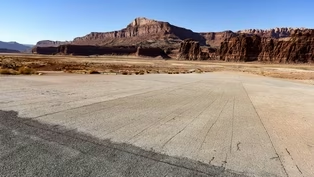
Preview: S2 Ep4 | 30s | With most of Utah in extreme drought , what will it take to turn things around? (30s)
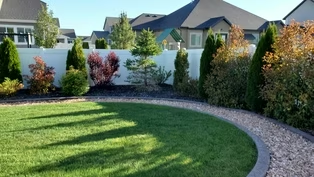
Localscapes Helps Homeowners Create Water-Wise Yards
Video has Closed Captions
Clip: S2 Ep4 | 3m 47s | Utah homeowners are learning how to create beautiful, water-wise yards with Localscapes. (3m 47s)
Providing Support for PBS.org
Learn Moreabout PBS online sponsorship
- News and Public Affairs

Top journalists deliver compelling original analysis of the hour's headlines.

- News and Public Affairs

FRONTLINE is investigative journalism that questions, explains and changes our world.












Support for PBS provided by:
Utah Insight is a local public television program presented by PBS Utah