
Drummer Gayelynn McKinney, Detroit Fine Arts Breakfast Club
Season 8 Episode 36 | 26m 46sVideo has Closed Captions
Jazz drummer Gayelynn McKinney, Detroit Fine Arts Breakfast Club and weekend events.
For Women’s History Month, world-renowned Detroit jazz drummer Gayelynn McKinney talks about her roots in jazz and the importance of showcasing women in music. Senior Producer Bill Kubota takes viewers to the Detroit Fine Arts Breakfast Club for a look at how it’s paving the way for the city’s emerging artists. Plus, ways to celebrate St. Patrick’s Day and more on “One Detroit Weekend.”
Problems playing video? | Closed Captioning Feedback
Problems playing video? | Closed Captioning Feedback
One Detroit is a local public television program presented by Detroit PBS
Drummer Gayelynn McKinney, Detroit Fine Arts Breakfast Club
Season 8 Episode 36 | 26m 46sVideo has Closed Captions
For Women’s History Month, world-renowned Detroit jazz drummer Gayelynn McKinney talks about her roots in jazz and the importance of showcasing women in music. Senior Producer Bill Kubota takes viewers to the Detroit Fine Arts Breakfast Club for a look at how it’s paving the way for the city’s emerging artists. Plus, ways to celebrate St. Patrick’s Day and more on “One Detroit Weekend.”
Problems playing video? | Closed Captioning Feedback
How to Watch One Detroit
One Detroit is available to stream on pbs.org and the free PBS App, available on iPhone, Apple TV, Android TV, Android smartphones, Amazon Fire TV, Amazon Fire Tablet, Roku, Samsung Smart TV, and Vizio.
Providing Support for PBS.org
Learn Moreabout PBS online sponsorship- [Narrator] Coming up on "One Detroit," in honor of Women's History Month, we'll have a wide ranging conversation with renowned jazz drummer Gayelynn McKinney.
Plus we'll take you to a weekly Detroit gathering that brings together local artists, art collectors, and art lovers.
And there's a variety of events and activities to choose from this weekend in Metro Detroit.
We'll give you some suggestions.
It's all coming up next on "One Detroit" - [Announcer] From Delta faucets to Behr paint, Masco Corporation is proud to deliver products that enhance the way consumers all over the world experience and enjoy their living spaces.
Masco, serving Michigan communities since 1929.
Support for this program is provided by the Cynthia and Edsel Ford Fund for Journalism at Detroit Public TV.
- [Announcer] The DTE Foundation is a proud sponsor of Detroit Public TV.
Among the state's largest foundation's committed to Michigan-focused giving.
We support organizations that are doing exceptional work in our state.
Visit dtefoundation.com to learn more - [Announcer] Nissan Foundation, and viewers like you.
(upbeat music) - [Narrator] Just ahead on "One Detroit," we'll take you inside a weekly tradition for Detroit artists, art collectors, and art lovers held on the grounds of the Marygrove Conservancy.
Plus one of Detroit's most accomplished musicians, Gayelynn McKinney, opens up about the obstacles she faced as a female drummer.
And Peter Wharf of 90.9 WRCJ lets us know what's happening around town this weekend and beyond.
But first up, March is Women's History Month, and we're shining a light on one of Detroit's trailblazing female musicians.
Renowned jazz drummer Gayelynn McKinney has made her mark in the music industry playing an instrument that is traditionally more popular among men.
McKinney sat down with "One Detroit" contributor Cecelia Sharp of 90.9 WRCJ to talk about the barrier she broke through as a female drummer.
Her work with the all female jazz band Straight Ahead and the creation of the Women Who Drum Festival.
(upbeat music) - And we are celebrating Women's History Month celebrating women in music.
And my guest today is one of Detroit's finest drummers, Mrs. Gayelynn McKinney, welcome to the show.
= Thank you thank you.
Thank you for having me.
- Absolutely.
Now Gayelynn, you come from a musical family.
Your father is the legendary Harold McKinney.
Your mother is a well-noted singer.
Your siblings are musicians, trumpeters, singers, you name it.
So you had no choice.
I had no choice.
- But to become a musician.
You started playing drums at the age of two.
- I got my first official lesson at nine from Danny, God bless his soul, he's not here either anymore, but he also started teaching me officially like rudiments and things like that at nine.
- So what made you, because you were playing the clarinet and saxophone, you were great.
You already beat out the first chair.
You challenged the first chair saxophonist within your first month of playing and won.
What made you stick with the drums?
- Nobody knew I played drums until one particular day, the drums were out and I said oh.
I went over there and I started playing on the snare and doing some stuff.
Everybody in the class went and they was looking at me like, "Oh my God, she's playing the drums."
And clearly I obviously knew what I was doing.
So that was very surprising to everyone.
And so after that day, I was standing at the bus stop on my way home from school and this little girl was looking at me like, and I was like, what's wrong with you?
And she said, "You were playing the drums."
And I said yeah.
And she said, "Well you're a girl."
I said, "Yeah, I know that."
And she said, "But you were playing the drums?"
I said yeah.
She said, "Well you're not supposed to be playing the drums.
The drums are for boys."
And that really hurt my feelings.
I was like, well, I'm a girl.
I like to play the drums.
Well, my father came home from New York one day.
He had been doing some music there and he didn't know how I was feeling.
He just knew, he never knew I was thinking about quitting.
And so he just came in all excited.
"Guess what?"
I said, "What?"
"I saw another little girl playing the drums."
I said, "Really?"
He said, "Yeah, yeah, yeah.
She was playing with Clark Terry and she's about eight years old."
So I'm 10 and she's eight.
And that drummer was Terri Lyne Carrington.
And so that was all I needed.
I just needed to know that there was some other girl playing this instrument because I never saw any other girl playing the instrument when I was coming up playing the drums.
- I didn't think that you would face flack, for lack of a better word, but catching the heat from girls from playing drums.
So did you find that you were more welcomed by the guys or?
- It was just the one little girl really that said something about it.
The boys just would, you know, I think they were in shock.
They were too shocked to even say anything.
So as I got in my older years though, that's when I really started to see from guys that they weren't quite that happy that I was playing the drums.
Especially during like jam sessions.
- Please help me welcome Straight Ahead.
(upbeat music) - Right after college, you joined a group called Straight Ahead, an all female jazz ensemble.
How did that band come about?
- That band came about thanks to a woman named Mickey Braden who was trying to find some musicians to perform at this club called Bert's Place.
And it used to be on Jefferson right across from Heart Plaza.
And she couldn't find anybody, everybody was busy.
So she called me and she said, "Hey Gayelynn, I'm trying to put a band together for Bert's Place for a Monday night gig."
And Monday is not a good night, but I guess words started circulating that there was an all female jazz group playing.
And like I said, we weren't tiptoeing through the tulips.
We was hitting.
So by the next couple of weeks, a couple weeks later, we had like 20 people come in the club.
By the end of the second month, there was a line going outside of Bert's Place.
- On a Monday.
- On a Monday from people wanting to see this all female group.
(upbeat music) - Last year in 2022, you launched a festival, Women Who Drum.
Tell us about that festival and the mission and purpose of Women Who Drum.
- So I started this thing because I played at Baker's Keyboard Lounge on Fridays and Saturdays with the great Ralph Armstrong and Gerard Gibbs.
And I've been doing this now since February of '21.
And do you know that almost every weekend, one night out of that weekend, sometimes two nights out of that weekend, somebody says, "Wow, you're the first woman drummer I've ever seen."
That's when the idea came to me.
I said, well I'm gonna start this festival because people here need to see and know that there's more than just me out here doing this.
For one thing, I love performing, I love playing for people especially who appreciate it.
And so I feel obligated to give them a show.
If you come to see me, I feel obligated to give you a show.
(upbeat music) You came to see me perform, so I'm gonna give you something back.
So that you gonna leave happy because you gonna know I put my all into it, you know?
(applause) - [Narrator] And in recognition of Women's History Month, you can check out our conversations with other women trailblazers in the music industry.
Go to onedetroitpbs.org for stories, interesting facts, and amazing performances showing the diverse talents of musicians, including violinist Regina Carter, bassist Marian Hayden, vocalist Joan Ellison, and many more.
Let's turn now to a uniquely Detroit tradition that brings artists and art collectors together each week on the campus of Marygrove Conservancy.
The Detroit Fine Arts Breakfast Club was created in 2009 by two Detroiters who came together over their love for art and food.
Today it has grown into a huge gathering where artists can showcase, explain, and even sell their works.
"One Detroit" Senior Producer Bill Kubota has the story of how this weekly experience has created opportunities for emerging and renowned Detroit-based artists.
- My apologies.
Black Expressionism goes all the way back to the founding of the visual arts on the African continent.
It flowed through time into this room.
It passed through many definitions and transitions until it comes to you.
- [Bill] The Marygrove Conservancy Detroit most Monday nights is the Breakfast Club.
- [Announcer] Please give him your undivided attention.
Look at that handsome face, look at him smiling.
- [Bill] Artists, art lovers, collectors, looking, talking, and buying art.
- I'm happy because it brings artists out of the woodwork.
- My name is Miriam Hall, I'm an acrylic painter.
I mostly do line work.
Portraiture is what I really dabble in, and I'm really inspired by Detroit's underground community.
- I was a technical illustrator for GM for over 40 years.
So that was my profession.
I'm a photorealistic artist.
- And I'm proud to say I am a folk artist.
- [Announcer] All right now.
- Breakfast Club started about 2009.
- [Bill] Henry Harper, antiques dealer on Detroit's east side and Art Aficionado.
- Here is Tashik Turner of Detroit.
And actually getting to be a national art rockstar.
- [Bill] Art Harper realized something to look forward to coming home to.
- Art just enhances one's life.
- [Bill] Artists check in, show their wares, get some advice.
- Yeah, the piece is of Black narrative.
And it's ironic, you know, prior to me coming here to drop it off, I got pulled over by the police.
So it's just the-- - You did?
With this in the car?
That should been interesting.
It's something new in this millennia about the business of art.
Art is now a business beyond what it used to be.
It was reserved for the one percenters.
- [Bill] Ah, the very rich.
Harper's been a procurer of antiques for some of them.
But this Breakfast Club, that goes in a different direction.
- Now what Breakfast Club has done was to make art absolutely democratic.
- But now as you go through life and you evolve up the stage of creativity, you're going to have to define who you are and what you are.
Are you a cubist?
Are you an impressionist?
Along the road of life, you're going to be experimenting with art, you're gonna be experimenting with techniques.
You've been going to be looking to find yourself.
Now once you find yourself, you have to define yourself.
When you make out a resume, you're going to have to tell people what type of artist you are.
I am a Black expressionist artist.
- It's not like this elitist, like the wine and cheese critiquing art power, Caucasian walking around.
- I have one work this evening, 30 by 40.
I have the up arrow.
- [Jonathan] It's very welcoming.
It's very home.
It's very community.
- It's acrylic, it's called.
It has two names.
"The Reunion" and it's also called "The Homecoming."
- It's really very therapeutic because they get to talk about in front of a crowd on top of that.
And then there's like in African culture, there's a call and response in African traditions and culture.
- Good afternoon, ladies and gentlemen.
My name is Damien Deyonte.
- So you put a call out and get a response back.
That is exactly what happens at Breakfast Club.
Some artists are showmen.
Andy Warhol was a showman.
- Some years back, I did the first one in 1989.
You had to be there.
- Picasso was a showman.
- It was in Australia.
You had to be there.
I threw rocks at wild parakeets.
You had to be there.
- The showman, showman, showman.
- And for hours, these parakeets attack me every time they saw me.
You had to be there.
- [Henry] And the showman's rise to the top.
- It's 36 by 48, untitled right now because it's untitled right now.
- The art is a byproduct of their showmanship.
- On acrylics.
- You've got to stay with your craft, stay what you believe in, and really get it out there.
And now it's easier now, in the old days, art dealer, and it really happened here in Detroit, it was sad, it happened all over the country.
Nobody wanted Black art.
They saw it as Black art rather than part of the American story.
- I would say I'm an abstract artist.
- However, now brown people, Black people all got an American story to tell.
And the way you tell it is by executing beautiful works of art.
(applause) - So these two pieces here, first one is, they're both ink.
So that is ink on paper and that one is ink on wood.
So that style, I feel like I've been developing that for the past 20 years because I spent the first 10 years mastering ink and then I spent the next 10 years mastering wood.
So I wanted to bring them together.
- If you look closely, you will see that this is a a Nigerian woman and she has a scar on her face.
Her the scar comes from Mewati, people who came to her village because of her religion.
But her attitude is, I'm still not turning back.
So that's why I called it "No Turning Back."
And this piece is $250.
(applause) - [Bill] Some fine eating can be found here, but for newcomers, the Breakfast Club, that name might be confusing.
- I hear people say, well you don't have dinner in the evening, why do you call it the Breakfast Club?
So I have to explain the history to them.
- [Bill] It's when Harold Braggs and Henry Harper started meeting regularly for breakfast.
- And then we start talking and then people would overhear us at that restaurant talking about art, and then people would start joining the meeting.
And that first Judy Bowman painting was the Real Breakfast Club.
Mr. Braggs told me a long time ago, he said, "This is gonna be historic."
And I said, "What?
Two old guys meeting, talking about art, how could that be historic?"
- [Bill] Artists, art collectors with coffee, bacon, and eggs.
- I started going and meeting with these people because I didn't know any artists.
I didn't know anything about the Detroit art scene.
I didn't know any of that.
We would bring our work in and talk about it, and more and more people started hearing about it, and it just started expanding, and then it exploded.
- [Bill] They moved meetings to evenings but kept calling it the Breakfast Club.
After Covid, they'd grown so big, they moved to the Marygrove Campus dining hall.
- With my interest or my background in antiques and art, going to auctions, what do they say at auction?
Sold!
They don't ring the bell, they say sold.
I went and found an antique cowbell and every time you sell something, and that just adds to the spontaneity of the evening.
- This one right here is 18 by 24.
That one actually sold already.
- Did it sell here?
- Yeah.
- Sold!
Artists will never know how to price their work and how work is priced is very difficult, difficult.
Online, they'll tell you per square inch and that doesn't work, but they tell people that.
- I had no idea that you could sell stuff for $10,000.
I I never thought that me a Black man would be able to do something like that, never ever.
- Like pricing wise, I don't know how that kind of goes honestly.
So yeah, I'm just starting to figure it out.
But I feel like if you keep applying pressure to your art, yo prices should just keep going up.
So yeah, just stay busy with it.
Can just tell they're pretty much my pieces.
- [Bill] Oshun Williams started as a graphic artist.
He put appliques on clothes he sold.
- [Oshun] A flower patch.
- [Bill] Those appliques now part of his painted work inspired by his daughters.
- I said I haven't seen my kids in a couple of years.
So like that's why I paint like little girls and I paint pictures of them and stuff.
Basically I'm self-taught pretty much.
I never went to school for it.
That picture, I did that one because you always gotta be positive.
Yeah, that's about it.
Thank you, bye.
(applause) I never sold my stuff because I didn't know how to price it.
That was like my biggest thing.
I never was really selling art.
Like I would probably sell maybe like two, four pieces a year.
Now I'm selling a couple pieces a week.
- The title of this piece is "Night School."
I heard a story about Frederick Douglass being taught to read illegally.
For Black people, there are anti literacy laws going around.
- [Bill] Jonathan Harris, his studio is in Corktown.
He became a national sensation a couple years ago with his painting "Critical Race Theory."
- And even when I was in school, like I studied graphic design and I was just told like, "Oh, if you really want to succeed, you have to go to California."
Like I've still had a pamphlet of the different companies in California and Chicago or New York that the teacher had gave us.
And now it's like, well I'm not even in that world and I'm able to do what I want to do in the city of Detroit at home.
- I saw how this really was something unique that Detroit has.
I don't know if it's anywhere else in the country.
Hi, my name is Melinda Ruth.
They're bringing emerging artists and it's like a direct connect to the art world.
- And I have two pieces.
The first, the smaller one is actually a mixed media Linocut.
- [Bill] Melinda Ruth-Rushings from Texas with a PhD in the health science field arriving in the midst of Covid.
- And I moved up here for a postdoc fellowship at the University of Michigan Block print ink I overlaid with India ink.
Before coming here, I was in a show, in a gallery in Chicago and they had mentioned how there's a big art scene in Detroit.
Instead of moving and living in Ann Arbor, I wanted to live in Detroit because I wanted to pursue this art.
And it was actually like a black and white study that I was working on.
I think artists, but especially for Black artists, it's hard getting into this industry and it's hard like finding where you kind of fit in.
But this one brings people that are more seasoned, that are vets in the industry.
- I'm asking for 400.
With the Linocut, it has already been sold.
- Did it sell here?
- Yes.
- [Henry] Sold!
(cowbell ringing) - When I first came to the Breakfast Club, they asked me what kind of artist did I want to be.
And from the very beginning I said I want my work to be in museums.
I want my children and grandchildren to come and say that's my grandma's work or that's my great grandma's work.
- [Bill] Judy Bowman, collage maker, retired educator and original Breakfast Clubber says she got serious about her art seven years ago.
- They start telling me, guiding me towards that venue that I wanted to be in.
And sure enough, my work is now in museums.
- Detroit artist Judy Bowman was in the Armory Show, which was the most important art exhibition in New York City.
And she sold out and then she went to Basel this year and she sold out.
- And so I guess I came at the right time because people were really surprised how quickly my career went.
I am.
It's like, whoa, this is a lot.
- Well me, I kinda just want to compete with the best because like that's what I do, I paint.
So I just want to like be around the best because I want to be the best.
- I think it is the least expensive art school in the world.
- That's why I always tell artists, just show up.
Even if you don't have nothing, you gonna learn something.
You gonna see something that's gonna inspire you.
If you show up with an open mind, you definitely gonna leave different.
- I have not heard this kind of vitality is anywhere yet.
People always say, why don't we brand it?
Why don't we do all that?
I ain't doing all that.
I don't wanna do all that.
It's just encouraging artists to do the best and be the best that they can be.
- [Bill] And for more on the Fine Arts Breakfast Club, go to onedetroitpbs.org.
The next gathering is Monday at Marygrove Conservancy.
Daylight savings time begins this weekend.
St. Patrick's Day is just around the corner.
And we're looking forward to the official start of spring later this month.
If you're looking for something to do to celebrate the arrival of March, there are plenty of choices this weekend and beyond.
Here's Peter Whorf of 90.9 WRCJ with today's One Detroit Weekend.
- Hi, I'm Peter Whorf with 90.9 WRCJ ready to fill your calendar for the upcoming weekend.
Through the 10th, you can get back into the swing of things with your golf game at the Michigan Golf Show at the Suburban Collection.
Among many exhibitors of top golf brands, the public can test their skills competing in putting contests, par three challenges, and interactive simulators.
And on Saturday and Sunday, head to the Irish Hills for a Taste of the Irish Hills event where your taste buds can sample foods from 20 local restaurants.
The chefs go all out for this event and you're sure to find some great new spots for your nights out.
Don't stop the Irish adventures there.
Get ready to walk or run at Shamrocks and Shenanigans taking place in Ann Arbor.
The kids' 1K starts at Conor O'Neills in Ann Arbor at 9:45 AM, and the 5K starts at 10:15 AM.
Proceeds go to Save a Heart.
For those looking to take in compelling visual arts, David Klein Gallery in Detroit has just that with Drawing.
It's an exhibition featuring 21 contemporary artists who show off various methods they use, including TYLONN Sawyer's charcoal drawing and graphite composition by Willie Wayne Smith among others.
Through March 17th, those who love theater can head to the Fisher Theater to see Richard Thomas as Atticus Finch in "To Kill A Mockingbird."
The classic novel was adapted to a stage play by Academy Award-winning writer Aaron Sorkin.
There's also so much more to do around here, so let's check out a few more events.
Have a fantastic weekend.
(upbeat music) - [Narrator] That'll do it for this week's "One Detroit."
Thanks for watching.
Head to the "One Detroit" website for all the stories we're working on.
Follow us on social media and sign up for our weekly newsletter (upbeat music) (upbeat music continues) - [Announcer] From Delta Faucets to Behr paint, Masco Corporation is proud to deliver products that enhance the way consumers all over the world experience and enjoy their living spaces.
Masco, serving Michigan communities since 1929.
Support for this program is provided by the Cynthia and Edsel Ford Fund for Journalism at Detroit Public TV.
- [Announcer] The DTE Foundation is a proud sponsor of Detroit Public TV.
Among the state's largest foundations committed to Michigan-focused giving.
We support organizations that are doing exceptional work in our state.
Visit dtefoundation.com to learn more.
- [Announcer] Nissan Foundation, and viewers like you.
(upbeat music) (gentle music)
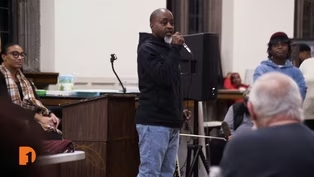
The Detroit Fine Arts Breakfast Club
Video has Closed Captions
Clip: S8 Ep36 | 12m 26s | The Detroit Fine Arts Breakfast Club paves the way for the city’s emerging artists. (12m 26s)
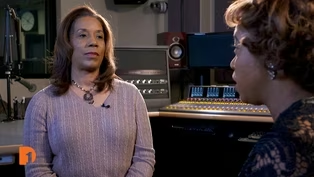
Gayelynn McKinney paves the way for other women drummers
Video has Closed Captions
Clip: S8 Ep36 | 6m 52s | Trailblazing Detroit drummer Gayelynn McKinney paves the way for other women drummers. (6m 52s)
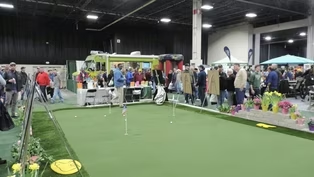
One Detroit Weekend: March 8, 2024
Video has Closed Captions
Clip: S8 Ep36 | 1m 53s | Check out ways to celebrate St. Patrick’s Day and more around Detroit this weekend. (1m 53s)
Providing Support for PBS.org
Learn Moreabout PBS online sponsorship
- News and Public Affairs

Top journalists deliver compelling original analysis of the hour's headlines.

- News and Public Affairs

FRONTLINE is investigative journalism that questions, explains and changes our world.












Support for PBS provided by:
One Detroit is a local public television program presented by Detroit PBS