
Duggan capital plan, Black church holiday help, Gift of Art
Season 7 Episode 26 | 26m 46sVideo has Closed Captions
Mayor Duggan’s 2022 capital plans, holiday hope and healing, and the Gift of Art exhibit.
Detroit Mayor Mike Duggan’s five-year, $2.45 billion capital plan gets reviewed by producer Will Glover and BridgeDetroit reporter Malachi Barrett. Plus, Religious leaders offer messages of hope and healing to people who are struggling with grief or economic uncertainty during the holiday season. And, Detroit’s Irwin House Gallery hosts its third-annual Gift of Art exhibition and art sale.
Problems playing video? | Closed Captioning Feedback
Problems playing video? | Closed Captioning Feedback
One Detroit is a local public television program presented by Detroit PBS
Duggan capital plan, Black church holiday help, Gift of Art
Season 7 Episode 26 | 26m 46sVideo has Closed Captions
Detroit Mayor Mike Duggan’s five-year, $2.45 billion capital plan gets reviewed by producer Will Glover and BridgeDetroit reporter Malachi Barrett. Plus, Religious leaders offer messages of hope and healing to people who are struggling with grief or economic uncertainty during the holiday season. And, Detroit’s Irwin House Gallery hosts its third-annual Gift of Art exhibition and art sale.
Problems playing video? | Closed Captioning Feedback
How to Watch One Detroit
One Detroit is available to stream on pbs.org and the free PBS App, available on iPhone, Apple TV, Android TV, Android smartphones, Amazon Fire TV, Amazon Fire Tablet, Roku, Samsung Smart TV, and Vizio.
Providing Support for PBS.org
Learn Moreabout PBS online sponsorship- [Will] Just ahead on "One Detroit."
Mayor Mike Duggan has a huge wishlist for improving the city.
BridgeDetroit's Malachi Barrett outlines the mayor's proposed capital plan.
Plus, religious leaders offer some hope and healing to those who are struggling with grief or economic insecurity this holiday season.
And Detroit's Irwin House Gallery encourages people to give the gift of art for the holidays.
It's all coming up next on One Detroit.
- [Narrator] From Delta Faucets to Behr Paint.
Masco Corporation is proud to deliver products that enhance the way consumers all over the world experience and enjoy their living spaces.
Masco, Serving Michigan Communities Since 1929.
Support for this program is provided by the Cynthia & Edsel Ford Fund for Journalism and Detroit Public TV.
The Kresge Foundation.
- [Narrator] The DTE Foundation, is a proud sponsor of Detroit Public TV.
Among the state's largest foundations committed to Michigan-focused giving.
We support organizations that are doing exceptional work in our state.
Visit dtefoundation.com to learn more.
- [Narrator] Nissan Foundation and viewers like you.
(upbeat music) - [Will] Just ahead on this week's One Detroit.
The holiday season can be tough for people experiencing loss or financial challenges.
American Black Journal, Stephen Henderson talks with church and community leaders about helping those in need during the holidays.
Plus, the Irwin House Gallery in Detroit is ready for the holiday season with its largest and most inclusive exhibition in sale this year.
We'll hear from the gallery director, exhibit curator and some of the artists.
But first up, Detroit Mayor Mike Duggan has proposed a record $2.45 billion capital plan for the city.
The massive plan includes increased services for residents, the redevelopment of city owned parks and properties and upgrades to the infrastructure.
Much of the funding will come from the city's allocation of American Rescue Plan Act dollars.
I sat down to discuss the details with the Bridge Detroit reporter, Malachi Barrett, who's been closely following the mayor's capital agenda.
- City's wishlist.
(soft music) - Malachi, what is Mayor Duggan's Capital agenda?
What is a capital plan and how is that different from a budget that people are used to hearing about?
- Yeah, so essentially this is a document, a very long document, I think it's close to 200 pages or something like that that identify some investments that this city needs to make over the next five fiscal years.
So, as part of the City of Detroit's budgeting process, every two years, this document is put together to kind of provide a roadmap for different kinds of investments that are needed, aspirational projects that the city would like to get done.
It's kind of a overhead, large 10,000 foot view of the city's wishlist of projects that it would like to dedicate some funding to in the next five years.
It's not a binding document.
This is something that again kind of provides a roadmap for the budgeting process which happens every year.
The city council is gonna have some input on this as well, but yeah, I think it's a good way to kind of think of it as like our our Christmas list as we're here in the holiday season.
- How does this capital plan differ from previous plans?
- It's a lot bigger.
That's the big kind of takeaway for me is that the mayor's spending priorities grew quite a bit since 2020.
This capital agenda is about 72% larger, which is about $600 million.
And I think part of that is the influx of the the Federal American Rescue Plan Act funding that Detroit received, it's allocation of pandemic relief funding, that accounts for part of it.
But the main takeaway for me is that there's a huge emphasis on open spaces and parks, the kind of parks and recreation planned spending quadrupled from the last plan that was approved back in 2020.
- Let's just go a little bit deeper.
So we're looking at things like parks, recreational spaces, what else is being targeted in this plan especially now that we have a very, very large sum of money added to the pot?
- Yeah, I mean, this can be broken down into a number of different categories.
The plan which anybody can read for themselves.
They can go on the city's website and take a look at this, and it's pretty easy to digest.
Aside from parks and recreation, which we can talk about some of the individual projects there, the water and sewerage department has some of the largest capital needs if we're talking about like infrastructure particularly, it represents about one fifth of the total capital agenda.
And so- - Oh wow.
- Right now the city's undertaking a big effort to replace water mains and lead service lines.
There's flood prevention programs that they are working on, storm water improvements, all of those kinds of like nuts and bolts, infrastructure investments are a major part of this plan, that goes so far as like bridges and roads as well.
There's an ongoing process this city's undertaking to make streets safer and improve street scapes particularly in like these commercial corridors making it easier for people to get around by bike or on foot, slowing down some of these roads, putting in speed humps so that pedestrians or even drivers don't have to worry so much about getting into crashes.
So those are some other things.
I mean, the city's also looking at what do we do with all of these vacant school buildings?
There was a really interesting study that was done last year of 63 of these buildings that the city has taken control over.
And the effort was to kind of like, okay so do we turn these into housing?
Do we turn these into office spaces, buildings?
Is there a way to maybe to turn them back into schools to bring kids back?
So that's another part of this, since these are all like neighborhood anchors too, that has a big impact.
Then there's also like really interesting little kind of nuggets of things, like the fire department wants some money so that they can get unmanned aerial vehicles, like UAV drones that have thermal imaging equipment on them so they can kind of see into burning buildings and apparently would help them locate parts of the building that are about to collapse or structural damage or things like that.
Everything from kind of big picture to these kind of more granular, interesting things are detailed in the plan.
- How is this going to impact a person's day-to-day life?
Maybe five years from now, 10 years from now, who's in the city of Detroit?
- Yeah, I mean, I think that's something to watch, right?
Like the devil's in the details.
These capital agendas are kind of a roadmap or a framework.
Again, they're not like legally binding documents.
So some of the stuff in here could change, some of the priorities could get shifted around, this is kind of just like a big picture look at what today the city would like to do a couple years down the road.
But let's say we're in 2028 and we're driving our flying cars around Detroit, and what do things look like?
Well you might see a park open up closer to your neighborhood depending on where you live.
You might see that pothole in the street that's been bugging you for years has been repaired.
You might see more speed humps in your neighborhood.
Maybe you're worried about speeding and cars kind of flying through there, and now that's something you don't have to worry about as much.
Maybe there's a blighted building that was on your corner that's been turned into affordable housing.
And look, I'm being really optimistic, right?
But like, these are the kinds of things that are included in this plan.
And I think that's kind of the ultimate goal is like let's look into the future, start planning for it now.
Start putting aside the resources now and be intentional about that.
- [Will] The holidays are a joyous time, but it can be a difficult season for those struggling with grief over the loss of a loved one or those experiencing financial issues.
As part of American Black Journal's Black Church in Detroit series, host Stephen Henderson spoke with local religious and community leaders about hope and healing during the holidays.
(gentle music) - I always say that Frankie Beverly & Maze tapped into their theological spirit with their song, "Joy and Pain", sunshine and rain, because often it is that close for so many families in this season, while it's so much joy and being able to gather together.
For many there'll be empty seats at the table which will really cause a continuation of them navigating grief for their lost loved ones.
And so we take it as very important in this season to make sure that we create spaces and resources for our congregation community.
So here at Third New Hope, we started this during the pandemic we had a strolling memorial where we had all of the pictures of those individuals that we lost throughout the year and we invited the families to come through and to share as a moment of processing.
And this year we've done the same with a memorial wall that will remain up for the remainder of the year.
Again, encouraging these families that we haven't forgotten about their loved ones, and that we're still here with them to journey with them through this season of sorrow.
- Pastor Thomas, this is a personal issue for you as well as a church issue.
Talk about the things not only that your congregation is confronting, but the things that you are now confronting this time of year?
- Well, it's very interesting.
The community that we serve in Brightmoor is probably one of the harder hit communities, and could arguably be one of the poorest communities in the State of Michigan.
And this whole thing wrapped around poverty and around trauma and the challenges that we're dealing with is just overwhelming.
There's several things that are happening, and some there's nothing we can do about.
Just historically, I'm a baby boomer.
I was born in 1960, and my generation is going home to be with the Lord.
That's just natural.
That's just nature.
The next 15, 20 years, we're going home.
And so that's just happening.
On top of the carnage that's happening in our streets with the gun violence and then the amount of trauma that people within our communities have served.
And so just two days ago, I lost my nephew to suicide.
And so his mother, my sister passed on Good Friday, and it was just devastating to him.
He was just completely devastated.
And he started hearing voices.
We tried to wrap around services for him, and we buried her ashes at Myrtle Beach in the ocean.
And so two days ago, he drove to Myrtle Beach and he drowned himself.
- And how do you wrap- - So sorry.
- How do you wrap your head around that?
22 years old.
And what it is, is this, as pastor was saying, Pastor Pressley was saying so eloquently, it's this compound.
You know what I mean?
One thing on top of another thing on top of another thing, and the pastor's wisdom to give people a place to process their grief and to be angry.
You know what I mean?
And, again, this is, I'm with him... Or I'm with you, I love this season, Stephen, I love Thanksgiving and Christmas.
I was a poor kid, but I didn't have much, but this is always my season.
But to see the flip side, that there are people who are not at the table.
- So it's interesting to me that for you, this is a balancing act then, right?
You're trying to give yourself space and deal with this unimaginable amount of trauma, but you're also the pastor of a church where you have to make that space for other people.
I mean, that's an incredible burden.
- It's something that the body of Christ, especially in the African-American church has have been doing from day one.
The church was always that space.
And I mean, generations who had it way worse than us, didn't have air condition, didn't have praise teams, didn't have all the fancy stuff that we have, but they had the church and it was a place that they could come and be prayed over, hands could be laid upon them.
And so now we are at another stage.
And so we are embracing behavioral health and making room for development center to come in and to do sessions and to teach people about anxiety and about depression, those type of things.
And then empowering them to really acknowledge that we are going through.
- Dr. Lockett.
You also are balancing the professional with the personal this year.
Talk about how that works for you.
- Yeah, so my son received his wings through gun violence in December of 2020.
So it's coming up on 20 years, two years that that's taken place.
And for me, I had to take a step back because I deal with that every single day.
And so I had to take care of me because if I don't take care of me, I can't take care of anyone else.
So I had to take a few months off, and go into that therapeutic space to make sure that I was equipped spiritually, mentally, and emotionally to go back out and make the impact that I make in other lives.
One of the things that I started just September the ninth which would've been his 30th birthday.
We started the Azal Benne Lockett Foundation.
We're here to help you heal, offer you hope, and hold your heart as you're going through that grieving journey.
And that grieving journey doesn't always necessarily have to look like the loss of a loved one.
It could be the loss of a lifestyle, losing a ligament, losing a home, losing a relationship.
There's so many different ways that we lose in this space, losing a pet.
Some people de-emphasize the loss of a pet.
When that furry animal is part of that family.
And so some people go through that grieving journey because the loss of a pet, the loss of a neighbor, I mean we have just amplified the way grief looks.
And nowadays, you're given that two week period to grieve because it's like, do believe her name is Alexandria Grande has a song out that says, "Thank U, Next".
So you got that two week window that says, okay we've given you, we've served you your chicken dinner and we've sent you a couple of cards, threw you a couple of dollars.
Okay, thank you, next.
Because we've gotta get onto the next person and we have to make sure that we're giving people time to grieve and not putting a time limit on it.
- Yeah.
Reverend Pressley, that reminds me of the sort of sustaining work I guess that the church has to do here.
I mean, we're talking about the holidays and that's a particularly tough time for folks but the church always is called to this space.
And because of the things that we experience as African Americans, not just in Detroit, but all over the country, the need is always there.
And so the demand on the church is always kind of at a high level.
- No, very much so.
And I'm blessed here at Third New Hope because we have a significant amount of licensed counselors and therapists who are also members of our congregation.
And as a result, we started a ministry called Seasons of Grace, which provides people an opportunity to access these counselors in order to process the grief that they're experiencing.
And so we situated the month of October as our Mental Health Awareness Month, and we even had settings for our youth and children to be able to process as well because along the lines of the items of loss, that Dr. Lockett mentioned divorce, family separations, are things that children are having to encounter particularly in this holiday season, that we wanna make sure that we're providing them the resource to think through and to find healthy ways to navigate the challenges in which they're experiencing.
- In Brightmoor, we have a significant portion of people who are homeless, and they're unhoused.
They're living in abandoned homes, no running water, no utilities.
And so when we first started feeding people, we thought we'd get 30, 40 people, and we're up to 200 people a day.
We're doing 200 meals a day, four days a week.
And then inflation, to a person that's doing well to the middle class, and upper middle class, inflation it affects everyone.
But to the poor, it hits straight to the core.
So I was watching a brother the other day who had a Yukon.
He had a older Yukon at the gas station putting almost $100 worth of gas- - In the tank.
- For his tank.
I'm sure when he bought that Yukon, he thought it was a good deal, but now he doesn't think it's a good deal.
We laugh the joke at the park but it is causing people to make very, very serious decisions that some of them were already making but just making from a deeper standpoint.
So we try to do a dualism, if you will, to hold people accountable.
But also to represent in a manner that gives them respect.
And if you need, that's what the church is here for.
- [Will] And finally, the Irwin House Gallery on West Grand Boulevard in Detroit is holding its largest and most diverse exhibition of 2022.
The gift of art holiday show features original artwork for sale in a variety of genres.
One Detroit contributor Deijah Moss visited the gallery to learn more about the exhibit and the artists.
(gentle music) - For the month of December, we are hosting our third annual Annual Gift of Art Holiday Exhibition.
And it is an affordable art exhibition, this year featuring more than 60 artists, at least 58 of them are local.
This is the first year we had more than 250 submissions.
We worked with a wonderful curator, Chanel Beebe to go through those submissions and it was a really difficult task.
But this is the first year that we weren't able to get every single submission in.
But we did get in over 120 works of art- - It was a really big undertaking both from like dealing with submissions, but also deciding where to place things 'cause there's so many different types of art, so many just different ways that we could have showcased stuff.
So it was definitely like a creative feat to put it all together in a way that makes sense.
We have literally every type of artwork here.
So we have portrait work, we have photography, we have abstract work, some surrealist pieces, we have some poor painting pieces.
We also have three dimensional sculptures, and like interior design items.
So literally anything you could possibly imagine.
- What is really special about the participating artist as well as the artwork is the diversity of the show.
And this is really the one time of year that we really get to bring everybody together no matter what your interests are.
In addition to just trying to provide exposure for as many artists as possible.
We have a lot of emerging artists in this show who are showing their work for the first time.
So we're really excited to be able to provide a platform for those artists and for all the artists but also to make art more accessible to the general public.
- Well I have three pieces here in the exhibition.
One is called, Inside Job.
And Inside Job is like what some people call, your spiritual garden.
It's the place that is private, it's the place that is solitude, serenity, happiness.
And so the majority of my work is personal, but it's also about the people I know and and how they're hurting.
And I can't help them, I can't save them, I can't fix them, but I can express it.
This is what all artists do of course, that are in the show.
But for me, my pieces are large and that's how my life feels, sometimes it feels large, it feels expansive, it feels like I have to keep up with it, but not in like a bad way.
Like do groceries, do pay the bills, that type of thing.
Not catching up that way, but more catching up internally.
- My pieces, I like to use bright colors to kind of pull viewers in while also exploring the human condition and how I feel.
But I'm also an abstract painter, so I do want other artists when they look at my pieces to question what lies beyond the surface.
I also feel that art in general, like a lot of other things in the world, is like color therapy.
And so beautiful bright color is like what's surrounding us here do make me feel happy.
It makes me feel bright.
I can feel a positive energy in this space.
And I hope my art also reflects that.
- When I was growing up, I don't think I really saw much Black representation in artwork unless it was in the historical context.
When I was going to museums, it was more of the art, historical canon type of pieces.
So I just decided to paint something that little Kirah would love to have seen when she was growing up.
Being in this show and having all these different artists and pieces around me has impacted me a lot as an artist because I feel like it has made me more confident.
I know for a long time I was creating things that I thought other people would like.
And I think that it's important to know that you can create what makes you happy.
You can create what makes you feel good and what you like, and what you think others may like.
- Diversity is very important to art 'cause it's like colors of the rainbow, the more inclusive art is, the more inclusive the world is, the more beauty we'll see in it.
- Detroit is really known for our history.
Like a lot of amazing artists have come out of Detroit but some of them have passed away and some of them have kind of become like relics in our culture.
So it's easy to forget about the living artists.
It's easy to forget about the artists that are still emerging, the artists that are still with us, still creating.
And I think that's really important for Detroiters to know and own and for anybody who visits the city to like be aware of the life that art has here.
Like it's not just a history thing.
It's not just a thing that happens in the DIA, but it's a thing that is happening in every community.
Like there's a artist on every block for sure, if not multiple, and all of them deserve space and good lighting for you to see what they have to offer.
- [Will] And you can see the Holiday Art Exhibit at the Irwin House Gallery through December 23rd.
That will do it for this week's One Detroit.
Thanks for watching.
Make sure to come back for One Detroit Arts and Culture on Mondays at 7:30 PM.
Head to the One Detroit website for all the stories we're working on.
Follow us on social media and sign up for our weekly newsletter.
(gentle music) - [Narrator] From Delta Faucets to Behr Paint.
Masco Corporation is proud to deliver products that enhance the way consumers all over the world experience and enjoy their living spaces.
Masco, Serving Michigan Communities Since 1929.
Support for this program is provided by the Cynthia & Edsel Ford Fund for Journalism at Detroit Public TV.
The Kresge Foundation.
- [Narrator] The DTE Foundation is a proud sponsor of Detroit Public TV.
Among the state's largest foundations committed to Michigan-focused giving.
We support organizations that are doing exceptional work in our state.
Visit dtefoundation.com to learn more.
- [Narrator] Nissan Foundation, and viewers like you.
(upbeat music) (bright music)
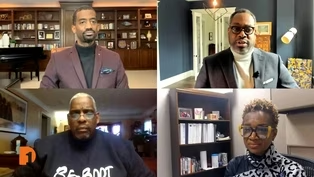
The Black Church in Detroit: Helping during the holidays
Video has Closed Captions
Clip: S7 Ep26 | 10m 35s | Examining the Black church’s role providing relief, support and hope during the holidays. (10m 35s)
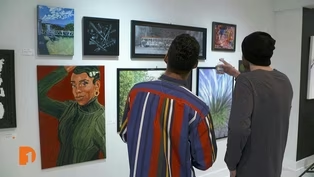
Irwin House Gallery 3rd annual Gift of Art exhibit and sale
Video has Closed Captions
Clip: S7 Ep26 | 5m 3s | Irwin House Gallery hosts its third-annual Gift of Art holiday exhibition and art sale. (5m 3s)
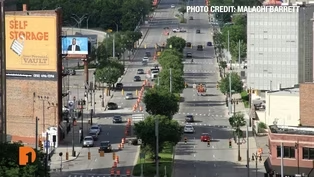
Mayor Duggan outlines $2.45 capital plan for Detroit
Video has Closed Captions
Clip: S7 Ep26 | 6m 22s | Detroit Mayor Mike Duggan outlines his wish list for improving the city through 2028. (6m 22s)
Providing Support for PBS.org
Learn Moreabout PBS online sponsorship
- News and Public Affairs

Top journalists deliver compelling original analysis of the hour's headlines.

- News and Public Affairs

FRONTLINE is investigative journalism that questions, explains and changes our world.












Support for PBS provided by:
One Detroit is a local public television program presented by Detroit PBS