One-on-One
Early childhood professor examines AI on young minds
Clip: Season 2026 Episode 2873 | 8m 18sVideo has Closed Captions
Early childhood professor examines AI on young minds
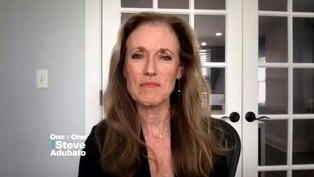
Steve Adubato sits down with Dr. Jennifer Chen, Professor of Early Childhood Education at Kean University, to explore the link between early childhood education and brain development and the impact of artificial intelligence on young minds.
Problems playing video? | Closed Captioning Feedback
Problems playing video? | Closed Captioning Feedback
One-on-One is a local public television program presented by NJ PBS
One-on-One
Early childhood professor examines AI on young minds
Clip: Season 2026 Episode 2873 | 8m 18sVideo has Closed Captions
Steve Adubato sits down with Dr. Jennifer Chen, Professor of Early Childhood Education at Kean University, to explore the link between early childhood education and brain development and the impact of artificial intelligence on young minds.
Problems playing video? | Closed Captioning Feedback
How to Watch One-on-One
One-on-One is available to stream on pbs.org and the free PBS App, available on iPhone, Apple TV, Android TV, Android smartphones, Amazon Fire TV, Amazon Fire Tablet, Roku, Samsung Smart TV, and Vizio.
Providing Support for PBS.org
Learn Moreabout PBS online sponsorship(upbeat music) - We are honored to be joined by Dr.
Jennifer Chen, who's Professor of Early Childhood Education at Kean University, one of our higher ed partners.
Dr.
Chen, great to have you with us.
- Hi, Steve.
I'm so delighted to be here.
Thanks for having me.
- Our pleasure.
Help us understand this.
What is the connection, I'm gonna talk about something called brain science.
And we've been part of a public awareness initiative around early childhood, and this term brain science comes up a lot.
We'll put up the website for Start Strong NJ.
- So I keep thinking about brain science, brain development, and then I think, wait a minute, wait a minute.
Artificial intelligence and childhood education and brain development of a child, meaning, what are some of the concerns in the research community, in the child education community around AI and early childhood education and brain development?
Please, Dr.
Chen?
- Sure, thanks.
It has something to do with experiences, the early childhood experiences.
For instance, in human developments, the brain adapts to and builds up on its previous experiences.
So when early experiences are positive, they can strengthen healthy brain developments as well as lay a strong foundation for other domains of development, such as cognitive, language, and socio or emotional.
So this is where early childhood education comes in.
High quality early childhood programs provides developmentally appropriate learning experiences, such as play, exploration, socio-emotional learning, and importantly, consistent responsive interactions with peers and teachers.
So in turn, these experiences help shape children's brain development in ways that support their overall wellbeing and development.
So if AI can help foster those early positive experiences, then yes, let's go for it.
So the key here is like to identify what AI tools parents, teachers, children can use to enhance their early positive experiences to contribute to their brain development.
- But, Dr.
Chen, on the other side, you talked about play, that early childhood education, early childhood experiences are critically important, particularly around playing, learning how to, as some people say, play in the sandbox.
I don't know whether there's a sandbox or not, but being able to interact with other people, other children, getting along, learning how to share, dealing with bullies, all kinds of stuff.
Does AI have the potential, if used incorrectly or abused, misused, to take our children away from that human interaction, Dr.
Chen?
- Oh, I totally agree with you.
Those are the questions that educators been trying to address.
So in one of my publications, I describe it, children's use of AI as a double-edged sword.
What this means is that AI has both benefits and drawbacks.
Specifically, AI can support like personalized learning to meet the children where they are, both educationally and developmentally.
However, and the social interactions, you know, like you said earlier, Steve, the interactions with peers, the playtime, that is hard to find.
Those are uniquely human qualities.
And AI, no matter how advanced AI may become, they still don't carry that kind of emotional interactions and connections with humans as we can, as humans.
- And what should we do?
What is your advice to parents right now, Dr.
Chen, as to, you know, who are saying, "Well, if artificial intelligence can help my child development and help my child grow and succeed."
And by the way, AI is gonna be more accessible in certain communities than others based on zip code, affluence and a whole range of other factors, socioeconomic and others, what advice do you have for parents right now?
And by the way, same thing goes for social media.
It's not the same, same.
But what advice do you have for parents who are concerned about their child's development and human interaction, or want to give them every technological opportunity possible?
Is it a balancing act, doctor?
- Absolutely.
There's a balance act.
And also, we need to ask our ourselves some fundamental questions.
What is AI?
What are AI tools out there that are developmentally appropriate for young children?
What good purposes do they serve, right?
Because AI can be used for harm.
So that is, why do children use AI?
How do children use AI?
Basically, we need to understand the what, the why, and the how of AI used by children to better enhance the learning and to navigate the complexity of the AI landscape, including the critical, ethical, and social, emotional implications of AI use.
- That's also true for social media, isn't it?
- I think so, yes.
With any kind of digital media, yes.
- Before I let you go, you're a parent.
- Yes.
- And so you experienced this not just as an academic, a scholar, and a researcher, but as a parent.
Advice for parents right now in terms of early childhood development and social media.
30 seconds, go ahead, give some advice.
- Okay, thanks.
So I think at this moment in time, I think we are approaching an inflection, critical inflection points in the use of AI by children for learning.
As AI becomes increasingly integrated into children's everyday experiences at home, at school, the balance between innovation in developmental appropriateness is shifting.
So at this juncture, all key stakeholders, not just parents, teachers, educators, education leaders, must understand how to use AI in the most effective ways, as well as in ethical and responsible matters, combining with the developmentally appropriate activities that are so critical in early childhood.
- But also, again, as we wrap up, you're talking about AI, but also related to social media, correct?
- Yes, and it's related to everything.
Now, as AI is their life in some ways, it's part of their daily experiences, as they are growing up in this AI-driven world, yes.
- Dr.
Jennifer Chen, Professor of Early Childhood Education at Kean University, one of our higher ed partners.
Dr.
Chen, thank you so much.
- Thank you so much, Steve.
- You got it.
I'm Steve Adubato.
We thank you for watching.
We'll see you next time.
- [Narrator] One-On-One with Steve Adubato is a production of the Caucus Educational Corporation.
Funding has been provided by United Airlines.
The Turrell Fund, a foundation serving children.
IBEW Local 102.
PSEG Foundation.
Newark Board of Education.
The North Ward Center.
Operating Engineers, Local 825.
New Jersey Manufacturing Extension Program.
And by Congress Hall.
Promotional support provided by NJBIA.
And by BestofNJ.com.
- (Narrator) For the last 125 years, the International Brotherhood of Electrical Workers Local 102 has powered progress and built a brighter future.
As we celebrate this incredible milestone, we honor the dedication of our past, the strength of our present, and the promise of our future.
Together, we're stronger.
Together, we're Local 102.
Garden State Initiative on budget transparency in NJ
Video has Closed Captions
Clip: S2026 Ep2873 | 7m 36s | Garden State Initiative on budget transparency in NJ (7m 36s)

PANYNJ Rick Cotton & Kevin O'Toole discuss projects underway
Video has Closed Captions
Clip: S2026 Ep2873 | 12m 30s | PANYNJ Rick Cotton & Kevin O'Toole discuss projects underway (12m 30s)
Providing Support for PBS.org
Learn Moreabout PBS online sponsorship
- News and Public Affairs

Top journalists deliver compelling original analysis of the hour's headlines.

- News and Public Affairs

FRONTLINE is investigative journalism that questions, explains and changes our world.












Support for PBS provided by:
One-on-One is a local public television program presented by NJ PBS